
 100% FREE ACCESS
11th Standard Syllabus & Materials
11th Standard
TN 11th Tamil இயற்கை வேளாண்மை,சுற்றுச்சூழல் -செய்யுள் - மனோன்மணீயம் Important Questions And Answers Study Material - QB365 Set A
NEW11th Standard
TN 11th Tamil என்னுயிர் என்பேன் -துணைப்பாடம் - இசைத்தமிழர் இருவர் Important Questions And Answers Study Material - QB365 Set A
NEW11th Standard
TN 11th Tamil மொழி கலை -செய்யுள் - ஒவ்வொரு புல்லையும் Important Questions And Answers Study Material - QB365 Set A
NEW11th Standard
TN 11th Tamil பீடு பெற நில் - இலக்கணம் - பகுபத உறுப்புகள் Important Questions And Answers Study Material - QB365 Set A
NEW11th Standard
TN 11th Tamil பீடு பெற நில் - துணைப்பாடம் - வாடிவாசல் Important Questions And Answers Study Material - QB365 Set A
NEW11th Standard
TN 11th Tamil பீடு பெற நில் - செய்யுள் - குறுந்தொகை Important Questions And Answers Study Material - QB365 Set A

Published on: 01/08/2018
From this chapter Cost and Revenue Analysis important question paper is prepared. It covers the one mark, two, three and five marks question from the book back and previous year questions.
Download Tamil Nadu 11th Standard Economics question papers, model tests, one-mark questions, important questions, and public exam papers in PDF format. Free study materials and answer keys for TN State Board students.
Questions + Answers key
Take MCQ Economics Test
1.
A shop keeper sold 20 bags with the price of Rs. 100 each. The total revenue of the seller is Rs.
200
20
2000
1500
2.
When AR remains constant MR is also ____.
constant
greater
lesser
none of these
3.
Planning curve is also called as ____.
Envelope curve
Long run average cost curve
Group of short run average cost curve
All the above
4.
Find total fixed cost where TC = 500 and TVC= 100.
100
200
300
400
5.
Find total cost where TFC = 200 and TVC = 150
300
350
200
150
6.
Identify the formula of estimating average variable cost.
TC/Q
TVC/Q
TFC/Q
TAC/Q
7.
The cost that remains constant at all levels of output is _____ cost.
fixed
variable
real
social
8.
The costs of self-owned resources are termed as ____ cost.
real
explicit
money
implicit
9.
Explicit costs are termed as
out of pocket expenses
real cost
social cost
sunk cost
10.
Explicit cost plus implicit cost denote _____ cost.
social
economic
money
fixed
11.
Define - Total cost.
12.
Give example for TFC.
13.
What is meant by sunk cost?
14.
Explicit Cost - Define.
15.
Define Revenue.
16.
17.
State the significant recent development in cost theory.
18.
Explain briefly Marginal cost with a suitable diagram.
19.
Define Private cost and Social cost.
20.
Explain the concept of 'cost minimization!
21.
State the relationship between AC and MC.
22.
Define opportunity cost and provide an example.
23.
Explain the meaning of Fixed and Variable factors and costs.
24.
If the total cost = 100 + Q3, find out AVC, AC, TFC, AFC and TVC when Q = 10.
1.
(c)
2000
2.
(a)
constant
3.
(d)
All the above
4.
(d)
400
5.
(b)
350
6.
(b)
TVC/Q
7.
(a)
fixed
8.
(d)
implicit
9.
(a)
out of pocket expenses
10.
(b)
economic
11.
Total cost means the sum total of all payments made in the production. It is also called as Total cost of production. TC = TFC + TVC.
12.
(i) Rent of the factory.
(ii) Watchman's wages.
(iii) Permanent worker's salary.
(iv) payments for minimum equipment and machines insurance premium.
(v) Deposit for power.
(vi) License fee etc.
13.
A cost incurred in the past and cannot be recovered anymore in future, once invested it is treated as drowned or disappeared.
14.
Payment made to others for the purchase of factors of production is known as explicit cost. It is also called accounting cost or out of pocket cost.
15.
The amount of money that a producer receives in exchange for the sale of goods is revenue.
16.
17.
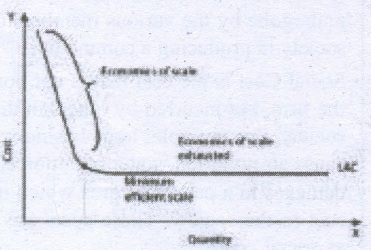
(i) A significant recent development in cost theory is that the long-run average cost curve is L-shaped rather than U-shaped.
(ii) The L-shape of the long-run average cost curve implies that in the beginning when output is expanded through increase in plant size and associated variable factors, cost per unit falls rapidly due to economies of scale.
(iii)
18.
Marginal Cost:
Marginal cost is defined as the addition made to the total cost by the production of one additional unit of output symbolically.
MCn = TCn - TCn-1 (or) TCn+1- TCn
where,
"MC" - Marginal cost.
"TC" - Total cost.
"TCn" - denotes total cost of "n"th item.
TCn-1 - denotes Total cost "n-1"th item.
TCn+1 - denotes Total cost of "n+1"th item.
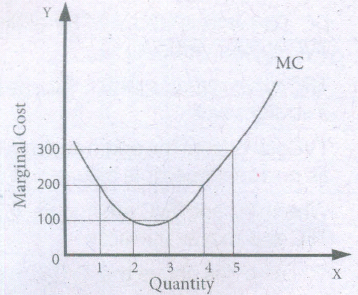
Marginal cost schedule and MC curve is shown in the following diagram.
It is to be noted that,
a) MC falls at first due to more efficient use of variable factors.
b) MC curve increases after the lowest point and it slopes upward.
a) MC curve is a "U"- shaped curve.
b) The slope of TC is Me.
If TC = Q3 -18Q2 + 91Q + 12
MC = 3Q2 - 36Q + 91
19.
(i) Private cost is the cost incurred by a firm for production. It includes both implicit costs and explicit costs.
(ii) Social costs are those costs, which are not borne by the producing firm but are incurred by others in society. For example, when an oil refinery discharges its waste in the river causing water pollution, such a pollution results in tremendous health hazards which involve costs to the society as a whole.
20.
(i) As the profit is the difference between total revenue and total cost.
(ii) Cost minimization is a necessary condition for achieving the profit maximization goal of the firm.
(iii) Cost minimization implies that the costs of inputs have to be reduced for the purpose.
(iv) The costs of inputs include the prices of raw materials, wages and salaries of labour, expenditure on machinery and equipment, depreciation on machines etc.
21.
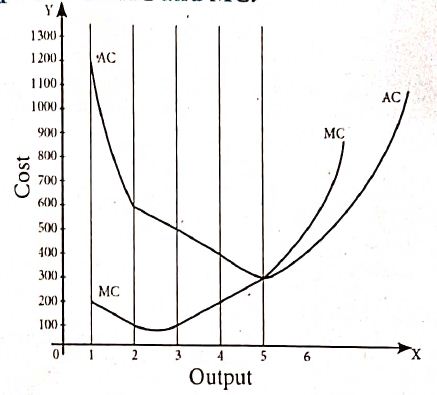
When AC is falling, MC remains below AC.
When AC becomes constant MC becomes equal to it.
When AC starts increasing MC is above the AC
MC always cuts AC at its minimum point from below.
22.
(i) It refers to the cost of next best alternative use.
(ii) It is the value of the next best alternative foregone
(iii) It is also called alternative cost or transfer cost.
(vi) (eg) A farmer can cultivate paddy or sugarcane in his land.
(v) If he cultivates paddy the opportunity cost of paddy output is the amount of sugarcane output given up.
23.
Fixed cost and variable cost: Fixed cost and variable cost are helpful in understanding the behaviour of costs over different levels of output.
Meaning of Fixed and Variable factors and costs:
Fixed and variable factors are with reference to short run production function. Short run is a period of time over which certain factors of production cannot be changed, and such factors are called fixed factors. The costs incurred on fixed factors are called fixed costs. The factors whose quantity can be changed in the short run are variable factors, and the costs incurred on variable factors are called variable costs
Fixed costs are those which are independent of output, that is, they do not change with changes in output. These costs are a 'fixed' amount, which must be incurred by a firm in the short run whether the output is small or large. E.g. contractual rent, interest on capital invested, salaries to the permanent staff, insurance premia and certain taxes. Variable costs are those costs, which are incurred on the employment of variable factors of production whose amount can be altered in the short run. Thus the total variable costs change with the level of output. It rises when output expands and falls when output contracts. When output is nil, variable cost becomes zero. These costs include payments such as wages of labour employed, prices of raw materials, fuel and power used arid the transport costs.
24.
TC = TFC + TVC
\(AVC=\frac{TVC}{Q}\)
\(AFC=\frac{TFC}{Q}\)
\(AC=\frac{TC}{Q}\)
(i) TC = 100 + Q3. Total cost has two components TFC and TVC.
(ii) TFC = is the total fixed cost which does not change with the level of output.
(iii) It is determined by putting the value of Q.
(iv) Given the total cost function T = 100+Q3
Q = units of output where Q = 10
Here TFC = 100 (TFC will not change with output changes)
TC 100 + (10)3
= 100 + 1000
TC = 1100
\(\therefore\)1100 = 100 + TVC
1100 - 100 = TVC
\(\therefore\)TVC = 1000
TVC = 1000, TC = 1100 \(\therefore\) TFC =?
TC = TFC + TVC
1100 = TFC + 1000
1100 - 1000 = TFC
\(\therefore\)TFC = 100
\(AFC=\frac{TFC}{Q}\)
TFC = 100, Q = 10
\(\therefore\) AFC = 10
\(AFC=\frac{TFC}{Q}\)
TVC = 1000, Q = 10
\(\therefore\) AVC = 100
\(AC=\frac{TC}{Q}\)
TC = 1100, Q = 10
\(\therefore\) AC = 110
or
AC = AFC + AVC
AFC = 10, AVC = 100
AC = 10 + 100
\(\therefore\) AC = 110

11th Standard Syllabus & Materials
11th Standard
TN 11th Tamil பீடு பெற நில் - செய்யுள் - காவடிச்சிந்து Important Questions And Answers Study Material - QB365 Set A
NEW11th Standard
TN 11th Tamil பீடு பெற நில் - உரைநடை - மலை இடப்பெயர்கள் : ஓர் ஆய்வு Important Questions And Answers Study Material - QB365 Set A
NEW11th Standard
TN 11th Tamil மாமழை போற்றுதும் - துணைப்பாடம் - யானை டாக்டர் Important Questions And Answers Study Material - QB365 Set A
NEW11th Standard
TN 11th Tamil மாமழை போற்றுதும் - செய்யுள் - ஐங்குறுநூறு Important Questions And Answers Study Material - QB365 Set A



Tamilnadu Stateboard 11th Standard Subjects

Maths

Commerce
Economics

Biology

Business Maths and Statistics

Accountancy

Computer Science

Physics

Chemistry
Maths
Biology
Economics
Physics
Chemistry

History
Business Maths and Statistics

Computer Science
Accountancy

Computer Applications
History
Computer Technology
Commerce
Computer Applications
Computer Technology

Tamil

English

French
Tamilnadu Stateboard Standards
