
 100% FREE ACCESS
11th Standard Syllabus & Materials
11th Standard
TN 11th Tamil இயற்கை வேளாண்மை,சுற்றுச்சூழல் -செய்யுள் - மனோன்மணீயம் Important Questions And Answers Study Material - QB365 Set A
NEW11th Standard
TN 11th Tamil என்னுயிர் என்பேன் -துணைப்பாடம் - இசைத்தமிழர் இருவர் Important Questions And Answers Study Material - QB365 Set A
NEW11th Standard
TN 11th Tamil மொழி கலை -செய்யுள் - ஒவ்வொரு புல்லையும் Important Questions And Answers Study Material - QB365 Set A
NEW11th Standard
TN 11th Tamil பீடு பெற நில் - இலக்கணம் - பகுபத உறுப்புகள் Important Questions And Answers Study Material - QB365 Set A
NEW11th Standard
TN 11th Tamil பீடு பெற நில் - துணைப்பாடம் - வாடிவாசல் Important Questions And Answers Study Material - QB365 Set A
NEW11th Standard
TN 11th Tamil பீடு பெற நில் - செய்யுள் - குறுந்தொகை Important Questions And Answers Study Material - QB365 Set A

Published on: 26/07/2018
From the chapter Introduction To Micro-Economics, some of the important questions are covered in this question paper. The questions are covers from the book back and the previous year questions.
Teachers can prepared question paper with answer key within five minutes. Please Click here for getting the question paper with answer key
Download Tamil Nadu 11th Standard Economics question papers, model tests, one-mark questions, important questions, and public exam papers in PDF format. Free study materials and answer keys for TN State Board students.
Questions + Answers key
Take MCQ Economics Test
1.
Public Finance is concerned with
Income and Expenditure of government
Public Debt
Taxation
All the above
2.
__________ are transferable and value in exchange.
Trade
Goods
Business
None
3.
What is the name for money Income.
Nominal Income
Real Income
Both
None
4.
'The General theory of Employment, Interest and Money' published by
Alfred Marshall
Adam Smith
Robbins
J.M. Keynes
5.
____studies about the pricing of factors of production.
Production
Exchange
Distribution
Consumption
6.
The process of reasoning from particular to general is
Deductive method
Inductive method
Positive economics
Normative economics
7.
8.
"Economics is a science" The basis of this statement is ______
Relation between cause and effect
Use of deductive method and inductive method for the formations of laws
Experiments
All of the above
9.
Who is the father of Economics?
Max Muller
Adam Smith
Karl Marx
Paul A Samuelson
10.
Find the odd one out:
"An inquiry into the Nature and the Causes of the Wealth of Nations"
"Principles of Economics"
"Nature and Significance of Economic science"
"Ceteris Paribus"
11.
Define Total Revenue?
12.
What are the major features of scarcity definitions (Robbins definitions)
13.
Name any two types of utility.
14.
15.
Define Microeconomics.
16.
What is meant by Economics?
17.
Discuss the Stable Equilibrium with the help of a diagram?
18.
Examine the samuelson's definition of economics.
19.
Distinguish between microeconomics and macroeconomics.
20.
What are the crucial decisions involved in 'what to produce'?
21.
Explain the scarcity definition of Economics and assess it.
22.
Explain the different types of utility.
23.
1.
(d)
All the above
2.
(b)
Goods
3.
(b)
Real Income
4.
(d)
J.M. Keynes
5.
(c)
Distribution
6.
(b)
Inductive method
7.
(a)
8.
(d)
All of the above
9.
(b)
Adam Smith
10.
(d)
"Ceteris Paribus"
11.
Total Revenue (TR) represents the money obtained from the sale of all the units of a good.
TR = P x Q
TR - Total Revenue
P 7 is the price per unit of the good
Q - is the total quantity of the goods sold
12.
1. Human beings have unlimited wants - Ends refers to wants
2. To satisfy unlimited wants means are limited
3. The scare means time and money are utilized III alternative uses.
13.
(i) Form utility
(ii) Time utility
(iii) Place utility
(iv) Service utility
(v) Possession utility
(vi) Knowledge utility
14.
15.
(i) Micro economics studies economic actions of small group of individuals, a household, firm or industry
(ii) It covers value theory and theory of economic welfare.
16.
(i) Economics means management of households.
(ii) It comes from the Greek word oikonomikos.
17.
Stable Equilibrium
a. Prof. Stigler states "equilibrium is a position from which there is no net tendency to move".
b. Its absence is referred to as disequilibrium.
c. A resource is in equilibrium when it gets fully employed and gets its maximum payment.
d. Static equilibrium is based on given and constant prices, quantities, income, technology, population etc.
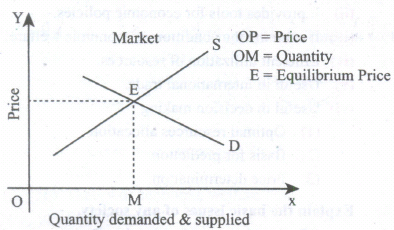
Explanation:
a. OX denotes Quantity demand and supplied and OY denotes price.
b. "DO. - Demand curve and "55" is the Supply curve.
c. At point "E" the quantity demanded is equal to Quantity supplied (0 = 5)
d. At equilibrium, price is stable because their is no tendency for change as (0 = 5).
18.
a. Samuelson's Definition (Modern Definition of Economics)
Samuelson's definition is known as a modern definition of economics. According to samuelsons, "Economics is a social science concerned chiefly with the way society chooses to employ its resources which have alternative uses, to produce goods and services for present and future consumption"
b. Common Points:
The above definition is general in nature there are many common points in the definitions of Robbins and samuelson. Samuelson's definition tells us that economics is a social science and it is mainly concerned with the way how society employs its limited resources for alternative uses.
All this we find in the definition of Robbins. But Samuelson goes a step further and discusses how a society uses limited resources for producing goods and services for present and future consumption of various people or groups An interesting point that Samuelson tells is that the society may or may not make use of money.
19.
| S.No | Micro Economics | Macro Economics |
| 1 | Micro Economics is that branch of economics which deals with the economic decision-making of individual economic agents such as the producer, the consumer etc. | Macro Economics is that branch of economics which deals with aggregates and averages of the entire economy. E.g., aggregate output, national income, aggregate savings and investment, etc. |
| 2 | It takes into account small components of the whole economy. | It takes into consideration the economy of the country as a whole. |
| 3 | It deals with the process of price determination in case of individual products and factors of production. | It deals with general price-level in any economy |
| 4 | It is known as price theory | It is also known as the income theory. |
| 5 | It is concerned with the optimization goals of individual consumers and producers | It is concerned with the optimization of the growth process of the entire economy. |
20.
(i) Whether to produce more of food, or clothing or housing or luxury goods.
(ii) Whether to produce more agricultural or industrial goods and services.
(iii) Whether to use more resources in education and health or military services.
(iv) Whether to have more consumption goods or investment goods.
(v) Whether to spend more on basic education or higher education.
21.
Definition: "Economics is a science which studies human behaviour as a relationship between ends and scarce means, which have alternative uses."
Explanation:
(i) Human beings have unlimited wants (ends)
(ii) Supply of resources is scarce in relation to demand.
(iii) Scarce resources have alternative uses.
Assessment:
(i) Robbins says that economics is neutral between ends.
(ii) He focuses on the theory of resource allocation.
(iii) He ignores theory of economic growth and development and macroeconomic aspects.
22.
Utility means "usefulness". In Economics utility is the want satisfying, power of a commodity or a service utility is a subjective or Psychological concept.
Types of Utility:
The following are the types of utility.
1. Form Utility: An individual consumer obtains utility from a good or service only where and when it is available in a particular form. (Ex) Cotton as a raw material may not possess utility for a consumer, but as it gets a new form as a cloth it yields the consumer utility.
2. Time Utility: A sick man derives time utility from blood not at the time of its donation, but only at the operation time, when it is used.
3. Place Utility: A student derives place utility from a book not at the place of its publication (Production centre) but only at the place of his education (consumption centre).
4. Service Utility: A consumer derives service utility from a service made available at the time when he most needs it. (Ex) Clients obtain service utility from their lawyers.
5. Possession Utility: When a student buy a book or dictionary from a book seller, then only it gives utility.
6. Knowledge Utility: It is the utility derived by having knowledge of a particular thing. Advertisement serves as a source of information on an object.
23.

11th Standard Syllabus & Materials
11th Standard
TN 11th Tamil பீடு பெற நில் - செய்யுள் - காவடிச்சிந்து Important Questions And Answers Study Material - QB365 Set A
NEW11th Standard
TN 11th Tamil பீடு பெற நில் - உரைநடை - மலை இடப்பெயர்கள் : ஓர் ஆய்வு Important Questions And Answers Study Material - QB365 Set A
NEW11th Standard
TN 11th Tamil மாமழை போற்றுதும் - துணைப்பாடம் - யானை டாக்டர் Important Questions And Answers Study Material - QB365 Set A
NEW11th Standard
TN 11th Tamil மாமழை போற்றுதும் - செய்யுள் - ஐங்குறுநூறு Important Questions And Answers Study Material - QB365 Set A



Tamilnadu Stateboard 11th Standard Subjects

Maths

Commerce
Economics

Biology

Business Maths and Statistics

Accountancy

Computer Science

Physics

Chemistry
Maths
Biology
Economics
Physics
Chemistry

History
Business Maths and Statistics

Computer Science
Accountancy

Computer Applications
History
Computer Technology
Commerce
Computer Applications
Computer Technology

Tamil

English

French
Tamilnadu Stateboard Standards
