
 100% FREE ACCESS
11th Standard Syllabus & Materials
11th Standard
TN 11th Tamil இயற்கை வேளாண்மை,சுற்றுச்சூழல் -செய்யுள் - மனோன்மணீயம் Important Questions And Answers Study Material - QB365 Set A
NEW11th Standard
TN 11th Tamil என்னுயிர் என்பேன் -துணைப்பாடம் - இசைத்தமிழர் இருவர் Important Questions And Answers Study Material - QB365 Set A
NEW11th Standard
TN 11th Tamil மொழி கலை -செய்யுள் - ஒவ்வொரு புல்லையும் Important Questions And Answers Study Material - QB365 Set A
NEW11th Standard
TN 11th Tamil பீடு பெற நில் - இலக்கணம் - பகுபத உறுப்புகள் Important Questions And Answers Study Material - QB365 Set A
NEW11th Standard
TN 11th Tamil பீடு பெற நில் - துணைப்பாடம் - வாடிவாசல் Important Questions And Answers Study Material - QB365 Set A
NEW11th Standard
TN 11th Tamil பீடு பெற நில் - செய்யுள் - குறுந்தொகை Important Questions And Answers Study Material - QB365 Set A

Published on: 21/11/2019
Introduction To Micro-Economics
Download Tamil Nadu 11th Standard Economics question papers, model tests, one-mark questions, important questions, and public exam papers in PDF format. Free study materials and answer keys for TN State Board students.
Questions + Answers key
Take MCQ Economics Test
1.
"Economics as the science of wealth" - It is the statement of
Adam Smith
Lionel Robbins
Alfred Marshall
Samuelson
2.
The term or word 'Economics' comes from language
Latin
Ancient Greek
Spanish
British
3.
Who is the father of Economics?
Max Muller
Adam Smith
Karl Marx
Paul A Samuelson
4.
The equilibrium price is the price at which
Everything is sold
Buyers spend their money
Quantity demanded equals quantity supplied
Excess demand is zero
5.
The basic problem studied in Economics is
Unlimited wants
Unlimited means
Scarcity
Strategy to meet all our wants
6.
What are the definitions of Economics?
7.
Distinguish between free goods and economic goods.
8.
Give the meaning of deductive method.
9.
Distinguish goods from services.
10.
11.
What are the fundamental problems faced by an economy?
12.
Critically examine the Adamsmith's wealth definition?
13.
What are the importance of microeconomics?
14.
15.
What are the crucial decisions involved in 'what to produce'?
16.
What do you mean by stable equilibrium, particular equilibrium and general equilibrium? Explain.
17.
Explain the different types of utility.
18.
Explain basic problems of the economy with the help of production possibility curve.
19.
1.
(a)
Adam Smith
2.
(b)
Ancient Greek
3.
(b)
Adam Smith
4.
(c)
Quantity demanded equals quantity supplied
5.
(c)
Scarcity
6.
1. Adam smith's wealth definition- representing the classical stage
2. Alfred marshall's welfare definition representing the he classical stage
3. Lionel Robbin's scarcity definition representing the new age and
4. Growth definitions of samuelson representing the modern age.
7.
| Sl.No | Economic Goods | Free Goods |
| 1 | Goods which scarce are called economic goods | Goods that are not scarce are called free goods. |
| 2 | Example: Chair, Table etc | Example: Air and Sunshine. |
8.
(i) In deductive method we move from general to particular.
(ii) It is also called as analytical (or) abstract method.
9.
(i) Goods are tangible, (eg) car but services are intangible (eg) goodwill.
(ii) Goods can be stored but services cannot be stored.
10.
11.
The fundamental problems faced by an economy are:
(i) What to produce: The first major decision relates to the quantity and the range of goods to be produced. Since resources are limited, we must choose between different alternatives collection of goods and services that may be produced.
(ii) How to produce: Having decided the quantity and the type of goods to be produced. We must next alternative determines the techniques of production to the used ego Labour or Capital.
(iii) For whom to produce: This means how the national product is to be distributed. i.e., who should get how much. This is the problem of the sharing of the national product.
(iv) Are the resources economically used: This is the problem of economic efficiency or welfare maximisation. There is to be no waste or misuse of resources since they are limited.
(v) Problem of full employment: Fullest possible use must be made of the available resources. In other words, an economy must endeavour to achieve full employment not only of labour but of all its resources.
(vi) Problem of growth: Another problem for an economy is to make sure that it keeps an expanding or developing. So that it maintain conditions of stability. It is not to be static.
12.
Introduction: Adamsmith (1723 - 1790) in this book "An enquiry in to Nature and causes of Wealth of Nations" (1776)
Wealth: Adamsmith defines "Economics as the science of wealth". He explains how a nations wealth is created and increased. He considered that the individual in the society wants to promote his wealth.
Adamsmith favours the introduction of "Division of Labour" to increase the quantum of output.
Criticism: For Smith, Economics consists of Wealth getting arid wealth spending activities. Wealth is treated to bean end in itself. This view leads him to ignore human welfare. It is an essential part of Economics.
Ruskin and 'Carlyle regard, Economics as a "dismal science", "Pig science" etc as it teaches, selfishness which it against ethics. Smith's definition is that there is over emphasis on wealth but it can be only a part of the study. There is other side more important side that is the study of "Man".
13.
Micro Economics:
(i) Understand the operation of an economy.
(ii) It provides tools for economic policies.
(iii) It examine the condition of economic welfare.
(iv) Efficient utilization of resources.
(v) Useful in international trade.
(vi) Useful in decision making
(1) Optimal resources allocation
(2) Basis for prediction.
(3) Price determination
14.
15.
(i) Whether to produce more of food, or clothing or housing or luxury goods.
(ii) Whether to produce more agricultural or industrial goods and services.
(iii) Whether to use more resources in education and health or military services.
(iv) Whether to have more consumption goods or investment goods.
(v) Whether to spend more on basic education or higher education.
16.
(a) Stable Equilibrium
Prof. Stigler states that "equilibrium is a position from which there is no net tendency to move". Its absence is referred to as disequilibrium. Consumer's equilibrium occurs when he gets maximum satisfaction. The equilibrium of the producer occurs when he gets maximum profit. A resource is in equilibrium when it gets fully employed and gets its maximum payment. Thus, static equilibrium is based on given and constant prices, quantities, income, technology, population etc.
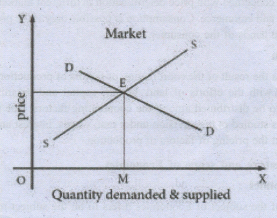
(b) Particular Equilibrium and General Equilibrium
An equilibrium, when it pertains to a single variable, may be called particular equilibrium. An equilibrium, on the other hand, when it relates to numerous variables or even the economy as a whole, may be called general equilibrium.
17.
Utility means "usefulness". In Economics utility is the want satisfying, power of a commodity or a service utility is a subjective or Psychological concept.
Types of Utility:
The following are the types of utility.
1. Form Utility: An individual consumer obtains utility from a good or service only where and when it is available in a particular form. (Ex) Cotton as a raw material may not possess utility for a consumer, but as it gets a new form as a cloth it yields the consumer utility.
2. Time Utility: A sick man derives time utility from blood not at the time of its donation, but only at the operation time, when it is used.
3. Place Utility: A student derives place utility from a book not at the place of its publication (Production centre) but only at the place of his education (consumption centre).
4. Service Utility: A consumer derives service utility from a service made available at the time when he most needs it. (Ex) Clients obtain service utility from their lawyers.
5. Possession Utility: When a student buy a book or dictionary from a book seller, then only it gives utility.
6. Knowledge Utility: It is the utility derived by having knowledge of a particular thing. Advertisement serves as a source of information on an object.
18.
The Problem of Choice:
(i) The problem of choice arises because of limited resources and unlimited wants, may relate to the allocation of resources between the goods for higher income group and the lower income group and the goods for defense and the civilians.
(ii) Since PPC is the locus of the combination of the goods the problem of choice will not arises when we choose any point on PPC.
The notion of scarcity:
(i) Every economy has scarce resources which can produce only limited amount of output even with the help of best technology.
(ii) PPC reflects the constraints imposed by the element of economic scarcity.
The solution of central problems:
(i) The solution of problem of what to produce involves the decision regarding the choice of location on the PPC.
(ii) Any point inside PPC indicates that the economy is using inefficient methods of production and inefficient combination of resources.
Conclusion:
(i) Thus the basic problems of the economy are solved with the help of PPC.
19.

11th Standard Syllabus & Materials
11th Standard
TN 11th Tamil பீடு பெற நில் - செய்யுள் - காவடிச்சிந்து Important Questions And Answers Study Material - QB365 Set A
NEW11th Standard
TN 11th Tamil பீடு பெற நில் - உரைநடை - மலை இடப்பெயர்கள் : ஓர் ஆய்வு Important Questions And Answers Study Material - QB365 Set A
NEW11th Standard
TN 11th Tamil மாமழை போற்றுதும் - துணைப்பாடம் - யானை டாக்டர் Important Questions And Answers Study Material - QB365 Set A
NEW11th Standard
TN 11th Tamil மாமழை போற்றுதும் - செய்யுள் - ஐங்குறுநூறு Important Questions And Answers Study Material - QB365 Set A



Tamilnadu Stateboard 11th Standard Subjects

Maths

Commerce
Economics

Biology

Business Maths and Statistics

Accountancy

Computer Science

Physics

Chemistry
Maths
Biology
Economics
Physics
Chemistry

History
Business Maths and Statistics

Computer Science
Accountancy

Computer Applications
History
Computer Technology
Commerce
Computer Applications
Computer Technology

Tamil

English

French
Tamilnadu Stateboard Standards
