
 100% FREE ACCESS
11th Standard Syllabus & Materials
11th Standard
TN 11th Tamil இயற்கை வேளாண்மை,சுற்றுச்சூழல் -செய்யுள் - மனோன்மணீயம் Important Questions And Answers Study Material - QB365 Set A
NEW11th Standard
TN 11th Tamil என்னுயிர் என்பேன் -துணைப்பாடம் - இசைத்தமிழர் இருவர் Important Questions And Answers Study Material - QB365 Set A
NEW11th Standard
TN 11th Tamil மொழி கலை -செய்யுள் - ஒவ்வொரு புல்லையும் Important Questions And Answers Study Material - QB365 Set A
NEW11th Standard
TN 11th Tamil பீடு பெற நில் - இலக்கணம் - பகுபத உறுப்புகள் Important Questions And Answers Study Material - QB365 Set A
NEW11th Standard
TN 11th Tamil பீடு பெற நில் - துணைப்பாடம் - வாடிவாசல் Important Questions And Answers Study Material - QB365 Set A
NEW11th Standard
TN 11th Tamil பீடு பெற நில் - செய்யுள் - குறுந்தொகை Important Questions And Answers Study Material - QB365 Set A

Published on: 12/08/2019
Market Structure and Pricing
Download Tamil Nadu 11th Standard Economics question papers, model tests, one-mark questions, important questions, and public exam papers in PDF format. Free study materials and answer keys for TN State Board students.
Questions + Answers key
Take MCQ Economics Test
1.
Price rigidity is the attribute of _______
Perfect competition
Oligopoly
Duopoly
Monopoly
2.
_______ is also called as international price discrimination.
Oligopoly
Dumping
Duopoly
Monopoly
3.
Imperfect competition was propounded in __________
1930
1932
1933
1940
4.
TR=TC is ________
Profit
Loss
Break Even Point
All of these
5.
Imperfect competition market which comprises _________
Monopoly market
Monopolistic competition market
Duopoly market
All of these
6.
The supply curve is __________ in the long period.
Perfectly inelastic
Inelastic
Elastic
Very much elastic
7.
Price discrimination will always lead to _________
Increase in output
Increase in profit
Different prices
b and c
8.
Perfect competition assumes ____________
Luxury goods
Producer goods
Differentiated goods
Homogeneous goods
9.
Profit of a firm is obtained when __________.
TR < TC
TR - MC
TR > TC
TR = TC
10.
A firm under monopoly can earn ________ in the short run
Normal profit
Loss
Super normal profit
More loss
11.
What is Monopoly?
12.
Classify the market on the basis of time.
13.
Define "Excess capacity".
14.
Who is price-taker?
15.
Define Market.
16.
What are the important features of monopolistic competition?
17.
Explain 'Monopsony'.
18.
What are the types of price discrimination? Explain?
19.
State the features of the duopoly.
20.
Differentiate between 'firm' and 'industry'.
21.
How is the price and output determined in the long run under monopolistic competition?
22.
Explain the market on the basis of area.
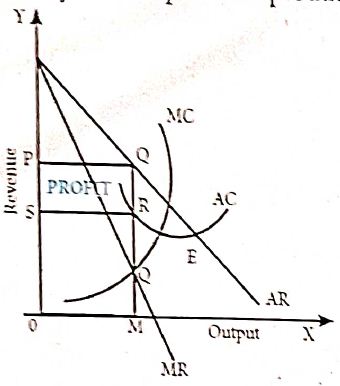
23.
1.
(b)
Oligopoly
2.
(b)
Dumping
3.
(c)
1933
4.
(c)
Break Even Point
5.
(d)
All of these
6.
(d)
Very much elastic
7.
(d)
b and c
8.
(d)
Homogeneous goods
9.
(c)
TR > TC
10.
(c)
Super normal profit
11.
(i) Monopoly has been derived from two words 'Mono' - single, 'poly' - to control.
(ii) Monopoly is a market situation in which there is only one seller.
(iii) There is no scope for competition.
12.
(i) Very short period (or) Market Period
(ii) Short period
(iii) Long-period
(iv) Very long period (or) Secular period
13.
Excess capacity is the difference between the optimum output that can be produced and the actual output produced by the firm.
14.
A person who has no power to fix the price of the product is a price taker. A seller in perfect competition is a price taker.
15.
Market refers to a system of exchange between the buyers and the sellers of a commodity.
16.
(i) Large number of buyers and sellers.
(ii) They are price makers. They set their own prices.
(iii) Firms produce differentiate products.
(iv) Free entry and exit.
(v) It follows an independent price policy.
(vi) Non-price competition is essential.
(vii) Expenditure on sale promotion of their products.
17.
(i) It is a market structure in which there is only one buyer of a good or service.
(ii) If there is only one customer for a certain good that customer has 'Monopsony' power in the market for that good.
(iii) Monopsony is analogous to monopoly. But monopoly has market power on the demand side rather than the supply side.
18.
There are three types of price discrimination. They are,
(i) Personal
(ii) Geographical
(iii) On the basis of use
Personal:
(i) Different prices are charged for different individuals.
(ii) For Example: Railway Ticket
Geographical:
(i) Different prices are charged at different places for the same product.
(ii) For Example: A book sold within India at a price is sold in a foreign country at a different price.
On the basis of use:
(i) Different prices are charged for the same product on the basis of use.
(ii) For Example: Electricity board in domestic and commercial.
19.
(i) In duopoly there are only two sellers.
(ii) Each seller is fully aware of his rival's motive and actions.
(iii) Both sellers may collude.
(iv) They may enter into cut-throat competition.
(v) There is no product differentiation.
(vi) They fix the price to get maximum profit.
20.
Firm : A single production unit in an industry, producing a large or a small amount of the commodity. (eg) Hamam, Lux are 2 firms.
Industry : A group of firms producing the same product. (eg) soap industry.
21.
Long run equilibrium of the firm and group equilibrium:
(i) In the short run under monopolistic competition, the firm earns supernormal profit or loss.
(ii) But in the long run, the entry of new firms will wipe out supernormal profit.
(iii) And the loss experienced by existing firms, monopolists leaving the industry.
(iv) Hence, the firm will earn the only normal profit in the long run.
(v) In the long run, AR curve is more elastic or flatter due to plenty of substitutes available.
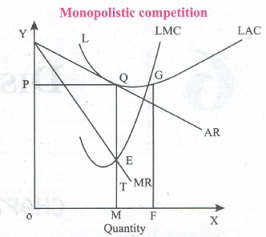
(vi) At Point E the firm achieves the equilibrium where MC = MR.
(vii) OP - Price, OM - Output
(viii) MQ - Average Cost, M = Average Revenue
\(\therefore\) MQ = MQ (AR = AC)
(ix) It means a firm earn the only normal profit in the long run.
22.
Here the market is classified not only on its geographical spread but also nature of goods.
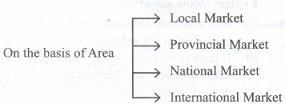
(i) Local Market:
1. The products exchanged are mostly perishable and semi-durable in nature.
2. For Example Halva in Tirunelveli.
(ii) Provincial Market:
1. Products are sold and bought in a restricted circle
2. For Example Provincial newspaper
(iii) National Market:
1. Products are sold and bought throughout a country is called national market.
2. For Example Tea, Coffee etc.
(iv) International Market:
1. Products are sold and bought at the world level are called international market.
2. For Example Petrol, Gold, etc.
23.

11th Standard Syllabus & Materials
11th Standard
TN 11th Tamil பீடு பெற நில் - செய்யுள் - காவடிச்சிந்து Important Questions And Answers Study Material - QB365 Set A
NEW11th Standard
TN 11th Tamil பீடு பெற நில் - உரைநடை - மலை இடப்பெயர்கள் : ஓர் ஆய்வு Important Questions And Answers Study Material - QB365 Set A
NEW11th Standard
TN 11th Tamil மாமழை போற்றுதும் - துணைப்பாடம் - யானை டாக்டர் Important Questions And Answers Study Material - QB365 Set A
NEW11th Standard
TN 11th Tamil மாமழை போற்றுதும் - செய்யுள் - ஐங்குறுநூறு Important Questions And Answers Study Material - QB365 Set A



Tamilnadu Stateboard 11th Standard Subjects

Maths

Commerce
Economics

Biology

Business Maths and Statistics

Accountancy

Computer Science

Physics

Chemistry
Maths
Biology
Economics
Physics
Chemistry

History
Business Maths and Statistics

Computer Science
Accountancy

Computer Applications
History
Computer Technology
Commerce
Computer Applications
Computer Technology

Tamil

English

French
Tamilnadu Stateboard Standards
