
 100% FREE ACCESS
11th Standard Syllabus & Materials
11th Standard
TN 11th Tamil இயற்கை வேளாண்மை,சுற்றுச்சூழல் -செய்யுள் - மனோன்மணீயம் Important Questions And Answers Study Material - QB365 Set A
NEW11th Standard
TN 11th Tamil என்னுயிர் என்பேன் -துணைப்பாடம் - இசைத்தமிழர் இருவர் Important Questions And Answers Study Material - QB365 Set A
NEW11th Standard
TN 11th Tamil மொழி கலை -செய்யுள் - ஒவ்வொரு புல்லையும் Important Questions And Answers Study Material - QB365 Set A
NEW11th Standard
TN 11th Tamil பீடு பெற நில் - இலக்கணம் - பகுபத உறுப்புகள் Important Questions And Answers Study Material - QB365 Set A
NEW11th Standard
TN 11th Tamil பீடு பெற நில் - துணைப்பாடம் - வாடிவாசல் Important Questions And Answers Study Material - QB365 Set A
NEW11th Standard
TN 11th Tamil பீடு பெற நில் - செய்யுள் - குறுந்தொகை Important Questions And Answers Study Material - QB365 Set A

Published on: 27/11/2019
Market Structure and Pricing
Download Tamil Nadu 11th Standard Economics question papers, model tests, one-mark questions, important questions, and public exam papers in PDF format. Free study materials and answer keys for TN State Board students.
Questions + Answers key
Take MCQ Economics Test
1.
Imperfect competition market which comprises _________
Monopoly market
Monopolistic competition market
Duopoly market
All of these
2.
Very long period market is also called as ____________
Market Period
Short Period
Long Period
Secular Period
3.
In monopoly, MR curve lies below ____________
TR
MC
AR
AC
4.
Which of the following is a feature of monopolistic competition?
One seller
Few sellers
Product differentiation
No entry
5.
6.
What is the meaning of monopoly?
7.
8.
Define "Excess capacity".
9.
Point out the essential features of pure competition.
10.
Define Market.
11.
Bring out the features of Monopoly?
12.
What are the conditions of price discrimination?
13.
State the features of the duopoly.
14.
Describe the degrees of price discrimination.
15.
What are the features of a market?
16.
Explain how markets are classified on the basis of Time.
17.
Explain the types of monopoly?
18.
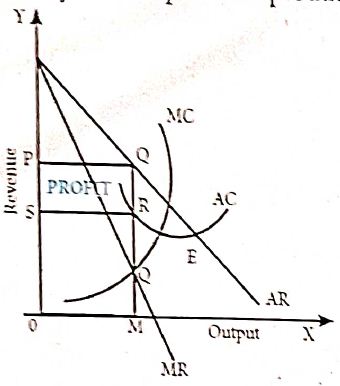
Explain how price and output are determined under monopolistic competition with help of a diagram.
19.
1.
(d)
All of these
2.
(d)
Secular Period
3.
(c)
AR
4.
(c)
Product differentiation
5.
(a)
6.
The word monopoly has been derived from the combination of two words i.e., 'Mono' and 'Poly'. Mono refers to a single and "Poly" to seller.
7.
8.
Excess capacity is the difference between the optimum output that can be produced and the actual output produced by the firm.
9.
(i) Pure competition is a narrower term for perfect competition.
(ii) Its features are presence of large number of buyers & sellers; homogeneous products and free entry and exit of the firms.
10.
Market refers to a system of exchange between the buyers and the sellers of a commodity.
11.
Features of Monopoly :
(1) There is a single producer / seller of a product;
(2) The product of a monopolist is unique and has no close substitute;
(3) There is strict barrier for entry of any new firm;
(4) The monopolist is a price-maker;
(5) The monopolist earns maximum profit/ abnormal profit.
(6) Firm and industry: Under monopoly, there is no difference between a firm and industry. As there is only one firm, that single firm constitutes the whole industry
12.
Price discrimination is possible only if the following conditions are fulfilled :
i. The demand must not be transferable from the high priced market to the low priced market.
ii. The monopolist should keep the two markets or different markets separate so that the commodity will not be moving from one market to the other market.
13.
(i) In duopoly there are only two sellers.
(ii) Each seller is fully aware of his rival's motive and actions.
(iii) Both sellers may collude.
(iv) They may enter into cut-throat competition.
(v) There is no product differentiation.
(vi) They fix the price to get maximum profit.
14.
First degree price discrimination:
(i) A monopolist charges the maximum price that a buyer is willing to pay.
(ii) This is perfect price discrimination.
(iii) Consumer's surplus is zero.
Second degree price discrimination:
(i) Price charged is such that a part of consumer's surplus is taken away by the sellers.
(ii) This is called imperfect discriminating monopoly.
(iii) Buyers are divided into groups and a different price is charged for each group. (eg) cinema theaters charge different price for the same film for different class.
Third degree price discrimination
(i) The entire market is split into a few sub markets and different prices are charged in each sub market.
(ii) The division is done based on age, sex, location. (eg) senior citizens pay lower fares in railways.
15.
(i) Buyers and sellers of a commodity or a service. A commodity is bought and sold.
(ii) Price agreeable to buyer and seller.
(iii) Direct exchange and indirect exchange.
16.
Markets on the basis of Time:
Alfred Marshall classifies market on the basis of time. The 'time' here refers to the nature of the factors, such as fixed factors and variable factors, used in the production process, and how the supply of the products meets with varying demand situations in the determination of price of the products.
(i) Very short period market or Market Period: It occurs when with the available time, the quantum supplied of a product cannot be increased (or decreased). Here, the supply curve is vertical; it is inelastic. In this market, the demand force is more active than the supply force in the determination of the price. For example, given an inelastic supply for food, an increase in its demand, during a flood situation, raises the price of food.
(ii) Short period market: It occurs when the quantum supplied of a product can be increased (or decreased) to some extent. Here, the supply curve is a, little more elastic. In this period, some factors continue to be fixed and they work a little more intensively to meet an increased demand.
(iii) Long period market: It occurs when the quantum supplied of a product can be increased (or decreased) to a larger extent. Here the supply curve is very much elastic. Thus, to meet an increase in demand, the quantum of all the factors becomes variable. There are no fixed factors here. Therefore, there is a possibility for larger changes in supply. The price of the product cannot be as high as in the case of short run.
(iv) Very long period market (or a Secular Period Market): It occurs when the entire economy undergoes a drastic change. Newer technologies are introduced and most modem products are produced. Several newer methods of production are adopted in the production process, with improvements taking place in technology. For example, the entry of pen-drive has driven out compact disc (CD); as CD has replaced floppies which once replaced tape cassettes.
17.
(i) Natural Monopoly :
Ownership of the natural raw materials (E.g. Gold mines (Africa), Coal mines, Nickel (Canada) etc.)
(ii) State Monopoly:
Single supplier of some special services (E.g.Railways in India)
(iii) Legal Monopoly :
A monopoly firm can get its monopoly power by getting patent right trade market from the government.
18.
Introduction:
E.H. Chamberlin introduced the concept of monopolistic competition.
(i) Firm under monopolistic competition has equilibrium when MC = MR & when MC cuts MR from below.
(ii) The AR curve slopes downward and is fairly elastic.
(iii) Different firms produce different varieties of the product and sell them at different prices.
Each firm seeks to get equilibrium with regard to
1) price & output 2) product adjustment 3) selling cost adjustment
Short run equilibrium
.JPG)
In fig (a) OM is the equilibrium output. OP is the price.
TR = OMQP, TC = OMRS, Abnormal Profit = PQRS
In fig (b) TR = OMQP, TC = OMLR, Loss = PQLR
Long run equilibrium:
.JPG)
(i) In short run the firm may earn super normal profit or incur loss.
(ii) In the long run the AR is more elastic.
(iii) The firms earn only normal profit.
(iv) Equilibrium output = OM. Price = OP, AR = QM, AC = QM.
(v) Equilibrium is got when AR = AC. AR is tangent to AC at Q.
19.

11th Standard Syllabus & Materials
11th Standard
TN 11th Tamil பீடு பெற நில் - செய்யுள் - காவடிச்சிந்து Important Questions And Answers Study Material - QB365 Set A
NEW11th Standard
TN 11th Tamil பீடு பெற நில் - உரைநடை - மலை இடப்பெயர்கள் : ஓர் ஆய்வு Important Questions And Answers Study Material - QB365 Set A
NEW11th Standard
TN 11th Tamil மாமழை போற்றுதும் - துணைப்பாடம் - யானை டாக்டர் Important Questions And Answers Study Material - QB365 Set A
NEW11th Standard
TN 11th Tamil மாமழை போற்றுதும் - செய்யுள் - ஐங்குறுநூறு Important Questions And Answers Study Material - QB365 Set A



Tamilnadu Stateboard 11th Standard Subjects

Maths

Commerce
Economics

Biology

Business Maths and Statistics

Accountancy

Computer Science

Physics

Chemistry
Maths
Biology
Economics
Physics
Chemistry

History
Business Maths and Statistics

Computer Science
Accountancy

Computer Applications
History
Computer Technology
Commerce
Computer Applications
Computer Technology

Tamil

English

French
Tamilnadu Stateboard Standards
