
 100% FREE ACCESS
11th Standard Syllabus & Materials
11th Standard
TN 11th Tamil இயற்கை வேளாண்மை,சுற்றுச்சூழல் -செய்யுள் - மனோன்மணீயம் Important Questions And Answers Study Material - QB365 Set A
NEW11th Standard
TN 11th Tamil என்னுயிர் என்பேன் -துணைப்பாடம் - இசைத்தமிழர் இருவர் Important Questions And Answers Study Material - QB365 Set A
NEW11th Standard
TN 11th Tamil மொழி கலை -செய்யுள் - ஒவ்வொரு புல்லையும் Important Questions And Answers Study Material - QB365 Set A
NEW11th Standard
TN 11th Tamil பீடு பெற நில் - இலக்கணம் - பகுபத உறுப்புகள் Important Questions And Answers Study Material - QB365 Set A
NEW11th Standard
TN 11th Tamil பீடு பெற நில் - துணைப்பாடம் - வாடிவாசல் Important Questions And Answers Study Material - QB365 Set A
NEW11th Standard
TN 11th Tamil பீடு பெற நில் - செய்யுள் - குறுந்தொகை Important Questions And Answers Study Material - QB365 Set A

Published on: 04/10/2019
Production Analysis
Download Tamil Nadu 11th Standard Economics question papers, model tests, one-mark questions, important questions, and public exam papers in PDF format. Free study materials and answer keys for TN State Board students.
Questions + Answers key
Take MCQ Economics Test
1.
State and explain laws of return to scale?
2.
Explain the characteristics of Capital?
3.
Explain Isoquant map with the help of diagram.
4.
State the Cobb-Douglas production function.
5.
Illustrate the concept of producer's Equilibrium.
6.
Bring out the relationship among Total, Average and Marginal Products.
7.
State and explain the elasticity of supply.
8.
What are the functions of Entrepreneur?
9.
What are the factors governing elasticity of supply?
10.
1.
In the long-run, there is no fixed factor; all factors are variable. The laws of returns to scale explain the relationship between output and the scale of inputs in the long-run when all the inputs are increased in the same proportion.
Assumptions:
(i) All the factors of production (such as land, labour and capital) are variable but organization is fixed.
(ii) There is no change in technology.
(iii) There is perfect competition in the market.
(iv) Outputs or returns are measured in physical quantities.
Three phases of returns to scale:
(i) Increasing returns to scale
(ii) Constant returns to scale
(iii) Diminishing returns to scale.
2.
Bohm - Bawerk defines it as "a Produced means of Production". All capital is wealth but all wealth is not capital.
Characteristics of Capital
i) is a man-made factor.
ii) Capital is mobile between places and persons.
iii) Capital is a passive factor of production.
iv) Capital's supply is elastic.
v) Capital's demand is a derived demand.
vi) Capital is durable.
3.
(i) An Iso quant map has different iso quant curves representing the different combinations of two factors yielding different levels of output.
(ii) An Iso quant is a family of iso quant
(iii) More than one iso quant is called Iso quant map.
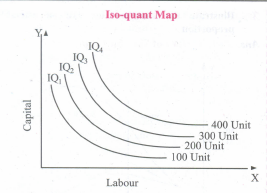
(iv) Higher the Iso quant denotes higher level of output and lower the Iso quant denotes lower level of output.
4.
(i) Charles Cobb and Paul Douglas have given a linear homogeneous production function.
(ii) A proportionate increase in the factors leads to a proportionate increase in output.
(iii) There is constant returns to scale with only labour and capital.
(iv) The elasticity of substitution between the factors is one.
Q = AL\(\alpha \)K\(\beta \)
Q = output; A = positive constant; K = Capital; L = Labour, \(\alpha \) + \(\beta \) = 1
5.
Producer's equilibrium happens when there is maximum output with minimum cost ie. optimum combination of the factors of production.
The two conditions to be fulfilled are
1. The iso-cost line must be tangent to iso-quant curve.
2. At the point of tangency, iso-quant must be convex and MRTSLK must be declining.
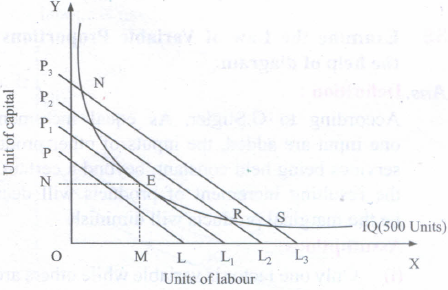
3. The producer is in equilibrium at E.
Slope of iso-quant curve = Slope of iso-cost curve.
6.
Relationship among Total, Average and Marginal Products.
| Stages | Total Product | Marginal Product | Average Product |
| Stage - I | It increases at an increasing rate. Then it increases at a decreasing rate. This is the point of inflexion. | It increases, reaches maximum and starts to decrease. | It increases, reaches maximum. |
| Stage - II | It continues to increase at a diminishing rate and reaches maximum | It continues to diminish and becomes zero. | It is equal to MP then begins to diminish. |
| Stage - III | It diminishes. | It becomes negative. | It diminishes but always greater than zero (positive) |
7.
(i) Elasticity of supply is the degree of responsiveness of change in supply to change in price on the part of sellers.
(ii) There are 5 types of elasticity of supply:
1. Relatively elastic supply
2. Relatively inelastic supply
3. Unitary elastic supply
4. Perfectly elastic supply
5. Perfectly inelastic supply
(iii) The factors governing elasticity of supply are the nature of the commodity, cost of production, technical condition & time factor.
8.
Initiation: He considers the situation and availability of resources and plans the process of production.
Innovation: He introduces new methods in the production process.
Co-ordination: He uses a particular combination of the factors of production.
Control, direction & supervision: He directs the factors to get better results and supervises for the efficient functioning of all factors.
Risk taking, uncertainty bearing: Risk is insured, uncertainties cannot be insured.
9.
Nature of the commodity:
(i) Durable goods can be stored for long till price increases so elasticity of supply is high.
(ii) Perishables have to be sold immediately, so elasticity of supply is low.
Cost of production:
When there is constant or increasing returns, supply increases so elasticity of supply is greater.
Technology:
In large-scale production with huge capital investment supply cannot be adjusted easily, so elasticity of supply is less.
Time factor:
During very short period, supply cannot be adjusted, so elasticity of supply is very low.
10.

11th Standard Syllabus & Materials
11th Standard
TN 11th Tamil பீடு பெற நில் - செய்யுள் - காவடிச்சிந்து Important Questions And Answers Study Material - QB365 Set A
NEW11th Standard
TN 11th Tamil பீடு பெற நில் - உரைநடை - மலை இடப்பெயர்கள் : ஓர் ஆய்வு Important Questions And Answers Study Material - QB365 Set A
NEW11th Standard
TN 11th Tamil மாமழை போற்றுதும் - துணைப்பாடம் - யானை டாக்டர் Important Questions And Answers Study Material - QB365 Set A
NEW11th Standard
TN 11th Tamil மாமழை போற்றுதும் - செய்யுள் - ஐங்குறுநூறு Important Questions And Answers Study Material - QB365 Set A



Tamilnadu Stateboard 11th Standard Subjects

Maths

Commerce
Economics

Biology

Business Maths and Statistics

Accountancy

Computer Science

Physics

Chemistry
Maths
Biology
Economics
Physics
Chemistry

History
Business Maths and Statistics

Computer Science
Accountancy

Computer Applications
History
Computer Technology
Commerce
Computer Applications
Computer Technology

Tamil

English

French
Tamilnadu Stateboard Standards
