
 100% FREE ACCESS
11th Standard Syllabus & Materials
11th Standard
TN 11th Tamil இயற்கை வேளாண்மை,சுற்றுச்சூழல் -செய்யுள் - மனோன்மணீயம் Important Questions And Answers Study Material - QB365 Set A
NEW11th Standard
TN 11th Tamil என்னுயிர் என்பேன் -துணைப்பாடம் - இசைத்தமிழர் இருவர் Important Questions And Answers Study Material - QB365 Set A
NEW11th Standard
TN 11th Tamil மொழி கலை -செய்யுள் - ஒவ்வொரு புல்லையும் Important Questions And Answers Study Material - QB365 Set A
NEW11th Standard
TN 11th Tamil பீடு பெற நில் - இலக்கணம் - பகுபத உறுப்புகள் Important Questions And Answers Study Material - QB365 Set A
NEW11th Standard
TN 11th Tamil பீடு பெற நில் - துணைப்பாடம் - வாடிவாசல் Important Questions And Answers Study Material - QB365 Set A
NEW11th Standard
TN 11th Tamil பீடு பெற நில் - செய்யுள் - குறுந்தொகை Important Questions And Answers Study Material - QB365 Set A

Published on: 17/01/2020
Download Tamil Nadu 11th Standard Economics question papers, model tests, one-mark questions, important questions, and public exam papers in PDF format. Free study materials and answer keys for TN State Board students.
Questions + Answers key
Take MCQ Economics Test
1.
FPI stands for____________.
Foreign Private Investment
Foreign Public Investment
Foreign Portfolio Investment
None of these
2.
Bhilai steel plant was started with the assistance from __________ country.
Russia
Germany
USA
UK
3.
In the case of two perfect substitutes, the indifference curve will be________________.
Straight line
L-shaped
If-shaped
C-shaped
4.
The firm and industry are one and the same under_______________.
perfect competition
duopoly
oligopoly
monopoly
5.
Higher the risks, the greater are the ________.
Loss
Subsidy
profit
None of these
6.
Variable cost + Cost of Administration together known as __________ .
Transfer cost
Real cost
Overhead cost
Prime cost
7.
_______ is a plural form
Matrix
Matrices
Both 'a' and 'b'
None of these
8.
Most of the villagers are indebtedness to _____________ agencies.
Private
Money lenders
Both (a) and (b)
None of these
9.
_________ of production mean resources used in the process of production of commodities.
Features
Assumption
Factors
Distribution
10.
The human capital of India is ______
Old
Young
Both 'a' and 'b'
None of these
11.
Identify the agriculture related problem of rural economy?
Poor communication
Small size of landholding
Rural poverty
Poor banking network
12.
When did the Government of India declare its first Industrial Policy?
1956
1991
1948
2000
13.
The Goods and Services Tax Act came into effect on ______
1st July 2017
1st July 2016
1st January 2017
1st January 2016
14.
15.
Identify the correct characteristics of utility
It is equivalent to 'usefulness'
It has moral significance
It is same as pleasure
It depends upon consumer's mental attitude
16.
Abstinence Theory of Interest was propounded by
Alfred Marshall
N.W. Senior
Bohm-Bawerk
Knut Wicksell
17.
Knitted garment production is concentrated in
Coimbatore
Tiruppur
Erode
Karur
18.
Mathematical Economics is the integration of
Mathematics and Economics
Economics and Statistics
Economics and Equations
Graphs and Economics
19.
20.
A scientific study of the characteristics of population is _____
Topography
Demography
Geography
Philosophy
21.
What are the merits of globalisation?
22.
Define perfect competition.
23.
What is Wage fund theory?
24.
Mention the various types of Internal Economies of scale
25.
Urbanization is a key ingredient of the growth of any economy - Explain.
26.
Define Environmental economics?
27.
What is MS Word?
28.
What is rural roads and rural transport?
29.
State the reasons for implementing LPG.
30.
Explicit Cost - Define.
31.
What are the arguments is favour of LPG.
32.
Mention any three benefits of perfect competition.
33.
34.
Explain the Period of Merchant Capital.
35.
Distinguish between internal and external economies
36.
Explain the causes for Rural Backwardness.
37.
38.
39.
Distinguish between explicit cost and implicit cost.
40.
State Ambedkar’s Economic ideas on agricultural economics.
41.
Enumerate the contribution of Amartya Kumar Sen to Indian Economy.
42.
Relationship between TR, AR, MR and Elasticity of demand.
43.
Give an account of the Iron and Steel industry in India.
44.
Solve by Cramer's rule
\(2{ x }_{ 1 }+3{ x }_{ 2 }=7;\)
\(2{ x }_{ 1 }+{ x }_{ 2 }=5\)
45.
Profit is the reward for risk-taking and uncertainty-bearing.
46.
Changes in Tastes and fashions the demand for some goods and services is very susceptible to change in tastes and fashions?
47.
48.
Explain about Agrarian Crisis after reforms.
49.
50.
Examine the Law of Variable Proportions with the help of diagram.
51.
Describe the salient features of EXIM policy (2015 - 2020)
52.
53.
54.
Explain the strong features of Indian economy.
1.
(c)
Foreign Portfolio Investment
2.
(a)
Russia
3.
(a)
Straight line
4.
(a)
perfect competition
5.
(c)
profit
6.
(d)
Prime cost
7.
(b)
Matrices
8.
(c)
Both (a) and (b)
9.
(c)
Factors
10.
(b)
Young
11.
(b)
Small size of landholding
12.
(c)
1948
13.
(a)
1st July 2017
14.
(b)
15.
(d)
It depends upon consumer's mental attitude
16.
(b)
N.W. Senior
17.
(b)
Tiruppur
18.
(a)
Mathematics and Economics
19.
(c)
20.
(b)
Demography
21.
Globalisation of under developed countries will
(i) Improve the efficiency of resources.
(ii) Reduce the capital output ratio.
(iii) Increase labour productivity.
(iv) Help to develop the export spheres and export culture.
(v) Increase the inflow of capital and updated technology into the country.
22.
According to Joan Robinson, "It prevails when the demand for the output of each producer is perfectly elastic".
23.
According to Wages fund theory, "wages depend upon the proportion between population and capital". The term' capital in the context refers to the fund set apart for payment of wages And the word 'population' refers to workers. If the supply of workers increases wages will fall and vice versa.
24.
The various types of Internal Economies of scale are
(a) Technical Economies
(b) Financial Economies
(c) Managerial Economies
(d) Labour Economies
(e) Marketing Economies
(f) Economies of survival
25.
There has been a rapid growth of urban areas in India after Independence. Improved connectivity in transport and communication, education and health have speeded up the pace of urbanization.
26.
Environmental economics which analyses the inter relationship between economy and environment. It is a study of inter disciplinary tools for the problems of ecology, economy and environment.
27.
MS Word is a Word processor, which helps to create, edit, print and save documents for future retrieval and reference.
28.
(i) Rural roads constitute the very lifeline of rural economy.
(ii) To get the benefits of well-constructed road network in rural areas is called rural transport
29.
(i) Liberalization was needed because the various licensing policies were preventing economic growth.
(ii) Since the private sector was not given enough opportunities to earn more money privatization was done.
(iii) Globalization was needed because today a developed country
can grow without the help of the underdeveloped countries.
30.
Payment made to others for the purchase of factors of production is known as explicit cost. It is also called accounting cost or out of pocket cost.
31.
(a) Liberalisation was necessitated because various licensing policies were said to be deterring the growth of the economy.
(b) Privatisation was necessitated because of the belief that the private sector was not given enough opportunities to earn more money.
(c) Globalisation was necessitated because today a developed country can grow without the help of the under developed countries. Natural and human resources of the developing countries are exploited by the developed countries and the developing economies are used as market for the finished goods of the developed countries. The surplus capital of the developed countries are invested in backward economies absolute and outdated technologies of the developed countries can be easily sold to poor under developed countries. Ultimately, the rich countries can grow further at the cost of developing economies.
32.
i. There is consumer sovereignty in a perfect competitive market. The consumer has perfect knowledge about the market conditions.
ii. The price is equal to the minimum average cost which is beneficial to the consumer.
iii. The firms are price-takers and the products are homogeneous.
33.
34.
(i) The period of merchant capital was from 1757 to 1813.
(ii) The only aim of the East India Company was to earn profit by establishing monopoly trade in goods with India and East Indies.
(iii) When Bengal and South India came under the political shake of the East India Company in 1750s and 1760s, the objective of monopoly trade was fulfilled.
(iv) The company generated huge surpluses which were sent to England.
(v) The officers of the company were unscrupulous and corrupt.
35.
| Internal Economies of Scale | External Economies of Scale |
| Expansion of the firm itself | Expansion of the industry |
| Lower long run average cost | Benefits most all firms |
| Range of economies e.g. Technical and Financial | Helps to explain the rapid growth of many cities. |
36.
(i) The distribution of land is highly skewed in rural areas. Majority of rural people work as hired labour to support their families.
(ii) Lack of non-farm employment: The excess supply of labour in rural areas reduce the wages and increases the incidence of poverty
(iii) Lack of public sector investment: The root cause of rural poverty in our country is lack of public sector investment on human resource development.
(iv) Inflation: Steady increase in prices affects the purchasing power of the rural poor leading to rural poverty.
(v) Low Productivity: Low Productivity of rural labour and farm activities is a cause and effect of poverty.
(vi) Unequal benefit of growth: The gaîns of economic development are enjoyed by the urban rich people leading to concentration of wealth. Due to defective economic structure and policies, the gains of growth are not reaching the poor.
(vii) Low rate of economic growth: The rate of growth of India is always below the target and it has benefited the rich. The poor are always denied of the benefits of growth.
(viii) More emphasis on large industries: Huge investment in large industries catering to the needs of middle and upper classes in urban areas. Such industries are capital intensive and so do not create more jobs. The poor are not in a position to get employment or to come out of social evils. Social evils like customs, beliefs increase unproductive expenditure.
37.
38.
39.
| S.No | Explicit cost | Implicit cost |
| 1 | Payment made to others for buying factors of production. | Payment made for the use of firm's own resource. |
| 2 | Actual expenditure of the firm in buying or hiring the inputs. | Cost of firm's self owned, self employed resources. |
| 3 | (eg) wages, rent, advertisement, depreciation. | Costs are not recorded as no cash payment takes place. |
| 4 | Also called accounting cost, out of pocket cost money cost. | Value of the own services are imputed and considered for preparing profit loss accounts. Also called imputed cost. |
40.
In 1918, Ambedkar published a paper "Small Holdings in India and their Remedies", citing Adam Smith's "Wealth of Nations", he differentiated "Consolidation of Holdings" and "Enlargement of Holdings".
41.
The Nobel citation refers to Sen's contributions to social choice theory, development economics; study on poverty and famines and concept of entitlements and capability development (1998).
(i) Poverty and Famines-Sen's Poverty and Famines: An Essay on Entitlement and Deprivation" (1981) is both a theoretical and an applied work. In the book, several famines have been studied in the working of a general theoretical framework from an original angle. He examined various meanings. of poverty and drew attention to the incidence of absolute and relative deprivation.
(ii) Poverty and Inequality: Sen has carried out massive work on poverty and inequality in India. Sen's major point has been that the distribution of income/consumption among the persons below the poverty line is to be taken into account.
(iii) The concept of capability: The concept of capabilities developed by Sen has been cited as a better index of well being than commodities or utilities. Capability, as defined by Sen, is the ability to transform Rawlsian primary goods to the achievement of well being.
(iv) Entitlement: Sen has included the concept of entitlement items like nutrition, food, medical and health care, employment, security of food supply in times of famine. etc. He considered famine as arising out of the failure of establishing a system of entitlements.
(v) Choice of Technique: Sen's 'Choice of Technique' was a research work where he argued that in a labour surplus economy, generation of employment cannot be increased at the initial stage by the adaptation of capital-intensive technique. Conclusively, Amartya Sent more than just an economist, is an ethical philosopher; He is a lover of freedom and a humanist. He has focused on the poor, viewing them not as objects of pity requiring charitable hand-outs, but as disempowered folk needing empowerment, education health, nutrition, gender equality-safety net in times of distress; all are needed to empower people.
42.
The relationship among AR, MR and elasticity of demand (e) is stated as follows. MR = AR.( e-1/e)
The relationship between the AR curve and MR curve depends upon the elasticity of AR curve (AR = DD = Price).
(i) When price elasticity of demand is greater than one, MR is positive and TR is increasing.
(ii) When price elasticity of demand is less than one, MR is negative and TR is decreasing.
(iii) When price elasticity of demand is equal to one, MR is equal to zero and TR is maximum and constant.
It is to be noted that, the output range of 1 to 5 units, the price elasticity of demand is greater than one according to total outlay method. Hence, TR is increasing and MR is positive.
At the output range of 5 to 6 units, the price elasticity of demand is equal to one. Hence, TR is maximum and MR equals to zero.
At the output range of 6 units to 10 units, the price elasticity of demand is less than unity. Hence, TR is decreasing and MR is negative.
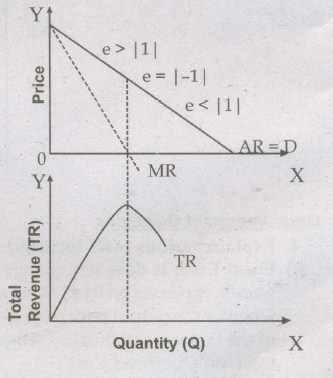
| Quantity (Q) | Price (P) | TR | AR | MR | Elasticity |
| 0 | 11 | 0 | 11 | - | e > 1 |
| 1 | 10 | 10 | 10 | 10 | e > 1 |
| 2 | 9 | 18 | 9 | 8 | e > 1 |
| 3 | 8 | 24 | 8 | 6 | e > 1 |
| 4 | 7 | 28 | 7 | 4 | e > 1 |
| 5 | 6 | 30 | 6 | 2 | e > 1 |
| 6 | 5 | 30 | 5 | 0 | e = 1 |
| 7 | 4 | 28 | 4 | -2 | e < 1 |
| 8 | 3 | 24 | 3 | -4 | e < 1 |
| 9 | 2 | 18 | 2 | -6 | e < 1 |
| 10 | 1 | 10 | 1 | -8 | e < 1 |
| 11 | 0 | 0 | 0 | -10 | e < 1 |
43.
Iron and steel industry :
(i) First steel industry at Kulti, Near Jharia, West Bengal - Bengal iron works company in 1870.
(ii) First large scale steal plant TISCO at Jamshedpur in 1907 followed by lISEO at Burnpur in 1919. Both belonged to private sector.
(iii) The first public sector unit was "Vishveshvaraya Iron and Steel works" at Bhadrawati.
Public sector steel plants:
| Location | Assistance |
| (a) Rourkela (Odissa) (b) Bhilai (MP) (c) Durgapur (WB) (d) Bokaro (Jharkhand) (e) Burnpur (WB) (f) Vishakhapatnam (AP) (g) Salem (Tamil Nadu) (h) Vijai Nagar (Karnataka) (i) Bhadrawati (Kamataka) |
Germany Russia UK Russia Acquired from private sector in 1976 Russia Government of India (No external assistance) Government of India Nationalisation of Vishveshvarayya Iron and Steel Ltd (owned by Centre and State government |
(iv) All these are managed by SAIL (at present all important steel plants except TISCO, are under public sector)
(v) Steel Authority of India Ltd (SAIL) was established in 1974 and was made responsible for the development of the steel industry.
(vi) Presently India is the eighth largest steel producing country in the world.
44.
The coefficient and the constant terms are given below for the equations
\(\triangle =\left| \begin{matrix} 2 & 3 \\ 2 & 1 \end{matrix} \right| \)
\(\triangle =2-6=-4\)
\(\triangle { x }_{ 1 }=\left| \begin{matrix} 7 & 3 \\ 5 & 1 \end{matrix} \right| \)
\(=7-15=-8\)
\( \triangle { x }_{ 2 }=\left| \begin{matrix} 2 & 7 \\ 2 & 5 \end{matrix} \right| \)
\(=10-14=-4\)
\(By\quad Carmer's\quad rule\)
\( { x }_{ 1 }=\frac { \triangle { x }_{ 1 } }{ \triangle } \)
\(=\frac { -8 }{ -4 } \)
\(=2\)
\({ x }_{ 2 }=\frac { \triangle { x }_{ 2 } }{ \triangle } \)
\(=\frac { -4 }{ -4 } =1\)
\(solution\quad set\)
\(\left( { x }_{ 1 }{ ,x }_{ 2 } \right) =\left\{ 2,1 \right\} \)
45.
a. Profits: Profits are the reward for organization or entrepreneurship. Risk-taking and uncertainty-bearing are the main functions of an entrepreneur. So we may consider profit as the reward for the above functions.
b. The Risk - bearing theory of profits: According to Prof.Hawley, profits are the reward for an entrepreneur for risk-taking. Risk-taking is an important function of an entrepreneur. Risk-taking and profit-making go together. The main criticism against this theory is that it does not make distinction between known risks and unknown risks Known risks (eg. theft, fire) can be insured against. We may say that profits are the reward for taking unknown risks. For there is a lot of uncertainty about such risks.
46.
1. Changes in Tastes and Fashions
The demand for some goods and services is very susceptible to changes in tastes and fashions.
2. Changes in Weather: An unusually
dry summer results in a increase in the demand for cool drinks.
3. Taxation and Subsidy
If fresh taxes are levied or the existing rates of taxation on commodities are increased their prices go up. The subsidies will bring down the prices. Therefore taxes reduce demand and subsidies raise demand.
4. Changes in Expectations
Expectations also bring about a change in demand. Expectation of rise in price in future. results in increase in demand.
5. Changes in Savings
Savings and demand are inversely related.
6. State of Trade Activity:
During the periods of boom and prosperity, the demand for all commodities tends to increase. On the contrary, during times of depression there is a general slackening of demand.
7. Advertisement
In advanced capitalistic countries advertising is a powerful instrument increasing the demand in the market.
8. Changes in Income
An increase in family income may increase the demand for durables like video recorders and refrigerators. Equal distribution of income enables poor to get more income. As a result consumption level increases.
9. Change in Population
The demand for goods depends on the size of population. An increase in population tends to increase the demand for goods and a decrease in population.
47.
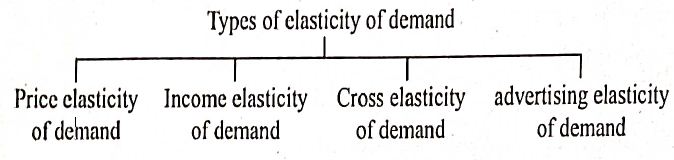
.JPG)
48.
(a) High Input Costs:
(i) The biggest input for farmers is seeds. Before liberalisation, farmers across the country had access to seeds from the state government institutions.
(ii) The institutions produced own seeds and were responsible for their quality and price.
(iii) With liberalization, India's seed market was opened up to global agribusiness. Also, following the deregulation many state government institutions were closed down in 2003.
(iv) These hit farmers doubly hard.
(v) Seed prices shot up, and fake seeds made an appearance in a big way.
(b) Cutback in agricultural subsidies:
Liberalisation policies reduced pesticide and fertilizer subsidy and so fertilizer prices have increased by 300% and electricity tariffs have been also increased.
(c) Reduction of import Duties:
(i) With a view to open India's market, the liberalisation reforms also withdrew tariffs and duties on imports, which protect and encourage domestic industry.
(ii) By 2001 India completely removed restrictions on imports of almost 1,500 items including food
(iii) As a result, cheap imports flooded the market, pushing prices of crops like cotton and pepper down.
(d) Paucity of credit facilities:
(i) After 1991 the lending pattern of commercial banks, including nationalised banks drastically changed.
(ii) This has forced the farmers to rely on moneylenders who charge exorbitant rate of interest.
49.
50.
Introduction:
The law states that if all other factors are fixed and one input is varied in the short run, the total output will increase at an increasing rate at first, then be constant and finally increase at a declining rate.
Definition:
"As equal increments of one input are added, the inputs of other productive services being held constant, beyond a certain point, the resulting increments of product will decrease (i.e) the MP will diminish". - G. Stigler
Assumptions:
1. Only one factor is variable.
2. All units of the variable factor are homogeneous.
3. The product is measured in physical units.
4. No change in technology.
5. No change in price of the product.
| Units of variable factor | Total Product (TPL) | Marginal Product (MPL) | Average Product (APL) | Stages |
| 1 2 3 |
2 6 12 |
2 4 6 |
2 3 4 |
I |
| 4 5 |
16 18 |
4 2 |
4 3.6 |
II |
| 6 7 |
18 16 |
0 -2 |
3 2.28 |
III |
x-axis represents labourers. y-axis represents TPL, MPL, APL
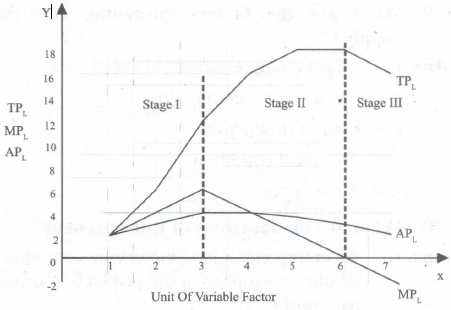
| Stages | Total Product (TP) | Marginal Product (MP) | Average Product (AP) |
| Stage I | It increases at an increasing rate. Then it increases at a decreasing rate. This is the point of inflection. |
It increases, reaches maximum and starts to decrease. | It increases, reaches maximum. |
| Stage II | It continues to increase at a diminishing rate and reaches maximum | It continues to diminish and becomes zero. | It is equal to MP then begins to diminish. |
| Stage III | It diminishes. | It becomes negative | It diminishes but always is positive. |
Conclusion:
The law of variable proportion helps the producer to decide on the amount of factors to be employed.
51.
Introduction:
The government of India, Ministry of Commerce and Industry announced New Foreign Trade Policy on 1st April 2015 for a period 2015 - 2020.
Salient Features:
(i) Reduce export obligations by 25% and give boost to domestic manufacturing supporting the 'Make in India' concept.
(ii) As a step to Digital India concept, online procedure to upload digitally signed document by CA/CS/Cost Accountant are developed and further mobile app for filing tax, stamp duty has been developed.
(iii) Repeated submission of physical copies of documents available on Exporter Importer Profile is not required.
(iv) Export obligation period for export items related to defence, military store, aerospace and nuclear energy to be 24 months.
Conclusion: EXIM Policy 2015 - 2020 is expected to double the share of India in World Trade from present level of 3% by 2020. This is too ambitious.
52.
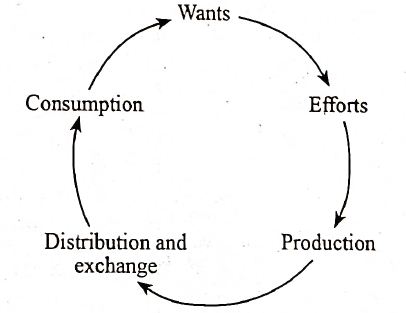
53.
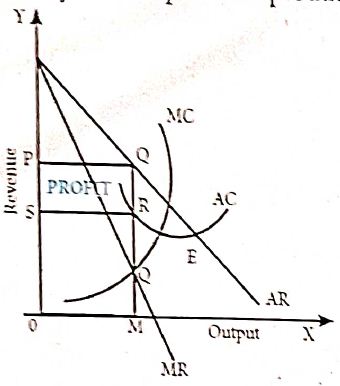
54.
Introduction:
Indian economy is the seventh largest economy of the world. Its features are:
Mixed economy:
(i) In India private and public sectors co-exist.
(ii) Some fundamental and heavy industries are under public sector.
(iii) Due to liberalization private sector's importance has increased.
Agriculture:
(i) 60 % of Indians depend on agriculture for their livelihood.
(ii) 17 % of GDP is got from agricultural sector.
(iii) Green revolution and inventions in biotechnology have made agriculture self sufficient.
(iv) The export of fruits, vegetables, spices, tobacco, animal skin, vegetable oils also add to foreign exchange earning.
An emerging market:
(i) India has emerged as a vibrant economy sustaining stable GDP growth rate even when there was global downtrend.
(ii) This has attracted foreign capital through FDI and FII.
(iii) India is in the 7th position in terms of nominal GDP and 3rd in terms of purchasing power parity.
(iv) India is one among the G20 countries.
Fast growing economy:
(i) With a growth rate of 7.1% in GDP India is the world's fastest growing economy in 2016-17 next to China.
Fast growing service sector:
(i) There has been growth in technical sectors like Information Technology, BPO.
(ii) These emerging services have helped the country to go global.
Large domestic consumption:
(i) The standard of living has improved a lot. There is rapid increase in domestic consumption.
Rapid growth of urban areas:
(i) There has been a rapid growth of urban areas in India after Independence. Improved connectivity in transport and communication, education and health have speeded up urbanization.
Stable macroeconomy:
(i) India is one of the most stable economies of the world.
(ii) The current year's economic survey represents the Indian economy to be a "heaven of macroeconomic stability, resilience and optimism".
Demographic dividend:
(i) The human capital is young.
(ii) They are young, skilled and trained enough to maximize growth.
(iii) This has invited foreign investments and outsourcing opportunities.

11th Standard Syllabus & Materials
11th Standard
TN 11th Tamil பீடு பெற நில் - செய்யுள் - காவடிச்சிந்து Important Questions And Answers Study Material - QB365 Set A
NEW11th Standard
TN 11th Tamil பீடு பெற நில் - உரைநடை - மலை இடப்பெயர்கள் : ஓர் ஆய்வு Important Questions And Answers Study Material - QB365 Set A
NEW11th Standard
TN 11th Tamil மாமழை போற்றுதும் - துணைப்பாடம் - யானை டாக்டர் Important Questions And Answers Study Material - QB365 Set A
NEW11th Standard
TN 11th Tamil மாமழை போற்றுதும் - செய்யுள் - ஐங்குறுநூறு Important Questions And Answers Study Material - QB365 Set A



Tamilnadu Stateboard 11th Standard Subjects

Maths

Commerce
Economics

Biology

Business Maths and Statistics

Accountancy

Computer Science

Physics

Chemistry
Maths
Biology
Economics
Physics
Chemistry

History
Business Maths and Statistics

Computer Science
Accountancy

Computer Applications
History
Computer Technology
Commerce
Computer Applications
Computer Technology

Tamil

English

French
Tamilnadu Stateboard Standards
