
 100% FREE ACCESS
11th Standard Syllabus & Materials
11th Standard
TN 11th Tamil இயற்கை வேளாண்மை,சுற்றுச்சூழல் -செய்யுள் - மனோன்மணீயம் Important Questions And Answers Study Material - QB365 Set A
NEW11th Standard
TN 11th Tamil என்னுயிர் என்பேன் -துணைப்பாடம் - இசைத்தமிழர் இருவர் Important Questions And Answers Study Material - QB365 Set A
NEW11th Standard
TN 11th Tamil மொழி கலை -செய்யுள் - ஒவ்வொரு புல்லையும் Important Questions And Answers Study Material - QB365 Set A
NEW11th Standard
TN 11th Tamil பீடு பெற நில் - இலக்கணம் - பகுபத உறுப்புகள் Important Questions And Answers Study Material - QB365 Set A
NEW11th Standard
TN 11th Tamil பீடு பெற நில் - துணைப்பாடம் - வாடிவாசல் Important Questions And Answers Study Material - QB365 Set A
NEW11th Standard
TN 11th Tamil பீடு பெற நில் - செய்யுள் - குறுந்தொகை Important Questions And Answers Study Material - QB365 Set A

Published on: 17/01/2020
Download Tamil Nadu 11th Standard Economics question papers, model tests, one-mark questions, important questions, and public exam papers in PDF format. Free study materials and answer keys for TN State Board students.
Questions + Answers key
Take MCQ Economics Test
1.
When industries offer employment only for a certain period of time in a year it leads to __________ employment.
Structural
Frictional
Casual
Seasonal
2.
The first known Economist to apply mathematical method to economic problems was____________.
J.M. Keynes
Adam Smith
JS.Mill
Giovanni Ceva
3.
Marginal productivity theory of distribution is otherwise known as_____________.
Ricardian Theory of rent
National Dividend Theory of distribution
Subsistence theory of wages
Abstinence Theory
4.
"Demand in economics is the desire to possess something and the willingness and the ability to pay a certain price in order to possess it," says ________
J. Harvey
Gossen
Giffen
J.S.Mill
5.
___________ is responsible for high marketing costs, market gluts and price fluctuations.
Perishability
Risk
Drought
Famine
6.
The Sarva Shiksha Abhiyan was introduced in the ____________
First five year plan
Tenth five year plan
Third five year plan
Ninth five year plan
7.
The ISO-quant is also called as the _________
Equal product curve
Product indifference curve
Both (a) and (b)
None of these
8.
There are __________ kinds of wastages under monopolistic competition.
Five
Four
Three
Two
9.
Give an example for main gold region in India _____
Kolar Gold field
Hutti Gold field
Ramgiri Gold field
All the above
10.
Opportunity cost is also called as ____.
Alternative Cost
Transfer Cost
Both 'a' and 'b'
None of these
11.
The PQLI was developed by _________
Planning Commission
Nehru
Morris
Morris D. Morris
12.
Which feature is identified with rural areas?
Low population density
High population density
Low natural resources
Low human resources
13.
Which district has the lowest child sex ratio?
Madurai
Theni
Ariyalur
Cuddalore
14.
Data processing is done by
PC alone
Calculator alone
Both PC and Calculator
Pen drive
15.
There is no excess capacity under _________
Monopoly
Monopolistic competition
Oligopoly
Perfect competition
16.
The cost per unit of output is denoted by _____ cost.
average
marginal
variable
total
17.
Agricultural Produce Market Committee is a _____.
Advisory body
Statutory body
Both a and b
None of these
18.
The problem studied by Ambedkar in the context of Indian Economy is ______________
Small land holdings and their remedies
Problem of Indian Currency
Economics of socialism
All of them
19.
Rent is the reward for the use of
Capital
Labour
Land
Organization
20.
'Economics is a study of mankind in the ordinary business of life' - It is the statement of
Adam Smith
Lionel Robbins
Alfred Marshall
Samuelson
21.
What is rural development, according to the World Bank?
22.
What is meant by Marginal Physical Product (MPP)?
23.
Mention few characteristics of SEZ..
24.
Mention the Factors determining supply?
25.
Define - Cost.
26.
What are the four kinds of worksheet calculation?
27.
Classify the market on the basis of time.
28.
Write any five strength of Indian economy?
29.
State the various components of Central sector schemes under post-harvest measures.
30.
Define Revenue.
31.
Explain Fiscal Reforms taken by the Government of India.
32.
Distinguish between Price-Marker and Price-Taker?
33.
Mention the relationship between marginal utility and total utility.
34.
Elucidate the different types of land tenure system in colonial India.
35.
Explain Isoquant map with the help of diagram.
36.
37.
What are the renewable sources of power in Tamil Nadu?
38.
Distinguish between rent and quasi-rent.
39.
Distinguish between explicit cost and implicit cost.
40.
Write a short note on Welfare Economics given by Amartya Sen.
41.
What are the impact of LPG on agricultural sector reforms?
42.
Explain the salient features of Indian economy.
43.
Write a note on Uncertainty Bearing Theory of Profit.
44.
Bring out the relationship among TR, AR, MR curves and elasticity of demand.
45.
What are the problems of British Rule in India?
46.
What is Microsoft Powerpoint? What are the step involved in executing a MS Powerpoint?
47.
48.
Explain the internal and external economies of scale.
49.
Explain the public transport system in Tamil Nadu.
50.
Explain the objectives and characteristics of SEZs.
51.
Compare and contrast various definitions of Economics.
52.
53.
Bring out Jawaharlal Nehru's contribution to the idea of economic development.
1.
(c)
Casual
2.
(d)
Giovanni Ceva
3.
(b)
National Dividend Theory of distribution
4.
(a)
J. Harvey
5.
(a)
Perishability
6.
(b)
Tenth five year plan
7.
(c)
Both (a) and (b)
8.
(a)
Five
9.
(d)
All the above
10.
(c)
Both 'a' and 'b'
11.
(c)
Morris
12.
(a)
Low population density
13.
(c)
Ariyalur
14.
(c)
Both PC and Calculator
15.
(d)
Perfect competition
16.
(a)
average
17.
(b)
Statutory body
18.
(b)
Problem of Indian Currency
19.
(c)
Land
20.
(c)
Alfred Marshall
21.
According to World Bank, 'Rural Development' is a strategy designed to improve the economic and social life of a specific group of people - rural poor.
22.
The Marginal Physical Product (MPP) of a factor is the increment in the total product obtained by the employment of an additional unit of that factor.
23.
Characteristics of SEZ:
i) Geographically demarked area with physical security.
ii) Administrated by single body/ authority.
iii) Having separate custom area.
iv) Greater freedom to the firms located in SEZs.
24.
Factors determining supply
(i) Price of the commodity.
(ii) Price of other commodities.
(iii) Price expectations.
(iv) Technology.
(v) Natural factors.
(vi) Taxes and subsidies.
25.
Cost refers to the expenses incurred to produce (or) acquire a given quantum of good. It determines (with revenue) the profit gained (or) the loss incurred by a firm.
26.
There are four kinds of calculation operators. They are:
(i) Arithmetic
(ii) Comparison
(iii) Text concatenation and
(iv) Reference
27.
(i) Very short period (or) Market Period
(ii) Short period
(iii) Long-period
(iv) Very long period (or) Secular period
28.
(i) Mixed economy.
(ii) Agriculture
(iii) Newly Industrialized economy.
(iv) Emerging market
(v) Large Domestic Consumption.
29.
Mega Food Parks; Integrated Cold Chain; Value Addition Preservation Infrastructure; Modernization of Slaughterhouse; Scheme for Quality Assurance; Codex Standards; Research and Development and other promotional activities.
30.
The amount of money that a producer receives in exchange for the sale of goods is revenue.
31.
Fiscal Reforms:
(i) A key element in the stabilization effort was to restore fiscal discipline. It means reduction of fiscal deficit to the extent of just 3% of GDP as suggested by Fund Bank Policies. In this way, the budget aimed at containing government expenditure and augmenting revenues, reversing the downtrend in the share of direct taxes to total tax revenues and curbing conspicuous consumption.
(ii) Some of the important policy initiatives introduced for correcting the fiscal imbalance were, reduction in fertilizer subsidy, abolition of subsidy on sugar and disinvestment of a part of the governments equity holdings in select Public Sector Undertakings.
32.
Price-Marker : The power in the firm to get the price for good in the market
Price-Taker : The feature of a firm to accept the price fixed in the industry.
33.
| Total utility | Marginal utility |
| Increases at a diminishing rate | Goes on diminishing |
| Reaches maximum | Becomes zero |
| Diminishes | Becomes negative |
34.
Zamindari system or Landlord-Tenant system:
(i) In 1793, Lord Cornwallis introduced Permanent Settlement Act.
(ii) Zamindars were the owners of the land and had to pay land revenue to the government.
(iii) The share of the government in total rent collected was fixed at 10/11th, the balance went to the Zamindar as remuneration.
Mahalwari system or Communal Farming system:
(i) This system was followed in Madhya Pradesh and Punjab.
(ii) The ownership of the land was maintained by a collective body of villagers.
(iii) They distributed land among the peasants, collected revenue from them and paid it to the state.
Ryotwari system or Owner-Cultivator system:
(i) This system was first introduced in Tamil Nadu and later to Maharashtra, Gujarat, Assam, Coorg, East Punjab and Madhya Pradesh.
(ii) The ownership rights of use and control of land were held by the tiller himself.
(iii) There was direct relationship between owners and tillers. This system was the least oppressive system before Independence.
35.
(i) An Iso quant map has different iso quant curves representing the different combinations of two factors yielding different levels of output.
(ii) An Iso quant is a family of iso quant
(iii) More than one iso quant is called Iso quant map.
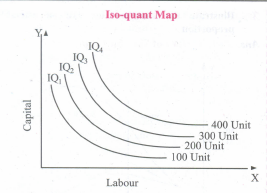
(iv) Higher the Iso quant denotes higher level of output and lower the Iso quant denotes lower level of output.
36.
37.
Wind energy: Muppandal wind farm supplies the villagers with electricity for work. Wind farms are found in Nagercoil, Tuticorin, Coimbatore, Pollachi, Dharapuram & Udumalaipettai. They generate about half of India's 2000 megawatts of wind energy.
Nuclear energy: The Kalpakkam Nuclear Power Plant and the Koodankulam Nuclear Power Plant are the major nuclear energy plants for the energy grid.
Thermal energy: The thermal power plants are at Athippattu (North Chennai), Ennore, Mettur, Neyveli & Thoothukudi.
Hydel energy: There are 20 hydroelectric units in Tamil Nadu at Hundah, Mettur, Periyar, Maravakandy, Parson Valley.
Solar energy: Tamil Nadu tops in solar power generation. Wind energy: Tamil Nadu has the highest installed wind energy capacity in India. The state has very high quality of offshore wind energy potential off the Tirunelveli coast & southern Thoothukudi & Rameswaram Coast.
38.
| SI.No | Rent | Quasi Rent |
|---|---|---|
| 1 | Rent accrues to land | Quasi - Rent accrues to man made appliances |
| 2 | The supply of land is fixed forever. | The supply of man made appliances is fixed for a short period only. |
| 3 | It enters into price. | It does not enter into price. |
| 4 | It is temporary. |
39.
| S.No | Explicit cost | Implicit cost |
| 1 | Payment made to others for buying factors of production. | Payment made for the use of firm's own resource. |
| 2 | Actual expenditure of the firm in buying or hiring the inputs. | Cost of firm's self owned, self employed resources. |
| 3 | (eg) wages, rent, advertisement, depreciation. | Costs are not recorded as no cash payment takes place. |
| 4 | Also called accounting cost, out of pocket cost money cost. | Value of the own services are imputed and considered for preparing profit loss accounts. Also called imputed cost. |
40.
Poverty and inequality:
Amartya Sen studied about poverty and inequality, distribution of income among the people below the poverty line.
The concept of capability:
(i) Capability is the ability to transform Rawlsian primary goods to the achievement of well-being
(ii) This was a better index of well-being than commodities.
Entitlement:
(i) Sen included the concept of entitlement items like nutrition, food, medical and health care, employment, scarcity of food supply in times of famine.
(ii) All this is included in Amartya Sen's Welfare Economics.
41.
(i) Crop Insurance: Agriculture in India is highly prone to risks like droughts and floods. It is necessary to protect the farmers from natural calamities and ensure their credit eligibility for the next season. For this purpose, the Government of India introduced many agricultural schemes throughout the country. The Pradhan Mantri Fasal Bima Yojana (Prime Minister's Crop Insurance Scheme) was launched on 18 February 2016. It envisages a uniform premium of only 2 percent to be paid by farmers for Kharif cmps and 1.5 percent for Rabi crops. The premium for (annual) commercial and horticultural crops will be 5 percent.
(ii) Cold Storage: India is the largest producer of fruits and second largest producer of vegetables in the world. In spite of that per capita availability of fruits and vegetables is quite low because of post harvest losses which account for about 25% to 30% of production. Besides, quality of a sizable quantity of produce also deteriorates by the time it reaches the consumer. Most of the problems relating to the marketing of fruits and vegetables can be traced to their perishability. Perishability is responsible for high marketing costs, market gluts, price fluctuations and other similar problems. In order to overcome this constraint, the Government of India and the Ministry of Agriculture promulgated an order known as, i Cold Storage Order, 1964" under Section 3 of the Essential Commodities Act, 1955. However, the cold storage facility is still very poor and highly inadequate. Post Harvest measures: The annual value of harvest and post-harvest losses of major agricultural produce at national level was of the order of Rs.92,651 crores, calculated using production data of 2012-13 at 2014 and wholesale prices, estimated by the Indian Council of Agricultural Research (ICAR).
42.
Salient features of Indian economy:
(1) India has a mixed economy:
Indian economy is a typical example of mixed economy. This means both private and public sectors co-exist and function smoothly. On one side, some of the fundamental and heavy industrial units are being operated under the public sector, while, due to the liberalization of the economy, the private sector has gained importance. This makes it a perfect model for public-private partnership.
(2) Agriculture plays the key role:
Agriculture being the maximum pursued occupation in India, it plays an important role in its economy as well. Around 60% of the people in India depend upon agriculture for their livelihood. In fact, about 17% of our GDP today is contributed by the agricultural sector. Green revolution, ever green revolution and inventions in bio technology have made agriculture self sufficient and also surplus production. The export of agricultural products such as fruits, vegetables, spices, vegetable oils, tobacco, animal skin, etc. also add to forex earning through international trading.
(3) An emerging market:
India has emerged as vibrant economy sustaining stable GDP growth rate. even in the midst of global downtrend. This has attracted significant foreign capital through FDI and Fll. India has a high potential for prospective growth. This also makes it an emerging market for the world.
(4) Emerging Economy:
Emerging as a top economic giant among the world economy, India bags the seventh position in terms of nominal Gross Domestic Product (GDP) and third in terms of Purchasing Power Parity (PPP). As a result of rapid economic growth Indian economy has a place among the G20 countries.
(5) Fast Growing Economy:
India's economy is well known for high and sustained growth. It has emerged as the world's fastest growing economy in the year 2016-17 with the growth rate of 7.1% in GDP next to People's Republic of China.
(6) Fast growing Service Sector:
The service sector, contributes a lion's share of the GDP in India. There has been a high rise growth in the technical sectors like Information Technology, BPO etc. These sectors have contributed to the growth of the economy. These emerging service sectors have helped the country go global and helped in spreading its branches around the world.
(7) Large Domestic consumption:
With the faster growth rate in the economy the standard of living has improved a lot. This in turn has resulted in rapid increase in domestic consumption in the country. The standard of living has considerably improved and lifestyle has changed.
(8) Rapid growth of Urban area:
Urbanization is a key ingredient of the growth of any economy. There has been a rapid growth of urban areas in India after independence. Improved connectivity in transport and communication, education and health have speeded up the pace of urbanization.
(9) Stable macro economy:
The Indian economy has been projected and considered as one of the most stable economies of the world. The current year's Economic survey represents the Indian economy to be a "heaven of macroeconomic stability, resilience and optimism. According to the Economic Survey for the year 2014-15, 8%-plus GDP growth rate has been predicted, with actual growth turning out to be a little less (7.6%). This is a clear indication of a stable macroeconomic growth.
(10) Demographic dividend:
The human capital of India is young. This means that India is a pride owner of the maximum percentage of youth. The young population is not only motivated but skilled and trained enough to maximize the growth. Thus human capital plays a key role in maximizing the growth prospects in the country. Also, this has invited foreign investments to the country and outsourcing opportunities too.
43.
Introduction:
Uncertainty theory was propounded by the American Economist Frant H. Knight. To him, profit is the reward for "uncertainty bearing". He distinguishes between "Insurable" and "Noninsurable" risks.
Insurable Risks:
Certain risks are measurable (or) calculable. Some of the examples of these risks are the;
i) The risk of fire.
ii) Theft and
iii) Natural disasters.
Hence they are insurable. Such risks are compensated by the Insurance companies.
Non-Insurable Risks:
There are some risks which are immeasurable (or) incalculable. The probability of their occurrence cannot be anticipated because of the presence of uncertainty in them. Some of the examples of these risks are;
i) Competition.
ii) Market condition.
iii) Technology change and
iv) Public policy.
No insurance company can undertake these risks. Hence they are non-insurable.
According to Knight, profit does not arise on account of risk taking, because the entrepreneur can guard himself against a risk by taking a suitable insurance policy.
When an entrepreneur takes himself the burden of facing an uncertain event, he secure remuneration. That remuneration is "profit".
44.
Relationship among TR, AR, MR Curves:
When marginal revenue is positive, total revenue rises, when MR is zero, the total revenue becomes maximum. When marginal revenue becomes negative, total revenue starts falling. When AR and MR both are falling, then MR falls at a faster rate than AR.
TR, AR, MR and Elasticity of Demand:
The relationship among AR, MR and elasticity of demand (e) is stated as follows.
MR = AR (e-i/e)
The relationship between the AR curve and MR curve depends upon the elasticity of AR curve (AR = DD = Price).
a) When price elasticity of demand is greater than one, MR is positive and TR is increasing.
b) When price elasticity of demand is less than one, MR is negative and TR is decreasing.
c) When price elasticity of demand is equal to one, MR is equal to zero and TR is maximum and constant.
It is to be noted that, the output range of 1 to 5 units, the price elasticity of demand is greater than one according to total out by method. Hence TR is increasing and MR is positive.
TR, AR, MR & Elasticity
| Quantity (Q) |
Price (P) |
TR | AR | MR | Elasticity |
| 0 | 11 | 0 | 11 | - | e > 1 |
| 1 | 10 | 10 | 10 | 10 | |
| 2 | 9 | 18 | 9 | 8 | |
| 3 | 8 | 24 | 8 | 6 | |
| 4 | 7 | 28 | 7 | 4 | |
| 5 | 6 | 30 | 6 | 2 | |
| 6 | 5 | 30 | 5 | 0 | e = 1 |
| 7 | 4 | 28 | 4 | -2 | e > 1 |
| 8 | 3 | 24 | 3 | -4 | |
| 9 | 2 | 18 | 2 | -6 | |
| 10 | 1 | 10 | 1 | -8 | |
| 11 | 0 | 0 | 0 | -10 |
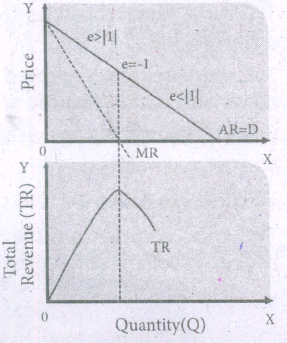
At the output range of 5 to 6 units, the price elasticity of demand is equal to one. Hence TR is maximum and MR equals to zero.
At the output range of 6 units to 10 units, the price elasticity of demand is less than unity. Hence TR is decreasing and MR is negative.
45.
a) The British rule stunted the growth of Indian enterprise.
b) The economic policies of British checked and retarded capital formation in India.
c) the drain of wealth financed capital development in Britain.
d) Indian agricultural sector became stagnant and deteriorated even when a large section of Indian population was depend on agriculture for subsistence.
e) The British rule in India led the collapse of handicraft industries.
f) Some efforts by the colonial British regime in developing the plantations, mines, jute mills banking and shipping mainly promoted a system of capitalist firms that were managed by foreigners. These profit motives led to further drain of resources from India.
46.
Microsoft Power Point:
(i) It is a software used to perform computer based presentation.
Steps involved in making presentation:
(i) Click start menu
(ii) Click program
(iii) Select Microsoft power point - click
(iv) New power point file will open and then type the title and subtitle if wanted.
(v) A new slide can be inserted by 'click' on icon 'new slide'.
(vi) We can type the content, insert the table, picture, movies, sounds etc. with the content.
(vii) Tab 'Design' helps to design the slides.
(viii) Click icon slide show, one can run slide show either starting from the first slide (or) starting from the current slide.
(ix) The PowerPoint presentation (PPP) facilitates the key point to be kept in memory and understand the particular topic.
(x) Recently, the smart class room teaching use the PPP to deliver the information in an effective way to enhance the quality of teaching
47.
.JPG)
.JPG)
48.
Introduction:
(i) Scale of production refers to the ratio of factors of production.
(ii) Every producer wants to reduce the cost of production.
(iii) When there is large scale production he enjoy lot of advantages.
(iv) These advantages are called economies of scale.
(v) Marshall divided them into internal economies and external economies.
Internal Economies:
They refer to advantages enjoyed by a firm.
Technical Economies:
When there is large scale production, there is more capital, new technology, research and development.
Financial Economies:
Big firms can float shares in the market for capital expansion.
Managerial Economies:
(i) Specialisation of labour is followed.
(ii) There is delegation of work.
Labour Economies:
(i) There is division of labour.
(ii) Quality and productivity increases.
Marketing Economies:
(i) Producers can buy raw materials at cheaper cost.
(ii) Transport cost is less.
(iii) They enjoy bargaining power.
Economies of survival:
(i) Product diversification is possible.
(ii) This reduces the risk in production.
(iii) Even if the market for one product falls, the market for other commodities offsets it.
External Economies:
(i) They refer to changes in any factor outside the firm causing an improvement in the production process.
(ii) These advantages are enjoyed by all the firms in the industry due to the structural growth.
Example:
1. Increased transport facilities.
2. Banking facilities.
3. Development of townships.
4. Development of information and communication.
49.
Tamil Nadu has a well established transportation system that connects all parts of the state. Tamil Nadu has an extensive road network in terms of its spread and quality, providing links between urban centres, agricultural market places & rural habitations in the countryside.
Roadways:
There are 28 national highways. The state has a total road length of 167,000 km of which 60,628 km are maintained by Highways Department. It ranks 2nd in India with 20% in total road projects under public-private partnership model.
Railways:
(i) Tamil Nadu has a well-developed rail network under Southern Railway (HQ at Chennai).
(ii) The Southern Railway covers Tamil Nadu, Kerala, Puducherry, parts of Karnataka and Andhra Pradesh.
(iii) The total railway track length is 6,693 km.
(iv) There are 690 railway stations. It is connected to most major cities.
(v) The main rail junctions are Chennai, Coimbatore, Erode, Madurai, Salem, Tiruchirapalli, Tirunelveli, Chennai has a well established suburban railway network, a Mass Rapid Transport system and a Metro system the direct underground stretch operational since May 2017.
Airways:
Tamil Nadu has 4 major international airports (Chennai, Coimbatore, Madurai, Trichy). Chennai International airport is the III largest airport in India. Domestic airports are at Tuticorin, Salem and Madurai. Increased industrial activity has given rise to an increase in passenger traffic & freight movement.
Ports:
(i) Chennai, Ennore & Tuticorin have major ports. Nagapattinam has an intermediate port.
(ii) There are 23 minor ports.
(iii) The ports handle 73 million metric tonnes of cargo.
(iv) All the minor ports are managed by the Tamil Nadu Maritime Board.
(v) Chennai port is an artificial harbour & the second principal port in India for handling containers.
(vi) It is currently being upgraded to have a dedicated terminal for cars capable of handling 4,00,000 vehicles.
(vii) Ennore port was recently converted from an intermediate port to a major port.
(viii) It handles all the coal and ore traffic in Tamil Nadu.
50.
Introduction:
(i) In order to promote export and industrial growth SEZ was introduced in many countries.
(ii) India was one of the first in Asia to set up EPZ (Kandla, 1965).
(iii) SEZ covers free trade zones, export processing zones, industrial parks, economic and technology development zones, high-tech zones, science and innovation parks, free ports, enterprise zones.
Major objectives of SEZs
(i) To enhance foreign investment, to attract foreign direct investment and increase GDP.
(ii) To increase shares in global export.
(iii) To generate additional economic activity.
(iv) To create employment opportunities.
(v) To develop infrastructure facilities.
(vi) To exchange technology in the global market.
Characteristics:
(i) Geographically demarcated area with physical security.
(ii) administered by single authority.
(iii) Streamlined procedures.
(iv) Having separate customs area.
(v) Governed by more liberal economic laws.
(vi) Greater freedom to firms located in SEZs.
(vii) They need not respect the government's rules and regulations.
(viii) The social and environmental impacts were disastrous.
51.
| Wealth | Welfare | Scarcity | Growth |
| Adam Smith classical era. |
Alfred Marshall- neo classical era. |
Lionel Robbins new age. |
Paul Samuelson modern age. |
| An Inquiry into nature and causes of Wealth of Nations (1776). |
Principles of |
An Essay on the nature and Significance of Economic Science (1932). |
Economics studies how men and society choose with or without the use of money, to employ scarce productive resources which could have alternative uses, to produce various commodities over time and distribute them for consumption now and in the future among various people and groups of society. |
| Economics is the science of wealth. | Economics is a study of mankind in the ordinary business of life, it examines that part of individual and social action which is most closely connected with the attainment and with the use of material requisites of well being. It studies wealth and man. |
Economics is a science which studies human behaviour as a relationship between ends and scarce means which have alternative uses. |
Economics deals with how the society uses the limited resources for alternative uses. |
| Deals with only the goods which are scarce and have money value |
wealth and welfare of man is important. | Human behaviour regarding choice is important. |
It covers production, distribution and consumption. |
| Deals with consumption, production, exchange, distribution of wealth. |
Only material welfare is considered, differentiates between material and immaterial things. |
Economic problem arises because of scarcity of resources. |
Economics is a social science. |
| By introducing welfare, economics becomes inexact. |
Ethical aspects are not considered so Economics is exact |
||
| Welfare definition makes Economics classificatory. | Economics is a positive science. |
||
| Economics is a science of individual behaviour. |
|||
| Both material and immaterial activities are considered. |
52.
53.
Introduction:
(i) Jawaharlal Nehru one of the chief builders of modern India was the first Prime Minister of Independent India.
(ii) He was a great patriot, thinker and statesman.
Democracy and secularism:
(i) Nehru believed in democracy, free speech, civil liberty, adult franchise, the Rule of law and Parliamentary democracy.
(ii) He favoured secularism.
(iii) Secularism means equal respect for all religions. In our country we have Hinduism, Islam, Christianity, Buddhism, Jainism, Sikhism and so on.
(iv) But there is no domination by religious majority.
Planning:
(i) Nehru introduced planning in our country.
(ii) Planning was linked with industrialisation and self-reliance.
(iii) Nehru contributed to the advancement of science, research, technology and industrial development.
(iv) Many IITs and Research Institutions were established.
Democratic socialism:
(i) Nehru wanted a socialistic pattern of society.
(ii) His socialism is democratic socialism.
Conclusion:
(i) Nehru's views on economics and social problems are found in his innumerable speeches and in the books he wrote.

11th Standard Syllabus & Materials
11th Standard
TN 11th Tamil பீடு பெற நில் - செய்யுள் - காவடிச்சிந்து Important Questions And Answers Study Material - QB365 Set A
NEW11th Standard
TN 11th Tamil பீடு பெற நில் - உரைநடை - மலை இடப்பெயர்கள் : ஓர் ஆய்வு Important Questions And Answers Study Material - QB365 Set A
NEW11th Standard
TN 11th Tamil மாமழை போற்றுதும் - துணைப்பாடம் - யானை டாக்டர் Important Questions And Answers Study Material - QB365 Set A
NEW11th Standard
TN 11th Tamil மாமழை போற்றுதும் - செய்யுள் - ஐங்குறுநூறு Important Questions And Answers Study Material - QB365 Set A



Tamilnadu Stateboard 11th Standard Subjects

Maths

Commerce
Economics

Biology

Business Maths and Statistics

Accountancy

Computer Science

Physics

Chemistry
Maths
Biology
Economics
Physics
Chemistry

History
Business Maths and Statistics

Computer Science
Accountancy

Computer Applications
History
Computer Technology
Commerce
Computer Applications
Computer Technology

Tamil

English

French
Tamilnadu Stateboard Standards
