
 100% FREE ACCESS
11th Standard Syllabus & Materials
11th Standard
TN 11th Tamil இயற்கை வேளாண்மை,சுற்றுச்சூழல் -செய்யுள் - மனோன்மணீயம் Important Questions And Answers Study Material - QB365 Set A
NEW11th Standard
TN 11th Tamil என்னுயிர் என்பேன் -துணைப்பாடம் - இசைத்தமிழர் இருவர் Important Questions And Answers Study Material - QB365 Set A
NEW11th Standard
TN 11th Tamil மொழி கலை -செய்யுள் - ஒவ்வொரு புல்லையும் Important Questions And Answers Study Material - QB365 Set A
NEW11th Standard
TN 11th Tamil பீடு பெற நில் - இலக்கணம் - பகுபத உறுப்புகள் Important Questions And Answers Study Material - QB365 Set A
NEW11th Standard
TN 11th Tamil பீடு பெற நில் - துணைப்பாடம் - வாடிவாசல் Important Questions And Answers Study Material - QB365 Set A
NEW11th Standard
TN 11th Tamil பீடு பெற நில் - செய்யுள் - குறுந்தொகை Important Questions And Answers Study Material - QB365 Set A

Published on: 21/09/2019
Download Tamil Nadu 11th Standard Economics question papers, model tests, one-mark questions, important questions, and public exam papers in PDF format. Free study materials and answer keys for TN State Board students.
Questions + Answers key
Take MCQ Economics Test
1.
The chief exponent of the cardinal utility approach was
J.R. Hicks
R.G.D. Allen
Marshall
Stigler
2.
The power for governance of India was transferred from the East India Company (EIC) to the British crown in
1758
1858
1958
1658
3.
In monopoly, MR curve lies below ____________
TR
MC
AR
AC
4.
5.
_____ have exchange value and their ownership rights can be established and exchanged
Goods
Services
Markets
Revenue
6.
Which factor is called the changing agent of the Society
Labourer
Land
Organizer
Capital
7.
The basic problem studied in Economics is
Unlimited wants
Unlimited means
Scarcity
Strategy to meet all our wants
8.
Money cost is also known as _____ cost.
explicit
implicit
social
real
9.
Which one of the following is a developed nations?
Mexico
Ghana
France
Sri Lanka
10.
Rent is the reward for the use of
Capital
Labour
Land
Organization
11.
Name the basic approaches to consumer behaviour.
12.
What are the objectives of Tenth five year plan?
13.
State the production function.
14.
Who is price-taker?
15.
Distinguish goods from services.
16.
What do you mean by interest?
17.
Define cost function.
18.
Write the short note on natural resources.
19.
What is PQLI?
20.
State the reasons for nationalisation of commercial banks.
21.
State and explain the elasticity of supply.
22.
State the Dynamic Theory of profit.
23.
Distinguish between microeconomics and macroeconomics.
24.
Distinguish between explicit cost and implicit cost.
25.
Explain social infrastructure.
26.
Explain the law of Equi-marginal utility
27.
Explain the strong features of Indian economy.
1.
(c)
Marshall
2.
(b)
1858
3.
(c)
AR
4.
(a)
5.
(a)
Goods
6.
(c)
Organizer
7.
(c)
Scarcity
8.
(a)
explicit
9.
(c)
France
10.
(c)
Land
11.
(i) Cardinal approach of Marshall- utility is measured by cardinal numbers such as 1,2,3
(ii) Ordinal approach of Hicks and Allen- utility can be compared or ranked or ordered such as I,II,III.
12.
(i) The plan aimed to double the per capita income of India in the next 10 years.
(ii) It aimed to reduce the poverty ratio to 15 % by 2012.
(iii) Its growth target was 8.0 % but it
achieved only 7.2%.
13.
(i) Production function refers to the relationship among units of the factors of production (inputs) and the resultant quantity of a good produced (output).
(ii) Q = f(N, L, K, T);
Q = Quantity of output, N = Land, L = Labour, K = Capital, T = Technology
14.
A person who has no power to fix the price of the product is a price taker. A seller in perfect competition is a price taker.
15.
(i) Goods are tangible, (eg) car but services are intangible (eg) goodwill.
(ii) Goods can be stored but services cannot be stored.
16.
(i) Interest is a payment made by a borrower to the lender for the money borrowed.
(ii) It is the price paid for the use of capital.
17.
C = F(Q) the functional relationship between cost and output is cost function. When output increases, Cost increases.
18.
(i) Any stock or reserve that can be drawn from nature is a Natural Resource.
(ii) The major natural resources are land, forest, water.
19.
(i) Morris D Morris developed the Physical Quality of Life Index (PQLI).
(ii) It is a measure to calculate the quality of life
(iii) He included life expectancy, infant mortality rate and literacy rate. A scale of each indicator ranges from 1 to 100.
(iv) Number 1 represents worst performance of any country.
(v) 100 is the best performance. Eg. in case of life expectancy, the upper limit is 100.
(vi) This was assigned to 77 years which was achieved by Sweden in 1973.
(vii) The lower limit 1 was assigned to 28 years achieved by Guinea-Bissau in 1960.
(viii) The difference between HDI and PQLI is the inclusion of income.
(ix) In HDI income is included and it represents both physical and financial aspects of development.
(x) In PQLI income is excluded and only physical aspects of life are considered.
20.
(i) After Independence, the government adopted planned economic development.
(ii) The main objective of planning was social welfare.
(iii) Before Independence commercial banks were in the private sector.
(iv) These banks did not help the government to achieve the social objectives of planning.
(v) So the government nationalised 14 major commercial banks on 19th July 1969 and 6 more banks in 1980.
21.
(i) Elasticity of supply is the degree of responsiveness of change in supply to change in price on the part of sellers.
(ii) There are 5 types of elasticity of supply:
1. Relatively elastic supply
2. Relatively inelastic supply
3. Unitary elastic supply
4. Perfectly elastic supply
5. Perfectly inelastic supply
(iii) The factors governing elasticity of supply are the nature of the commodity, cost of production, technical condition & time factor.
22.
(i) According to Clark profit is the difference between price and cost of production.
(ii) Profit is the reward for dynamic changes in society-like increase in population, increase in volume of capital, improvement in methods of production, change in forms of industrial organisation and increase in wants of consumers.
23.
| S.No | Micro Economics | Macro Economics |
| 1 | Micro Economics is that branch of economics which deals with the economic decision-making of individual economic agents such as the producer, the consumer etc. | Macro Economics is that branch of economics which deals with aggregates and averages of the entire economy. E.g., aggregate output, national income, aggregate savings and investment, etc. |
| 2 | It takes into account small components of the whole economy. | It takes into consideration the economy of the country as a whole. |
| 3 | It deals with the process of price determination in case of individual products and factors of production. | It deals with general price-level in any economy |
| 4 | It is known as price theory | It is also known as the income theory. |
| 5 | It is concerned with the optimization goals of individual consumers and producers | It is concerned with the optimization of the growth process of the entire economy. |
24.
| S.No | Explicit cost | Implicit cost |
| 1 | Payment made to others for buying factors of production. | Payment made for the use of firm's own resource. |
| 2 | Actual expenditure of the firm in buying or hiring the inputs. | Cost of firm's self owned, self employed resources. |
| 3 | (eg) wages, rent, advertisement, depreciation. | Costs are not recorded as no cash payment takes place. |
| 4 | Also called accounting cost, out of pocket cost money cost. | Value of the own services are imputed and considered for preparing profit loss accounts. Also called imputed cost. |
25.
Social infrastructure refers to those structures which improve the quality of manpower and contribute indirectly towards the growth of an economy.
Education:
(i) Education is in Concurrent List.
(ii) The Ministry of Human Resource Development decides the education budget and education policy.
(iii) India follows a six-level system - nursery, primary, secondary, higher secondary, graduation and post-graduation.
(iv) We have the 10 +2 pattern.
(v) The education department consists of schools, colleges and universities imparting education to all.
(vi) Though the budget share of education is 3% of GDP yet the per pupil expenditure for school students is the lowest.
Health:
(i) Health is a state-government responsibility.
(ii) The Central Council of Health and Welfare formulates various health care projects.
(iii) India has the ayurvedic medicine, unani, homeopathy, allopathy and yoga.
(iv) Medical practicing needs a licensing from the Ministry of Health. All medical systems now are under one ministry viz AYUSH.
(v) Health status is better in Kerala but generally India's health status is not satisfactory
26.
Introduction:
(i) The law of diminishing marginal utility was extended and is called Law of Equi-marginal utility
(ii) Law of substitution or Law of consumer's Equilibrium or Gossen's II law or law of maximum satisfaction.
Definition:
Marshall, "If a person has a thing which he can put to several uses, he will distribute it among these uses in such a way that it has the same marginal utility in all. For, if it had a greater marginal utility in one use than another, he would gain by taking away some of it from the second use and applying it to first.
Assumption
(i) Consumer is rational and wants maximum satisfaction.
(ii) Utility is measurable in cardinal numbers.
(iii) Marginal utility of money is constant.
(iv) Income of the consumer is given.
(v) There is perfect competition.
(vi) Price is given.
(vii) Law of diminishing marginal utility operates
Explanation:
(i) The consumer has Rs. 11.
(ii) He wants to spend it on apple ( Rs 1 each) and orange (Rs. 1 each)
(iii) He will be in equilibrium only when he gets maximum satisfaction ie.
\(\mathrm{K}=\frac{\text { Marginal utility of apple }}{\text { Price of apple }}=\frac{\text { Marginal utility of orange }}{\text { Price of orange }}\)
If is \(\frac{\mathrm{MU_A}}{\mathrm{P_A}}\) less than \(\frac{\mathrm{MU_O}}{\mathrm{P_O}}\) he would transfer money from apple to orange till it is equal.
He should buy 6 units of apple & 5 units of oranges. He gets (92 + 58) = 150 units satisfaction.
\(\frac{\mathrm{MU_A}}{\mathrm{P_A}}=\frac{\mathrm{MU_O}}{\mathrm{P_O}}=\frac{4}{1}=\frac{4}{1}\)
| Apple | orange | |||
| Units of Commodities | Total Utility | marginal Utility | Total Utility | marginal Utility |
| 1 | 25 | 25 | 30 | 30 |
| 2 | 45 | 20 | 41 | 11 |
| 3 | 63 | 18 | 49 | 8 |
| 4 | 78 | 15 | 54 | 5 |
| 5 | 88 | 10 | 58 | 4 |
| 6 | 92 | 4 | 61 | 3 |
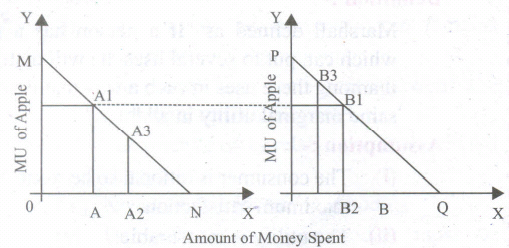
Explanation:
(i) X axis shows amount of money spent
(ii) Y axis shows marginal utility of apple and orange.
(iii) If consumer spends Rs.6 on apple and Rs.5 on orange MU will be equal.
(iv) ie. AA1 = BB1 = 4 = 4. So he gets maximum utility.
Criticisms:
(i) Utility cannot be measured.
(ii) No consumer compares the utility and disutility from each unit of the commodity while buying it.
(iii) This law cannot be applied to durable goods.
Conclusion:
(i) The law of Equi-marginal utility is an improvement over the law of diminishing marginal utility because it can be used for many commodities consumed at the same time.
27.
Introduction:
Indian economy is the seventh largest economy of the world. Its features are:
Mixed economy:
(i) In India private and public sectors co-exist.
(ii) Some fundamental and heavy industries are under public sector.
(iii) Due to liberalization private sector's importance has increased.
Agriculture:
(i) 60 % of Indians depend on agriculture for their livelihood.
(ii) 17 % of GDP is got from agricultural sector.
(iii) Green revolution and inventions in biotechnology have made agriculture self sufficient.
(iv) The export of fruits, vegetables, spices, tobacco, animal skin, vegetable oils also add to foreign exchange earning.
An emerging market:
(i) India has emerged as a vibrant economy sustaining stable GDP growth rate even when there was global downtrend.
(ii) This has attracted foreign capital through FDI and FII.
(iii) India is in the 7th position in terms of nominal GDP and 3rd in terms of purchasing power parity.
(iv) India is one among the G20 countries.
Fast growing economy:
(i) With a growth rate of 7.1% in GDP India is the world's fastest growing economy in 2016-17 next to China.
Fast growing service sector:
(i) There has been growth in technical sectors like Information Technology, BPO.
(ii) These emerging services have helped the country to go global.
Large domestic consumption:
(i) The standard of living has improved a lot. There is rapid increase in domestic consumption.
Rapid growth of urban areas:
(i) There has been a rapid growth of urban areas in India after Independence. Improved connectivity in transport and communication, education and health have speeded up urbanization.
Stable macroeconomy:
(i) India is one of the most stable economies of the world.
(ii) The current year's economic survey represents the Indian economy to be a "heaven of macroeconomic stability, resilience and optimism".
Demographic dividend:
(i) The human capital is young.
(ii) They are young, skilled and trained enough to maximize growth.
(iii) This has invited foreign investments and outsourcing opportunities.

11th Standard Syllabus & Materials
11th Standard
TN 11th Tamil பீடு பெற நில் - செய்யுள் - காவடிச்சிந்து Important Questions And Answers Study Material - QB365 Set A
NEW11th Standard
TN 11th Tamil பீடு பெற நில் - உரைநடை - மலை இடப்பெயர்கள் : ஓர் ஆய்வு Important Questions And Answers Study Material - QB365 Set A
NEW11th Standard
TN 11th Tamil மாமழை போற்றுதும் - துணைப்பாடம் - யானை டாக்டர் Important Questions And Answers Study Material - QB365 Set A
NEW11th Standard
TN 11th Tamil மாமழை போற்றுதும் - செய்யுள் - ஐங்குறுநூறு Important Questions And Answers Study Material - QB365 Set A



Tamilnadu Stateboard 11th Standard Subjects

Maths

Commerce
Economics

Biology

Business Maths and Statistics

Accountancy

Computer Science

Physics

Chemistry
Maths
Biology
Economics
Physics
Chemistry

History
Business Maths and Statistics

Computer Science
Accountancy

Computer Applications
History
Computer Technology
Commerce
Computer Applications
Computer Technology

Tamil

English

French
Tamilnadu Stateboard Standards
