
 100% FREE ACCESS
11th Standard Syllabus & Materials
11th Standard
TN 11th Tamil இயற்கை வேளாண்மை,சுற்றுச்சூழல் -செய்யுள் - மனோன்மணீயம் Important Questions And Answers Study Material - QB365 Set A
NEW11th Standard
TN 11th Tamil என்னுயிர் என்பேன் -துணைப்பாடம் - இசைத்தமிழர் இருவர் Important Questions And Answers Study Material - QB365 Set A
NEW11th Standard
TN 11th Tamil மொழி கலை -செய்யுள் - ஒவ்வொரு புல்லையும் Important Questions And Answers Study Material - QB365 Set A
NEW11th Standard
TN 11th Tamil பீடு பெற நில் - இலக்கணம் - பகுபத உறுப்புகள் Important Questions And Answers Study Material - QB365 Set A
NEW11th Standard
TN 11th Tamil பீடு பெற நில் - துணைப்பாடம் - வாடிவாசல் Important Questions And Answers Study Material - QB365 Set A
NEW11th Standard
TN 11th Tamil பீடு பெற நில் - செய்யுள் - குறுந்தொகை Important Questions And Answers Study Material - QB365 Set A

Published on: 18/07/2019
Download Tamil Nadu 11th Standard Economics question papers, model tests, one-mark questions, important questions, and public exam papers in PDF format. Free study materials and answer keys for TN State Board students.
Questions + Answers key
Take MCQ Economics Test
1.
"Economics as the science of wealth" - It is the statement of
Adam Smith
Lionel Robbins
Alfred Marshall
Samuelson
2.
The term or word 'Economics' comes from language
Latin
Ancient Greek
Spanish
British
3.
Microeconomics is concerned with
The economy as a whole
Different sectors of an economy
The study of individual economic units' behaviour
The interactions within the entire economy
4.
The basic problem studied in Economics is
Unlimited wants
Unlimited means
Scarcity
Strategy to meet all our wants
5.
'Economics is a study of mankind in the ordinary business of life' - It is the statement of
Adam Smith
Lionel Robbins
Alfred Marshall
Samuelson
6.
What are the major features of Robbins definitions?
7.
Who criticized Adam Smith's Wealth definition?
8.
State four definitions of economics.
9.
Name any two types of utility.
10.
Distinguish goods from services.
11.
12.
Distinguish between particular equilibrium and general equilibrium.
13.
Examine the major implications of samuelson growth definition
14.
What are the important features of Marshall's Welfare definition?
15.
Compare positive economics and normative economics.
16.
Distinguish between microeconomics and macroeconomics.
17.
18.
Examine Adam Smith's Definition of Economics.
19.
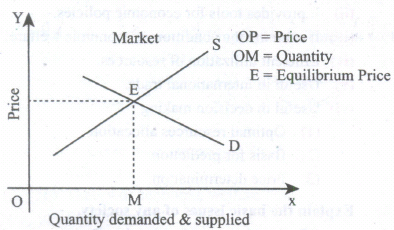
Explain the stable equilibrium with the help of diagram.
20.
Explain basic problems of the economy with the help of production possibility curve.
1.
(a)
Adam Smith
2.
(b)
Ancient Greek
3.
(c)
The study of individual economic units' behaviour
4.
(c)
Scarcity
5.
(c)
Alfred Marshall
6.
(i) Ends refer to wants, Human beings have unlimited wants.
(ii) Means are limited.
(iii) The scarce means time and money are utilized in alternative uses.
7.
(i) Ruskin and Carlyle criticized economics as a 'Dismal science', 'Pig science' etc.
(ii) As it teaches selfishness which is against ethics.
8.
(i) Smith's Wealth Definition, representing the classical stage.
(ii) Marshall's Welfare Definition, representing the neoclassical stage.
(iii) Robbin's Scarcity Definition, representing the New age, and
(iv) Samuelson's Growth Definition, representing the Modern age
9.
(i) Form utility
(ii) Time utility
(iii) Place utility
(iv) Service utility
(v) Possession utility
(vi) Knowledge utility
10.
(i) Goods are tangible, (eg) car but services are intangible (eg) goodwill.
(ii) Goods can be stored but services cannot be stored.
11.
12.
Particular Equilibrium:
An equilibrium pertains to a single variable may be called particular equilibrium.
General Equilibrium:
An equilibrium relates to numerous variables or even the economy as a whole is called general equilibrium.
13.
(i) Samuelson states that the means are scarce so such means could be put to alternative uses.
(ii) He makes his definition dynamic by including the element of time.
(iii) His definition is applicable only in a barter economy, where money is not used.
(iv) Samuelson treats economics as a social science, whereas Robbins regards science of individual behaviour.
14.
(i) Man promotes primarily welfare and not wealth.
(ii) The science of economics contains the concerns of ordinary people who are directed by the desire to get maximum monetary benefit.
(iii) Economics is a social science. It studies about people in the society who influence one another.
15.
| S.No | Positive Economics | Normative Economics |
| 1 | Deals with what is, how and why | deals with what ought to be |
| 2 | Analyses a problem on the basis of facts and examines its causes. | results are not based on facts but on social, cultural, political and religious considerations. |
| 3 | it is subjective | |
| 4 | (eg) if rate of interest increases we see why & how it can be reduced. | (eg) if rate of interest increases, we see whether it is good or bad |
16.
| S.No | Micro Economics | Macro Economics |
| 1 | Micro Economics is that branch of economics which deals with the economic decision-making of individual economic agents such as the producer, the consumer etc. | Macro Economics is that branch of economics which deals with aggregates and averages of the entire economy. E.g., aggregate output, national income, aggregate savings and investment, etc. |
| 2 | It takes into account small components of the whole economy. | It takes into consideration the economy of the country as a whole. |
| 3 | It deals with the process of price determination in case of individual products and factors of production. | It deals with general price-level in any economy |
| 4 | It is known as price theory | It is also known as the income theory. |
| 5 | It is concerned with the optimization goals of individual consumers and producers | It is concerned with the optimization of the growth process of the entire economy. |
17.
18.
(i) Adam Smith (1723 - 1790) in his book "An Inquiry into Nature and Causes of Wealth of Nations" (1776) defines "Economics as the science of Wealth"
(ii) He explains how a nation's wealth is created and increased.
(iii) He considers that the individual in the society wants to promote his own gain and led by an "invisible hand".
(iv) He states that every man is motivated by his self-interest
(v) Severe competition in factories and the society help in bettering the product
Criticism:
(i) Economics consists of wealth-getting activities and wealth-spending activities.
(ii) He ignores human welfare as an essential part of economics.
(iii) Smith gives his definition when religious and spiritual values are held high.
(iv) Ruskin and Carlyle criticized economics as a 'dismal science'. 'pig science' etc
19.
(i) Prof. Stigler states that "equilibrium is a position from which there is no net tendency to move".
(ii) It's referred to as disequilibrium.
(iii) Consumer's equilibrium occurs when he gets maximum satisfaction.
(iv) The equilibrium of the producer occurs when he gets maximum profit.
(v) Thus static equilibrium is based on given and constant prices, quantities, income, technology, population etc.
(vi) Equilibrium = Demand equal to supply
(vii) Equilibrium means state of rest or balance
20.
The Problem of Choice:
(i) The problem of choice arises because of limited resources and unlimited wants, may relate to the allocation of resources between the goods for higher income group and the lower income group and the goods for defense and the civilians.
(ii) Since PPC is the locus of the combination of the goods the problem of choice will not arises when we choose any point on PPC.
The notion of scarcity:
(i) Every economy has scarce resources which can produce only limited amount of output even with the help of best technology.
(ii) PPC reflects the constraints imposed by the element of economic scarcity.
The solution of central problems:
(i) The solution of problem of what to produce involves the decision regarding the choice of location on the PPC.
(ii) Any point inside PPC indicates that the economy is using inefficient methods of production and inefficient combination of resources.
Conclusion:
(i) Thus the basic problems of the economy are solved with the help of PPC.

11th Standard Syllabus & Materials
11th Standard
TN 11th Tamil பீடு பெற நில் - செய்யுள் - காவடிச்சிந்து Important Questions And Answers Study Material - QB365 Set A
NEW11th Standard
TN 11th Tamil பீடு பெற நில் - உரைநடை - மலை இடப்பெயர்கள் : ஓர் ஆய்வு Important Questions And Answers Study Material - QB365 Set A
NEW11th Standard
TN 11th Tamil மாமழை போற்றுதும் - துணைப்பாடம் - யானை டாக்டர் Important Questions And Answers Study Material - QB365 Set A
NEW11th Standard
TN 11th Tamil மாமழை போற்றுதும் - செய்யுள் - ஐங்குறுநூறு Important Questions And Answers Study Material - QB365 Set A



Tamilnadu Stateboard 11th Standard Subjects

Maths

Commerce
Economics

Biology

Business Maths and Statistics

Accountancy

Computer Science

Physics

Chemistry
Maths
Biology
Economics
Physics
Chemistry

History
Business Maths and Statistics

Computer Science
Accountancy

Computer Applications
History
Computer Technology
Commerce
Computer Applications
Computer Technology

Tamil

English

French
Tamilnadu Stateboard Standards
