
 100% FREE ACCESS
11th Standard Syllabus & Materials
11th Standard
TN 11th Tamil இயற்கை வேளாண்மை,சுற்றுச்சூழல் -செய்யுள் - மனோன்மணீயம் Important Questions And Answers Study Material - QB365 Set A
NEW11th Standard
TN 11th Tamil என்னுயிர் என்பேன் -துணைப்பாடம் - இசைத்தமிழர் இருவர் Important Questions And Answers Study Material - QB365 Set A
NEW11th Standard
TN 11th Tamil மொழி கலை -செய்யுள் - ஒவ்வொரு புல்லையும் Important Questions And Answers Study Material - QB365 Set A
NEW11th Standard
TN 11th Tamil பீடு பெற நில் - இலக்கணம் - பகுபத உறுப்புகள் Important Questions And Answers Study Material - QB365 Set A
NEW11th Standard
TN 11th Tamil பீடு பெற நில் - துணைப்பாடம் - வாடிவாசல் Important Questions And Answers Study Material - QB365 Set A
NEW11th Standard
TN 11th Tamil பீடு பெற நில் - செய்யுள் - குறுந்தொகை Important Questions And Answers Study Material - QB365 Set A

Published on: 28/12/2018
11th Half Yearly Model Question
Download Tamil Nadu 11th Standard Economics question papers, model tests, one-mark questions, important questions, and public exam papers in PDF format. Free study materials and answer keys for TN State Board students.
Questions + Answers key
Take MCQ Economics Test
1.
Export subsidies are provided to Indian exporters_________.
directly
indirectly
continuously
conditionally
2.
In the long-run, the quantity of factors of production_________.
remains constant
changes
is zero
is infinity
3.
A place where buyers and sellers meet and bargain over a commodity for a price is called __________
Den
shop
market
exchange
4.
The Five Year Plan, based on the Harrod-Domar model was the__________
First Five Year Plan
Second Five Year Plan
Third Five Year Plan
Fourth Five Year Plan
5.
The Law of Equi-Marginal Utility' is also called as _________
Law of demand
Law of supply
Law of substitution
Law of gravitation
6.
Who is the author of the book "An essay on the nature and significance of economic science?
Lionel Robbins
Karal Marx
Adam smith
Alfred Marshall
7.
___________ is the surplus of income over expenses on production.
Interest
Wages
Profit
Rent
8.
Choice is always constrained or limited by the _______ of our resources.
Scarcity
Supply
Demand
Abundance
9.
__________ is the formula for calculating per capita income.
\(\frac { National\ Income }{ Total\ Population } \)
\(\frac { Total\ Population }{ National\ Income } \)
\(\frac { GST }{ Total\ Population } \)
\(\frac { Tax }{ Price }\)
10.
Identify the agriculture related problem of rural economy?
Poor communication
Small size of landholding
Rural poverty
Poor banking network
11.
The Industry which was de-reserved in 1993?
Railways
Mining of copper and zinc
Atomic energy
Atomic minerals
12.
The transfer of ownership from public sector to private sector is known as________
Globalization
Liberalization
Privatization
Nationalization
13.
The first differentiation of Total Revenue function gives
Average Revenue
Profit
Marginal Revenue
Zero
14.
15.
Largest area of land is used in the cultivation of
Paddy
Sugarcane
Groundnut
Coconut
16.
Mention the economies reaped from inside the firm
financial
technical
managerial
all of the above
17.
Marginal revenue is the addition made to the
total sales
total revenue
total production
total cost
18.
The advocate of democratic socialism was
Jawaharlal Nehru
P.C. Mahalanobis
Dr. Rajendra Prasad
Indira Gandhi
19.
Theory of distribution is popularly known as,
Theory of product-pricing
Theory of factor-pricing
Theory of wages
Theory of interest
20.
'Economics is a study of mankind in the ordinary business of life' - It is the statement of
Adam Smith
Lionel Robbins
Alfred Marshall
Samuelson
21.
If Y = 2x3 – 6x, then find \(\frac { dy }{ dx } \)
22.
What does Dumping refer to?
23.
Explain Automotives?
24.
What is meant by division of labour?
25.
What do you mean by Agricultural Produce Market Committee?
26.
What do you mean by economic infrastructure?
27.
What are the Phases of colonial exploitation of India?
28.
State any two causes of housing problem in rural areas.
29.
30.
Give the definition for 'Real cost'.
31.
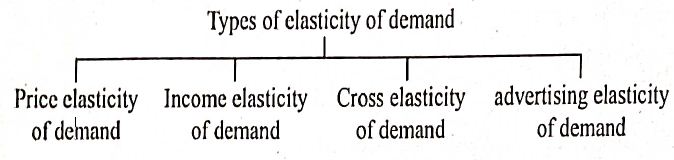
What are the importance of elasticity of demand?
32.
Given TR = 50Q - 4Q2, find marginal revenue when Q = 3.
33.
What are the different types of price discrimination under monopoly?
34.
Explain briefly education system in India.
35.
What is the Kisan Credit Card Scheme?
36.
State the reasons for nationalisation of commercial banks.
37.
Bring out the relationship among Total, Average and Marginal Products.
38.
39.
40.
State the relationship between AC and MC.
41.
What are the weaknesses of Indian Economy?
42.
A manufacturer estimates that, when units of a commodity are produced each month the total costs will be TC(Q) = 128 + 60Q + 8Q2. Find the marginal cost, average cost, fixed cost, variable cost, average fixed cost and average variable cost.
43.
Trace the development of Industry in Tamil Nadu.
44.
Explain the Residual Claimant Theory of Wage.
45.
Explain the uses of production possibility curve.
46.
Solve by Cramer's rule
\(2{ x }_{ 1 }+3{ x }_{ 2 }=7;\)
\(2{ x }_{ 1 }+{ x }_{ 2 }=5\)
47.
Explain the meaning of Fixed and Variable factors and costs.
48.
What are the factors determining supply?
49.
50.
Explain about Agrarian Crisis after reforms.
51.
52.
"The features of Rural Economy are peculiar"- Argue.
53.
54.
Bring out the features of perfect competition.
1.
(b)
indirectly
2.
(b)
changes
3.
(c)
market
4.
(a)
First Five Year Plan
5.
(c)
Law of substitution
6.
(a)
Lionel Robbins
7.
(c)
Profit
8.
(a)
Scarcity
9.
(a)
\(\frac { National\ Income }{ Total\ Population } \)
10.
(b)
Small size of landholding
11.
(b)
Mining of copper and zinc
12.
(c)
Privatization
13.
(c)
Marginal Revenue
14.
(a)
15.
(a)
Paddy
16.
(d)
all of the above
17.
(b)
total revenue
18.
(a)
Jawaharlal Nehru
19.
(b)
Theory of factor-pricing
20.
(c)
Alfred Marshall
21.
Y = 2x3 – 6x
Differentiate ‘y’ with respect to x,
\(\frac { dy }{ dx } =2\left( 3 \right) { x }^{ 3-1 }-6\left( 1 \right) { x }^{ 1-1 }\)
\(=6{ x }^{ 2 }-6{ x }^{ 0 }\)
\(\frac { dy }{ dx } =6{ x }^{ 2 }-6\)
22.
Dumping:
(i) Dumping refers to practice of the monopolist charging higher price for his product in the local market and lower price in the foreign market.
(ii) Through dumping, a country expands its command over other countries for its products.
(iii) This is also called as 'International Price Discrimination'.
(iv) Example: Electronic market in India is flooded with the products of China
23.
"The Detroit of Asia" is home to a large number of auto component industries.
24.
Division of labour means dividing the process of production into distinct and several component processes and assigning each component in the hands of a labour or a set of labourers who are specialists in the particular process the concept of Division of Labour was introduced by Adam Smith.
25.
Under the Agricultural Produce market Committee (APMC) Act 2003, the Agricultural Produce Market Committee (APMC) is a statutory body constituted by state government in order to trade in agriculture or horticulture or livestock products.
26.
Economic infrastructure is the support system which helps in facilitating production and distribution for instance railways, trucks, ports, canals..
27.
(i) Period of merchant capital
(ii) Period of industrial capital
(iii) Period of finance capital.
28.
Rapid adaptation of nuclear families; no proper water supply nor proper disposal of sewage.
29.
30.
It is the payment made for the efforts, pain and sacrifices of all factor owners in production.
31.
(i) Price fixation: Each seller under monopoly and imperfect competition has to take into account elasticity of demand while fixing the price for his product. If the demand for the product is inelastic, he can fix a higher price.
(ii) Production: Producers generally decide their production level on the basis of demand for the product.
(iii) Distribution: Elasticity of demand also helps in the determination of rewards for factors of production.
(iv) International trade: It helps in finding out the terms of trade between two countries. Terms of trade depends upon the elasticity of demand for the goods of the two countries.
(v) Public finance: It helps the government in formulating tax policies, For example, for imposing tax on a commodity.
(vi) Nationalisation: The concept of elasticity of demand enables the government to decide over nationalization of industries.
32.
TR = 50Q - 4Q2
MR = d(TR)/dQ
MR = 50(1)Q1-1 - 4(2)Q2-1
= 50(1)Q0 - 8 Q1
= 50(1) - 8Q (\(\therefore\) Q0 = 1, Q1 = Q)
MR = 50 - 8Q
When Q = 3
MR = 50 - 8(3) = 26
33.
Types of Price Discrimination:
There are three types of price discrimination.
(i) Personal - Different prices· are charged for different individuals (for example, the railways give tickets at concessional rate to the 'senior citizens' for the same journey).
(ii) Geographical - Different prices are charged at different places for the same product (for example, a book sold within India at a price is sold in a foreign country at lower price). On their basis, China drops its goods in Indian market. As a result, watch and toys industries closed down their business.
(iii) On the basis of Use - Different prices are charged according to the use of a product (for example, lower rates are charged by Tamil Nadu Electricity Board for domestic uses of electricity and higher rates are charged for commercial and industrial uses.
34.
Education in India until 1976 was the responsibility of the state governments. It was then brought under concurrent list both (centre and state). The centre is represented by the Minister of Human Resource Development decides the India's education budget.
The education system in India consists of primarily six levels.
i) Nursery class.
ii) Primary class.
iii) Secondary level.
iv) Higher education.
v) Graduation.
vi) Post-Graduation.
Education Institutions in India:
Education in India follows the (10+2) pattern. For higher education, there are various state run as well as private institutions and universities providing a variety of courses and subjects. The accreditation of the universities is decided under the University Grant Commission Act. The education department consists of various school, colleges and universities imparting education on fair means for all section of the society. The budget share of the education sector is around 3% of GDP, of this largest proportion goes for school education.
35.
A Kisan Credit Card (KCC) is a credit delivery mechanism that is aimed at enabling farmers to have quick and timely access to affordable credit.
36.
(i) After Independence, the government adopted planned economic development.
(ii) The main objective of planning was social welfare.
(iii) Before Independence commercial banks were in the private sector.
(iv) These banks did not help the government to achieve the social objectives of planning.
(v) So the government nationalised 14 major commercial banks on 19th July 1969 and 6 more banks in 1980.
37.
Relationship among Total, Average and Marginal Products.
| Stages | Total Product | Marginal Product | Average Product |
| Stage - I | It increases at an increasing rate. Then it increases at a decreasing rate. This is the point of inflexion. | It increases, reaches maximum and starts to decrease. | It increases, reaches maximum. |
| Stage - II | It continues to increase at a diminishing rate and reaches maximum | It continues to diminish and becomes zero. | It is equal to MP then begins to diminish. |
| Stage - III | It diminishes. | It becomes negative. | It diminishes but always greater than zero (positive) |
38.
39.
40.
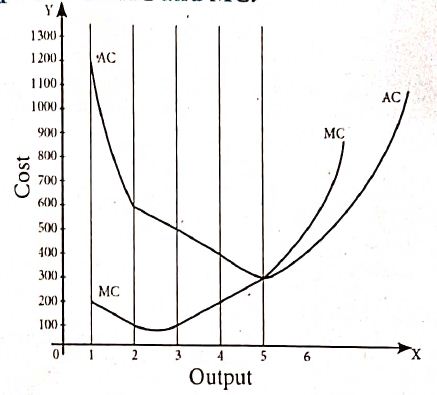
When AC is falling, MC remains below AC.
When AC becomes constant MC becomes equal to it.
When AC starts increasing MC is above the AC
MC always cuts AC at its minimum point from below.
41.
(i) Large Population: India stands second in terms of size of population next to China and our country is likely to overtake china in near future. Population growth rate of India is very high and this is always a hurdle to growth rate. The population growth rate in India is as high as 1.7 per 1000. The annual addition of population equals the total population of Australia.
(ii) Inequality and poverty: There exists a huge economic disparity in the Indian economy. The proportion of income and assets owned by top 10% of Indians goes on increasing. This has led to an increase in the poverty level in the society and still a higher percentage of individuals are living Below Poverty Line (BPL). As a result of unequal distribution of the rich becomes richer and poor becomes poorer.
(iii) Increasing Prices of Essential Goods: Even though there has been a constant growth in the GDP and growth opportunities in the Indian economy, there have been steady increase in the prices of essential goods. The continuous rise in prices erodes the purchasing power and adversely affects the poor people, whose income is not protected.
(iv) Weak Infrastructure: Even though there has been a gradual improvement in the infrastructural development in the past few decades, there is still a scarcity of the basic infrastructure like power, transport, storage etc.
(v) Inadequate Employment generation: With growing youth population, there is a huge need of the employment opportunities.' The growth in production is not accompanied by creation of job the Indian economy is characterized by 'jobless growth'.
(vi) Outdated technology: The level of technology in agriculture and small scale industries is still outdated and obsolete.
42.
Given that TC(Q) = 128 + 60Q + 8Q2
We know TC = Fixed cost + variable cost
MC (Q) =\(\frac { d(TC) }{ dQ } \)
= 0 + 60(1)Q1-1 + 8(2)Q2-1
= 0 + 60Q0 + 16Q1(Since, Q0= 1)
MC = 60 + 16Q
Average Cost =\(\frac { TC }{ dQ } \)
=\(\frac { 128+60Q+8Q^{ 2 } }{ Q } \)
AC = \(\frac { 128 }{ Q } \) + 60 + 8Q
Constant value is known as fixed cost
Fixed cost = 128
FC = 128
Average Fixed cost = \(\frac { 128 }{ Q } \)
AFC = \(\frac { 128 }{ Q } \)
Average Variable cost = 60 + 8Q (total variable cost divided by Q)
∴ AVC = 60 + 8Q
43.
Industry - in Tamil Nadu:
(a) Chennai is sometimes referred to as the Health Capital of India or the Banking Capital of India, having attracted investments from International Finance Corporations and the World Bank. It is also called as Detroit of Asia.
(b) Tamil Nadu has a network of about 110 industrial parks/estates that offer developed' plots with supporting infrastructure. Also, the Government is promoting other industrial parks like Rubber Park, Apparel Park, Floriculture Park, TICEL Park for Biotechnology, Siruseri IT Park and Agro Export Zones.
(c) The heavy engineering manufacturing companies are centred around the suburbs of Chennai. Chennai boasts of global car manufacturing giants as well as homegrown companies.
44.
Residual Claimant Theory of Wage:
(i) This theory was propounded by the American economist F.A.Walkar in 1875, in his book Political Economy.
(ii) According to this theory, wage is the residual portion after paying the remuneration of all the other three factors, namely, land, capital and organization.
(iii) Criticisms
(1) This theory does not explain the role of trade unions can secure higher wage for workers.
(2) Demand side of labour in the determination of wages needs to be considered.
45.
Uses of production possibility curve: The device of PPC can be used for many analytical purposes. We shall discuss below some of its popular uses.
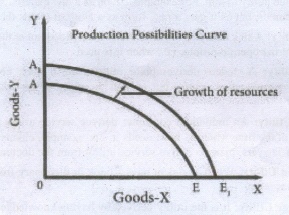
(i) The problem of choice
The problem of choice arise because of the given limited resources and unlimited wants, may relate to the allocation of resources between the goods for the higher income group and the lower income group and the goods for the defence and the civilians. Since PPC is the locus of the combination of the goods the problem of choice will not arises when we choose any point on PPC.
(ii) The Notion of Scarcity:
We can explain the notion of scarcity with the help of PPC. We know that every society possesses only a specific amount of resources, which can produce only limited amount of output even with the help of best technology, Economic scarcity of best fact of life. The production possibility curve reflects the constraints imposed by the element of economic scarcity.
(iii) Solution of central problems:
The central problems of an economy can be explained with the help of PPC. The solution of problem of what to produce involves the decision regarding the choice of location on the production possibility curves. A production combination represented by any point inside the PPC indicates that the economy is using inefficient methods of production and inefficient combination of resources.
46.
The coefficient and the constant terms are given below for the equations
\(\triangle =\left| \begin{matrix} 2 & 3 \\ 2 & 1 \end{matrix} \right| \)
\(\triangle =2-6=-4\)
\(\triangle { x }_{ 1 }=\left| \begin{matrix} 7 & 3 \\ 5 & 1 \end{matrix} \right| \)
\(=7-15=-8\)
\( \triangle { x }_{ 2 }=\left| \begin{matrix} 2 & 7 \\ 2 & 5 \end{matrix} \right| \)
\(=10-14=-4\)
\(By\quad Carmer's\quad rule\)
\( { x }_{ 1 }=\frac { \triangle { x }_{ 1 } }{ \triangle } \)
\(=\frac { -8 }{ -4 } \)
\(=2\)
\({ x }_{ 2 }=\frac { \triangle { x }_{ 2 } }{ \triangle } \)
\(=\frac { -4 }{ -4 } =1\)
\(solution\quad set\)
\(\left( { x }_{ 1 }{ ,x }_{ 2 } \right) =\left\{ 2,1 \right\} \)
47.
Fixed cost and variable cost: Fixed cost and variable cost are helpful in understanding the behaviour of costs over different levels of output.
Meaning of Fixed and Variable factors and costs:
Fixed and variable factors are with reference to short run production function. Short run is a period of time over which certain factors of production cannot be changed, and such factors are called fixed factors. The costs incurred on fixed factors are called fixed costs. The factors whose quantity can be changed in the short run are variable factors, and the costs incurred on variable factors are called variable costs
Fixed costs are those which are independent of output, that is, they do not change with changes in output. These costs are a 'fixed' amount, which must be incurred by a firm in the short run whether the output is small or large. E.g. contractual rent, interest on capital invested, salaries to the permanent staff, insurance premia and certain taxes. Variable costs are those costs, which are incurred on the employment of variable factors of production whose amount can be altered in the short run. Thus the total variable costs change with the level of output. It rises when output expands and falls when output contracts. When output is nil, variable cost becomes zero. These costs include payments such as wages of labour employed, prices of raw materials, fuel and power used arid the transport costs.
48.
1. Price of the commodity
Higher the price larger the supply Price IS the incentive for the producers and sellers to supply more.
2. Price of other commodities
The supply of a commodity depends not only upon its price but also price of other commodities For instance if the price of commercial crops like cotton rise, this may result in reduction in cultivation of food crops like paddy and so its supply.
3. Price of factors
When the input prices go up, this result in rise in cost and supply will be affected.
4. Price expectations
The expectation over future prices determines present supply. If a rise in price is anticipated in future sellers tend to retain their produce for future sale and so supply in present market is reduced.
5. Technology
With advancement in technology production level improves, average cost production level improves average cost declines and as a result supply level increases.
6. Natural factors
In agriculture, natural factor like monsoon, climate etc. play a vital role in determining production level.
7. Discovery of new raw materials The discovery of new raw materials which are cheaper and of high quality tends to increase supply of the product.
8. Taxes and subsidies
Subsidies for inputs, credit, power etc. encourage the producers to produce more. Withdrawal of such incentives will hamper production. Taxes both dirt and indirect kill the ability and willingness to produce more.
9. Objective of the firm
When the goal of the firm is sales maximisation or improving market share, the supply of the product is likely to be higher.
49.
.JPG)
50.
(a) High Input Costs:
(i) The biggest input for farmers is seeds. Before liberalisation, farmers across the country had access to seeds from the state government institutions.
(ii) The institutions produced own seeds and were responsible for their quality and price.
(iii) With liberalization, India's seed market was opened up to global agribusiness. Also, following the deregulation many state government institutions were closed down in 2003.
(iv) These hit farmers doubly hard.
(v) Seed prices shot up, and fake seeds made an appearance in a big way.
(b) Cutback in agricultural subsidies:
Liberalisation policies reduced pesticide and fertilizer subsidy and so fertilizer prices have increased by 300% and electricity tariffs have been also increased.
(c) Reduction of import Duties:
(i) With a view to open India's market, the liberalisation reforms also withdrew tariffs and duties on imports, which protect and encourage domestic industry.
(ii) By 2001 India completely removed restrictions on imports of almost 1,500 items including food
(iii) As a result, cheap imports flooded the market, pushing prices of crops like cotton and pepper down.
(d) Paucity of credit facilities:
(i) After 1991 the lending pattern of commercial banks, including nationalised banks drastically changed.
(ii) This has forced the farmers to rely on moneylenders who charge exorbitant rate of interest.
51.
The concept of economic planning in India was the limited natural resources are utilized skillfully so as to achieve the desired goals.
(i) First Five Year Plan (1951 - 1956) :
Agriculture development of the country.
(ii) Second Five Year Plan (1956 - 1961) :
Industrial Development of the country.
(iii) Third Five Year Plan (1961 - 1966) :
To make the economy independent and to reach self active position to take off.
(iv) Fourth Five Year Plan (1969 - 1974) :
The two main objectives of this plan growth with stability and progressive achievement of self reliance.
(v) Fifth Five year Plan (1974 - 1979) :
In this plan top priority was given to agriculture, next cement industry and mines.
(vi) Sixth Five Year Plan (1980 - 1985) :
Poverty eradication and technological self reliance was the main objective of this plan.
(vii) Seventh Five Year Plan (1986 - 1991) :
The establishment of the self sufficient economy opportunities for productive employment.
(viii) Eighth Five Year Plan (1992 - 1997) :
The top priority was given to development of human resources, employment, education and public health.
(ix) Ninth Five Year Plan (1997 - 2002) :
The main focus of this plan growth with justice and equity
(x) Tenth Five Year Plan (2002- 2007) :
To double the per capita income of India next 10 years.
(xi) Eleventh Five Year Plan (2007 - 2012) :
"Faster and more inclusive growth was the main aim of this plan"
(xii) Twelfth Five Year Plan (2012 - 2017) :
Its main aim is "Faster, more inclusive and sustainable growth".
52.
Introduction:
Rural economy refers to villages and rural community refers to people living in villages.
Features of rural economy:
Village is an institution:
(i) Village is a primary institution and it satisfies almost all the needs of the rural community.
(ii) The rural people have a feeling of belongingness and a sense of unity towards each other.
Dependence on agriculture:
The rural economy depends on nature and agricultural activities.
Life of rural people:
(i) Lifestyle in village is very simple. Education, housing, health and sanitation, transport and communication, banking, roads and markets are limited and unavailable.
(ii) Rural people rely on faith, superstitions and traditional cultural practices.
(iii) The methods of production, social organization, political mobilization, rural sector is extremely weak and backward.
(iv) The incidence of alcohol drinking has gone up.
Population density:
Population density is very low. Houses are scattered in the entire village.
Employment:
There is unemployment, seasonal unemployment and underemployment.
Poverty:
(i) Basic needs of the people like food, clothing and shelter are not met
(ii) About 22 crores of people in rural areas are poor and live below poverty line.
Indebtedness:
(i) People in rural areas are highly indebted owing to poverty, underemployment, lack of farm and non-farm employment opportunities, low wage employment, seasonality in production, poor marketing network.
(ii) Since formal loan facilities are not available to the villagers, they depend on local money lenders who squeeze the villagers.
Rural income
Large proportion of labourers are underemployed and the scope for increasing their income is limited.
Dependency:
Rural households are largely dependent on social grants and remittances from family members working in urban areas.
Dualism:
The co-existence of features of organised and unorganised, traditional and modern, regulated and unregulated, poor and rich, skilled and unskilled is very common in rural areas.
Inequality:
There is inequality in distribution of income, wealth and assets. Land, livestock are owned by a few people. Landlords dominate the rural activities.
Migration:
Rural people migrate from villages to urban areas for gainful employment. Lack of basic amenities in rural areas also push the people to urban areas.
53.
54.
Large number of buyers and sellers:
(i) Since there are large number of buyers and sellers each individual buyer or seller buys or sells a very small quantity of the product found in the market.
(ii) So he has no power to fix the price of the product.
(iii) He is only a price taker.
Homogeneous product & uniform price:
(i) All the units of the product are perfectly substitutable - they are of the same size, shape, colour, quality.
(ii) So a uniform price prevails in the market.
Free entry and exit:
(i) In the short run, the very efficient producer can produce the product at a very low cost & earn super normal profit.
(ii) This attracts new firms to enter.
(iii) When there are more firms, supply increases, so price falls.
(iv) Inefficient producer faces loss & so quits the market.
Absence of transport cost:
The prevalence of the uniform price is also due to the absence of the transport cost.
Perfect knowledge of the market:
(i) All buyers and sellers have a thorough knowledge of the quality of the product, prevailing price.
No government intervention:
(i) No government regulation on supply of raw materials & in price determination.

11th Standard Syllabus & Materials
11th Standard
TN 11th Tamil பீடு பெற நில் - செய்யுள் - காவடிச்சிந்து Important Questions And Answers Study Material - QB365 Set A
NEW11th Standard
TN 11th Tamil பீடு பெற நில் - உரைநடை - மலை இடப்பெயர்கள் : ஓர் ஆய்வு Important Questions And Answers Study Material - QB365 Set A
NEW11th Standard
TN 11th Tamil மாமழை போற்றுதும் - துணைப்பாடம் - யானை டாக்டர் Important Questions And Answers Study Material - QB365 Set A
NEW11th Standard
TN 11th Tamil மாமழை போற்றுதும் - செய்யுள் - ஐங்குறுநூறு Important Questions And Answers Study Material - QB365 Set A



Tamilnadu Stateboard 11th Standard Subjects

Maths

Commerce
Economics

Biology

Business Maths and Statistics

Accountancy

Computer Science

Physics

Chemistry
Maths
Biology
Economics
Physics
Chemistry

History
Business Maths and Statistics

Computer Science
Accountancy

Computer Applications
History
Computer Technology
Commerce
Computer Applications
Computer Technology

Tamil

English

French
Tamilnadu Stateboard Standards
