
 100% FREE ACCESS
11th Standard Syllabus & Materials
11th Standard
TN 11th Tamil இயற்கை வேளாண்மை,சுற்றுச்சூழல் -செய்யுள் - மனோன்மணீயம் Important Questions And Answers Study Material - QB365 Set A
NEW11th Standard
TN 11th Tamil என்னுயிர் என்பேன் -துணைப்பாடம் - இசைத்தமிழர் இருவர் Important Questions And Answers Study Material - QB365 Set A
NEW11th Standard
TN 11th Tamil மொழி கலை -செய்யுள் - ஒவ்வொரு புல்லையும் Important Questions And Answers Study Material - QB365 Set A
NEW11th Standard
TN 11th Tamil பீடு பெற நில் - இலக்கணம் - பகுபத உறுப்புகள் Important Questions And Answers Study Material - QB365 Set A
NEW11th Standard
TN 11th Tamil பீடு பெற நில் - துணைப்பாடம் - வாடிவாசல் Important Questions And Answers Study Material - QB365 Set A
NEW11th Standard
TN 11th Tamil பீடு பெற நில் - செய்யுள் - குறுந்தொகை Important Questions And Answers Study Material - QB365 Set A

Published on: 27/11/2019
Binomial Theorem, Sequences and Series
Download Tamil Nadu 11th Standard Maths question papers, model tests, one-mark questions, important questions, and public exam papers in PDF format. Free study materials and answer keys for TN State Board students.
Questions + Answers key
Take MCQ Maths Test1.
The value of \({ 9 }^{ \frac { 1 }{ 3 } }\) ,\({ 9 }^{ \frac { 1 }{ 9 } }\)\({ 9 }^{ \frac { 1 }{ 27}}\),\(\infty \) is ______________
1
3
9
none of these
2.
The term without x in \({ \left( 2x-\frac { 1 }{ 2{ x }^{ 2 } } \right) }^{ 12 }\) is ______________
495
-495
-7920
7920
3.
The coefficient of x5 in the series e-2x is
\(\frac { 2 }{ 3 } \)
\(\frac { 2 }{ 3 } \)
\(\frac { -4 }{ 15 } \)
\(\frac { 4 }{ 15 } \)
4.
The sum up to n terms of the series \(\frac { 1 }{ \sqrt { 1 } +\sqrt { 3 } } +\frac { 1 }{ \sqrt { 3 } +\sqrt { 5 } } +\frac { 1 }{ \sqrt { 5 } +\sqrt { 7 } } +\)....is
\(\sqrt { 2n+1 } \)
\(\frac { \sqrt { 2n+1 } }{ 2 } \)
\(\sqrt { 2n+1 } -1\)
\(\frac { \sqrt { 2n+1 } -1 }{ 2 } \)
5.
The sequence \(\frac { 1 }{ \sqrt { 3 } } ,\frac { 1 }{ \sqrt { 3 } +\sqrt { 2 } }, \frac { 1 }{ \sqrt { 3 } +2\sqrt { 2 } },...... \)form an
AP
GP
HP
AGP
6.
Find the fourth root of 623 correct to seven places of decimal.
7.
Find the sum of the series \(1+\frac { 2 }{ 5 } +\frac { 3 }{ { 5 }^{ 2 } } +\frac { 5 }{ { 5 }^{ 3 } } +\)
8.
Find the value of n if the sum to n terms of the series \(\sqrt { 3 } +\sqrt { 75 } +\sqrt { 243 } +....is\quad 435\sqrt { 3 } .\)
9.
Compute the sum of first n terms of 1 + (1 + 4) + (1 + 4 + 42) + (1 + 4 + 42 + 43) + ...
10.
Sum the series: (1 + x) + (1 + x + x2) + (1 + x + x2 +x3) + ... up to n terms
11.
Find \(\sum_{1}^{\infty}{\frac{1}{(k+1)(k+2)}}\).
12.
The sum of two members is\(\frac { 13 }{ 6 } \). An even number A.M.S are being inserted between them and their sum exceeds their number by 1. Find the number of A.M.S inserted.
13.
Write the first 4 terms of the logarithmic series of log (1 - 2x). Find the intervals on which the expansions are valid
14.
Compute 97
15.
Find a positive value of m for which the coefficient of x2 in the expansion of (1 + x)m is 6.
16.
If H be the H. M. between a and b, then show that (H - 2a) (H - 2b) = H2
17.
If \(x=a+\frac { a }{ r } +\frac { a }{ { r }^{ 2 } } +...+\infty ,y=b-\frac { b }{ r } +\frac { b }{ { r }^{ 2 } } +.....+\infty \quad z=c+\frac { c }{ { r }^{ 2 } } +\frac { c }{ { r }^{ 4 } } +...+\infty\) then show that \(\frac{xy}{z}=\frac{ab}{c}\)
18.
Write the first 6 terms of the sequences whose nth terms are given below and classify them as arithmetic progression, geometric progression, arithmetic-geometric progression, harmonic progression and none of them 2018
19.
Write the first 6 terms of the sequences whose nth terms are given below and classify them as arithmetic progression, geometric progression, arithmetic-geometric progression, harmonic progression and none of them \(\frac { 2n+3 }{ 3n+4 } \)
1.
(b)
3
2.
(d)
7920
3.
\(\mathrm{e}^{-2 x}=1-\frac{2 x}{1 !}+\frac{(2 x)^{2}}{2 !}-\frac{(2 x)^{3}}{3 !}+\frac{(2 x)^{4}}{4 !}-\frac{(2 x)^{5}}{5 !}+\ldots\)
\(\text { Coefficient of } x^{5} \text { is } \frac{-2^{5}}{5 !}=\frac{-32}{120}=\frac{-4}{15}\)
4.
\(\frac{1}{\sqrt{1}+\sqrt{3}} =\frac{1}{\sqrt{3}+\sqrt{1}} \times \frac{\sqrt{3}-1}{\sqrt{3}-1}=\frac{\sqrt{3}-1}{2} \)
\(\frac{1}{\sqrt{3}+\sqrt{5}} =\frac{1}{\sqrt{5}+\sqrt{3}} \times \frac{\sqrt{5}-\sqrt{3}}{\sqrt{5}-\sqrt{3}} \)
\(=\frac{\sqrt{5}-\sqrt{3}}{2} \)
\(\text { Sum to } \mathrm{n} \text { terms }=\frac{(\sqrt{3}-1)}{2}+\frac{(\sqrt{5}-\sqrt{3})}{2}+\ldots . .\left(\frac{\sqrt{2 n+1}-\sqrt{2 n-1}}{2}\right)\)
\(=\frac{\sqrt{2 n+1}-1}{2}\)
5.
\(\frac{1}{\sqrt{3}}, \frac{1}{\sqrt{3}+\sqrt{2}}, \frac{1}{\sqrt{3}+2 \sqrt{2}}, \ldots \ldots \text { form } a \text { HP. }\)
6.
Fourth root of 623 = \(\left( \frac { -2 }{ 625 } \right) \)
\(\left( \frac { -2 }{ 625 } \right) \)
\(={ \left[ 625\left( 1-\frac { 2 }{ 625 } \right) \right] }^{ \frac { 1 }{ 4 } }=5{ \left[ 1+\left( -\frac { 2 }{ 625 } \right) \right] }^{ \frac { 1 }{ 4 } }\)
\(={ 5\left[ 1+\frac { 1 }{ 4 } \left( \frac { -2 }{ 625 } \right) +\frac { \frac { 1 }{ 4 } \left( -\frac { 3 }{ 4 } \right) }{ 1.2 } { \left( \frac { -2 }{ 625 } \right) }^{ 2 } \right] }\)
Other terms will have more than seven zeroes after the decimal]
= 5[1-0.0008 - 0.0000009]
\(\sqrt [ 4 ]{ 623 } =4.9959955\)
7.
Given series is \(1+2\left( {1 \over 5} \right)+3{\left( {1\over 5} \right)}^{2}+4{\left({1\over 5} \right)}^{2}+....\) ...(1)
This is an arithmetico - geometric series with corresponding A.P. 1, 2, 3, 4, .... and G.P: \(1,{1 \over 5},\left( {1\over 5} \right)^2,{\left( {1\over 5} \right)}^{3},......\)
Let \(S=1+2\left({1\over 5} \right)+3{\left( {1\over 5} \right)}^{2}+4{\left({1\over 5} \right)}^{3}+....\) ...(2)
Multiplying both sides by the common ratio \(={1\over 5}\) of G.P. we get,
\({1\over 5}S={1\over5}+2{\left( {1 \over 5} \right)}^{2}+3{\left( {1\over 5} \right)}^{3}+4{\left( {1\over 5} \right)}^{4}+....\)
(2) - (1), we get,
\(S-{1\over5}S=1+(2-1)\left( {1\over5} \right)(3-2){\left( {1\over 5} \right)}^{2}+(4-3){\left({1\over 5} \right)}^{2}+...\)
\(\Rightarrow\) \(S-{1\over 5}S=1+\left[ {1\over5}+{\left( {1\over 5} \right)}^{2}+{\left( {1\over 5} \right)}^{3}+... \right]\)
\(=1+\frac { \frac { 1 }{5 } }{ 1-\frac { 1 }{ 5 } } \) \(\left[ \because {S}_{\infty}={a \over 1-r} \right]\)
\(=1+\frac { \frac { 1 }{ 5 } }{ \frac { 4 }{ 5 } } =1+{1\over 4}={5\over 4}\) \(\left[ \because |{1\over 5}| ={1\over 5}<1\right]\)
\(\Rightarrow\) \(S={5\over 4}\times{5\over 5}={25\over16}\)
8.
Given series is \(\sqrt { 3 } +\sqrt { 75 } +\sqrt { 243 } +.... .\) and \(S_n =435\sqrt { 3 }\)
Given series is \(1(\sqrt3)+5(\sqrt3)+9(\sqrt3)+...\)
Here a = √3, d = 4√3
∴ The given series an arithmetic progression
\(∴\ S_n={n\over2}[2a+(n-1)d]\)
\(435\sqrt3={n\over2}[2\sqrt3 +(n -1)4\sqrt3]\) [∵ given Sn = 435√3J]
\(435\sqrt3={n\over2}[2\sqrt3+4n\sqrt3-4\sqrt4]\)
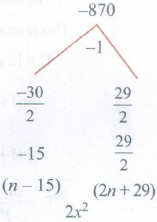
\(⇒\ 435\sqrt3={n\over2}[4n\sqrt3-2\sqrt3]\)
\(⇒\ 435\sqrt3=2{\sqrt3.n\over2}[2n-1]\)
⇒ 435 = 2n2-n
⇒ 2n2- n - 435 = 0
⇒ (n = 15)(2n + 29) = 0
⇒ \(n-15\ or\ n={-29\over2}\) which is not possible
⇒ n = 15
9.
Let Tn be the nth term of the given series
Then Tn = 1 + 4 + 42 + 43 + ...
\(=1\left(4^n-1\over 4-1\right)\)
\(={4^n-1\over 3}\)
Let Sn be the sum to n terms of the given series
Then \(S_n={\sum_{k=1}^n}T_k=\sum_{k=1}^n{4^n-3\over3}\)
\(⇒\ S_n={1\over3}\left[ \sum_{k=1}^n4^n-\sum_{k=1}^n3\right]\)
\(⇒\ S_n= {1\over3}[4^1+4^]+...+4^n-3^n\)
\(⇒\ S_n={1\over3}\left[ 4{(4^n-1)\over4-1}-3n\right]\)
\(⇒\ S_n={1\over3}\left[ 4{(4^n-1)\over4-1}-3n\right]={1\over 3}\left[4{(4^n-1)-9n\over3}\right]\)
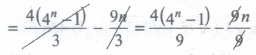
\({ S }_{ n }=\frac { 4 }{ 9 } \left[ \left( { 4 }^{ n }-1 \right) -n/3 \right] \)
10.
(1 + x) + (1 + x + x2) + (1 + x + x2 + x3) + ... up to n terms
= \(\frac{1-x^{2}}{1-x}+\frac{1-x^{3}}{1-x}+..\frac{1-x^{4}}{1-x}+...\) to n terms
= \(\frac{1}{1-x}[(1+1+1+... to\ n\ terms)-(x^{2}+x^{3}+x^{4}.... to\ n\ terms)\)
= \(\frac{1}{1-x}[n-\frac{x^{2}(1-x^{n})}{1-x}]\)
11.
\(\frac{1}{2}\)
12.
Let the number be a and b
∴ a + b = \(\frac { 13 }{ 6 } \)
Let A1, A2,..A2n be the 2n A,M s between a and b ....(1)
= \(2n\left( \frac { a+b }{ 2 } \right) =n(a+b)=n\times \frac { 13 }{ 6 } (2)\) using (1)
Also A1+ A2+ A2n = 2n+1(given) ...(3)
From (2) and (3),\(\frac { 13n }{ 6 } \) = 2n+1
⇒ 13n = 12n + 6
⇒ n = 6
∴ No of A.M's inserted = 2n - 2(6) = 12
13.
We have log (1 - x) = \(-x-\frac { { x }^{ 2 } }{ 2 } -\frac { { x }^{ 3 } }{ 3 } -\frac { { x }^{ 4 } }{ 4 } ....\)
\(\therefore \log { \left( 1-2x \right) } =-\left( 2x \right) -\frac { { \left( 2x \right) }^{ 2 } }{ 2 } -\frac { { \left( 2x \right) }^{ 3 } }{ 3 } -\frac { { \left( 2x \right) }^{ 4 } }{ 4 } +\frac { { \left( 2x \right) }^{ 5 } }{ 5 } -\frac { { \left( 2x \right) }^{ 6 } }{ 6 } +....\)
\(\log { \left( 1-2x \right) } =-2x-\frac { { 4x }^{ 2 } }{ 2 } -\frac { { 8x }^{ 3 } }{ 3 } -\frac { { 16x }^{ 4 } }{ 4 } -\frac { { 32x }^{ 5 } }{ 5 } -\frac { 6{ 4x }^{ 6 } }{ 6 } +....\)
This series is valid only when \(\left| 2x \right| <1\Rightarrow \left| x \right| <\frac { 1 }{ 2 } \)
Hence, this series is valid only in the interval \(-\frac { 1 }{ 2 }
14.
(10 -1)7 (a -b)n = nC0 an b0 - nC1 an-1 b1 +... nCn a0 bn, n \(\in\) N
= 107 - 7C1 106 (1) + 7C2 105 (1)2 - 7C3 104 (1)3 +7C4 (10)3 (1)4 - 7C5(10)2 (1)5 + 7C6(10)1(1)6 - (1)7
= 10000000 - 7(1000000 ) + \(\frac { 7\times 6 }{ 2\times 1 } \)(100000) -\(\frac { 7\times 6\times 5 }{ 3\times 2\times 1 } \) 10000 + \(\frac { 7\times 6\times 5 }{ 3\times 2\times 1 } \) 1000
= - \(\frac { 7\times 6 }{ 2\times 1 } \) (100) + 7(10) - 1
= 10000000 - 7000000 + 21.00000 -350000 + 35000 - 2100 + 70 - 1
= 4782969
15.
The general term in the expansion of (1 + x)m is Tr+1 = nCr(1)m-r xr
On putting r = 2, we get T3 = mC2(1)m-2 x2 = mC2 x2
∴ Coefficient of x2 = mC2
Also, coefficient of x2 in the expansion of (1+x)m is 6
∴ mC2 = 6 ⇒ \(\frac{m(m-1)}{2.1}=6 \Rightarrow m(m-1)=12\)
⇒ m(m-1) = 4.3
⇒ m = 4
16.
Since H is the H. M. between a and b,
\(we\quad get\quad H=\frac { 2ab }{ a+b } \quad ........(1)\)
\(LHS=(H-2a)(H-2b)\)
\(=\left( \frac { 2ab }{ a+b } -2a \right) \left( \frac { 2ab }{ a+b } -2b \right) \)
\(=\left( \frac { 2ab-2{ a }^{ 2 }-2ab }{ a+b } \right) \left( \frac { 2ab--2ab-{ ab }^{ 2 } }{ a+b } \right) \)
\(=\left( \frac { { -2a }^{ 2 } }{ a+b } \right) \left( \frac { { -2b }^{ 2 } }{ a+b } \right) =\left( \frac { { 4a }^{ 2 }{ b }^{ 2 } }{ { \left( a+b \right) }^{ 2 } } \right) { \left( \frac { 2ab }{ a+b } \right) }^{ 2 }\)
\(={ H }^{ 2 }[using\quad 1]\)
17.
Given x = a + \(\frac{a}{r}+\frac{a}{r^{2}}+...\infty\)
\(=a(1+\frac{1}{r}+\frac{1}{r^{2}}+...+\infty)\) \([\because S=\frac{a}{1-r}]\)
= \(a(\frac{1}{1-\frac{1}{r}})=a(\frac{r}{r-1})\)
x = \(\frac{ar}{r-1}\) --- (1)
y = \(b-\frac{b}{r}+\frac{b}{r^{2}}...b(\frac{1}{1-(\frac{-1}{r})})=\frac{b}{1+\frac{1}{r}}\)
y = \(\frac{br}{r+1}\) --- (2)
z = c + \(\frac{c}{r^{2}}+\frac{c}{r^{4}}+..\) = \(\frac{c}{1-\frac{1}{r^{2}}}=\frac{cr^{2}}{r^{2}-1}\) ---- (3)
ஃ \(\frac{xy}{z}=(\frac{ar}{r-1}.\frac{br}{r+1})/\frac{cr^{2}}{r^{2}-1}=\frac{abr^{2}}{r^{2}-1}\times\frac{r^{2}-1}{cr^{2}}=\frac{ab}{c}\) [∵ using (1),(2) and (3)]
⇒ \(\frac{xy}{z}=\frac{ab}{c}\)
18.
2018
Let an = 2018
then the first 6 terms are 2018, 2018, 2018, 2018, 2018, 2018
It is not an AP, GP, AGP and HP.
19.
Let an = \(\frac { 2n+3 }{ 3n+4 } \)
\({ a }_{ 1 }=\frac { 2+3 }{ 3+4 } =\frac { 5 }{ 9 } \)
\({ a }_{ 2 }=\frac { 4+3 }{ 6+4 } =\frac { 7 }{ 10 } \)
\({ a }_{ 3 }=\frac { 6+3 }{ 9+4 } =\frac { 9 }{ 13 } \)
\({ a }4=\frac { 8+3 }{ 12+4 } =\frac { 11 }{ 16 } \)
\({ a }_{ 5 }=\frac { 10+3 }{ 15+4 } =\frac { 13 }{ 19 } \)
\({ a }_{ 6 }=\frac { 12+3 }{ 18+4 } =\frac { 15 }{ 22 } \)
\(\frac { 5 }{ 9 } ,\frac { 7 }{ 10 } ,\frac { 9 }{ 13 } ,\frac { 11 }{ 16 } ,\frac { 13 }{ 19 } ,\frac { 15 }{ 22 } ...\)
this is neither A.P, G.P nor AGP

11th Standard Syllabus & Materials
11th Standard
TN 11th Tamil பீடு பெற நில் - செய்யுள் - காவடிச்சிந்து Important Questions And Answers Study Material - QB365 Set A
NEW11th Standard
TN 11th Tamil பீடு பெற நில் - உரைநடை - மலை இடப்பெயர்கள் : ஓர் ஆய்வு Important Questions And Answers Study Material - QB365 Set A
NEW11th Standard
TN 11th Tamil மாமழை போற்றுதும் - துணைப்பாடம் - யானை டாக்டர் Important Questions And Answers Study Material - QB365 Set A
NEW11th Standard
TN 11th Tamil மாமழை போற்றுதும் - செய்யுள் - ஐங்குறுநூறு Important Questions And Answers Study Material - QB365 Set A



Tamilnadu Stateboard 11th Standard Subjects
Maths

Commerce

Economics

Biology

Business Maths and Statistics

Accountancy

Computer Science

Physics

Chemistry
Maths
Biology
Economics
Physics
Chemistry

History
Business Maths and Statistics

Computer Science
Accountancy

Computer Applications
History
Computer Technology
Commerce
Computer Applications
Computer Technology

Tamil

English

French
Tamilnadu Stateboard Standards

