
 100% FREE ACCESS
11th Standard Syllabus & Materials
11th Standard
TN 11th Tamil இயற்கை வேளாண்மை,சுற்றுச்சூழல் -செய்யுள் - மனோன்மணீயம் Important Questions And Answers Study Material - QB365 Set A
NEW11th Standard
TN 11th Tamil என்னுயிர் என்பேன் -துணைப்பாடம் - இசைத்தமிழர் இருவர் Important Questions And Answers Study Material - QB365 Set A
NEW11th Standard
TN 11th Tamil மொழி கலை -செய்யுள் - ஒவ்வொரு புல்லையும் Important Questions And Answers Study Material - QB365 Set A
NEW11th Standard
TN 11th Tamil பீடு பெற நில் - இலக்கணம் - பகுபத உறுப்புகள் Important Questions And Answers Study Material - QB365 Set A
NEW11th Standard
TN 11th Tamil பீடு பெற நில் - துணைப்பாடம் - வாடிவாசல் Important Questions And Answers Study Material - QB365 Set A
NEW11th Standard
TN 11th Tamil பீடு பெற நில் - செய்யுள் - குறுந்தொகை Important Questions And Answers Study Material - QB365 Set A

Published on: 31/07/2019
Combinations and Mathematical Induction
Download Tamil Nadu 11th Standard Maths question papers, model tests, one-mark questions, important questions, and public exam papers in PDF format. Free study materials and answer keys for TN State Board students.
Questions + Answers key
Take MCQ Maths Test1.
A group consists of 4 girls and 7 boys. In how many ways can a team of 5 members be selected, if the team has at least three girls
2.
There are six periods in each working day of a school. In how many ways can one arrange 5 subjects such that each subject is allowed at least one period?
3.
How many words can be formed using the letter A thrice, the letter B twice and the letter C thrice?
4.
In how many ways can the letters of the word PENCIL be arranged so that N is always next to E.
5.
A mobile phone has a passcode of 6 distinct digits. What is the maximum number of attempts one makes to retrieve the passcode?
6.
In how many ways 5 persons can be seated in a row?
7.
Find r if 5pr= 26pr-1
8.
If nPr = nPr+1 and nCr = nCr-1 find the values of n and r.
9.
If (n + 1)C8 : (n - 3) P4 = 57:16, find n.
10.
How many numbers are there between 100 and 500 with the digits 0, 1, 2, 3, 4, 5 ? if
(i) repetition of digits allowed
(ii) the repetition of digits is not allowed.
11.
Number of all four digit numbers having different digits formed of the digits 1, 2, 3, 4 and 5 and divisible by 4 is _________
24
30
125
100
12.
The number of ways to arrange the letters of the word CHEESE are _________
120
240
720
6
13.
If a2-a \(C_2 = ^{a^2-a}\) C4 then the value of 'a' is
2
3
4
5
14.
The number of five digit telephone numbers having at least one of their digits repeated is
90000
10000
30240
69760
15.
The sum of the digits at the 10th place of all numbers formed with the help of 2, 4, 5, 7 taken all at a time is
432
108
36
18
16.
32n - 1 is divisible by 8
17.
If (n+2)! = 60(n-1)! find n.
18.
Prove that n!(n + 2) = n! + (n + 1)!
19.
Evaluate \(\frac { (2n)! }{ n! } \)
20.
If 10Pr-1 = 2 \(\times\) 6Pr, find r.
1.
When atleast 3 girls are included, then
Number of ways = 4C3 \(\times\)7C2 + 4C4 \(\times\)7CI
\(=4\times {7\times6\over2\times1}+1\times7=84+7=91ways\)
Hence the required number of ways are 91 ways
2.
There are 6 periods in each working day of a school.
Since each subject is allowed at least one period, we first select one subject for the left out period. This can be done in 5C1 ways.
Now, six subject can be arranged in \(=\frac { 6! }{ 2! } \) ways
Hence, total number of permutations = 5C1 \(\times\)\(\frac { 6! }{ 2! } \)ways
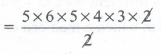
= 1800.
3.
We are given 8 letters namely AAABBCCC.
Clearly three are of one kind, 2 are of second kind and 3 are of third kind.
\(\therefore\) Total number of permutations = \(\frac { 8! }{ 3!2!3! } \)
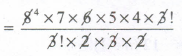
= 560.
4.
Let us keep EN together and consider it as one letter.
Now, we have 5 letters which can be arranged in a row in 5P5 = 5! = 120 ways.
Hence, the total number of ways in which N is always next to E is 120.
5.
Since the passcode has 6 distinct digits, the first digit can be tried in 10 ways using 0, 1, 2, 3, 4, 5, 6, 7, 8, 9.
Similarly 2nd, 3rd, 4th, 5th and 6th digit can also be tried in 9, 8, 7, 6, 5, 10 respectively.
∴ Maximum number of attempts made to retrieve the passcode = 10 \(\times\) 9 \(\times\) 8 \(\times\) 7 \(\times\) 6 \(\times\) 5
= 151200.
6.
To arrange 5 persons in a row, we need 5 place.
Number of ways of 1st person can be seated in a row = 5
Number of ways of 2nd person can be seated in a row = 4
Number of ways of 3rd person can be seated in a row = 3
Number of ways of 4th person can be seated in a row = 2
Number of ways of 5th person can be seated in a row = 1
∴ Number of ways of 5 persons' can be seated in a row = 5 \(\times\) 4 \(\times\) 3 \(\times\) 2 \(\times\) 1 = 5!
= 120
7.
Given, 5pr= 26pr-1
\(\Rightarrow {5!\over (5-r)!}={6!\over \{6-(r-1)\}!}\)
\(\Rightarrow {5!\over (5-r)!}={6.5!\over (7-r)!}\)
\(\Rightarrow {5!\over (5-r)!}={6\over (7-r)(6-r)(5-r)!}\)
\(\Rightarrow 1={6\over (7-r)(6-r)} \Rightarrow (7-r)(6-r)=6\)
\(\Rightarrow\) 42 - 13r + r2 = 6 \(\Rightarrow\)r2 - 13r + 36 = 0
\(\Rightarrow\) (r-4)(r-9)=0\(\Rightarrow\) r =4,9
Now, we know that nPr is meaningful only when r \(\le\) n.
\(\therefore\)5prand 6pr-1are meaningless when r = 9.
\(\therefore\)Rejecting r = 9, we have r = 4
8.
Given nPr = nPr+ 1
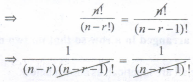
⇒ 1 = n-r ...(1)
Also, it is given that nCr = nCr-1
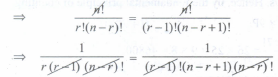
\(⇒\ {1\over r}={1\over n-r+1}\)
⇒ n - r + 1 = r
⇒ n -2r = -1 ...(2)
(1) - (2} ⟶ 2 = r
Substituting r = 2 in (1) we get,
n-2 = 1 ⇒ = 3
∴ n = 3 and r = 2
n = 3 and r = 2
9.
Given (n + 1)C8 : (n -3) P4 = 57 : 16
⇒ \(\frac { (n+1){ C }_{ 8 } }{ (n-3){ P }_{ 4 } } =\frac { 57 }{ 16 } \)
⇒ 16(n+2)C8 = 57(n-3)P4
\(\frac { 16(n+1)! }{ 8!(n+1-8)! } =\frac { 57(n-3)! }{ (n-3-4)! } \) \(\left[ \because nP_{ r }=\frac { n! }{ (n-r)! } ,n{ C }_{ r }=\frac { n! }{ r!(n-r)! } \right] \)
.jpg)
(n+1) n(n-1) (n-2) = \(\frac { 57\times 8! }{ 16 } \)
=.jpg)
= \(3 \times 19 \times 7 \times 6 \times 54 \times 3\)
\((n+1) n(n-1)(n-2)=21 \times 20 \times 19 \times 18\)
n = 20
10.
(i) Repetition of digit is allowed
| 4 | 6 | 6 |
Since we are going to find numbers between 100 and 500 it has 3 digits
The unit place can be filled in 6 ways using the digits 0, 1, 2, 3, 4, 5
The tens place also can be filled in 6 ways since repetition of digits is allowed.
The hundreds place can be filled in 4 ways using the digits 1, 2, 3, 4 [excluding 0 and 5]
∴ By fundamental principle of multiplication, required number of 3 - digit numbers = 4 \(\times\) 6 \(\times\) 6 = 144.
(ii) Repetition of digits is not allowed.
| 4 | 5 | 4 |
Hundreds place can be filled in 4 ways excluding 0 and 5
Tens place can be filled in 5 ways since repetition of digits is not allowed
Unit place can be filled in 4 ways.
∴ By fundamental principle of multiplication, required number of three-digit numbers = 4 \(\times\) 5 \(\times\) 4 = 80.
11.
(a)
24
12.
(a)
120
13.
\(a^{2}-a^{a} C_{2} =a^{2}-a^{a} C_{4} \)
\(a^{2}-a^{a} C_{2} =a^{2}-a^{a} C_{a-a-4}\left(\because^{n} C_{r}={ }^{n} C_{n-r}\right) \)
\(a^{2}-a-4 =2 \)
\(a^{2}-a-6 =0 \)
\((a-3)(a+2) =0 \)
\(a=3 \text { or } a=-2 \text { which is impossible }\)
14.
The number of five digit telephone numbers which can be formed using the digits 0,1,2.... 9 is 105.
The number of 5 digit numbers which has none of their digit repeated is 10P5, = 30240
The required number of telephone number is 105 =- 30240 = 69,760
15.
Total numbers = 4 \(\times\) 3 \(\times\) 2 \(\times\) 1 = 24,
Sum of all integers in tenth place
= 6 ( 2 + 4 + 5 + 7) = 108
16.
p(n) 23n - 1 is divisible by 8
For n = 1, we get
P(1) = 32.1-1 = 9 - 1 = 8
P(1) = 8, which is divisible by 8.
Let P(n) be true for n = k
P(k)32k - 1 is divisible by 8......(1)
Now, P(K+1) = 3(2k + 2) - 1 = 32k.32 - 1
= 32 (32k - 1) + 8
Now,32k-1 is divisible by 9. [Using (1)]
\(\therefore\) 32 (32k - 1) + 8 is also divisible by 8.
Hence, 32n - 1 is divisible by 8\(\forall\) n \(\in\) N
17.
Given (n+2)! = 60(n-1)!

\(\Rightarrow \) (n+2) (n+1)(n) = 60
\(\Rightarrow \) (n+2)(n+1)(n) = 5 \(\times\)4 \(\times\)3
Equating the terms both sides we get, n = 0
18.
LHS = n!(n + 2)
RHS = n! + (n+1)!
= n!+(n+1)(n)!....(1)
= n!(1+n+1)
= n!(n+20)...(2)
From (1) and (2), LHS = RHS
Hence Proved.
19.
\(\frac { (2n)! }{ n! } =\frac { (2n)(2n-1)(2n-2)...4.3.2.1 }{ n! } \)
\(=\frac { (2n)(2n-2)(2n-4)..4.2(2n-1)(2n-3)....3.1 }{ n!\quad n! } \) [Separating odd and even terms]
\(=\frac { { 2 }^{ n }.(2n-1)(2n-3)...3.1 }{ n! } \)
20.
Given 10Pr-1 = 2 \(\times\) 6Pr
⇒ \(\frac { 10! }{ (10-r+1)! } =2\times \frac { 6! }{ (6-r)! } \) \(\left[ \because n{ P }_{ r }=\frac { n! }{ (n-r)! } \right] \)
⇒ \(\frac { 10\times 9\times 8\times 7\times 6! }{ (11-r)! } =\frac { 10\times 9\times 8\times 7\times 6! }{ (11-r)! } \)
⇒ \(\frac { 10\times 9\times 8\times 7 }{ (11-r)(10-r)(8-r)(7-r)(6-r) } =\frac { 2 }{ (6-r)! } \)
⇒ \(\frac { 10\times 9\times 8\times 7 }{ (11-r)(10-r)(8-r)(7-r) } =2\)
\(
\Rightarrow(11-r)(10-r)(9-r)(8-r)(7-r)=5 \times 9 \times 8 \times 7
\)
\( \Rightarrow(11-r)(10-r)(9-r)(8-r)(7-r)=7 \times 6 \times 5 \times 4 \times 3
\)
\( \Rightarrow(11-r)(10-r)(9-r)(8-r)(7-r)=(11-4)(10-4)(9-4)(8-7)(7-4)
\)
⇒ r = 4

11th Standard Syllabus & Materials
11th Standard
TN 11th Tamil பீடு பெற நில் - செய்யுள் - காவடிச்சிந்து Important Questions And Answers Study Material - QB365 Set A
NEW11th Standard
TN 11th Tamil பீடு பெற நில் - உரைநடை - மலை இடப்பெயர்கள் : ஓர் ஆய்வு Important Questions And Answers Study Material - QB365 Set A
NEW11th Standard
TN 11th Tamil மாமழை போற்றுதும் - துணைப்பாடம் - யானை டாக்டர் Important Questions And Answers Study Material - QB365 Set A
NEW11th Standard
TN 11th Tamil மாமழை போற்றுதும் - செய்யுள் - ஐங்குறுநூறு Important Questions And Answers Study Material - QB365 Set A



Tamilnadu Stateboard 11th Standard Subjects
Maths

Commerce

Economics

Biology

Business Maths and Statistics

Accountancy

Computer Science

Physics

Chemistry
Maths
Biology
Economics
Physics
Chemistry

History
Business Maths and Statistics

Computer Science
Accountancy

Computer Applications
History
Computer Technology
Commerce
Computer Applications
Computer Technology

Tamil

English

French
Tamilnadu Stateboard Standards

