
 100% FREE ACCESS
11th Standard Syllabus & Materials
11th Standard
TN 11th Tamil இயற்கை வேளாண்மை,சுற்றுச்சூழல் -செய்யுள் - மனோன்மணீயம் Important Questions And Answers Study Material - QB365 Set A
NEW11th Standard
TN 11th Tamil என்னுயிர் என்பேன் -துணைப்பாடம் - இசைத்தமிழர் இருவர் Important Questions And Answers Study Material - QB365 Set A
NEW11th Standard
TN 11th Tamil மொழி கலை -செய்யுள் - ஒவ்வொரு புல்லையும் Important Questions And Answers Study Material - QB365 Set A
NEW11th Standard
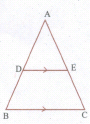
TN 11th Tamil பீடு பெற நில் - இலக்கணம் - பகுபத உறுப்புகள் Important Questions And Answers Study Material - QB365 Set A
NEW11th Standard
TN 11th Tamil பீடு பெற நில் - துணைப்பாடம் - வாடிவாசல் Important Questions And Answers Study Material - QB365 Set A
NEW11th Standard
TN 11th Tamil பீடு பெற நில் - செய்யுள் - குறுந்தொகை Important Questions And Answers Study Material - QB365 Set A

Published on: 21/01/2020
Download Tamil Nadu 11th Standard Maths question papers, model tests, one-mark questions, important questions, and public exam papers in PDF format. Free study materials and answer keys for TN State Board students.
Questions + Answers key
Take MCQ Maths Test1.
Find the projection of:
(i) \(\hat { i } -\hat { j } \) on Z-axis
(ii) \(\hat { i } +2\hat { j } -2\hat { k } \) on \(2\hat { i } -\hat { \quad j } -2\hat { k } \)
(iii) \(3\hat { i } +\hat { j } -\hat { k } \) on \(4\hat { i } -\hat { j } +2\hat { k } \)
2.
If \(A=\left[ \begin{matrix} 1 & 2 \\ 2 & 0 \end{matrix} \right] ,B=\left[ \begin{matrix} 3 & -1 \\ 1 & 0 \end{matrix} \right] \) verify the following:
3.
If \(A=\left[ \begin{matrix} 1 & 8 \\ 4 & 3 \end{matrix} \right] \quad B=\left[ \begin{matrix} 1 & 3 \\ 7 & 4 \end{matrix} \right] \quad C=\left[ \begin{matrix} -4 & 6 \\ 3 & -5 \end{matrix} \right] \)
Prove that
(l) AB ≠ BA
(it)A(BC) = (AB)C
(iii) A(B + C) = AB + AC
(iv) AI = IA = A
4.
A purse contains 3 silver and 4 copper coins. A second purse contains 4 silver and 3 copper coins. If a coin is pulled out at random from one of the two purses, what is the probability that it is a silver coin?
5.
The probability that a new railway bridge will get an award for its design is 0.48, the probability that it will get an award for the efficient use of materials is 0.36, and that it will get both awards is 0.2. What is the probability, that (i) it will get at least one of the two awards (ii) it will get only one of the awards.
6.
Integrate the following functions with respect to x : \(x+1\over (x+2)(x+3)\)
7.
Find y' if x4 + y4 = 16.
8.
Do the limits of following functions exist as x\(\rightarrow 0?\) State reasons for your answer.\(sin x\over |x|\)
9.
Prove that the line segment joining the midpoints of two sides of a triangle is parallel to the third side whose length is half of the length of the third side.
10.
Show that the straight lines joining the origin to the points of intersection of 3x - 2y + 2 = 0 and 3x2 + 5xy - 2y2 + 4x + 5y = 0 are at right angles.
11.
Using the Mathematical induction, show that for any natural number n; with the assumption i2 = -1, (r(cos ፀ + i sin ፀ))n = rn (cos nፀ+i sin nፀ)
12.
The product of three increasing numbers in GP is 5832. if we add 6 to the second number and 9 to the third number, then resulting numbers form an AP. Find the numbers in GP
13.
Find the fourth root of 623 correct to seven places of decimal.
14.
If the sides of a \(\triangle\)ABC are a = 4, b = 6, and c = 8, show that \(4\cos { B } +3\cos { C } =2\)
15.
Resolve the following rational expressions into partial fractions.
\({{2x^2+5x-11}\over{x^2+2x-3}}\)
16.
Determine the region in the plane determined by the inequalities.
\(2x+3y\le 6,\ x+4y\le 4,\ x\ge 0,\ y\ge 0.\)
17.
Write the values of f at -3, 5, 2, -1, 0 if
\(f(x)=\begin{cases} x^2+x-5\quad if\ x \in(-\infty, 0) \\x^2+3x-2\quad if\ x\in(3,\infty) \\x^2\quad \quad \quad \quad \quad if\ x\ \in(0,2) \\x^2-3 \quad \quad \quad otherwise \end{cases}\)
18.
If a2 = by + cz, b2 = cz + ax and c2= ax + by, prove that \({{x}\over{a+x}}+{{y}\over{b+y}}+{{z}\over{c+z}}=1.\)
19.
Graph the function f(x) = x3 and \(g(x)=\sqrt[3]x\) on the same co-ordinate plane. Find f o g and graph it on the plane as well. Explain your results.
20.
A simple cipher takes a number and codes it, using the function f(x) = 3x - 4. Find the inverse of this function, determine whether the inverse is also a function and verify the symmetrical property about the line y = x(by drawing the lines)
1.
Projection of \(\vec { a } \) on \(\vec { b } \)
(i) Here \(\vec { a } =\hat { i } -\hat { j } \) ;\(\vec { a } .\vec { b } =\left( \hat { i } -\hat { j } \right) \)
So projection of \(\hat { i } -\hat { j } \) on Z-axis = O.
(ii) \(\vec { a } =\hat { i } +2\hat { j } -2\hat { k } \) ;\(\vec { b } =2\hat { i } -\hat { j } +5\hat { k } \)
\(\vec { a } .\vec { b } =2-2-10=-10\) ;\(\left| \vec { b } \right| =\sqrt { 4+1+25 } =\sqrt { 30 } \)
ஃ Projection of \(\vec { a } \) on \(\vec { b } \) =\(\cfrac { -10 }{ \sqrt { 3 } } \) units.
(iii) \(\vec { a } =3\hat { i } +\hat { j } \) ;\(\vec { b } =4\hat { i } -\hat { j } +2\hat { k } \)
\(\vec { a } .\vec { b } =12-1-2=9\) ;\(\left| \vec { b } \right| =\sqrt { 16+1+4 } =\sqrt { 21 } \)
∴ Projection of \(\vec { a } \vec { b } =\cfrac { 9 }{ \sqrt { 21 } } \)
2.
\(A=\left[ \begin{matrix} 1 & 2 \\ 2 & 0 \end{matrix} \right] ,B=\left[ \begin{matrix} 3 & -1 \\ 1 & 0 \end{matrix} \right] \)
\(\therefore A+B=\left[ \begin{matrix} 1 & 2 \\ 2 & 0 \end{matrix} \right] +\left[ \begin{matrix} 3 & -1 \\ 1 & 0 \end{matrix} \right] =\left[ \begin{matrix} 4 & 1 \\ 3 & 0 \end{matrix} \right] \) ...(1)
\(A-B=\left[ \begin{matrix} 1 & 2 \\ 2 & 0 \end{matrix} \right] -\left[ \begin{matrix} 3 & -1 \\ 1 & 0 \end{matrix} \right] \)
= \(\left[ \begin{matrix} 1 & 2 \\ 2 & 0 \end{matrix} \right] +\left[ \begin{matrix} -3 & 1 \\ -1 & 0 \end{matrix} \right] =\left[ \begin{matrix} -2 & 3 \\ 1 & 0 \end{matrix} \right] \) ...(2)
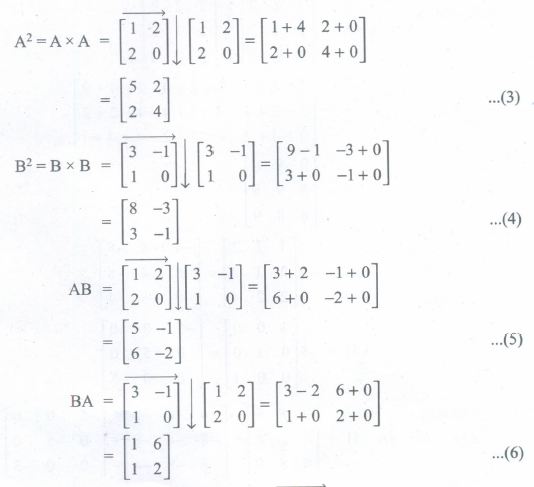

= \(\left[ \begin{matrix} 16+3 & 4+0 \\ 12+0 & 3+0 \end{matrix} \right] =\left[ \begin{matrix} 19 & 4 \\ 12 & 3 \end{matrix} \right] \) ...(7)

= \(\left[ \begin{matrix} 4+3 & -6+0 \\ -2+0 & 3+0 \end{matrix} \right] =\left[ \begin{matrix} 7 & -6 \\ -2 & 3 \end{matrix} \right] \)
(i) \(LHS=\left( A+B \right) ^{ 2 }=\left[ \begin{matrix} 19 & 4 \\ 12 & 3 \end{matrix} \right] [from7]\)
RHS = A2 + AB + BA + B2
= \(\left[ \begin{matrix} 5 & 2 \\ 2 & 4 \end{matrix} \right] +\left[ \begin{matrix} 5 & -1 \\ 6 & -2 \end{matrix} \right] +\left[ \begin{matrix} 1 & 6 \\ 1 & 2 \end{matrix} \right] +\left[ \begin{matrix} 8 & -3 \\ 3 & -1 \end{matrix} \right] \) (from (3), (5), (6) and (4))
= \(\left[ \begin{matrix} 5+5+1+8 & 2-1+6-3 \\ 2+6+1+3 & 4-2+2-1 \end{matrix} \right] =\left[ \begin{matrix} 19 & 4 \\ 12 & 3 \end{matrix} \right] \)
LHS = RHS ⇒ (A + B)2 = A2 + AB + BA + B2
(ii) LHS .\({ \left( A-B \right) }^{ 2 }=\left[ \begin{matrix} 7 & -6 \\ -2 & 3 \end{matrix} \right] \) from (8)
RHS. \({ A }^{ 2 }-AB-BA+{ B }^{ 2 }=\left[ \begin{matrix} 5 & 2 \\ 2 & 4 \end{matrix} \right] -\left[ \begin{matrix} 5 & -1 \\ 6 & -2 \end{matrix} \right] -\left[ \begin{matrix} 1 & 6 \\ 1 & 2 \end{matrix} \right] +\left[ \begin{matrix} 8 & -3 \\ 3 & -1 \end{matrix} \right] \)
= \(\left[ \begin{matrix} 5 & 2 \\ 2 & 4 \end{matrix} \right] +\left[ \begin{matrix} -5 & 1 \\ -6 & 2 \end{matrix} \right] +\left[ \begin{matrix} -1 & -6 \\ -1 & -2 \end{matrix} \right] +\left[ \begin{matrix} 8 & -3 \\ 3 & -1 \end{matrix} \right] \)
= \(\left[ \begin{matrix} 5-51+8 & 2+1-6-3 \\ 2-6-1+3 & 4+2-2-1 \end{matrix} \right] =\left[ \begin{matrix} 7 & -6 \\ -2 & 3 \end{matrix} \right] \)
LHS = RHS ⇒ (A - B)2 = A2 - AB - BA + B2
3.
(i) \(AB=\left[ \begin{matrix} 1 & 8 \\ 4 & 3 \end{matrix} \right] \left[ \begin{matrix} 1 & 3 \\ 7 & 4 \end{matrix} \right] =\left[ \begin{matrix} (1)(1)+(8)(7) & (1)(3)+(8)(4) \\ (4)(1)+(3)(7) & (4)(3)+(3)(4) \end{matrix} \right] \)
= \(\left[ \begin{matrix} 1+56 & 3+32 \\ 4+21 & 12+12 \end{matrix} \right] =\left[ \begin{matrix} 57 & 35 \\ 25 & 24 \end{matrix} \right] \) ...(1)
\(BA=\left[ \begin{matrix} 1 & 3 \\ 7 & 4 \end{matrix} \right] \left[ \begin{matrix} 1 & 8 \\ 4 & 3 \end{matrix} \right] =\left[ \begin{matrix} (1)(1)+(3)(4) & (1)(8)+(3)(3) \\ (7)(1)+(4)(4) & (7)(8)+(4)(3) \end{matrix} \right] \)
= \(\left[ \begin{matrix} 1+12 & 8+9 \\ 7+16 & 56+12 \end{matrix} \right] =\left[ \begin{matrix} 13 & 17 \\ 23 & 68 \end{matrix} \right] \) ...(2)
From (1) and (2) we have AB ≠ BA
(ii) \(\\ (AB)C=\left[ \begin{matrix} 57 & 35 \\ 25 & 24 \end{matrix} \right] \left[ \begin{matrix} -4 & 6 \\ 3 & -5 \end{matrix} \right] \)
= \(\left[ \begin{matrix} (57)(-4)+(35)(3) & (57)(6)+(35)(-5) \\ (25)(-4)+(24)(3) & (25)(6)+(24)(-5) \end{matrix} \right] \)
= \(\left[ \begin{matrix} -228+105 & 342-175 \\ -100+72 & 150-120 \end{matrix} \right] \)
\(\therefore (AB)C=\left[ \begin{matrix} -123 & 167 \\ -28 & 30 \end{matrix} \right] \) ..(3)
= \(BC=\left[ \begin{matrix} 1 & 3 \\ 7 & 4 \end{matrix} \right] \left[ \begin{matrix} -4 & 6 \\ 3 & -5 \end{matrix} \right] \)
= \(\left[ \begin{matrix} (1)(-4)+(3)(3) & (1)(6)+(3)(-5) \\ (7)(-4)+(4)(3) & (7)(6)+(4)(-5) \end{matrix} \right] =\left[ \begin{matrix} -4-9 & 6-15 \\ -28+12 & 42-20 \end{matrix} \right] \)
\(BC=\left[ \begin{matrix} 5 & -9 \\ -16 & 22 \end{matrix} \right] \) ...(1)
\(A(BC)\left[ \begin{matrix} 1 & 8 \\ 4 & 3 \end{matrix} \right] =\left[ \begin{matrix} 5 & -9 \\ -16 & 22 \end{matrix} \right] \)
= \(\left[ \begin{matrix} (1)(5)+(8)(-16) & (1)(-9)+(8)(22) \\ (4)(5)+(3)(-16) & (4)(-9)+(3)(22) \end{matrix} \right] =\left[ \begin{matrix} 5-128 & -9+176 \\ 20-48 & -36+66 \end{matrix} \right] \)
\(A(BC)=\left[ \begin{matrix} 1-123 & 167 \\ -28 & 30 \end{matrix} \right] \) ..(4)
From (3) and (4) we have, (AB)C = A (BC)
(iii)
\(B+C=\left[ \begin{matrix} 1 & 3 \\ 7 & 4 \end{matrix} \right] +\left[ \begin{matrix} -4 & 6 \\ 3 & -5 \end{matrix} \right] =\left[ \begin{matrix} 1-4 & 3+6 \\ 7+3 & 4-5 \end{matrix} \right] =\left[ \begin{matrix} -3 & 9 \\ 10 & -1 \end{matrix} \right] \)
\(A(B+C)=\left[ \begin{matrix} 1 & 8 \\ 4 & 3 \end{matrix} \right] \left[ \begin{matrix} -3 & 9 \\ 10 & -1 \end{matrix} \right] =\left[ \begin{matrix} -3+80 & 9-8 \\ -12+30 & 36-3 \end{matrix} \right] \)
\(A(B+C)=\left[ \begin{matrix} 77 & 1 \\ 18 & 33 \end{matrix} \right] \) .(5)
\(AB=\left[ \begin{matrix} 57 & 35 \\ 25 & 24 \end{matrix} \right] \) ..
\(AC=\left[ \begin{matrix} 1 & 8 \\ 4 & 3 \end{matrix} \right] \left[ \begin{matrix} -4 & 6 \\ 3 & -5 \end{matrix} \right] =\left[ \begin{matrix} -4+24 & 6-40 \\ -16+9 & 24-15 \end{matrix} \right] =\left[ \begin{matrix} 20 & -34 \\ -7 & 9 \end{matrix} \right] \)
\(AB+AC=\left[ \begin{matrix} 57 & 35 \\ 25 & 24 \end{matrix} \right] +\left[ \begin{matrix} 20 & -34 \\ -7 & 9 \end{matrix} \right] =\left[ \begin{matrix} 57+20 & 35-34 \\ 25-7 & 24+9 \end{matrix} \right] \)
= \(\left[ \begin{matrix} 77 & 1 \\ 18 & 33 \end{matrix} \right] \) ...(6)
From equations(5) and (6) we haveA(B + C) = AB + AC
(iv) Sinceorder of A is 2 \(\times\) 2, take \(I=\left[ \begin{matrix} 1 & 0 \\ 0 & 1 \end{matrix} \right] \)
\(AI=\left[ \begin{matrix} 1 & 8 \\ 4 & 3 \end{matrix} \right] \left[ \begin{matrix} 1 & 0 \\ 0 & 1 \end{matrix} \right] =\left[ \begin{matrix} 1(1)+8(0) & 1(0)+8(1) \\ 4(1)+3(3) & 4(0)+3(1) \end{matrix} \right] =\left[ \begin{matrix} 1+0 & 0+8 \\ 4+0 & 0+3 \end{matrix} \right] \)
= \(\left[ \begin{matrix} 1 & 8 \\ 4 & 3 \end{matrix} \right] =A\) ...(7)
\(IA=\left[ \begin{matrix} 1 & 0 \\ 0 & 1 \end{matrix} \right] \left[ \begin{matrix} 1 & 8 \\ 4 & 3 \end{matrix} \right] =\left[ \begin{matrix} 1(1)+0(4) & 1(8)+0(3) \\ 0(1)+1(4) & 0(8)+1(3) \end{matrix} \right] =\left[ \begin{matrix} 1+0 & 8+0 \\ 0+4 & 0+3 \end{matrix} \right] \)
= \(\left[ \begin{matrix} 1 & 8 \\ 4 & 3 \end{matrix} \right] =A\) ...(8)
∴From (7) and (8) AI = IA = A
4.
Consider the following events.
E1: I purse is chosen
E2: II purse is chosen
A: Coin pulled out is silver
\(\Rightarrow \quad \therefore P(E_{ 1 })=P({ E }_{ 2 })=\frac { 1 }{ 2 }\)
There are 3 silver and 4 copper coins in I purse
\(\Rightarrow \quad P(A/{ E }_{ 1 })=\frac { 3 }{ 7 } \)
There are 4 silver and 3 copper coins in II Purse
\(\therefore\) P(A/E1) = \(\frac { 4 }{ 7 } \)
By the theorem of total probability
P(A) = P(E1).P(A/E1)+P(E2).P(A/E2) = \(\frac { 1 }{ 2 } \times \frac { 3 }{ 7 } +\frac { 1 }{ 2 } \times \frac { 4 }{ 7 } =\frac { 3 }{ 14 } +\frac { 4 }{ 17 } =\frac { 7 }{ 14 } =\frac { 1 }{ 2 } \)
5.
Let A be the event of getting award for design of railway bridge and B be the event of getting award for the efficient use of materials
Then, \(P(A)=0.48, P(B)=0.36, P(A \cap B)=0.2\)
(i) P (atleast one of the two awards)
\(=P(A \cup B) \)
\(=P(A)+P(B)-P(A \cap B) \)
\(=0.18+0.36-0.2=0.64\)
(ii) P (will get only one of the award)
\(=P(A \cap \bar{B})+P(\bar{A} \cap B) \)
\(=P(A)-P(A \cap B)+P(B)-P(A \cap B) \)
\(=0.48-0.20+0.36-0.20 \)
\(=0.44\)
6.
Let \(\frac{x+1}{(x+2)(x+3)}=\frac{A}{x+2}+\frac{B}{x+3}\)
Multiplying both sides by (x + 2)(x + 3)
x + 1 = A(x + 3) + B(x + 2) ............(1)
Putting x = -2 in (1)
-2 + 1 = A(-2 + 3) + 0
-1 = A(1) ⇒ A = -1
Putting x = -3 in (1)
-3 +1 = 0 + B(-3 + 2)
-2 = B(-1) ⇒ B = 2
\(\therefore \frac{x+1}{(x+2)(x+3)}=\frac{-1}{x+2}+\frac{2}{x+3}\)
\(\therefore \int \frac{x+1}{(x+2)(x+3)} d x=\int\left[\frac{-1}{x+2}+\frac{2}{x+3}\right] d x\)
\( =-\int \frac{1}{x+2} d x+2 \int \frac{1}{x+3} d x\)
\(=-\log |x+2|+2 \log |x+3|+c \)
\(=2 \log |x+3|-\log |x+2|+c \)
7.
We have x4 + y4 = 16.
Differentiating implicitly, 4x3 +4y3y' = 0
Solving for y' gives
\(y'=-{x^3\over y^3}\)
To find y'' we differentiate this expression for y' using the quotient rule and remembering that y is a function of x.
\( y^{\prime \prime}=\frac{d}{d x}\left(\frac{-x^3}{y^3}\right) =\frac{-\left[y^3 \frac{d}{d x}\left(x^3\right)-x^3 \frac{d}{d x}\left(y^3\right)\right]}{\left.\left(y^3\right)^2\right]} \\ \)
\(=-\frac{\left[y^3 \cdot 3 x^2-x^3\left(3 y^2 y^{\prime}\right)\right]}{y^6} \)
\( =-\frac{3 x^2 y^3-3 x^3 y^2\left(-\frac{x^3}{y^3}\right)}{y^6} \)
\( =-\frac{3\left(x^2 y^4+x^6\right)}{y^7}=\frac{-3 x^2\left[x^4+y^4\right]}{y^7} \)
\( = \frac{-3 x^2(16)}{y^7}=\frac{-48 x^2}{y^7} . \)
8.
\(\frac{\sin x}{|x|}= \begin{cases}\frac{\sin (x)}{-x} & \text { if }-1<x<0 \\ \frac{\sin x}{x} & \text { if } 0<x<1\end{cases}\)
Therefore, \(lim_{x\rightarrow 0^-}f(x)=-1\)
\(lim_{x\rightarrow 0^+}f(x)=1\)
Hence the limit does not exist.
9.
Let ABC be a triangle and let O be the origin.
Let D and E be the midpoints of AB and AC\(\overrightarrow{OE}={\overrightarrow{OA}+\overrightarrow{OC}\over 2}={\overrightarrow{a}+\overrightarrow{c}\over 2}\)
\(
\text { Let } \overrightarrow{O A}=\vec{a}, \overrightarrow{O B}=\vec{b}, \overrightarrow{O C}=\vec{c}
\)
\(\overrightarrow{O D}= \frac{\vec{a}+\vec{b}}{2}, \quad \overrightarrow{O E}=\frac{\vec{a}+\vec{c}}{2}
\)
\(\left.\therefore \overrightarrow{D E}=\overrightarrow{O E}-\overrightarrow{O D}=\left(\frac{\vec{a}+\vec{c}}{2}\right)-\left(\frac{\vec{a}+\vec{b}}{2}\right)=\frac{\vec{a}+\vec{c}-\vec{a}-\vec{b}}{2}\right)
\)
\(=\frac{\vec{c}-\vec{b}}{2}=\frac{(\overrightarrow{O C}-\overrightarrow{O B})}{2}\)
\(
\overrightarrow{D E}=\frac{\overrightarrow{B C}}{2}=\frac{1}{2} \overrightarrow{B C}
\)
\(\therefore D E \| B C .
\)
\(\text {Also } \overrightarrow{D E}=\frac{1}{2} \overrightarrow{B C} \Rightarrow|\overrightarrow{D E}|=\frac{1}{2}|\overrightarrow{B C}|
\)
\(D E=\frac{1}{2} B C
\)
Hence, \(D E \| B C \text { and } D E=\frac{1}{2} B C \text {. }\)
10.
The straight lines joining the origin and the points of intersection of given equations is a second degree homogeneous equation.
Following steps show, the way of homogenizing the
3x2 + 5xy - 2y2 + 4x + 5y = 0 with 3x - 2y + 2 = 0
3x2 + 5xy - 2y2 + (4x + 5y)(1) = 0 and \(\frac { (3x-2y) }{ -2 } \) = 1
3x2 + 5xy - 2y2 + (4x + 5y)\(\left( \frac { 3x-2y }{ -2 } \right) \)= 0
(-2) (3x2 + 5xy - 2y2) + (4x + 5y) (3x - 2y) = 0
On simplification,
We get, 2x2 + xy - 2y2 = 0 ⇒ a = 2, b = -2 ⇒ a + b = 0
Since sum of the coefficient of x2 and y2 is equal to zero, the lines are at right angles.
11.
Let, P(n): = (r(cos ፀ + i sin ፀ)n = rn (cos nፀ+i sin nፀ)
Substituting the value of n = 1, in the statement we get,
P(1) =(r(cos ፀ + i sin ፀ))1 = r(cos ፀ+i sin ፀ)
Hence, P(1) is true.
Let us assume that the statement is true for n = k. Then
(r(cos ፀ + i sin ፀ))k = rk (cos kፀ + i sin kፀ)
We need to show that P(k + 1) is true. Consider,
P(k+1) = ((r(cos ፀ + i sin ፀ))k+1
=(r(cos ፀ + i sin ፀ))k+1
=(r(cos ፀ + i sin ፀ))k \(\times\) r(cosፀ+ isinፀ)
=rk(coskፀ+i sin kፀ) \(\times\) r(cosፀ+ i sinፀ)
=rk+1 x (cos kፀ cos ፀ + i2 sin kፀ sin) + i(sin kፀ cos ፀ + cos kፀ sin ፀ)
=rk+1 x (cos(k+1)ፀ + i sin(k+1)ፀ).
This implies that P(k + 1) is true. The validity of P(k + 1) follows from that of P(k).
Therefore by the principle of mathematical induction, for any natural number n,
(r(cos ፀ + i sin ፀ))n = rn(cos(nፀ) + i sin(nፀ))
12.
Given \({a\over r}.a.ar=5832\)
⇒ a3 = 5832 = 183
⇒ a =18
Also given \({a\over r},a+6, ar+9\) form an A.P
\(∴ a+6-{a\over r}=ar+9-a-6\)
\(⇒\ 18 + 6 --{18\over r}=18r + 9 - 18 - 6\ \ \ [∵ a = 18 ]\)
\(⇒\ 24-{18\over r}=18r-15\)
\(⇒ 24 + 15=18r+{18\over r}\)
\(⇒ 39 ={18r^2+18\over r}\)
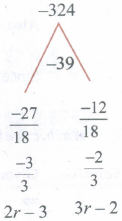
⇒ 39r = 18r2 + 18
⇒ (2r- 3) (3r- 2) =0
⇒ \(r={3\over2},{2\over 3}\)
Case (i) When \(a=18,r={3\over 2},\)the numbers in G.P. are \({18\over {3\over 2}},18,18\left(2\over 3\right)⇒27,18,12\)
Case (ii) When \(a=18,r={2\over 3},\) the numbers in G.P. are \({18\over {2\over 3}},18,18\left(2\over 3\right)⇒27,18,12\)
13.
Fourth root of 623 = \(\left( \frac { -2 }{ 625 } \right) \)
\(\left( \frac { -2 }{ 625 } \right) \)
\(={ \left[ 625\left( 1-\frac { 2 }{ 625 } \right) \right] }^{ \frac { 1 }{ 4 } }=5{ \left[ 1+\left( -\frac { 2 }{ 625 } \right) \right] }^{ \frac { 1 }{ 4 } }\)
\(={ 5\left[ 1+\frac { 1 }{ 4 } \left( \frac { -2 }{ 625 } \right) +\frac { \frac { 1 }{ 4 } \left( -\frac { 3 }{ 4 } \right) }{ 1.2 } { \left( \frac { -2 }{ 625 } \right) }^{ 2 } \right] }\)
Other terms will have more than seven zeroes after the decimal]
= 5[1-0.0008 - 0.0000009]
\(\sqrt [ 4 ]{ 623 } =4.9959955\)
14.
Given a = 4, b = 6 and c = 8.
By cosine formula, \(\cos { B } =\frac { { a }^{ 2 }+{ c }^{ 2 }-{ b }^{ 2 } }{ 2ac } \)
\(\Rightarrow \cos { B } =\frac { 16+64-36 }{ 2(4)(8) } =\frac { 80-36 }{ 64 } =\frac { 44 }{ 64 } =\frac { 11 }{ 16 } ....(1)\)
Also \(\cos { C } =\frac { { a }^{ 2 }+{ b }^{ 2 }-{ c }^{ 2 } }{ 2ab } =\frac { 16+36-64 }{ 2(4)(6) } \)
\(=\frac { 52-64 }{ 48 } =\frac { -12 }{ 48 } =\frac { -1 }{ 4 }.....(2)\)
Now, LHS = \(4\cos { B } +3\cos { C } \)
\(=4\left( \frac { 11 }{ 16 } \right) +3\left( \frac { -1 }{ 4 } \right) \) [ From (1) and (2) ]
= \(\frac { 11 }{ 4 } -\frac { 3 }{ 4 } =\frac { 11-3 }{ 4 } =\frac { 8 }{ 4 } =2=RHS\)
Hence Proved.
15.
Since the numerator's degree is equal to the denominator's degree, let us divide the numerator by the denominator.
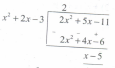
\(∴\ {2x^3+5x+11\over x^2+2x-3}=2+{x-5\over x^3+2x-3}\)
Consider \({x-5\over x^2+2x-3}={x-5\over (x+3)(x-1)}{A\over x+3}+{B\over x-1}\)
∴ x-5 = A(x-1) + B(x+3)
Putting x = 1 in (2) we get
-4 = B(4) ⇒ B = 1
Putting x = -3 in (2) we get
-8 = A(-4) ⇒ A = 2

\(∴\ {x-5\over x^2+2x-3}={2\over x+3}-{1\over x-1}\)
Substituting this in (1) we get
\({{2x^2+5x-11}\over{x^2+2x-3}}=2+{{2}\over{x+3}}-{{1}\over{x-1}}\)
16.
If 2x + 3y = 6
| x | 0 | 3 |
| y | 2 | 0 |
x + 4y = 4
| x | 0 | 4 |
| y | 1 | 0 |
x > y > 0 represents the area in the 1st quadrant.
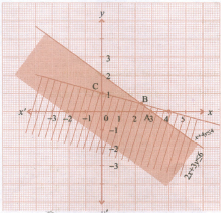
All points bounded between x = 0, y = 0, x + 4y = 4 and 2x + 3y = 6 is required region. Darkly shaded area will represent the solution set of the given linear inequalities.
17.
f(-3) = (-3)2 - 3 \(\left[ \therefore \ f(x)={ x }^{ 2 }-3\quad when\ x=-3 \right] \)
= 9 - 3 = 6
f(5) = 52 + 3(5)-2 \(\left[ \therefore f(x)={ x }^{ 2 }+3x-2\quad when\quad x=5 \right] \)
= 25 + 15 - 2
= 38
f(2) = 22 - 3
= 4 - 3 = 1 \(\left[ \therefore \ f(x)={ x }^{ 2 }-3\ when\ x=2 \right] \)
f(-1) = (-1)2 + (-1) -5 \(\left[ \therefore \ f(x)={ x }^{ 2 }+x-5\ when\ x=-1 \right] \)
= 1-1-5 = -5
f(0) = 02-3 = -3 \(\left[ \therefore \ f(x)={ x }^{ 2 }-3\ when\ x=0 \right] \)
\(\therefore\) f(-3) = 6, f(5) = 38, f(2) = 1, f(-1) = -5, f(0) = -3
18.
LHS = \({{x}\over{a+x}}+{{y}\over{b+y}}+{{z}\over{c+z}}=1\)
\({{ax}\over{a^2+ax}}+{{by}\over{b^2+by}}-{{cz}\over{c^2+cz}}\) [ Multiplying the numerator and denominator by, a, b, c respectively]
\(={{ax}\over{by+cz+ax}}+{{by}\over{cz+ax+by}}+{{cz}\over{ax+by+cz}}\) \([\therefore a^2=by+cz;b^2=cz+ax;c^2=ax+by]\)
\(\frac { ax+by+cz }{ ax+by+cz } =1\) = RHS
Hence proved.
19.
Given functions are f(x) = x3 and g(x) = \(x^{ ^{ \frac { 1 }{ 3 } } }\)
Now, f o g(x) = f(g(x)
= \(f\left( { x }^{ \frac { 1 }{ 3 } } \right) \)
= \(\left( { x }^{ 3 } \right) ^{ \frac { 1 }{ 3 } }=x\)
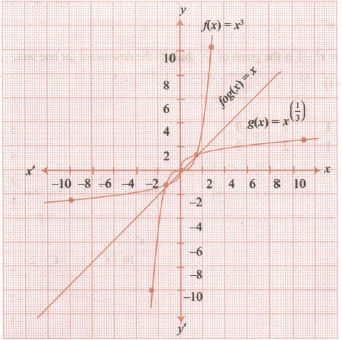
Since f o g(x) = x is symmetric about the line y = x, g(x) is the inverse of f(x)
∴ g(x) = f-1(x).
where f o g(x) = g o f(x) = x so that
(i) f o g is bijective.
(ii) both f(x) and g(x) also bijective.
(iii) f and g are symmetrical about y = x
20.
Given f(x) = 3x - 4
Let y = 3x - 4 ⇒ y + 4 = 3x
\(⇒ x={y+4\over 3}\)
Let g(y) = \(y+4\over 3\)
Now gof(n) = g(f(n)) = g(3\(\times\) -4) = \({3x-4+4\over 3}={3x\over 3}=x\)
and fog(y) = f(g(y)) = \(f\left(y+4\over 4\right)=3\left(y+4\over 3\right)-4=y+4-4=y\)
Thus, gof(x) = Ix and fog (y) = Iy
This implies that f and g are bijections and inverses to each other
Hence f is bijection and \(f^{-1} (x)={y+4\over 3}\)
Replacing y by x, we get f-1 (x) = \(\frac { x+4 }{ 3 } \)
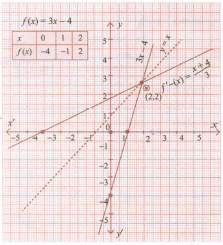
Hence, the graph of y = f-1(x) is the reflection of the graph of f in y = x

11th Standard Syllabus & Materials
11th Standard
TN 11th Tamil பீடு பெற நில் - செய்யுள் - காவடிச்சிந்து Important Questions And Answers Study Material - QB365 Set A
NEW11th Standard
TN 11th Tamil பீடு பெற நில் - உரைநடை - மலை இடப்பெயர்கள் : ஓர் ஆய்வு Important Questions And Answers Study Material - QB365 Set A
NEW11th Standard
TN 11th Tamil மாமழை போற்றுதும் - துணைப்பாடம் - யானை டாக்டர் Important Questions And Answers Study Material - QB365 Set A
NEW11th Standard
TN 11th Tamil மாமழை போற்றுதும் - செய்யுள் - ஐங்குறுநூறு Important Questions And Answers Study Material - QB365 Set A



Tamilnadu Stateboard 11th Standard Subjects
Maths

Commerce

Economics

Biology

Business Maths and Statistics

Accountancy

Computer Science

Physics

Chemistry
Maths
Biology
Economics
Physics
Chemistry

History
Business Maths and Statistics

Computer Science
Accountancy

Computer Applications
History
Computer Technology
Commerce
Computer Applications
Computer Technology

Tamil

English

French
Tamilnadu Stateboard Standards

