
 100% FREE ACCESS
11th Standard Syllabus & Materials
11th Standard
TN 11th Tamil இயற்கை வேளாண்மை,சுற்றுச்சூழல் -செய்யுள் - மனோன்மணீயம் Important Questions And Answers Study Material - QB365 Set A
NEW11th Standard
TN 11th Tamil என்னுயிர் என்பேன் -துணைப்பாடம் - இசைத்தமிழர் இருவர் Important Questions And Answers Study Material - QB365 Set A
NEW11th Standard
TN 11th Tamil மொழி கலை -செய்யுள் - ஒவ்வொரு புல்லையும் Important Questions And Answers Study Material - QB365 Set A
NEW11th Standard
TN 11th Tamil பீடு பெற நில் - இலக்கணம் - பகுபத உறுப்புகள் Important Questions And Answers Study Material - QB365 Set A
NEW11th Standard
TN 11th Tamil பீடு பெற நில் - துணைப்பாடம் - வாடிவாசல் Important Questions And Answers Study Material - QB365 Set A
NEW11th Standard
TN 11th Tamil பீடு பெற நில் - செய்யுள் - குறுந்தொகை Important Questions And Answers Study Material - QB365 Set A

Published on: 21/01/2020
Download Tamil Nadu 11th Standard Maths question papers, model tests, one-mark questions, important questions, and public exam papers in PDF format. Free study materials and answer keys for TN State Board students.
Questions + Answers key
Take MCQ Maths Test1.
Integrate the function with respect to x : \(\sqrt { { x }^{ 2 }-3x+10 } \)
2.
Find the unit vectors parallel to the sum of \(3\vec { i } -5\vec { j } +8\vec { k } \) and \(-2\vec { i } -2\vec { k } \)
3.
Prove that \(\left| \begin{matrix} 1 & a & { a }^{ 3 } \\ 1 & b & { b }^{ 3 } \\ 1 & c & { c }^{ 3 } \end{matrix} \right| =\left( a-b \right) \left( b-c \right) \left( c-a \right) \left( a+b+c \right) \)
4.
If f(x) = 2x2 + 3x - 5, then prove that f' (0) + 3 f' (-1) = 0
5.
Evaluate \(\int { \frac { \left( { a }^{ x }+{ b }^{ x } \right) ^{ 2 } }{ { a }^{ x }{ b }^{ x } } } \)dx
6.
Evaluate \(\lim _{ x\rightarrow a }{ \frac { { (x+2) }^{ \frac { 3 }{ 2 } }-{ (a+2) }^{ \frac { 3 }{ 2 } } }{ x-a } } \)
7.
One card is drawn from a well shuffled pack of 52 cards. If E is the event, "the card drawn is a king or queen" and F is the event "the card drawn is a queen or an ace", then find P(E/F).
8.
Prove that the product of the 2nd and 3rd terms of an arithmetic progression exceeds the product of the first and fourth by twice the square of the difference between the 1st and 2nd.
9.
If the 5th and 9th terms of a harmonic progression are \({1\over 19}\) and \({1 \over 35},\) find the 12th term of the sequence.
10.
In a \(\triangle\)ABC, prove that (b + c) cos A +(c + a) cos B + (a + b) cos C = a + b + c
11.
Compute log35 log2527
12.
Find the number of ways of arranging the letters of the word RAMANUJAN so that the relative positions of vowels and consonants are not changed.
13.
Prove that 15C3 + 2 x 15C4 + 15C4 + 15C5 = 17C5.
14.
Find the domain of \(\frac { 1 }{ 1-2sinx } \)
15.
Count the number of three-digit numbers which can be formed from the digits 2, 4, 6, 8 if
(i) repetitions of digits is allowed.
(ii) repetitions of digits is not allowed
16.
In a circular of diameter 40 cm, a chord is of length 20 cm. Find the length of the minor arc of the chord?
17.
For each given Angle, find a coterminal angle with a measure of \(\theta\) such that \(0^o\le \theta \le 360°\)
3950
18.
A man repays an amount of Rs. 3250 by paying Rs. 20 in the first month and then increases the payment by Rs.15 per month. How long will it take him to clear the amount?
19.
The function for exchanging American dollars for Singapore Dollar on a given day is f(x) = 1.23x, where x represents the number of American dollars. On the same day function for exchanging Singapore dollar to Indian Rupee is g(y) = 50.50y, Where y represents the number of Singapore dollars. Write a function which will give the exchange rate of American dollars in terms of Indian rupee
20.
Check whether the following for one-to-oneness and ontoness.
(i) \(f:R\rightarrow R\) defined by f(x) \(f(x)={1\over x}.\)
(ii) \(f: \mathbb{R}-\{0\} \rightarrow \mathbb{R}\) defined by \(f(x)=\frac{1}{x}\)
1.
\({ x }^{ 2 }-3x+10={ x }^{ 2 }-2\left( \cfrac { 3 }{ 2 } \right) x+10+\cfrac { 9 }{ 4 } -\cfrac { 9 }{ 4 } \)
= \(\left( x-\cfrac { 3 }{ 2 } \right) ^{ 2 }+\cfrac { 31 }{ 4 } =\left[ \left( x-\cfrac { 3 }{ 2 } \right) ^{ 2 }+\cfrac { \sqrt { 31 } }{ 2 } \right] ^{ 2 }\)
\(\therefore \int { \sqrt { { x }^{ 2 }-3x+10 } dx } =\int { \sqrt { \left( x-\cfrac { 3 }{ 2 } \right) ^{ 2 }+\left( \cfrac { \sqrt { 31 } }{ 2 } \right) ^{ 2 } } dx } \)
= \(\cfrac { 1 }{ 2 } \left\{ x-\cfrac { 3 }{ 2 } \right\} \sqrt { \left( x-\cfrac { 3 }{ 2 } \right) ^{ 2 }+\left( \cfrac { \sqrt { 31 } }{ 2 } \right) ^{ 2 } } +\cfrac { 31 }{ 4 } log\left[ \left( x-\cfrac { 3 }{ 2 } \right) +\sqrt { \left( x-\cfrac { 3 }{ 2 } \right) ^{ 2 }+\left( \cfrac { \sqrt { 31 } }{ 2 } \right) ^{ 2 } } \right] \)
= \(\cfrac { 2x-3 }{ 4 } \sqrt { { x }^{ 2 }-3x+10 } +\cfrac { 31 }{ 4 } log\left[ \left( x-\cfrac { 3 }{ 2 } \right) +\sqrt { { x }^{ 2 }-3x+10 } \right] +c\)
2.
Let the given vectors be \(\vec { a } =3\vec { i } -5\vec { j } +8\vec { k } \) and \(\vec { b } =-2\vec { i } -2\vec { k } \)
Now \(\vec { a } +\vec { b } =\left( 3\hat { i } -5\hat { j } +8\hat { k } \right) +\left( -2\hat { j } -2\hat { k } \right) \)
= \(\hat { i } (3)+\hat { j } (-5-2)+\hat { k } (8-2)\)
= \(3\hat { i } -7\hat { j } +6\hat { k } \)
\(\left| \vec { a } +\vec { b } \right| =\sqrt { 9+49+36 } =\sqrt { 94 } units\)
The unit vectors parallel \(\vec { a } +\vec { b } \) are \(\pm \cfrac { \vec { a } +\vec { b } \quad }{ \left| \vec { a } +\vec { b } \right| } =\pm \cfrac { 3\hat { i } -7\hat { j } +6\hat { k } }{ \sqrt { 94 } } \)
3.
\(LHS=\left| \begin{matrix} 1 & a & { a }^{ 3 } \\ 1 & b & { b }^{ 3 } \\ 1 & c & { c }^{ 3 } \end{matrix} \right| \begin{matrix} { C }_{ 1 }\rightarrow { C }_{ 1 }-{ C }_{ 2 } \\ { C }_{ 2 }\rightarrow { C }_{ 2 }-{ C }_{ 3 } \end{matrix}\)
= \(\left| \begin{matrix} 0 & a-b & { a }^{ 3 }-{ b }^{ 3 } \\ 1 & b-c & { b }^{ 3 }-{ c }^{ 3 } \\ 1 & c & { c }^{ 3 } \end{matrix} \right| \) Expanding along C1
= \((0)-(0)+1\left| \begin{matrix} a-b & { a }^{ 3 }-{ b }^{ 3 } \\ b-c & { b }^{ 3 }-{ c }^{ 3 } \end{matrix} \right| \)
= (a - b) (b3 - c3) - (b - c) (a3 - b3)
= (a - b) (b - c) (b2 + bc + 2) - (b - c) (a - b) (a2 + ab + b2)
= (a - b) (b - c) [(b2 + bc + c2) - (a2 + ab + b2)]
= (a - b) (b - c) [b2 + bc + 2 - a2 - ab - b2]
= (a - b) (b - c) [(bc - ab) + (c2 - a2)]
= (a - b) (b - c) [(b (c - a) + (c + a) (c - a)]
= (a - b)(b - c)[b + c + a] (c - a)
= (a - b) (b - c) (c - a) (a + b + c) = RHS
4.
f'(x) = 4x + 3
f'(0) = 3
f'(-1) = -1
\(\therefore\) f'(0) + 3f(-1) = 3 + 3(-1) = 3 - 3 = 0
5.
Let I = \(\int { \frac { \left( { a }^{ x }+{ b }^{ x } \right) ^{ 2 } }{ { a }^{ x }{ b }^{ x } } } \) dx = \(\int { \frac { { a }^{ 2x }+{ b }^{ 2x }+{ 2a }^{ x }{ b }^{ x } }{ { a }^{ x }{ b }^{ x } } } dx\)
= \(\int { \frac { { a }^{ x } }{ { b }^{ x } } dx } +\int { \frac { { a }^{ x } }{ { b }^{ x } } dx+2 } \int { dx } =\int { \left( \frac { a }{ b } \right) ^{ x } } dx+\left( \frac { a }{ b } \right) ^{ x }dx+2\int { dx } \)
= \(\frac { \left( \frac { a }{ b } \right) ^{ x } }{ log\left( \frac { a }{ b } \right) } +\frac { \left( \frac { a }{ b } \right) ^{ x } }{ log_{ e }\left( \frac { a }{ b } \right) } +2x+c\)
6.
\(\lim _{ x\rightarrow a }{ \frac { { (x+2) }^{ \frac { 3 }{ 2 } }-{ (a+2) }^{ \frac { 3 }{ 2 } } }{ x-a } } =\lim _{ x+2\rightarrow a+2 }{ \frac { { (x+2) }^{ \frac { 3 }{ 2 } }-{ (a+2) }^{ \frac { 3 }{ 2 } } }{ x-a } } \left[ \because \quad \lim _{ x\rightarrow a }{ \frac { { x }^{ n }-{ a }^{ n } }{ n-a } =n.{ a }^{ n-1 } } \right] \)
\( =\frac { 3 }{ 2 } (a+2{ ) }^{ \frac { 3 }{ 2 } -1 }=\frac { 3 }{ 2 } (a+2{ ) }^{ \frac { 1 }{ 2 } }\)
7.
n(S) = 52
There are 4 kings and 4 queens in a pack of cards
\(\therefore\) n(E) = 8
There are 4 queens and 4 aces in a pack of cards
\(\therefore\) n(F) = 8
\(\therefore P(E)=\frac { 8 }{ 52 } =\frac { 2 }{ 13 } \) and \(P(F)=\frac { 8 }{ 52 } =\frac { 2 }{ 13 } \) and \(P(E\cap F)=\frac { 4 }{ 52 } =\frac { 1 }{ 13 } \)
\(P(E/F)=\frac { P(E\cap F) }{ P(F) } =\frac { \frac { 1 }{ 13 } }{ \frac { 2 }{ 13 } } =\frac { 1 }{ 13 } \times \frac { 13 }{ 2 } =\frac { 1 }{ 2 } \)
8.
Let 'a' be the first term and 'd' the common difference of A.P.
Then, a1 = a, a2 = a + (2 -1) d = a + d
a3 = a + (3-1) d = a + 2d, a4 = a + (4-1) d = a + 3d
We have to show that a2.a3 - a1.a4 = 2 (a2 - a1)2
LHS = a2a3 -a,a4 = (a + d)( a+ 2d) - a(a + 3d)
= a2 + 3ad + 2d2 - a2 - 3ad = 2d2
RHS = 2 ( a2 - a1 )2 = 2 ( a + d - a)2 = 2d2
Since LHS = RHS. Hence proved.
9.
Let hn be the harmonic progression and let \(a_n={1\over h_n}.\)
Then a5 = 19 and a9 = 35.
As an's from an arithmetic progression, we have a + 4d = 19 and a + 8d = 35.
Solving these two equations, we get a = 3 and d = 4.
Thus a12 = a + 11d = 47.
Thus the 12th term of the harmonic progression is \({1\over 47}.\)
10.
LHS = b cos A + c cos A + c cos B + a cos B + a cos C + b cos C
= b cos C + c cos B + c cos A + a cos C + b cos A + a cos B
= a + b + c [by projection formula]
11.
log35 log2527 = log35 log2533
= log35 x 3 log253 (by exponent rule)
= 3 log255 =\(\frac{3}{log25}=\frac{3}{2log_55}=\frac{3}{2}\)
12.
In the word RAMANUJAN there are 4 vowels (A, A, U, A) in that 3 A's, 1 U and 5 consonants (R, M, N, J, N) in that two N's and rest are distinct. The 4 vowels (A, A, A, U) can be arranged themselves in \(\frac { 4! }{ 3! } \) = 4 ways. The 5 consonants (R, M, N, J, N) can be arranged themselves in \(\frac { 5! }{ 2! } \) = 60 ways. Therefore the number of required arrangements are \(\frac { 4! }{ 3! } \times \frac { 5! }{ 2! } \) = 4 \(\times\) 60 = 240.
13.
LHS =15C3 + 2 \(\times\) 15C4 +15C4 +15C5
= (15C3 +15C4) + (15C4 + 15C5)
=(15C3 +15C4) + (15C4 + 15C5) [∴ nCr-1 + nCr = n +1Cr]
= 16C4 + (15C4 +15C5)
=16C4 + 16C5
= 17C5 = RHS.
14.
Let f(x) = \(\frac { 1 }{ 1-2sinx } \)
When the denominator is 0,
1-2 sin x = 0
\(\Rightarrow\) 1 = 2 sin x
\(\Rightarrow sin\quad x=\frac { 1 }{ 2 } \)
\(\Rightarrow sin\quad x=sin\frac { \pi }{ 6 } \)
\(\Rightarrow x=n\pi +{ (-1) }^{ n }\frac { \pi }{ 6 } n\in Z\) \(\left[ \because sin\quad x=sin\alpha \Rightarrow x=n\pi +{ (-1) }^{ n }\alpha \quad n\in Z \right] \)
Domain of f(x) is R - \(\left( n\pi +{ (-1) }^{ n }\frac { \pi }{ 6 } \right) ,n\in Z\)
15.
(i)Repetition of digits is allowed
| hundreds | tens | unit |
| 4 | 4 | 4 |
The unit place can be filled in 4 ways.
Since repetition is allowed, the tens place and hundreds place can also be filled in 4 ways each.
∴ Total number one-digit numbers = 4 x 4 x 4 = 64
(ii) Repetition of digits is not allowed
| hundreds | tens | unit |
| 2 | 3 | 4 |
The unit place can be filled in 4 ways.
Since repetition of digits is not allowed, the tens place can be filled in 3 ways.
Hundreds place can be filled in 2 ways .
∴ Total number of 3-digit numbers without repetition = 4 \(\times\) 3 \(\times\) 2 = 24
16.
Given diameter of the circle is 40 cm
r = 20cm
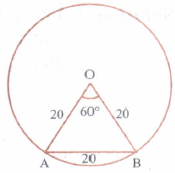
Let AB = 20 cm be a chord of the circle
Since OA = OB = AB = 20 cm, ΔAOB is equilateral
ஃ θ = ㄥAOB = 60°= 60 \(\times\) \(\frac{\pi}{180}=\frac{\pi}{3}\) radians
Let I be the length of the minor arc of the chord AB.
Then θ = \(\frac{l}{r}\) ⇒ l = rθ ⇒ l = 20(\(\frac{\pi}{3}\))
l = \(\frac{20\pi}{3}\) cm = 20 \(\times\) \(\frac{22}{7}\times\frac{1}{3}\) = 20.95 cm (app)
17.
3950
3950 = 3600 + 350
\(\Rightarrow \) 395 - 350 = 3600
∴ Coterminal angle For 3950 is 350
18.
Suppose the loan is cleared in n months. Clearly the amount forms an A.P. with a = 20 and d = 15
∴ Sum of the amounts = 3250
Sn = 3250
\(⇒\ {n\over2}[2a + (n -1)d]=3250\)
\(⇒\ {n\over2}[40+(n-1)15]=3250\)
⇒ n(40 + 15n - 15) = 6500
⇒ n (15n + 25) = 6500
⇒ 15n2 + 25n = 6500
⇒ 15n2 + 25n = 6500
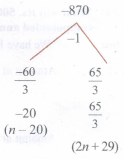
⇒ 3n2 + 5n - 1300 = 0
⇒ (n - 20) (3n + 65) = 0
⇒ n = 20 or \(n={-65\over 3}\) which is not possible
∴ n = 20
Thus, the amount is cleared in 20 months.
19.
Given f(x) = 1.23x where x represents the number of American dollars.
and g(y) = 50.50y where y represents the number of Singapore dollars.
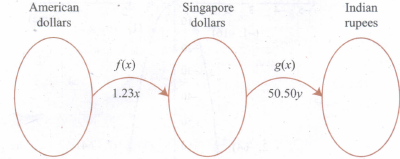
To convert American dollars to Indian rupees, we have to find out go f(x)
∴ go f(x) = g(f(x))
= g(1.23x)
= 50.50[1.23x]
= 62.115x
∴ The function for exchange rate of American dollars in terms of Indian rupee is g o f (x) = 62.115x.
20.
(i) This is not at all a function because f(x) is not defined for x = 0.
(ii) This function is one-to-one (verify) but not onto because 0 has no pre-image.

11th Standard Syllabus & Materials
11th Standard
TN 11th Tamil பீடு பெற நில் - செய்யுள் - காவடிச்சிந்து Important Questions And Answers Study Material - QB365 Set A
NEW11th Standard
TN 11th Tamil பீடு பெற நில் - உரைநடை - மலை இடப்பெயர்கள் : ஓர் ஆய்வு Important Questions And Answers Study Material - QB365 Set A
NEW11th Standard
TN 11th Tamil மாமழை போற்றுதும் - துணைப்பாடம் - யானை டாக்டர் Important Questions And Answers Study Material - QB365 Set A
NEW11th Standard
TN 11th Tamil மாமழை போற்றுதும் - செய்யுள் - ஐங்குறுநூறு Important Questions And Answers Study Material - QB365 Set A



Tamilnadu Stateboard 11th Standard Subjects
Maths

Commerce

Economics

Biology

Business Maths and Statistics

Accountancy

Computer Science

Physics

Chemistry
Maths
Biology
Economics
Physics
Chemistry

History
Business Maths and Statistics

Computer Science
Accountancy

Computer Applications
History
Computer Technology
Commerce
Computer Applications
Computer Technology

Tamil

English

French
Tamilnadu Stateboard Standards

