
 100% FREE ACCESS
11th Standard Syllabus & Materials
11th Standard
TN 11th Tamil இயற்கை வேளாண்மை,சுற்றுச்சூழல் -செய்யுள் - மனோன்மணீயம் Important Questions And Answers Study Material - QB365 Set A
NEW11th Standard
TN 11th Tamil என்னுயிர் என்பேன் -துணைப்பாடம் - இசைத்தமிழர் இருவர் Important Questions And Answers Study Material - QB365 Set A
NEW11th Standard
TN 11th Tamil மொழி கலை -செய்யுள் - ஒவ்வொரு புல்லையும் Important Questions And Answers Study Material - QB365 Set A
NEW11th Standard
TN 11th Tamil பீடு பெற நில் - இலக்கணம் - பகுபத உறுப்புகள் Important Questions And Answers Study Material - QB365 Set A
NEW11th Standard
TN 11th Tamil பீடு பெற நில் - துணைப்பாடம் - வாடிவாசல் Important Questions And Answers Study Material - QB365 Set A
NEW11th Standard
TN 11th Tamil பீடு பெற நில் - செய்யுள் - குறுந்தொகை Important Questions And Answers Study Material - QB365 Set A

Published on: 29/09/2018
Important 5 mark questions
Download Tamil Nadu 11th Standard Maths question papers, model tests, one-mark questions, important questions, and public exam papers in PDF format. Free study materials and answer keys for TN State Board students.
Questions + Answers key
Take MCQ Maths Test1.
If sum of the n terms of a G.P be S, their product P and the sum of their reciprocals R, then prove that \(P^{2}=(\frac{S}{R})^{n}\)
2.
If S1, S2, S3 be respectively the sums of n, 2n, 3n, terms of a G.P. , then prove that S1 (S3 - S2) = (S2 - S1)2.
3.
Prove that \(\sqrt [ 3 ]{ x^3+7 } -\sqrt [ 3 ]{ x^3+4 } \) is approximately equal to \({1\over x^2}\) when x is large.
4.
Expand \({1\over (3+2x)^2}\) in powers of x. Find a condition on x for which the expansion is valid.
5.
Evaluate \(\sum_{k=1}^{10}(k^2-3k+5)\).
6.
Find \(\sqrt{x^2+4}-\sqrt{x^2-4}\) when x is large.
7.
Expand \((x^2+\sqrt{1-x^2})^5+(x^2-\sqrt{1-x^2})^5.\)
8.
Find the sum to n terms of the series 1 - 5 + 9 - 13+ ......
9.
If (p+1) th term of an A.P is twice the (q+1)th terms prove that the (3p+1)th term is twice the (p+q+1)th term
10.
If x = 0.001, prove that \(\frac { { \left( 1-2x \right) }^{ \frac { 2 }{ 3 } }{ \left( 4+5x \right) }^{ \frac { 3 }{ 2 } } }{ \sqrt { 1-x } } \) = 8.01 up to two places of decimals
11.
In a certain town, a viral disease caused severe health hazards upon its people disturbing their normal life. It was found that on each day, the virus which caused the disease spread in Geometric Progression. The amount of infectious virus particle gets doubled each day, being 5 particles on the first day. Find the day when the infectious virus particles just grow over 1,50,000 units?
12.
In a race, 20 balls are placed in a line at intervals of 4 meters, with the first ball 24 meters away from the starting point. A contestant is required to bring the balls back to the starting place one at a time. How far would the contestant run to bring back all balls?
13.
A man repays an amount of Rs. 3250 by paying Rs. 20 in the first month and then increases the payment by Rs.15 per month. How long will it take him to clear the amount?
14.
Find the value of n if the sum to n terms of the series \(\sqrt { 3 } +\sqrt { 75 } +\sqrt { 243 } +....is\quad 435\sqrt { 3 } .\)
15.
Compute the sum of first n terms of 1 + (1 + 4) + (1 + 4 + 42) + (1 + 4 + 42 + 43) + ...
16.
Compute the sum of first n terms of the following series 6 + 66 + 666 + .......
17.
Compute the sum of first n terms of the following series 8 + 88 + 888 + .......
18.
Find the general terms and sum to n terms of the sequence 1, \(\frac{4}{3},\frac{7}{9},\frac{10}{27},....\)
19.
Show that the sum of (m + n)th and (m - n)th term of an A.P is equal to twice the mth term.
1.
Let a be the first term and r the common ratio of the G.P.
∴ S= a + ar + ar2+ ...+ arn - 1
\(=\frac{a(1-r^{n})}{1-r}\) --- (1)
p =\(a\times ar \times ar^{2}\times...\times ar^{n-1}=a^{n}r^{1+2+3}+..+(n-1)=a^{n}r^{n{(n-1})/2}\)
∴ \(P^{2}=a^{2n}r^{n(n-1)}\) --- (2)
\(R=\frac{1}{a}+\frac{1}{ar}+\frac{1}{ar^{2}}+....+\frac{1}{ar^{n-1}}\)
⇒ \(R=\frac{1}{a}.\frac{(1-\frac{1}{r^{n}})}{(1-\frac{1}{r})}=\frac{(r^{n}-1)}{(r-1)}.\frac{1}{ar^{n-1}}\) [∵Here, r<1]
∴ \(\frac{S}{R}=a\frac{(1-r^{n})}{1-r}.\frac{r-1}{r^{n}-1} ar^{n-1}= a^{2}r ^{n-1}\)
∴ \((\frac{S}{R})^{n}=a^{2n}r^{n(n-1)}\) --- (3)
From (2) and (3) we get \(P^{2}=(\frac{S}{R})^{n}\)
2.
Let a be the first term and r be the common ratio of G.P.
∴ \(S_{1}=\frac{a(r^{n}-1)}{r-1}, S_{2}=\frac{a(r^{2n}-1)}{r-1}, S_{3}=\frac{a(r^{3n}-1)}{r-1}\)
where r ≠ 1
\(S_{3}-S_{2}= \frac{a}{r-1}(r^{3n}-r^{2n})=\frac{a(r^{n}-1)}{r-1}r^{2n}\)
\(S_{1}(S_{3}-S_{2})\frac{a(r^{n}-1)}{r-1}\times \frac{a(r^{n}-1)}{r-1}r^{2n}\)
=\([\frac{a(r^{n}-1)}{r-1}.r^{n}]^{2}\) --- (1)
\((S_{2}-S_{1})=\frac{a}{r-1}(r^{2n}-r^{n})=\frac{a(r^{n}-1)}{r-1}r^{n}\) --- (2)
∴ \(S_{1}(S_{3}-S_{2})=(S_{2}-S_{1})^{2}\) [From (1) and (2)]
When r = 1, S1 = na, S2 = 2na and S3 = 3 na
Then, \((S_{2}-S_{1})^{2}=2(na-na)^{2}=n^{2}a^{2}\) and \(S_{1}(S_{3}-S_{2})=na(3na-2na)\)
= na(na) = n2 a2
∴ S1 (S3 - S2) = (S2 - S1)2
3.
\(\sqrt [ 3 ]{ x^3+7 } ={(x^3+7)}^{{1\over 3}}\)
\(={\left[ x^3\left( 1+{7\over x^3} \right) \right]}^{{1\over 3}}\) (\(\left |{7\over x^3}\right |<1\) as x is large)
\(=x{\left( 1+{7\over x} \right)}^{1\over 3}\)
\(=x\left( 1+{1\over 3} \times {7\over x^3}+{{{1\over3}\left( {1\over 3}-1 \right)}\over{2!}} {\left( {{7\over x^3}} \right)}^{2} +......\right)\)
\(=x\left( 1+{7\over 3}\times{1\over x^3}-{49\over 9}\times{1\over x^6}+...... \right)\)
\(=x+{7\over 3}\times{1\over x^2}-{49\over 9}\times{1\over x^5}+...\)
\(\sqrt [ 3 ]{ x^3+4 } ={(x^3+4)}^{1\over 3}\)
\(={\left[ x^3\left( 1+{4\over x^3} \right) \right]}^{1\over 3}\)
\(=x\left( 1+{4\over x^3} \right)^{1\over 3}\)
\(=x{\left( 1+{1\over3}\times{4\over x^3}+{{1\over 3}\left( {1\over3}-1 \right)\over{2!}} {\left( {4\over x^3} \right)}^{2}+... \right)}^{1\over3}\)
\(=x+{4\over 3}\times{1\over x^3}-{16\over 9}\times{1\over x^5}+...\)
Since x is large, \({1 \over x}\) is very small and hence higher powers of \({1 \over x}\) are negligible.
Thus \(\sqrt [ 3 ]{ x^3+7 } =x+{7\over 3}\times{1\over x^2}\) and \(\sqrt [ 3 ]{ x^3+4 } =x+{4\over3}\times{1\over x^3}.\) Therefore
\(\sqrt [ 3 ]{ x^3+7 } -\sqrt [ 3 ]{x^3+4 } =\left(x+{7\over 3}\times{1\over x^2} \right)-\left( x+{4\over 3}\times{1\over x^2} \right)={1\over x^2}\)
4.
(Clearly, we have to use the expansion of (1 +x)-2. So, we have to write (3 + 2x) as \(3(1+{2x\over3})\) and proceed.)
\({1\over (3+2x)^2}={1\over 3^2(1+{2x\over3})^2}\)
\(={1\over 9}(1+{2x\over3})^{-2}\)
\(={1\over 9}(1+y)^{-2}\) \((where \ y={2x\over 3})\)
\(={1\over 9}(1+2y+3y^3-4y^3+5y^4-....),\) if |y|<1
\(={1\over 9}(1-2({2x\over3})+3({2x\over 3})^2-4({2x\over3})^3+5({2x\over3})^4-...),|{2x\over3}|<1\)
\(={1\over9}(1-{4\over3}x+{4\over3}x^2-{32\over27}x^3+{80\over81}x^4-......)\)
Thus,\({1\over (3+2x)^2}={1\over9}({4\over27}x+{4\over27}x^2-{32\over243}x^3+{80\over729}x^4-....,|x|<{3\over2})\)
The expansion is valid if |y| < 1. So, the expansion is valid if |x|<\(3\over2\)
5.
Rs.270
6.
\(\frac{x}{4}\)
7.
\((x^2+\sqrt{1-x^2})^5\) = 5C0(x2)5 \({(\sqrt{1-x^2})}^{0}\) + 5C1(x2)4\({(\sqrt{1-x^2})}^{1}\)+5C2(x2)3\({(\sqrt{1-x^2})}^{2}\)+5C3(x2)2\({(\sqrt{1-x^2})}^{3}\)+5C4(x2)1\({(\sqrt{1-x^2})}^{4}\)+5C5(x2)0\({(\sqrt{1-x^2})}^{5}\)
= x10+5x2\(\sqrt{1-x^2}\) +10x6(1-x2)+10x4(1-x2)\(\sqrt{1-x^2}+5x^2(1-x^2)^2+(1-x^2)^2(\sqrt{1-x^2})\)
\((x^2-\sqrt{1-x^2})^5\) =5C0(x2)5\({(\sqrt{1-x^2})}^{0}\) - 5C1(x2)4 \((\sqrt{1-x^2})^1\) +5C2(x2)3\({(\sqrt{1-x^2})}^{2}\) -5C3(x2)2\({(\sqrt{1-x^2})}^{3}\)+5C4(x2)1\({(\sqrt{1-x^2})}^{4}\) -5C5(x2)0\({(\sqrt{1-x^2})}^{5}\)
\(={x}^{10}-5x^8\sqrt{1-x^2}+10x^6(1-x^2)-10x^4(1-x^2)\sqrt{1-x^2}+5x^2(1-x^2)^2-(1-x^2)^2(\sqrt{1-x^2})\)
Thus
\((x^2+\sqrt{1-x^2})^5+(x^2+\sqrt{1-x^2})^5\) = 2[x10 + 10x6 (1 - x2) + 5x2 (1-x2)2]
= 2[x10 + 10x6 -10x8+ 5x2 (1- 2x2 +x4)]
= 2[x10 - 10x8 + 15x6 - 10x4 + 5x2]
8.
The given series is 1 + 5(-1)+9(1)+13(-1)+....
= 1 + 5(-1)+9(-1)2+13(-1)3+....
This is an arithmetic - geometric series with corresponding A.P. 1, 5, 9, 13.... and G.P. 1, -1, (-1)2, (-1)3, ....
\(\therefore\) Tn of A.G. series = (Tn of A.P) (Tn of G.P)
= [ 1 + ( n - 1)4 ] [ 1 (-1)n-1] [ \(\because\) Tn in A.P. is a + (n - 1)d, Tn in G.P. is a rn-1 ]
= (4n-3)(-1)n-1
Let Sn be the Sum of the first n terms of AG series
Sn = T1 + T2 + T3 + ... Tn-1 + Tn
Sn = 1 + 5(-1)+9(-1)2 + .. + (4n-7)(-1)n-2 + (4n-3) (-1)n-1 ...(2)
Multiplying by (-1) we get,
-1 Sn = 1 + 5(-1)+9(-3)3 + .. + (4n-7)(-1)n-1 + 4n-3(-1)n
(2)-(3) we get,
Sn + Sn = 1 + [4(-1) + 4(-1)2]+...+4(-1)n-1]-(4n-3)(-1)n
\(\Rightarrow\) \(2S_n=1+{4(-1)[1-(-1)^{n-1}]\over1-(-1)}-(4n-3)(-1)^n\) \(\begin{bmatrix} \because For\ GP, S_N={a(1-r^n)\over 1-r} \\a=1,r=-1 \end{bmatrix}\)
\(\Rightarrow\) \(2S_n=1-2()1-(-1)^{n-1}-(4n-3){(-1)}^{n}\)
\(\Rightarrow\) \(S_n={1\over 2}-1+{(-1)}^{n-1}-{4n-3\over 2}{(-1)}^{n-1}(-1)\)
\(\Rightarrow\) \(S_n={-{1\over 2}}+{2+4n-3\over 2}{(-1)}^{n-1}\)
\(\Rightarrow\) \(S_n={1\over 2}[-1+(4n-14){(--1)}^{n-1}].\)
9.
Given Tp+1 = 2.Tq+1
\(\Rightarrow\) a+(+1-1)d = 2[a+(q+1-1)d] [ \(\because\) Tn = a + ( n - 1) d ]
\(\Rightarrow\) a + pd = 2a +2qd
\(\Rightarrow\) a = ( p - 2q ) d ...(1)
Now T3p+1 = a+ ( 3p + 1 - 1 )d = a + 3pd
= ( p - 2q ) d + 3pd (using (1))
= 4pd - 2qd
= 2d (2p-q) ...(2)
Also Tp+q+1 = a + (p+q+1-1)d
= a+(p+q)d
= (p-2q)d + (p+q)d (using (1))
= d(p-2q+p+q) = d(2p-q) ...(3)
From (2) and (3), T3p+1 = 2. Tp+q+1.
10.
\(\frac { { \left( 1-2x \right) }^{ \frac { 2 }{ 3 } }{ \left( 4+5x \right) }^{ \frac { 3 }{ 2 } } }{ \sqrt { 1-x } } =\frac { \left( 1+\frac { 2 }{ 3 } (-2x)+..... \right) { \left( 4 \right) }^{ \frac { 3 }{ 2 } }{ \left( 1+\frac { 5 }{ 4 } x \right) }^{ \frac { 3 }{ 2 } } }{ { \left( 1-x \right) }^{ \frac { 1 }{ 2 } } } \) [using binomial theorem for rational index]
\(={ \left( 1-\frac { 4x }{ 3 } \right) (8) }{ \left( 1+\frac { 3 }{ 2 } \left( \frac { 5 }{ 4 } x \right) \right) }\left( 1-\frac { 1 }{ 2 } (-x) \right) \) [neglecting x2, x3 terms....]
\(=8\left( 1-\frac { 4x }{ 3 } \right) \left( 1+\frac { 15x }{ 8 } \right) \left( 1+\frac { x }{ 2 } \right) \)
\(=8\left( 1-\frac { 4x }{ 3 } +\frac { 15x }{ 8 } \right) \left( 1+\frac { x }{ 2 } \right) \)
\(=8\left( 1+\frac { 13x }{ 24 } \right) \left( 1+\frac { x }{ 2 } \right) =8\left( 1+\frac { 13x }{ 24 } +\frac { x }{ 2 } \right) =8\left( 1+\frac { 25x }{ 24 } \right) \)
When x = 0.001, the value of \(\frac { { \left( 1-2x \right) }^{ \frac { 2 }{ 3 } }{ \left( 4+5x \right) }^{ \frac { 3 }{ 2 } } }{ \sqrt { 1-x } } \)
= 8 + \(\frac { 25 }{ 3 } \)(0.001) = 8.01 (upto 2 places )
11.
Given a = 5
Since the particle gets doubled, the G.P will be 5, 10,20,40, ... 1,50,000
⇒ a.rn-1 > 1,50,000
⇒ a.(2n-1) > 1,50,000
⇒ 5(2n-1) > 1,50,000
⇒ \(2^{n-1}>{1,50,000\over5}\)
⇒ 2n-1 > 30,000
⇒ 2n-1 > 24 x 1875
⇒ \({2^{n-1}\over24}>1875\)
⇒ 2n-5 > 1875
⇒ (n - 5) log 2 > log 1875
⇒ \(n-5>{log1875\over log2}\)
⇒ \(n-5>{3.2730\over 0.3010}\)
⇒ n-5 > 10.873
⇒ n > 10.873 + 5
⇒ n > 15.873
⇒ n = 15
Hence the 15th day, the infectious Virus particles just grow over 1,50,000 units.
12.
According to the given information, we have the following diagram.

Distance travelled to bring first ball = 24 + 24 = 2 \(\times\) 24 = 48 m
Distance travelled to bring second ball = 2 (24 + 4) = 2(28) = 56 m
Distance travelled to bring third ball = 2 (24 + 4 + 4) = 2(32) = 64 m
\(\therefore\) The series of distances are 48, 56, 64 ...
Here a = 48, d = 56 - 48 = 8 and n = 20.
To find the total distance that he run in bringing back all balls, we have to find the sum of 20 terms of the above series
\(\therefore\) \({ S }_{ 20 }=\frac { 20 }{ 2 } \left[ 2\left( 48 \right) +19\left( 8 \right) \right] \)
= 10[96 + 152]
= 10[248]
S20 = 2480 m.
13.
Suppose the loan in cleared in n months. Clearly the amount forms an. A.P. with a = 20 and d = 15
∴ Sum of the amounts = 3250
Sn = 3250
\(⇒\ {n\over2}[2a + (n -1)d]=3250\)
\(⇒\ {n\over2}[40+(n-1)15]=3250\)
⇒ n(40 + 15n - 15) = 6500
⇒ n (15n + 25) 6500
⇒ 15n2 + 25n = 6500
⇒ 15n2 + 25n = 6500
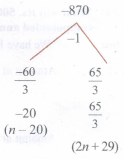
⇒ 3n2 + 5n - 1300 = 0
⇒ (n - 20) (3n + 65) = 0
⇒ n = 20 or \(n={-65\over 3}\) which is not possible
∴ n = 20
Thus, the amount is cleared in 20 months.
14.
Given series is \(\sqrt { 3 } +\sqrt { 75 } +\sqrt { 243 } +.... .\) and \(S_n =435\sqrt { 3 }\)
Given series is \(1(\sqrt3)+5(\sqrt3)+9(\sqrt3)+...\)
Here a = √3, d = 4√3
∴ The given series an arithmetic progression
\(∴\ S_n={n\over2}[2a+(n-1)d]\)
\(435\sqrt3={n\over2}[2\sqrt3 +(n -1)4\sqrt3]\) [∵ given Sn = 435√3J]
\(435\sqrt3={n\over2}[2\sqrt3+4n\sqrt3-4\sqrt4]\)
\(⇒\ 435\sqrt3={n\over2}[4n\sqrt3-2\sqrt3]\)
\(⇒\ 435\sqrt3=2{\sqrt3.n\over2}[2n-1]\)
⇒ 435 = 2n2-n
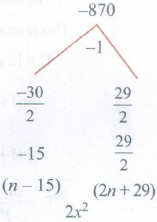
⇒ 2n2- n - 435 = 0
⇒ (n = 15)(2n + 29) = 0
⇒ \(n-15\ or\ n={-29\over2}\) which is not possible
⇒ n = 15
15.
Let Tn be the nth term of the given series
Then Tn = 1 + 4 + 42 + 43 + ...
\(=1\left(4^n-1\over 4-1\right)\)
\(={4^n-1\over 3}\)
Let Sn be the sum to n terms of the given series
Then \(S_n={\sum_{k=1}^n}T_k=\sum_{k=1}^n{4^n-3\over3}\)
\(⇒\ S_n={1\over3}\left[ \sum_{k=1}^n4^n-\sum_{k=1}^n3\right]\)
\(⇒\ S_n= {1\over3}[4^1+4^]+...+4^n-3^n\)
\(⇒\ S_n={1\over3}\left[ 4{(4^n-1)\over4-1}-3n\right]\)
\(⇒\ S_n={1\over3}\left[ 4{(4^n-1)\over4-1}-3n\right]={1\over 3}\left[4{(4^n-1)-9n\over3}\right]\)
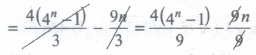
\({ S }_{ n }=\frac { 4 }{ 9 } \left[ \left( { 4 }^{ n }-1 \right) -n/3 \right] \)
16.
Let = 6 + 66 + 666 + ... upto n terms
= 6 (I + 11 + 111+ ....) upto n terms
\(={6\over9}(9+99+999+ ...)\) upto n terms
\(={63\over 6}[(10 -1) + (10^2-1) + (10^3 -1) + ...]\) upto n terms
\(={6\over 9}[(10+ 10^2 + 10^3+ ...) - (1+ 1+1...)]\) upto n terms
\(={6\over9}\left[{ 10(10^n-1)\over 10-1}n\right]\)[In a G.P with a = 10 r = 10, \(S_n={(r^n-1)\over r-1}\)]
\(={6\over9}\left[{ 10(10^n-1)\over 10-1}n\right]={6\over9}\left[ 10(10^n-1)-9n\over9\right]\)
\({ S }_{ n }=\frac { 6 }{ 81 } \left[ 10\left( { 10 }^{ n }-1 \right) -9n \right] \)
17.
Let Sn = 8 + 88 + 888 + 8888 + .... upto n terms
= 8 (1 + 11 + 111 + 1111 + ....) upto n terms
\(={8\over9}(9 + 99 + 999 + ...)\)
\({ S }_{ n }=\frac { 8 }{ 81 } \left[ \left( { 10 }^{ n }-1 \right) -9n \right] \) [multiplying and dividing by 9]
\(={8\over9}[10 -1) + (100 -1) + (1000 -1) + ...]\)
\(S_n={8\over 9}[(10^1 +10^2 +10^3 + ... +10^n)-(1+1+1+ ... +1n\ terms)]\)
In 10 + 102 + 103 + ... + 10n, a = 10, r= 10, and it forms a G.P.
\(∴\ S_n={a(r^n-1)\over r-1}=10{(10^n-1)\over 10-1}={10\over 9}(10^n)-1\) and 1 + 1 + 1 ... + upto n terms = n
Substituting these values in (1) we get
\(S_n={8\over 9}\left[ 10(10^n-1)n\over 9\right]\)
\(S_n={8\over 81}[(10^n-1)-9n]\)
18.
Let Tn be the nth term of the given sequence.
Given sequence is \({1\over1},{4\over3},{7\over9},{10\over27}....\)
Consider the terms in the numerator
1, 4, 7, 10,...
Here a = 1, d = 3
The terms in the denominator are \({1\over3^0},{1\over3^1},{1\over 3^2}\), which is a G.P with \(r={1\over3}\)
∴ The given sequence can be written in the form of a, (a + d)r, (a + 2d)r2,(a + 3d), r3, ...
This is an arithmetic - geometric progression.
∴ Tn = [a+(n-1)d]rn-1
\(=[1+(n -1)3]\left(1\over3\right)^{n-1}\)
\(=({1+3n-3})\left(1\over 3^{n-1}\right)={3n-2\over 3^{n-1}}\)
\(∴\ T_n={3n-2\over 3^{n-1}}\)
Let Sn be the sum to n terms of the given sequence
\(S_n=\sum_{k=1}^n{3k-2\over 3^{k-1}}\)
\(={\sum_{k=1}^n3k-2.{1\over{\sum_{k=1}^n}3^{k-1}}}\)
\(= 3[1+ 2 + 3+ ...+ n] - 2n \left[ 1\over3^0+3^2+...+3^{r-1}\right]\)
\(=\left[ 3{n(n+1)\over2}-2n\right]\left[ 1\over 1\left(3^n-1\over 3-1\right)\right]\)
\(=\left[{3n^2+3n\over2}-2n\right]\left[2\over 3^n-1\right]={3n^2+3n-4n\over2}\times{2\over3^n-1}\)
\(\frac { { 3n }^{ 2 }-n }{ { 3 }^{ n }-1 } =\frac { n\left( n-1 \right) }{ { 3 }^{ n }-1 } \)
19.
Tn = a + (n - 1)d
Tm+n = a + (m + n - 1)d
& Tm-n = a + (m - n - 1)d
Tm+n + Tm-n = a + (m + n - 1)d + a + (m - n - 1)d
= 2a + d(m + n - 1 + m - n - 1)
= 2a + d(2m - 2)
= 2[a + (m - 1)d]
Tm+n + Tm-n = 2. Tm

11th Standard Syllabus & Materials
11th Standard
TN 11th Tamil பீடு பெற நில் - செய்யுள் - காவடிச்சிந்து Important Questions And Answers Study Material - QB365 Set A
NEW11th Standard
TN 11th Tamil பீடு பெற நில் - உரைநடை - மலை இடப்பெயர்கள் : ஓர் ஆய்வு Important Questions And Answers Study Material - QB365 Set A
NEW11th Standard
TN 11th Tamil மாமழை போற்றுதும் - துணைப்பாடம் - யானை டாக்டர் Important Questions And Answers Study Material - QB365 Set A
NEW11th Standard
TN 11th Tamil மாமழை போற்றுதும் - செய்யுள் - ஐங்குறுநூறு Important Questions And Answers Study Material - QB365 Set A



Tamilnadu Stateboard 11th Standard Subjects
Maths

Commerce

Economics

Biology

Business Maths and Statistics

Accountancy

Computer Science

Physics

Chemistry
Maths
Biology
Economics
Physics
Chemistry

History
Business Maths and Statistics

Computer Science
Accountancy

Computer Applications
History
Computer Technology
Commerce
Computer Applications
Computer Technology

Tamil

English

French
Tamilnadu Stateboard Standards

