
 100% FREE ACCESS
11th Standard Syllabus & Materials
11th Standard
TN 11th Tamil இயற்கை வேளாண்மை,சுற்றுச்சூழல் -செய்யுள் - மனோன்மணீயம் Important Questions And Answers Study Material - QB365 Set A
NEW11th Standard
TN 11th Tamil என்னுயிர் என்பேன் -துணைப்பாடம் - இசைத்தமிழர் இருவர் Important Questions And Answers Study Material - QB365 Set A
NEW11th Standard
TN 11th Tamil மொழி கலை -செய்யுள் - ஒவ்வொரு புல்லையும் Important Questions And Answers Study Material - QB365 Set A
NEW11th Standard
TN 11th Tamil பீடு பெற நில் - இலக்கணம் - பகுபத உறுப்புகள் Important Questions And Answers Study Material - QB365 Set A
NEW11th Standard
TN 11th Tamil பீடு பெற நில் - துணைப்பாடம் - வாடிவாசல் Important Questions And Answers Study Material - QB365 Set A
NEW11th Standard
TN 11th Tamil பீடு பெற நில் - செய்யுள் - குறுந்தொகை Important Questions And Answers Study Material - QB365 Set A

Published on: 29/09/2018
Important 5mark questions
Download Tamil Nadu 11th Standard Maths question papers, model tests, one-mark questions, important questions, and public exam papers in PDF format. Free study materials and answer keys for TN State Board students.
Questions + Answers key
Take MCQ Maths Test1.
Let A = {1, 2, 3, 4} and B = {a, b, c, d}. Give a function from A\(\rightarrow\)B for each of the following:
one-to-one but not onto.
2.
Let A = {1, 2, 3, 4} and B = {a, b, c, d}. Give a function from A\(\rightarrow\)B for each of the following:
not one-to-one but onto.
3.
Let A={1,2,3,4} and B = {a,b,c,d}. Give a function from A\(\rightarrow\)B for each of the following:
neither one-to-one and nor onto.
4.
In a ∆ABC, prove that (a2 - b2 + c2) tan B = (a2 + b2 - c2) tan C
5.
Prove that \(1+cos2x+cos4x+cos6x=4cosx\ cos2x\ cos3x\)
6.
Prove that \(\frac { sin4x+sin2x }{ cos4x+cos2x } =tan3x\)
7.
Using Heron's formula, show that the equilateral triangle has the maximum area for any fixed perimeter. [Hint: In xyz \(\le\) k, maximum occurs when x = y = z]
8.
In a triangle ABC, prove that \({a^2+b^2\over a^2+c^2}={1+cos(A-B)cos C\over 1+cos (A-C)cos B}\)
9.
If A + B + C = \(\pi\), prove the following
i. cos A + cos B + cos C = 1 + 4 sin \(({A\over 2})\) sin \(({B\over 2})\) sin \(({C\over 2})\)
ii. sin \(({A\over 2})sin({B\over2})sin({C\over 2})\le{1\over 8}\)
iii. 1 < cos A + cos B + cos C \(\le\frac{3}{2}\)
10.
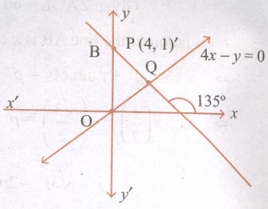
Find the distance of the line 4x - y = 0 from the point p( 4,1) measured along the line making an angle of 135° with the positive x-axis.
11.
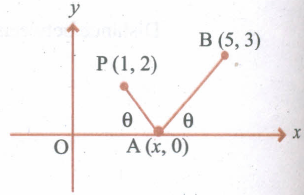
A ray of light coming from the point (1, 2) is reflected at a point A on the x-axis and it passes through the point (5, 3). Find the co-ordinates of the point A.
12.
Find the largest possible domain of the real valued function f(x) =\(\frac { \sqrt { 4-{ x }^{ 2 } } }{ \sqrt { { x }^{ 2 }-9 } } \)
13.
Prove that \(sin\frac { \theta }{ 2 } sin\frac { 7\theta }{ 2 } +sin\frac { 3\theta }{ 2 } sin\frac { 11\theta }{ 2 } =sin2\theta sin5\theta \)
1.
The function does not exist for one-to-one but not onto.
Since f = A\(\rightarrow\) B, f is one-one \(\Rightarrow\) f must be onto [\(\therefore\) n(A) = n(B)]
2.
Given A = {1, 2, 3, 4}, and B = {a, b, c, d}
Let f = A \(\rightarrow\) B.
The function does not exist for not one-one but onto. Since f = A\(\rightarrow\)B, f is onto \(\Rightarrow\) f must be one-one since n(A) = n(B)
3.
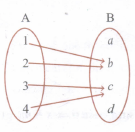
Let f = {(1, b) (2, b) (3, c) (4, d)}
Different elements in A does not have different images in B
∴ f is not one-one
Now, Co-domain = {a, b, c, d}, Range = {b, c}
Co-domain ≠ range
∴ f is not onto. Hence f is neither one-one and nor onto.
4.
Let us prove that \(\frac { { a }^{ 2 }-{ b }^{ 2 }+{ c }^{ 2 } }{ { a }^{ 2 }+{ b }^{ 2 }-{ c }^{ 2 } } =\frac { tanC }{ tanB } -tanC.tanB\)
LHS = \(\frac { { a }^{ 2 }-{ b }^{ 2 }+{ c }^{ 2 } }{ { a }^{ 2 }+{ b }^{ 2 }-{ c }^{ 2 } } =\frac { { k }^{ 2 }{ sin }^{ 2 }A-{ k }^{ 2 }{ sin }^{ 2 }B+{ k }^{ 2 }{ sin }^{ 2 }C }{ { k }^{ 2 }{ sin }^{ 2 }A+{ k }^{ 2 }{ sin }^{ 2 }B-{ k }^{ 2 }{ sin }^{ 2 }C } \)
\(\frac { { sin }^{ 2 }A-{ sin }^{ 2 }B+{ sin }^{ 2 }C }{ { sin }^{ 2 }A-{ sin }^{ 2 }C+{ sin }^{ 2 }B } \)
= \(\frac { sin\left( A+B \right) sin\left( A-B \right) +{ sin }^{ 2 }C }{ sin\left( A+C \right) sin\left( A-C \right) +{ sin }^{ 2 }B } \)
= \(\frac { sinC\left[ sin\left( A-B \right) +sinC \right] }{ sinB\left[ sin\left( A-C \right) +sinB \right] } \)
= \(\frac { sinC\left[ sin\left( A-B \right) +sin\left( A+B \right) \right] }{ sinB\left[ sin\left( A-C \right) +sin\left( A+C \right) \right] } \)
= \(\frac { sinC.2sinAcosB }{ sinB.2sinAcosC } \)
= \(\frac { sinC }{ cosC } .\frac { cosB }{ sinB } \)
= tan C = RHS
Hence proved.
5.
\(LHS=1+cos2x+cos4x+cos6x\quad \left[ \because 1+cos2x=2{ cos }^{ 2 }x \right] \)
\(=2{ cos }^{ 2 }x+cos4x+cos6x\)
\(=2{ cos }^{ 2 }x+2cos\left( \frac { 4x+6x }{ 2 } \right) .cos\left( \frac { 4x-6x }{ 2 } \right) \quad \left[ \because cosA+cosB=2cos\left( \frac { A+B }{ 2 } \right) .cos\left( \frac { A-B }{ 2 } \right) \right] \)
= 2cos2x + 2cos 5x.cos(-x)
= 2cos2x + 2cos 5x cos x
\(=2cosx\left( 2cos\frac { x+5x }{ 2 } .cos\left( \frac { x-5x }{ 2 } \right) \right) \)
= 2cos x.2cos 3x.cos(-2x)
= 4cos x cos 3x.cos 2x
= RHS \(\quad \left[ \because cos(-\theta =cos\theta \right] \)
6.
\(LHS=\frac { sin4x+sin2x }{ cos4x+cos2x } \)
\(=\frac { 2sin\left( \frac { 4x+2x }{ 2 } \right) .cos\left( \frac { 4x-2x }{ 2 } \right) }{ 2cos\left( \frac { 4x+2x }{ 2 } \right) .cos\left( \frac { 4x-2x }{ 2 } \right) } =\frac { sin3x.cosx }{ cos3x.cosx } =tan3x\) = RHS
7.
Let ABC be a triangle with constant perimeter 2s. Thus s is constant.
We know that \(\triangle =\sqrt{s(s-a)(s-b)(s-c)}\)
Observe that \(\triangle\) is maximum, when (s - a) (s - b) (s - c) is maximum.
Now, (s-a)(s-b)(s-c)\(\le\)\(({(s-a)+(s-b)+(s-c)\over 3})^3\) = \({s^3\over 27}\) [G.M\(\le\) A.M]
Thus, we get (s - a) (s - b) (s - c) \(\le\) \({s^3\over 27}\)
Equality occurs when s - a = s - b = s - c. That is, when a = b = c maximum of (s - a) (s - b) (s - c) is \({s^3\over 27}\)
Thus, for a fixed perimeter 2s, the area of a triangle is maximum when a = b = c.
Hence, for a fixed perimeter, the equilateral triangle has the maximum area and the maximum area is given by \(\triangle =\sqrt {s(s)^3\over 27}={s^2\over3\sqrt{3}}sq.units\)
8.
The law of sine: \(({a\over sin A})=({b\over sin B})=({c\over sin C})=2R\)
LHS \(={{a^2+b^2}\over{a^2+c^2}}={{(2R \sin A)}^{2}+{(2R \sin B)}^{2}\over{{(2 R \sin A)}^{2}+{(2R \sin C)}^{2}}}\)
\(={{\sin^2 A+\sin^2 B}\over{\sin^2 A+\sin^2 C}}={{1-\cos^2 A+\sin^2 B}\over{1-\cos^2 A+\sin^2 C}}\)
\(={{1-({\cos}^{2}A-{\sin}^{2}B)}\over{1-({\cos}^{2}A-{\sin}^{2}C)}}={1-\cos(A+B)\cos(A-B)\over1-\cos(A+C)\cos(A-C)}\)
\(={1+\cos(A-B)\cos C\over 1+\cos (A-C)\cos B}\)
9.
i. cos A + cos B + cos C = 2 cos \(({A+B\over 2})\) cos \(({A-B\over 2})\) + cos C
= 2cos \(({\pi \over2}-{c\over2})cos ({A\over2}-{B\over2})+cos C \ (\frac{A+B+C}{2}=\frac{\pi}{2})\)
= 2sin \(({c\over2})cos ({A\over2}-{B\over2})+1-2 sin^2( {C\over 2})\)
= 1 + 2sin \(({c\over2})[cos ({A\over2}-{B\over2})- sin( {C\over 2})]\)
= 1 + 2sin \(({c\over2})[cos ({A\over2}-{B\over2})- cos({\pi\over2}- {C\over 2})]\)
= 1 + 2sin \(({c\over2})[cos ({A\over2}-{B\over2})- cos({A\over2}+ {B\over 2})]\)
= 1 + 4sin \(({A\over 2})sin({B\over2})sin({C\over 2})\)
ii. Let u = sin \(({A\over 2})sin({B\over2})sin({C\over 2})\)
\(=-{1\over2}[cos({A+B\over2})-cos({A-B\over2})]sin{c\over2}\)
\(=-{1\over2}[cos({A+B\over2})-cos({A-B\over2})]cos{A+B\over2}\)
\(=cos^2{A+B\over2}-cos{A-B\over2}cos{A+B\over2}+2u=0,\) which is quadratic in cos \({A+B\over2}\)
Since cos \({A+B\over2}\) is real number, the above equation has a solution.
Thus, the discriminant b2 - 4ac \(\ge\) 0, which gives
\(=cos^2{A-B\over2}-8u \ge 0 \Rightarrow u \le {1\over8}cos^2{A-B\over2}\le{1\over 8}\)
Hence, sin \(({A\over 2})sin({B\over2})sin({C\over 2})\le{1\over 8}\)
iii. From (i) and (ii), we have cos A + cos B + cos C > 1 and cos A + cos B + cos C ≤ 1 + 4 × \({1\over 8}\)
Thus, we get 1 < cos A + cos B + cos C \(\le\frac{3}{2}\)
10.
The equation in distance form of the line passing through p(4, 1) and making an angle of 135o with the positive x-axis is
\(\frac { x-4 }{ \cos { { 135 }^{ o } } } =\frac { y-1 }{ \sin { { 135 }^{ o } } } \)
Suppose it cuts 4x - y =0 at Q such that pQ = r.
Then, the co-ordinates of Q are
\(\frac { x-4 }{ \cos { { 135 }^{ o } } } =\frac { y-1 }{ \sin { { 135 }^{ o } } } =r\)
cos 135o = cos (180o - 45o) = - cos 45o = \(\frac { -1 }{ \sqrt { 2 } } \)
sin (135o) = sin (180o - 45o) = - sin 45o = \(\frac { -1 }{ \sqrt { 2 } } \)
Substituting these values in (1) we get,
\(\frac { x-4 }{ \frac { -1 }{ \sqrt { 2 } } } =\frac { y-1 }{ \frac { 1 }{ \sqrt { 2 } } } =r\)
\(\Rightarrow x=4-\frac { r }{ \sqrt { 2 } } ,y=1+\frac { r }{ \sqrt { 2 } } \)
\(\therefore\) Q is \(\left( 4-\frac { r }{ \sqrt { 2 } } ,1+\frac { r }{ \sqrt { 2 } } \right) \)
Clearly Q lies on 4x - y = 0
\(\therefore 16-\frac { 4r }{ \sqrt { 2 } } -1-\frac { r }{ \sqrt { 2 } } =0\)
\(\Rightarrow \frac { 5r }{ \sqrt { 2 } } =15\Rightarrow r=3\sqrt { 2 } \)
Hence, the required distance is \(3\sqrt2\) units.
11.
Let P(1, 2) and B(5, 3) are the given points.
By the property of reflector \(\angle \) XAB = \(\angle \) OAP = \(\theta\)
Let m1 be the slope of the x-axis, m2 and m3 be the slopes of the lines AP and AB.
To find XAB,
Clearly m1 = 0 Since it represents slope of x-axis.
\({ m }_{ 2 }=\frac { 2-0 }{ 1-x } =\frac { 2 }{ 1-x } and\left[ m=\frac { { y }_{ 2 }-{ y }_{ 1 } }{ { x }_{ 2 }-{ x }_{ 1 } } \right] \)
\({ m }_{ 3 }=\frac { 3-0 }{ 5-x } =\frac { 3 }{ 5-x } \)
\(tan\ \theta =\left| \frac { { m }_{ 1 }-{ m }_{ 3 } }{ 1+{ m }_{ 1 }.{ m }_{ 3 } } \right| \)
\(tan\ \theta =\left| \frac { 0-\frac { 3 }{ 5-x } }{ 1+0\left( \frac { 3 }{ 5 } -x \right) } \right| =\frac { 3 }{ 5-x } \)
To find \(\angle \)OAP,
\(tan(-\theta )=\left| \frac { { m }_{ 1 }-{ m }_{ 2 } }{ 1+{ m }_{ 1 }{ m }_{ 2 } } \right| =\left| \frac { 0-\frac { 2 }{ 1-x } }{ 1+0\left( \frac { 2 }{ 1-x } \right) } \right| =\frac { 2 }{ 1-x } \) [Since OAP is in the clockwise direction]
\(\Rightarrow \ -tan\theta =\frac { 2 }{ 1-x } \ \quad [\because tan\theta (-\theta )=tan\quad \theta ]\)
\(\Rightarrow \quad tan\quad \theta =\frac { -2 }{ 1-x } \)
From (1) and (2),
\(\frac { 3 }{ 5-x } =\frac { -2 }{ 1-x } \Rightarrow 3-3x=-10+2x\)
\(\Rightarrow\) 3 + 10 = 2x + 3x
\(\Rightarrow\) 13 = 5x
\(\Rightarrow \ x=\frac { 13 }{ 5 } \)
The required co-ordinates of A is \( \left( \frac { 13 }{ 5 } ,0 \right) \)
12.
Given f(x) = \(\frac { \sqrt { 4-{ x }^{ 2 } } }{ \sqrt { { x }^{ 2 }-9 } } \)
When x = 2, f(x) = 0
When x = -2, f(x) = 0
For all the other values, we get negative value in the square root which is not possible.
\(\therefore\) Domain = {2, -2}
13.
\(LHS=sin\frac { \theta }{ 2 } sin\frac { 7\theta }{ 2 } +sin\frac { 3\theta }{ 2 } sin\frac { 11\theta }{ 2 } \)
\(=\frac { 1 }{ 2 } \left[ cos\left( \frac { \theta }{ 2 } -\frac { 7\theta }{ 2 } \right) -cos\left( \frac { \theta }{ 2 } -\frac { 7\theta }{ 2 } \right) \right] +\frac { 1 }{ 2 } \left[ cos\left( \frac { 3\theta }{ 2 } -\frac { 11\theta }{ 2 } \right) -cos\left( \frac { 3\theta }{ 2 } -\frac { 11\theta }{ 2 } \right) \right] \)
\(=\frac { 1 }{ 2 } \left[ cos(-3\theta )-cos(4\theta )+cos(-4\theta )-cos7\theta \right] \)
\(=\frac { 1 }{ 2 } \left[ cos3\theta -cos4\theta +cos4\theta -cos7\theta \right] \quad \quad \left[ \because cos(-\theta )=cos\theta \right] \)
\(=\frac { 1 }{ 2 } \left[ cos3\theta -cos7\theta \right] =\frac { 1 }{ 2 } \left[ 2sin\left( \frac { 3\theta +7\theta }{ 2 } \right) .sin\left( \frac { 7\theta -3\theta }{ 2 } \right) \right] \)
\(=sin5\theta .sin2\theta =RHS.\)

11th Standard Syllabus & Materials
11th Standard
TN 11th Tamil பீடு பெற நில் - செய்யுள் - காவடிச்சிந்து Important Questions And Answers Study Material - QB365 Set A
NEW11th Standard
TN 11th Tamil பீடு பெற நில் - உரைநடை - மலை இடப்பெயர்கள் : ஓர் ஆய்வு Important Questions And Answers Study Material - QB365 Set A
NEW11th Standard
TN 11th Tamil மாமழை போற்றுதும் - துணைப்பாடம் - யானை டாக்டர் Important Questions And Answers Study Material - QB365 Set A
NEW11th Standard
TN 11th Tamil மாமழை போற்றுதும் - செய்யுள் - ஐங்குறுநூறு Important Questions And Answers Study Material - QB365 Set A



Tamilnadu Stateboard 11th Standard Subjects
Maths

Commerce

Economics

Biology

Business Maths and Statistics

Accountancy

Computer Science

Physics

Chemistry
Maths
Biology
Economics
Physics
Chemistry

History
Business Maths and Statistics

Computer Science
Accountancy

Computer Applications
History
Computer Technology
Commerce
Computer Applications
Computer Technology

Tamil

English

French
Tamilnadu Stateboard Standards

