
 100% FREE ACCESS
11th Standard Syllabus & Materials
11th Standard
TN 11th Tamil இயற்கை வேளாண்மை,சுற்றுச்சூழல் -செய்யுள் - மனோன்மணீயம் Important Questions And Answers Study Material - QB365 Set A
NEW11th Standard
TN 11th Tamil என்னுயிர் என்பேன் -துணைப்பாடம் - இசைத்தமிழர் இருவர் Important Questions And Answers Study Material - QB365 Set A
NEW11th Standard
TN 11th Tamil மொழி கலை -செய்யுள் - ஒவ்வொரு புல்லையும் Important Questions And Answers Study Material - QB365 Set A
NEW11th Standard
TN 11th Tamil பீடு பெற நில் - இலக்கணம் - பகுபத உறுப்புகள் Important Questions And Answers Study Material - QB365 Set A
NEW11th Standard
TN 11th Tamil பீடு பெற நில் - துணைப்பாடம் - வாடிவாசல் Important Questions And Answers Study Material - QB365 Set A
NEW11th Standard
TN 11th Tamil பீடு பெற நில் - செய்யுள் - குறுந்தொகை Important Questions And Answers Study Material - QB365 Set A

Published on: 22/08/2018
objective type
Download Tamil Nadu 11th Standard Maths question papers, model tests, one-mark questions, important questions, and public exam papers in PDF format. Free study materials and answer keys for TN State Board students.
Questions + Answers key
Take MCQ Maths Test1.
The locus of a point which is collinear with the points (a, 0) and (0, b) is ______________
x + y = 1
\(\frac{x}{a}+\frac{y}{b}=1\)
x + y = ab
\(\frac{x}{a}-\frac{y}{b}=1\)
2.
If the co-ordinates of a variable point p be \((t+\frac{1}{t},t-\frac{1}{t})\) where t is the parameter then the locus of p ______________
xy = 1
x2+ y2 = 4
x2- y2 = 4
x2- y2 = 8
3.
The locus of a point which is equidistant from (1, 0) and (-1, 0) is ______________
x-axis
y-axis
y = x
y = -x
4.
The locus of a point which is equidistant from (-1, 1) and (4, 2) is ______________
5x + 3y + 9 = 0
5x + 3y - 9 = 0
3x - 5y = 0
3x + 5y - 9 = 0
5.
If O is the origin and Q is a variable point on y2 = x, then the locus of the mid-point of OQ is ______________
y2 = 2x
2y2 = x
4y2 = x
y = 2x2
6.
If p is the length of perpendicular from origin to the line \(\frac{x}{a}+\frac{y}{b}=1\) then ______________
\(\frac{1}{p^2}=\frac{1}{a^2}+\frac{1}{b^2}\)
\(\frac{1}{p^2}=\frac{1}{a^2}-\frac{1}{b^2}\)
\(\frac{1}{p^2}=-\frac{1}{a^2}+\frac{1}{b^2}\)
\(\frac{1}{p^2}=-\frac{1}{a^2}-\frac{1}{b^2}\)
7.
The co-ordinates of a point on x + y + 3 = 0 whose distance from x + 2y + 2 = 0 is \(\sqrt 5\), is ______________
(9, 6)
(-9, 6)
(6, -9)
(-9, -6)
8.
The point (2, 1) and (-3, 5) are on ______________
Same side of the line 3x - 2y + 1 = 0
Opposite sides of the line 3x - 2y + 1 = 0
On the line 3x - 2y + 1 = 0
On the line x + y = 3
9.
If one of the lines by 6x2- xy + 4cy2 = 0 is 3x + 4y = 0, then c = ______________
1
-1
3
-3
10.
If one of the lines of my2+(1-m2)xy - mx2 = 0 is a bisector of the angle between the lines xy = 0 then m is ______________
\(\frac{-1}{2}\)
-2
1
2
11.
The distance between the parallel lines 3x - 4y + 9 = 0 and 6x - 8y -15 = 0 is ______________
\(\frac{-33}{10}\)
\(\frac{10}{33}\)
\(\frac{33}{10}\)
\(\frac{33}{20}\)
12.
The angle between the lines x2+ 4xy + y2 = 0 is ______________
600
150
300
450
13.
Separate equation of lines for a pair of lines whose equation is x2+ xy -12y2 = 0 are ______________
x + 4y = 0 and x + 3y = 0
2x - 3y = 0 and x - 4y = 0
x - 6y = 0 and x - 3y = 0
x + 4y = 0 and x - 3y = 0
14.
The equation of the straight line joining the origin to the point of intersection of y - x + 7 = 0 and y + 2x - 2 = 0 is ______________
3x + 4y = 0
3x - 4y = 0
4x - 3y = 0
4x + 3y = 0
15.
The equation x2+ kxy + y2- 5x - 7y + 6 = 0 represents a pair of straight lines then k = ______________
\(\frac{5}{3}\)
\(\frac{10}{3}\)
\(\frac{3}{2}\)
\(\frac{3}{10}\)
16.
The gradient of one of the lines of ax2+ 2hxy + by2 = 0 is twice that of the other, then ______________
h2 = ab
h = a + b
8h2 = 9ab
9h2 = 8ab
17.
The angle between the lines 2x - y + 5 = 0 and 3x + y + 4 = 0 is ______________
450
300
600
900
18.
The points (a, 0),(0, b) and (1, 1) will be collinear if ______________
a + b = 1
a + b = 2
\(\frac{1}{a}+\frac{1}{b}=1\)
a + b = 0
19.
If the points (2k, k) (k, 2k) and (k, k) enclose a triangle of area 18 sq units, then the centroid of the triangle is ______________
(8, 8)
(4, 4)
(3, 3)
(2, 2)
20.
The image of the point (3,8) in the line x+3y=7 is
(1,4)
(-1,-4)
(-4,-1)
(1,-4)
21.
The points (k + 1, 1), (2k + 1, 3) and (2k + 2, 2k) are collinear if ______________
k = -1
\(k=\frac{1}{2}\)
k = 3
k = 2
22.
The value \(\lambda\) for which the equation 12x2- 10xy + 2y2+11x-5y+\(\lambda\) = 0 represent a pair of straight lines is ______________
\(\lambda\) = 1
\(\lambda\) = 2
\(\lambda\) = 3
\(\lambda\) = 0
23.
If co-ordinate axes are the angle bisectors of the pair of lines ax2+ 2hxy + by2 = 0 then ______________
a = b
h = 0
a + b = 0
a2+ b2 = 0
24.
The equation of the bisectors of the angle between the lines represented by 3x2- 5xy + 4y2 = 0 is ______________
3x2- 5xy - 3y2 = 0
3x2+ 5xy + 4y2 = 0
5x2- 2xy - 5y2 = 0
5x2- 2xy + 5y2 = 0
25.
If h2 = ab, then the lines represented by ax2+ 2hx + by2 = 0 are ______________
parallel
perpendicular
coincident
None
26.
The angle between the lines \((x^2+y^2)sin^2\alpha=(xcos\alpha-y\beta)^2\)
\(\alpha\)
\(2\alpha\)
\(\alpha+\beta\)
None
27.
Pair of lines perpendicular to the lines represented by ax2+ 2hxy + by2 = 0 and through origin is ______________
ax2+ 2hxy + by2 = 0
bx2+ 2hxy + ay2 = 0
bx2- 2hxy + ay2 = 0
bx2- 2hxy + ay2 = 0
28.
The equation 3x2+ 2hxy + 3y2 = 0 represents a pair of straight lines passing through the origin. The two lines are ______________
real and distinct if h2 > 3
real and distinct if h2 > 0
real and distinct h2 > 6
real and distinct if h2- 9 = 0
29.
The condition that the slope of one of the lines represented by ax2 + 2hxy + by2 = 0 is n times the slope of the other is ______________
4nh2 = ab(1 + n)2
8h2 = 9ab
4n = ab(1 + n)2
4nh2 = ab
30.
The image of the point (1, 2) with respect to the line y = x is ______________
(-1, -2)
(2, 1)
(2, -1)
(2, 1)
31.
Which one of the following statements is false?
The image of a point \((\alpha\beta)\) about x-axis \((\alpha,-\beta)\)
The image of the line ax+by+c=0 about x-axis is ax-by+c=0
The image of a point \((\alpha,\beta)\) about y-axis \((-\alpha,\beta)\)
The image of the line ax+by+c=0 about y-axis is ax-by+c=0
32.
The co-ordinates of the foot of the perpendicular drawn from the point (2, 3) to the line 3x - y + 4 = 0 is ______________
\((\frac{1}{10},\frac{37}{10})\)
\((\frac{-1}{10},-\frac{37}{10})\)
\((\frac{-1}{10},\frac{37}{10})\)
\((\frac{37}{10},\frac{-1}{10})\)
33.
The lines ax + y + 1 = 0, x + by + 1 = 0 and x + y + c = 0(a ≠ b ≠ c ≠ 1) are concurrent, then the value of \(\frac{1}{1-a}+\frac{1}{1-b}+\frac{1}{1-c}=\) ______________
-1
1
0
abc
34.
Which one of the following statements in false?
A point \((\alpha,\beta)\) will lie on origin side of the line ax+by+c=0 if a\(\alpha\)+b\(\beta\)+c and c have the same sign
A point \((\alpha,\beta)\) will lie on non-origin side of the line ax+by+c=0 if a\(\alpha\)+b\(\beta\) +c and c have opposite sign
If \(\alpha=\frac{\pi}{2},p=0\) , then the equation xcos\(\alpha\)+ysin\(\alpha\)=p represents x-axis
If \(\alpha =0,p=0\), then the equation xcos\(\alpha\)+ysin\(\alpha\)=presents x-axis
35.
The distance of the point (2, 3) from the line 2x - 3y + 9 = 0 measured along the line 2x - 2y + 5 = 0 is ______________
\(\sqrt 2\)
\(2\sqrt 2\)
\(4\sqrt 2\)
4
36.
The lines x cos \(\alpha\) + y sin \(\alpha\) = p and xcos\(\beta\) + y sin\(\beta\) = q will be perpendicular if ______________
\(\alpha =\beta\)
\(\alpha-\beta=\frac{\pi}{2}\)
\(|\alpha-\beta|=\frac{\pi}{2}\)
\(\alpha-\beta=0\)
37.
The length of perpendicular from the origin to a line is 12 and the line makes an angle of 120° with the positive direction of y-axis. then the equation of line is ______________
\(x+y\sqrt 3=24\)
\(x+y=12\sqrt 2\)
x + y = 24
\(x+y=12\sqrt 3\)
38.
The equation of the straight line upon which the length of perpendicular from the origin is p and this normal makes an angle \(\theta\) with the positive direction of x-axis is ______________
x sin\(\theta\) + y cot\(\theta\) = p
x sin \(\theta\) + y cos \(\theta\) = p
x sin \(\theta\) + y tan \(\theta\) cos \(\theta\) = p
x cos \(\theta\) + y sin \(\theta\) = p
39.
The equation of the straight line which passes through the point (2, 4) and have intercept on the axes equal in magnitude but opposite in sign is ______________
x - y = 2
x - y + 2 = 0
x - y + 1 = 0
x - y - 1 = 0
40.
The equation of median from verten B of the triangle \(\triangle ABC\) the co-ordinates of whose vertices are A(-1, 6)B(-3, -9)C(5, -8) ___________
29x + 4y + 5 = 0
8x - 5y - 21 = 0
13x + 14y + 47 = 0
x + y -7 = 0
41.
The equation of the straight line bisecting the line segment joining the points (2, 4) and (4, 2) and making an angle of 45o with positive direction of x-axis is ______________
x + y = 6
x - y = 0
x - y = 6
x + y = 0
42.
The equation of a line which makes an angle of 135° with positive direction of x-axis and passes through the point (1, 1) is ______________
x+y=2
x-y=0
\(2\sqrt {2x}-\sqrt {2y}=0\)
x-3y=0
43.
The equation of the bisectors of the angle between the co-ordinate axes are ______________
x+y=0
x-y=0
x\(\pm\)y=0
x=0
44.
The inclination to the x-axis and intercept on y-axis of the line \(\sqrt {2y}=x+2\sqrt 2\) ______________
\(30^0,\sqrt 2\)
300,2
\(45^0,2\sqrt 2\)
450,2
45.
If the straight line y = mx + c passes through the point (1, 2) and (-2, 4) then the value of m and c are ______________
\(\frac{8}{3},\frac{-2}{3}\)
\(\frac{-2}{3},\frac{8}{3}\)
\(\frac{2}{3},\frac{-8}{3}\)
\(\frac{-2}{3},\frac{-8}{3}\)
46.
Find the angle between the lines 3x2- 10xy - 3y2 = 0 ______________
90°
45°
60°
30°
47.
The slope of the line joining A and B where A is (-1, 2) and B is the point of intersection of the lines 2x + 3y = 5 and 3x + 4y = 7 is ______________
-2
2
\(\frac{1}{2}\)
-\(\frac{1}{2}\)
48.
Find the nearest point on the line 3x + y = 10 from the origin is ______________
(2, 1)
(1, 2)
(3, 1)
(1,3)
49.
The lines x + 2y - 3 = 0 and 3x - y + 7 = 0 are ______________
parallel
neither parallel nor perpendicular
perpendicular
parallel as wellas perpendicular
50.
If(1, 3) (2,1) (9, 4) are collinear then a is ______________
\(\frac{1}{2}\)
2
0
-\(\frac{1}{2}\)
51.
The length of the perpendicular from origin to line is \(\sqrt{3}x-y+24=0\) is ______________
2\(\sqrt{3}\)
8
24
12
52.
The equating straight line with y-intercept -2 and inclination with x-axis is 135° is ______________
x + y - 2 = 0
y - x + 2 = 0
y + x + 2 = 0
none
53.
AB = 12 cm. AB slides with A on x-axis, B on y-axis respectively. Then the radius of the circle which is the locus of ΔAOB, where O is origin is ______________
36
4
16
9
54.
The locus of a moving point P(a cos3θ, a sin3θ) is ______________
\({ x }^{ \frac { 2 }{ 3 } }+{ y }^{ \frac { 2 }{ 3 } }={ a }^{ \frac { 2 }{ 3 } }\)
x2 + y2 = a2
x + y = a
\({ x }^{ \frac { 3 }{ 2 } }+{ y }^{ \frac { 3 }{ 2 } }={ a }^{ \frac { 3 }{ 2 } }\)
55.
When h2 = ab, the angle between the pair of straight lines ax2 + 2hxy + by2 = 0 is ______________
\(\frac\pi4\)
\(\frac\pi3\)
\(\frac\pi6\)
0o
56.
If 7x2 - 8xy +A = 0 represents a pair of perpendicular lines, the A is ______________
7
-7
-8
8
57.
The distance between the line 12x - 5y + 9 = 0 and the point (2, 1) is ______________
\(\pm\frac{28}{13}\)
\(\frac{28}{13}\)
\(-\frac{28}{13}\)
none of these
58.
A point equidistant from the line 4x + 3y + 10 = 0, 5x -12y + 26 = 0 and 7x + 24y - 50 = 0 is ______________
(1, -1)
(1, 1)
(0, 0)
(0, 1)
59.
If the lines x + q = 0, y - 2 = 0 and 3x + 2y + 5 = 0 are concurrent, then the value of q will be ______________
2
2
3
5
60.
The value of \(\lambda\)for which the lines 3x + 4y = 5, 5x + 4y = 4 and \(\lambda\)x + 4y = 6 meet at a point is ______________
2
1
4
3
61.
The angle between the lines 2x - y + 3 = 0 and x + 2y + 3 = 0 is ______________
90°
60°
45°
30°
62.
Distance between the lines 5x + 3y - 7 = 0 and 15x + 9y + 14 = 0 is ______________
\(\frac{35}{\sqrt{34}}\)
\(\frac{1}{3\sqrt{34}}\)
\(\frac{35}{2\sqrt{34}}\)
\(\frac{35}{3\sqrt{34}}\)
63.
The figure formed by the lines ax ± by ± c = 0 is a ______________
rectangle
square
rhombus
none of these
64.
The equation of the line passing through (1, 5) and perpendicular to the line 3x -5y + 7 = 0 is ______________
5x + 3y - 20 = 0
3x - 5y + 7 = 0
3x - 5y + 6 = 0
5x + 3y + 7 = 0
65.
Slope of x-axis or a line parallel to x-axis is ______________
0
positive
negative
infinity
66.
If the points (a, 0) (0, b) and (x, y) are collinear, then ______________
\(\frac{x}{a}-\frac{y}{b}=1\)
\(\frac{x}{a}+\frac{y}{b}=1\)
\(\frac{x}{a}+\frac{y}{b}=-1\)
\(\frac{x}{a}+\frac{y}{b}=0\)
67.
The value of x so that 2 is the slope of the line through (2, 5) and (x, 3) is ______________
-1
1
0
2
68.
The locus of a point which moves such that it maintains equal distances from two fixed points is a ______________
straight line
line bisector
pair of straight lines
angle bisector
69.
The locus of a point which moves such that it maintains equal distance from the fixed point is a ______________
straight line
line bisector
circle
angle bisector
70.
One of the equation of the lines given by \(x^2+2xy \ cot \theta- y^2 = 0\) is
\(x-y\cot\theta =0\)
\(x+y\tan\theta =0\)
\(x\cos\theta+y(\sin\theta+1)=0\)
\(x\sin\theta+y(\cos\theta+1)=0\)
71.
\(\theta\) is acute angle between the lines x2- xy - 6y2 = 0, then \(\frac{2\cos\theta+3\sin\theta}{4\sin\theta+5\cos\theta}\) is
1
\(-\frac{1}{9}\)
\(\frac{5}{9}\)
\(\frac{1}{9}\)
72.
If one of the lines given by 6x2 - xy + 4cy2 = 0 is 3x + 4y = 0, then c equals to
-3
-1
3
1
73.
The area of the triangle formed by the lines x2 - 4y2 = 0 and x = a is
2a2
\(\frac{\sqrt3}{2}a^2\)
\(\frac12a^2\)
\(\frac{2}{\sqrt3}a^2\)
74.
If the lines represented by the equations 6x2 + 41xy - 7y2 = 0 make angles α and β with x-axis, then \(tan \ \alpha\tan \ \beta=\)
\(-\frac{6}{7}\)
\(\frac{6}{7}\)
\(-\frac{7}{6}\)
\(\frac{7}{6}\)
75.
If a vertex of a square is at the origin and its one side lies along the line 4x + 3y - 20 = 0, then the area of the square is
20 sq. units
16 sq. units
25 sq. units
4 sq. units
76.
If the two straight lines x + (2k -7)y + 3 = 0 and 3kx + 9y - 5 = 0 are perpendicular then the value of k is
k = 3
\(k=\frac13\)
\(k=\frac23\)
\(k=\frac32\)
77.
The y-intercept of the straight line passing through (1, 3) and perpendicular to 2x - 3y + 1 = 0 is
\(\frac{3}{2}\)
\(\frac{9}{2}\)
\(\frac{2}{3}\)
\(\frac{2}{9}\)
78.
The length of \(\bot\) from the origin to the line \(\frac{x}{3}-\frac{y}{4}=1,\) is
\(\frac{11}{5}\)
\(\frac{5}{12}\)
\(\frac{12}{5}\)
\(\frac{-5}{12}\)
79.
The image of the point (2, 3) in the line y = -x is
(-3, -2)
(-3, 2)
(-2, -3)
(3, 2)
80.
The point on the line 2x - 3y = 5 is equidistant from (1, 2) and (3, 4) is
(7, 3)
(4, 1)
(1, -1)
(-2, 3)
81.
The line (p + 2q)x + (p - 3q)y = p - q for different values of p and q passes through the point
\(\left(\frac{3}{5},\frac{5}{2}\right)\)
\(\left(\frac{2}{5},\frac{2}{5}\right)\)
\(\left(\frac{3}{5},\frac{3}{5}\right)\)
\(\left(\frac{2}{5},\frac{3}{5}\right)\)
82.
If the equation of the base opposite to the vertex (2, 3) of an equilateral triangle is x + y = 2, then the length of a side is
\(\sqrt{\frac{3}{2}}\)
6
\(\sqrt{6}\)
\(3\sqrt{2}\)
83.
Equation of the straight line perpendicular to the line x - y + 5 = 0, through the point of intersection of the y-axis and the given line
x - y - 5 = 0
x + y - 5 = 0
x + y + 5 = 0
x + y + 10 = 0
84.
A line perpendicular to the line 5x - y = 0 forms a triangle with the coordinate axes. If the area of the triangle is 5 sq. units, then its equation is
\(x+5y\pm5\sqrt2=0\)
\(x-5y\pm5\sqrt2=0\)
\(5x+y\pm5\sqrt2=0\)
\(5x-y\pm5\sqrt2=0\)
85.
The equation of the line with slope 2 and the length of the perpendicular from the origin equal to \(\sqrt5\) is
x - 2y = \(\sqrt5\)
2x - y =\(\sqrt5\)
2x - y = 5
x - 2y - 5 = 0
86.
The intercepts of the perpendicular bisector of the line segment joining (1, 2) and (3, 4) with coordinate axes are
5, -5
5, 5
5, 3
5, -4
87.
The coordinates of the four vertices of a quadrilateral are (-2, 4), (-1, 2), (1, 2) and (2, 4) taken in order. The equation of the line passing through the vertex (-1, 2) and dividing the quadrilateral in the equal areas is
x + 1 = 0
x + y = 1
x + y + 3 = 0
x - y + 3 = 0
88.
Equation of the straight line that forms an isosceles triangle with coordinate axes in the I-quadrant with perimeter 4 + 2\(\sqrt{2}\) is
x + y + 2 = 0
x + y - 2 = 0
\(x+y-\sqrt{2}=0\)
\(x+y+\sqrt{2}=0\)
89.
The slope of the line which makes an angle 45o with the line 3x- y = -5 are:
1, -1
\(\frac{1}{2},-2\)
\(1,\frac{1}{2}\)
\(2,-\frac{1}{2}\)
90.
91.
If the point (8, -5) lies on the locus \(\frac{x^2}{16}-\frac{y^2}{25}=k\), then the value of k is
0
1
2
3
92.
Which of the following point lie on the locus of 3x2+ 3y2- 8x - 12y + 17 = 0
(0, 0)
(-2, 3)
(1, 2)
(0, -1)
93.
Which of the following equation is the locus of (at2, 2at)
\(\frac{x^2}{a^2}-\frac{y^2}{b^2}=1\)
\(\frac{x^2}{a^2}+\frac{y^2}{b^2}=1\)
x2 + y2 = a2
y2 = 4ax
94.
The equation of the locus of the point whose distance from y-axis is half the distance from origin is
x2 + 3y2 = 0
x2- 3y2 = 0
3x2+ y2 = 0
3x2- y2 = 0
1.
(b)
\(\frac{x}{a}+\frac{y}{b}=1\)
2.
(c)
x2- y2 = 4
3.
(b)
y-axis
4.
(b)
5x + 3y - 9 = 0
5.
(b)
2y2 = x
6.
(a)
\(\frac{1}{p^2}=\frac{1}{a^2}+\frac{1}{b^2}\)
7.
(b)
(-9, 6)
8.
(b)
Opposite sides of the line 3x - 2y + 1 = 0
9.
(d)
-3
10.
(c)
1
11.
(c)
\(\frac{33}{10}\)
12.
(a)
600
13.
(d)
x + 4y = 0 and x - 3y = 0
14.
(d)
4x + 3y = 0
15.
(b)
\(\frac{10}{3}\)
16.
(c)
8h2 = 9ab
17.
(a)
450
18.
(c)
\(\frac{1}{a}+\frac{1}{b}=1\)
19.
(a)
(8, 8)
20.
(b)
(-1,-4)
21.
(d)
k = 2
22.
(b)
\(\lambda\) = 2
23.
(b)
h = 0
24.
(c)
5x2- 2xy - 5y2 = 0
25.
(c)
coincident
26.
(b)
\(2\alpha\)
27.
(c)
bx2- 2hxy + ay2 = 0
28.
(b)
real and distinct if h2 > 0
29.
(a)
4nh2 = ab(1 + n)2
30.
(d)
(2, 1)
31.
(d)
The image of the line ax+by+c=0 about y-axis is ax-by+c=0
32.
(c)
\((\frac{-1}{10},\frac{37}{10})\)
33.
(a)
-1
34.
(d)
If \(\alpha =0,p=0\), then the equation xcos\(\alpha\)+ysin\(\alpha\)=presents x-axis
35.
(c)
\(4\sqrt 2\)
36.
(c)
\(|\alpha-\beta|=\frac{\pi}{2}\)
37.
(a)
\(x+y\sqrt 3=24\)
38.
(d)
x cos \(\theta\) + y sin \(\theta\) = p
39.
(b)
x - y + 2 = 0
40.
(b)
8x - 5y - 21 = 0
41.
(b)
x - y = 0
42.
(a)
x+y=2
43.
(c)
x\(\pm\)y=0
44.
(d)
450,2
45.
(b)
\(\frac{-2}{3},\frac{8}{3}\)
46.
(a)
90°
47.
(d)
-\(\frac{1}{2}\)
48.
(c)
(3, 1)
49.
(b)
neither parallel nor perpendicular
50.
(a)
\(\frac{1}{2}\)
51.
(d)
12
52.
(c)
y + x + 2 = 0
53.
(a)
36
54.
(a)
\({ x }^{ \frac { 2 }{ 3 } }+{ y }^{ \frac { 2 }{ 3 } }={ a }^{ \frac { 2 }{ 3 } }\)
55.
(a)
\(\frac\pi4\)
56.
(b)
-7
57.
(b)
\(\frac{28}{13}\)
58.
(c)
(0, 0)
59.
(c)
3
60.
(b)
1
61.
(a)
90°
62.
(c)
\(\frac{35}{2\sqrt{34}}\)
63.
(c)
rhombus
64.
(a)
5x + 3y - 20 = 0
65.
(a)
0
66.
(b)
\(\frac{x}{a}+\frac{y}{b}=1\)
67.
(b)
1
68.
(b)
line bisector
69.
(c)
circle
70.
\(x^{2}+2 x y \cot \theta-y^{2} =0 \)
\(x^{2}+x(2 y \cot \theta) +\left(-y^{2}\right)=0 \)
\(x =\frac{-2 y \cot \theta \pm \sqrt{4 y^{2} \cot ^{2} \theta+4 y^{2}}}{2} \)
\(x =-y \cot \theta \pm y \operatorname{cosec} \theta \)
\(x \sin \theta =-y \cos \theta-y \)
\(x \sin \theta+y(1+\cos \theta)=0 \)
71.
\(\tan \theta=\frac{2 \sqrt{b^{2}-a b}}{a+b}=\frac{2 \sqrt{\left(\frac{-1}{2}\right)^{2}+6}}{-5}\)
\(=\left|\frac{2 \sqrt{\frac{1}{4}+6}}{-5}\right|\)
\(=\frac{2\left(\frac{5}{2}\right)}{5}=1 \Rightarrow \theta=45^{\circ}\)
\(\frac{2 \cos \theta+3 \sin \theta}{4 \sin \theta+5 \cos \theta}=\frac{\frac{2}{\sqrt{2}}+\frac{3}{\sqrt{2}}}{\frac{4}{\sqrt{2}}+\frac{5}{\sqrt{2}}}=\frac{5}{9}\)
72.
Let the other line be ax + by = 0
(3x + 4y) (ax + by) = 6x2 - xy + 4cy2
\(3 a =6 \)
\(a =2 \)
\(4 a+3 b =-1 \)
\(3 b =-9 \)
\(b =-3 \)
\(4 b =4 c \)
\(c =-3 \)
73.
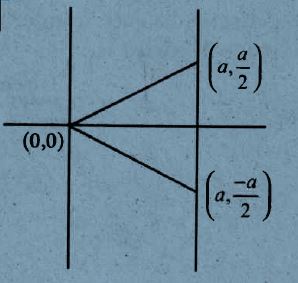
\(x-2 y =0 \)
\(x+2 y =0 \)
\(x =a \)
\(\text {The points are }(0,0),\left(a, \frac{a}{2}\right),\left(a, \frac{-a}{2}\right)\)
\(\text {Area }=-\frac{1}{2} \text { (base } \times \text { height } \text { ) }\)
\(=\frac{1}{2}(a \cdot a)\)
\(\text {Area }=\frac{1}{2} a^{2}\)
74.
\(m_{1} m_{2}=\frac{a}{b}=\frac{6}{-7}\)
75.
Perpendicular distance from origin to the line is
4x + 3y - 20 = 0 is
\(\left(\frac{-20}{\sqrt{16+9}}\right)=\frac{20}{\sqrt{25}}=\frac{20}{5}=4 \text { units }\)
Area of the square = 4 \(\times\) 4 = 16 sq. units.
76.
\(\text { Slope of first line }=\frac{-1}{(2 k-7)}\)
\(\text { Slope of second line }=\frac{-3 k}{9}\)
\(\text { They are perpendicular } \mathrm{m}_{1} \mathrm{~m}_{2}=-1\)
\(\frac{3 k}{9(2 k-7)} =-1 \)
\(k =-3(2 k-7) \)
\(k =-6 k+21 \)
\(7 k =21 \)
\(k=3 \)
77.
2x- 3y +1 = 0
Perpendicular line is 3x + 2y + k = 0
This passes through point (1, 3)
3 + 6 + k = 0
k = -9
Equation is 3x + 2y - 9 = 0
.'. y intercept is given by taking x = 0,
\(2 y=9, y=\frac{9}{2}\)
78.
Perpendicular distance from origin to the given line is
\(\frac{1}{\sqrt{\frac{1}{3^{2}}+\frac{1}{4^{2}}}}=\frac{1}{\sqrt{\frac{1}{9}+\frac{1}{16}}}=\frac{1}{\sqrt{\frac{16+9}{144}}}=\frac{12}{5}\)
79.
The required point is (-3, -2)
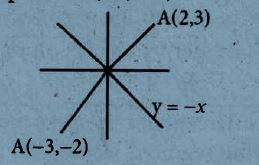
80.
Let (a, b) be on 2x - 3y= 5 = 2a - 3b = 5
It is equidistance from (1, 2) and (3, 4)
\(\sqrt{(a-1)^{2}+(6-2)^{2}}=\sqrt{(a-3)^{2}+(b-4)^{2}} \)
\((a-1)^{2}+(b-2)^{2}=(a-3)^{2}+(b-4)^{2} \)
\(a^{2}-2 a+1+b^{2}-4 b+4=a^{2}-6 a+9+b^{2} -8 b+16 \)
\(\begin{gathered} 4 a+4 b=20 \\ \Rightarrow {2 a+2 b=10}\\{2 a-3 b=5} \\ \hline 5 b=5 \end{gathered}\)
b = 1, a = 4
The point is (4, 1)
81.
\((p+2 q) x+(p-3 q) y-p+q=0 \)
\(p(x+y-1)+q(2 x-3 y+1)=0 \)
\(x+y=1 ...(1)\)
\(2 x-3 y=-1..(2)\)
\(\begin{array}{r} 3 \times(1) \Rightarrow 3 x+3 y=3 \\ (2) \Rightarrow 2 x-3 y=-1 \\ \hline 5 x=2 \end{array}\)
\(x=\frac{2}{5}, y=\frac{3}{5} \)
\(\therefore\left(\frac{2}{5}, \frac{3}{5}\right) \)
82.
Perpendicular distance from vertex to the opposite side is \(\frac{2+3-2}{\sqrt{1+1}}=\frac{3}{\sqrt{2}}\)
\(\frac{3}{\sqrt{2}}=\frac{\sqrt{3}}{2} a\)
\(\Rightarrow a =\frac{6}{\sqrt{6}} \)
\(\therefore a =\sqrt{6}\)
83.
x - y + 5 = 0;
Put x = 0, then y = 5
The point is (0, 5)
Any line perpendicular to x - y + 5 = 0 is
x + y + k = 0,
This passes through (0, 5)
k = -5
Required equation is x + y - 5 = 0
84.
\(5 x-y=0 \text { perpendicular line is } x+5 y+k=0\)
\(x \text { intercept is }-\mathrm{k} \text { and } \mathrm{y} \text { intercepts } \frac{-\mathrm{k}}{5}\)
\(\text { Area of the } \Delta=\frac{1}{2}(-\mathrm{k})\left(\frac{-\mathrm{k}}{5}\right)\)
\(5 =\frac{\mathrm{k}^{2}}{10} \text { (given) } \)
\(\mathrm{k}^{2} =50 \)
\(\mathrm{k} =\pm 5 \sqrt{2}\)
\(\text {Equation of the line is } x+5 y \pm 5 \sqrt{2}=0\)
85.
Let y = 2x + c be the required line.
Given perpendicular distance from origin'to this line is \(\sqrt5\)
\(\frac{c}{\sqrt{1+4}}=\sqrt{5}\)
c = 5
This required line is y - 2x + 5
2x - y + 5 = 0
86.
Equation of line joining (1, 2) and (3, 4) is
\(\frac{y-2}{4-2} =\frac{x-1}{3-1} \)
\(x-y+1 =0 \)
Any line perpendicular to this x + y + k = 0
This passes through midpoint of (1, 2) and (3, 4)
That is (2, 3)
k = -5, x+y-5 = 0
x intercept is 5, y intercept is 5.
87.
The point M is (0, 3)
The equation of line joining ('-1, 2) and (0, 3) is
\(\frac{y-2}{3-2} =\frac{x+1}{0+1} \)
\(x-y+3 =0\)
88.
\(\text {Perimeter }=4+2 \sqrt{2}\)
\(a+a+\sqrt{2} =4+2 \sqrt{2} \)
\(2 a+\sqrt{2} a =4+2 \sqrt{2} \)
\(\therefore a =2 \)
\(\text {Equation of line is } \frac{x}{2}+\frac{y}{2}=1\)
\(x+y-2=0\)
89.
\(\text { Slope of } 3 x-y+5=0 \text { is } \frac{-3}{-1}=3=m_{1}\)
Let m2 be the slope of the second line
\(\text {Given } \tan \theta=\tan 45^{\circ}=1 \Rightarrow \frac{m_{1}-m_{2}}{1+m_{1} m_{2}}=\pm 1\)
\(\frac{3-m_{2}}{1+3 m_{2}}=1 \quad \frac{m_{2}-3}{1+3 m_{2}}=1\)
\(3-m_{2}=1+3 m_{2} \quad m_{2}-3=1+3 m_{2}\)
\(2=4 m_{2} \quad-2 m_{2}=4\)
\(\mathrm{m}_{2}=\frac{1}{2} \quad \mathrm{~m}_{2}=-2\)
\(\left(\frac{1}{2},-2\right)\)
90.
(c)
91.
\(\frac{\left(8^{2}\right)}{16}-\frac{(-5)^{2}}{25} =\mathrm{k} \)
\(\frac{64}{16}-\frac{25}{25} =\mathrm{k} \)
\(\mathrm{k} =4-1=3 \)
92.
\((1,2) \text { lies on } 3 x^{2}+3 y^{2}-8 x-12 y+17=0\)
\(\text { Because, } 3(1)^{2}+3(2)^{2}-8(1)-12(2)+17\)
\(=3+12-8-24+17=0\)
93.
\(\left(a t^{2}, 2 a t\right) \Rightarrow x=a t^{2}, \quad y=2 a t\)
\(y^{2} =4 a^{2} t^{2} \)
\(=4 a^{2}\left(\frac{x}{a}\right) \)
\(y^{2} =4 a x \)
94.
Let the point be (x, y)
Its distance from origin is \(\sqrt{x^{2}+y^{2}}\)
Given \(x =\frac{1}{2} \sqrt{x^{2}+y^{2}} \)
\(\Rightarrow 2 x =\sqrt{x^{2}+y^{2}} \)
\(4 x^{2} =x^{2}+y^{2} \)
\(3 x^{2}-y^{2}=0 \) is the required equation of the locus

11th Standard Syllabus & Materials
11th Standard
TN 11th Tamil பீடு பெற நில் - செய்யுள் - காவடிச்சிந்து Important Questions And Answers Study Material - QB365 Set A
NEW11th Standard
TN 11th Tamil பீடு பெற நில் - உரைநடை - மலை இடப்பெயர்கள் : ஓர் ஆய்வு Important Questions And Answers Study Material - QB365 Set A
NEW11th Standard
TN 11th Tamil மாமழை போற்றுதும் - துணைப்பாடம் - யானை டாக்டர் Important Questions And Answers Study Material - QB365 Set A
NEW11th Standard
TN 11th Tamil மாமழை போற்றுதும் - செய்யுள் - ஐங்குறுநூறு Important Questions And Answers Study Material - QB365 Set A



Tamilnadu Stateboard 11th Standard Subjects
Maths

Commerce

Economics

Biology

Business Maths and Statistics

Accountancy

Computer Science

Physics

Chemistry
Maths
Biology
Economics
Physics
Chemistry

History
Business Maths and Statistics

Computer Science
Accountancy

Computer Applications
History
Computer Technology
Commerce
Computer Applications
Computer Technology

Tamil

English

French
Tamilnadu Stateboard Standards

