
 100% FREE ACCESS
11th Standard Syllabus & Materials
11th Standard
TN 11th Tamil இயற்கை வேளாண்மை,சுற்றுச்சூழல் -செய்யுள் - மனோன்மணீயம் Important Questions And Answers Study Material - QB365 Set A
NEW11th Standard
TN 11th Tamil என்னுயிர் என்பேன் -துணைப்பாடம் - இசைத்தமிழர் இருவர் Important Questions And Answers Study Material - QB365 Set A
NEW11th Standard
TN 11th Tamil மொழி கலை -செய்யுள் - ஒவ்வொரு புல்லையும் Important Questions And Answers Study Material - QB365 Set A
NEW11th Standard
TN 11th Tamil பீடு பெற நில் - இலக்கணம் - பகுபத உறுப்புகள் Important Questions And Answers Study Material - QB365 Set A
NEW11th Standard
TN 11th Tamil பீடு பெற நில் - துணைப்பாடம் - வாடிவாசல் Important Questions And Answers Study Material - QB365 Set A
NEW11th Standard
TN 11th Tamil பீடு பெற நில் - செய்யுள் - குறுந்தொகை Important Questions And Answers Study Material - QB365 Set A

Published on: 29/09/2018
Important questions2
Download Tamil Nadu 11th Standard Maths question papers, model tests, one-mark questions, important questions, and public exam papers in PDF format. Free study materials and answer keys for TN State Board students.
Questions + Answers key
Take MCQ Maths Test1.
Evaluate sin\(\left( cos^{ -1 }\left( \frac { 3 }{ 5 } \right) \right) \)
2.
In a ΔABC if a = 3, b = 5 and c = 7, find cos A and cos B.
3.
Find the value of tan\(\frac { \pi }{ 2 } \).
4.
Identify the quadrant in which an angle of each given measure lies; 3280
5.
If sec \(\theta\) + tan \(\theta\) = p, obtain the values of sec \(\theta\), tan \(\theta\) and sin \(\theta\) in terms of p
6.
If x = \(\sum _{ n=0 }^{ \infty }{ { cos }^{ 2n } } \theta ;\) y = \(y=\sum _{ n=0 }^{ \infty }{ { sin }^{ 2n } } \theta \) and z = \(\sum _{ n=0 }^{ \infty }{ { cos }^{ 2n }\theta } \) sin2n\(\theta \), 0 < \(\theta \) < \(\frac { \pi }{ 2 } \), then show that xyz = x+y+z
Hint :1+x+x2+x3+.......= \(\frac { 1 }{ 1-x } \), where \(\left| x\right| \)< 1].
7.
If sin \(\theta\) + cos \(\theta\) = m, show that cos6\(\theta\) + sin6\(\theta\) = \(\frac { 4-3({ m }^{ 2 }-1)^{ 2 } }{ 4 } \), where m2 \(\le \) 2
8.
A fighter jet has to hit a small target by flying a horizontal distance. When the target is sighted, the pilot measures the angle of depression to be 300. If after 100 km, the target has an angle of depression of 600, how far is the target from the fighter jet at that instant?
9.
For each given Angle, find a coterminal angle with a measure of \(\theta\) such that \(0^o\le \theta \le 360°\)
3950
10.
If \(\sin { x } =\frac { 15 }{ 17 } \) and \(\cos {y } =\frac { 12 }{ 13 } \), 0 < x < \(\frac{\pi}{2}\), 0 < y < \(\frac{\pi}{2}\), find the value of tan (x + y)
11.
If in a triangle a = 5, b = 4 and cos(A - B) = \(\frac{31}{32}\) then the third side C is equal to _______________
5
6
3
12
12.
If sin θ = sin \(\alpha\), then the angles θ and \(\alpha\) are related by _______________
\(\theta=n\pi\pm\alpha\)
\(\theta=2n\pi+(-1)^n\alpha\)
\(\alpha=n\pi\pm(-1)^n\theta\)
\(\theta=(2n+1)\pi+\alpha\)
13.
The value of sin\({\pi\over 48}cos {\pi \over 48} cos {\pi \over 24}cos {\pi \over 12}cos{\pi \over 6}cos {\pi \over 3}\) is _____________
\(\sqrt{3}\over32\)
\(\sqrt{3}\over64\)
\({3}\over32\)
\({3}\over64\)
14.
\(\frac { cos3x }{ 2cos2x-1 } \) is _______________
cos x
sin x
tan x
cot x
15.
The value of sin2\(\frac { 5\pi }{ 12 } -sin^{ 2 }\frac { \pi }{ 12 } \) is ___________
\(\frac { 1 }{ 2 } \)
\(\frac { \sqrt { 3 } }{ 2 } \)
1
0
16.
A wheel is spinning at 2 radians/second. How many seconds will it take to make 10 complete rotations?
10\(\pi \) seconds
20\(\pi \) seconds
5\(\pi \) seconds
15\(\pi \) seconds
17.
\(\frac { cos6x+6cos4x+15cos2x+10 }{ cos5x+5cos3x+10cosx } \) is equal to
cos 2x
cos x
cos 3x
2 cos x
18.
Which of the following is not true?
sinፀ = \(-\frac { 3 }{ 4 } \)
cosፀ = -1
tanፀ = 25
secፀ = \(\frac { 1 }{ 4 } \)
19.
Let fk(x) = \(\frac { 1 }{ k } \)[sinkx + coskx] where x\(\in \)R and k ≥ 1. Then f4(x) - f6(x) =
\(\frac { 1 }{ 4 } \)
\(\frac { 1 }{ 12 } \)
\(\frac { 1 }{ 6 } \)
\(\frac { 1 }{ 3 } \)
20.
If tan400 = λ, then \(\frac { tan{ 140 }^{ 0 }-tan{ 130 }^{ 0 } }{ 1+tan{ 140 }^{ 0 }.tan{ 130 }^{ 0 } } \) =
\(\frac { 1-\lambda ^{ 2 } }{ \lambda } \)
\(\frac { 1+{ \lambda }^{ 2 } }{ \lambda } \)
\(\frac { 1+{ \lambda }^{ 2 } }{ 2\lambda } \)
\(\frac { 1-{ \lambda }^{ 2 } }{ 2\lambda } \)
1.
Let \(\left( cos^{ -1 }\left( \frac { 3 }{ 5 } \right) \right) =\theta \)
∴ \(\theta \in \left[ 0,\frac { \pi }{ 2 } \right] \quad cos\theta =\frac { 3 }{ 5 } \)
⇒ \(sin\theta =+\sqrt { 1-cos^{ 2 }\theta } =\sqrt { 1-\frac { 9 }{ 25 } } =\sqrt { \frac { 16 }{ 25 } } =\frac { 4 }{ 5 } \)
∴ \(sin\left( cos^{ -1 }\left( \frac { 3 }{ 5 } \right) \right) =\frac { 4 }{ 5 } \)
2.
cos A = \(\frac { { b }^{ 2 }+{ c }^{ 2 }-{ a }^{ 2 } }{ 2bc } \)
= \(\frac { 25+49-9 }{ 2(5)(7) } =\frac { 65 }{ 70 } =\frac { 13 }{ 14 } \)
cosB = \(\frac { { c }^{ 2 }+{ a }^{ 2 }-{ b }^{ 2 } }{ 2ca } =\frac { 49+9-25 }{ 2(7)(3) } =\frac { 33 }{ 42 } =\frac { 11 }{ 14 } \) .
3.
\(tan\left( \frac { \pi }{ 12 } \right) =tan\left( \frac { \pi }{ 4 } -\frac { \pi }{ 6 } \right) \)
= \(\frac { tan\frac { \pi }{ 4 } -tan\frac { \pi }{ 6 } }{ 1+tan\frac { \pi }{ 4 } .tan\frac { \pi }{ 6 } } \) \(\left[ \because tan(A-B)=\frac { tanA-tanB }{ 1+tanAtanB } \right] \)
=\(\frac { 1-\frac { 1 }{ \sqrt { 3 } } }{ 1+1\left( \frac { 1 }{ \sqrt { 3 } } \right) } =\frac { \frac { \sqrt { 3 } -1 }{ \sqrt { 3 } } }{ \frac { \sqrt { 3 } +1 }{ \sqrt { 3 } } } =\frac { \sqrt { 3 } -1 }{ \sqrt { 3 } } \times \frac { \sqrt { 3 } }{ \sqrt { 3 } +1 } =\frac { \sqrt { 3 } -1 }{ \sqrt { 3 } +1 } \) \(\left[ \because tan\frac { \pi }{ 4 } =1,tan\frac { \pi }{ 6 } =\sqrt { 3 } \right] \)
=\(\frac { (\sqrt { 3 } -1)(\sqrt { 3 } -1) }{ (\sqrt { 3 } +1)(\sqrt { 3 } 1) } =\frac { (\sqrt { 3 } )^{ 2 }-2(1)(\sqrt { 3 } )+1 }{ (\sqrt { 3 } )^{ 2 }-1^{ 2 } } =\frac { 3-2\sqrt { 3 } +1 }{ 2 } \) [∵ conjugating the denominator]
\(tan\left( \frac { \pi }{ 12 } \right) =\frac { 4-2\sqrt { 3 } }{ 2 } =\frac { 2(2-\sqrt { 3 } ) }{ 2 } =2-\sqrt { 3 } \).
4.
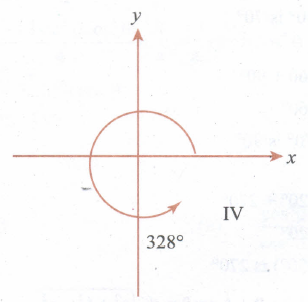
3280
3280 = 2700 + 580
∴ 3280 lies in the IV quadrant
5.
Given sec θ + tan θ = p ...(1)
We know sec2θ-tan2θ = 1
(sec θ + tan θ) (sec θ - tan θ) = 1
p(sec θ - tan θ) = 1
sec θ - tan θ = \(\frac{1}{p}\)...(2)
(1)+(2)➝ (sec θ + tan θ) + (sec θ - tan θ) = p+\(\frac{1}{p}\)
2sec θ = \(\frac{p^2+1}{2p}\)...(3)
(1)-(2)⟶ (sec θ + tan θ) - (sec θ - tan θ) = p-\(\frac{1}{p}\)
2tan θ = \(\frac{p^2-1}{2p}\)
tan θ = \(\frac{p^2-1}{2p}\)...(4)
(4)+(3) gives,
\(\frac{tan\theta}{sec\theta}=\frac{p^2-1}{2p}\div\frac{p^2+1}{2p}\)
\(\frac{sin\theta}{cos\theta.\frac{1}{cos\theta}}=\frac{p^2-1}{2p}\times\frac{2p}{p^2+1}=\frac{p^2-1}{p^2+1}\)
Sin \(\theta\) = \(\frac { { p }^{ 2 }-1 }{ { p }^{ 2 }+1 } \)
6.
Given \(x=\sum _{ n=0 }^{ \infty }{ { cos }^{ 2n }\theta } ={ cos }^{ 0 }\theta +{ cos }^{ 2 }\theta +{ cos }^{ 4 }\theta +...\)
= \(1+{ cos }^{ 2 }\theta +{ cos }^{ 4 }\theta +...\)
= \(1+{ \left( cos\theta \right) }^{ 2 }+{ \left( { cos }^{ 2 }\theta \right) }^{ 2 }+...=\frac { 1 }{ 1-{ cos }^{ 2 }\theta } \)
= \(\frac { 1 }{ { sin }^{ 2 }\theta } \) ...(1)
\(y=\sum _{ n=0 }^{ \infty }{ { sin }^{ 2n }\theta } ={ sin }^{ 0 }\theta +{ sin }^{ 2 }\theta +{ sin }^{ 4 }\theta +...\)
= \(1+{ sin }^{ 2 }\theta +{ sin }^{ 4 }\theta +...\)
= \(1+{ \left( sin\theta \right) }^{ 2 }+{ \left( { sin }^{ 2 }\theta \right) }^{ 2 }+...=\frac { 1 }{ 1-{ sin }^{ 2 }\theta } =\frac { 1 }{ { cos }^{ 2 }\theta } \)...(2)
Similarly z = \(\sum _{ n=0 }^{ \infty }{ { cos }^{ 2n }\theta } { sin }^{ 2n }\theta ={ cos }^{ 0 }\theta { sin }^{ 0 }\theta +{ cos }^{ 2 }\theta { sin }^{ 2 }\theta +{ cos }^{ 4 }\theta +{ sin }^{ 4 }\theta ...\)
= \(1+{ \left( sin\theta cos\theta \right) }^{ 2 }+{ \left( { sin }^{ 2 }\theta { cos }^{ 2 }\theta \right) }^{ 2 }+...\)
= \(\frac { 1 }{ 1-{ sin }^{ 2 }\theta { cos }^{ 2 }\theta } \) ...(3)
Now x + y + z = \(\frac { 1 }{ { sin }^{ 2 }\theta } +\frac { 1 }{ { cos }^{ 2 }\theta } +\frac { 1 }{ 1-{ sin }^{ 2 }\theta { cos }\theta } \)(using 1, 2 and 3)
= \(\frac { { cos }^{ 2 }\theta \left( 1-{ sin }^{ 2 }\theta { cos }^{ 2 }\theta \right) +{ sin }^{ 2 }\theta \left( 1-{ sin }^{ 2 }\theta { cos }^{ 2 }\theta \right) +{ sin }^{ 2 }\theta { cos }^{ 2 }\theta }{ { sin }^{ 2 }\theta { cos }^{ 2 }\theta \left( 1-{ sin }^{ 2 }\theta { cos }^{ 2 }\theta \right) } \)
= \(\frac { { cos }^{ 2 }\theta -{ sin }^{ 2 }\theta { cos }^{ 4 }\theta +{ sin }^{ 2 }\theta --{ sin }^{ 4 }\theta { cos }^{ 4 }\theta +{ sin }^{ 2 }\theta { cos }^{ 2 }\theta }{ { sin }^{ 2 }\theta { cos }^{ 2 }\theta \left( 1-{ sin }^{ 2 }\theta { cos }^{ 2 }\theta \right) } \)
= \(\frac { 1-\left( { sin }^{ 2 }\theta { cos }^{ 4 }\theta +{ sin }^{ 2 }\theta { cos }^{ 4 }\theta \right) +{ sin }^{ 2 }\theta { cos }^{ 2 }\theta }{ { sin }^{ 2 }\theta { cos }^{ 2 }\theta \left( 1-{ sin }^{ 2 }\theta { cos }^{ 2 }\theta \right) } \)
= \(\frac { 1-{ sin }^{ 2 }\theta { cos }^{ 2 }\theta (1)+{ sin }^{ 2 }\theta { cos }^{ 2 }\theta }{ { sin }^{ 2 }\theta { cos }^{ 2 }\theta \left( 1-{ sin }^{ 2 }\theta { cos }^{ 2 }\theta \right) } \)
= \(\frac { 1 }{ { sin }^{ 2 }\theta { cos }^{ 2 }\theta \left( 1-{ sin }^{ 2 }\theta { cos }^{ 2 }\theta \right) } =\frac { 1 }{ { sin }^{ 2 }\theta } \times \frac { 1 }{ { cos }^{ 2 }\theta } \times \frac { 1 }{ 1-{ sin }^{ 2 }\theta { cos }^{ 2 }\theta } \)
ஃ x + y + z = xyz
Hence proved.
7.
Given sin θ + cos θ = m
LHS = cos6 θ + sin6θ
= (cos2θ)3+ (sin2 θ)3
= (cos2θ + sin2θ)(cos4θ - cos2θ sin2θ + sin4θ)
= 1(cos4θ - cos2θ sin2θ + sin4θ)
= (cos2θ)2+ (sin2θ)2 - cos2θsin2θ
= (cos2θ)2+ (sin2θ)2- cos2θ sin2θ
= 1 - 3 sin2\(\theta\) cos2\(\theta\) ....(1)
RHS = \(\frac { 4-3{ \left( { m }^{ 2 }-1 \right) }^{ 2 } }{ 4 } \)
= \(\frac { 4-3{ \left[ { \left( sin\theta +cos\theta \right) }^{ 2 }-1 \right] }^{ 2 } }{ 4 } =\frac { 4-3\left[ { sin }^{ 2 }\theta +{ cos }^{ 2 }\theta +2sin\theta cos\theta -1 \right] }{ 4 } \)
= \(\frac { 4-12{ sin }^{ 2 }\theta { cos }^{ 2 }\theta }{ 4 } =\frac { 4 }{ 4 } -\frac { 12 }{ 4 } { sin }^{ 2 }\theta { cos }^{ 2 }\theta \)
= 1 - 3 sin2\(\theta\) cos2\(\theta\) ...(2)
From (1) and (2), LHS = RHS
8.
Let C be the position of the target and A and B be the positions of the fighter jet
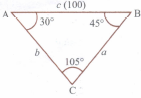
Given ㄥBAC = 30, ㄥABC = 45
ஃ ㄥC = 180 - (30 - 45) = 180 - 75 = 105
Given AB = 100 km
Using sine formula,
\(\frac { a }{ sinA } =\frac { c }{ sinC } \)
\(\Rightarrow \frac { a }{ sin30° } =\frac { 100 }{ sin105° } \)
\(\Rightarrow \frac { a }{ \frac { 1 }{ 2 } } =\frac { 100 }{ sin105° } \Rightarrow 2a=\frac { 100 }{ sin105° } \Rightarrow a=\frac { 50 }{ sin105° } \)
Now, sin 105° = sin (60 + 45) = sin 60 cos 45 + cos 60 sin 45
= \(\frac { \sqrt { 3 } }{ 2 } .\frac { 1 }{ \sqrt { 2 } } +\frac { 1 }{ 2 } .\frac { 1 }{ \sqrt { 2 } } =\frac { \sqrt { 3 } +1 }{ 2\sqrt { 2 } } \)
Substituting (2) in (1) we get,
a = \(\frac { 50 }{ \frac { \sqrt { 3 } +1 }{ 2\sqrt { 2 } } } \Rightarrow a=\frac { 50\left( 2\sqrt { 2 } \right) }{ \sqrt { 3 } +1 } =\frac { 100\sqrt { 2 } }{ \sqrt { 3 } +1 } \times \frac { \sqrt { 3 } -1 }{ \sqrt { 3 } -1 } \)
a = \(\frac { 100\left( \sqrt { 6 } -\sqrt { 2 } \right) }{ 3-1 } =50\left( \sqrt { 6 } -\sqrt { 2 } \right) km\)
9.
3950
3950 = 3600 + 350
\(\Rightarrow \) 395 - 350 = 3600
∴ Coterminal angle For 3950 is 350
10.
Since 0
ஃ All the trigonometric ratios are positive.
\(\sqrt { { 17 }^{ 2 }-{ 15 }^{ 2 } }\) \(\sqrt { { 13 }^{ 2 }-12^{ 2 } } \)
\(\sqrt { 289-225 } \) = 5
=\(\sqrt { 64 } \)
= 8
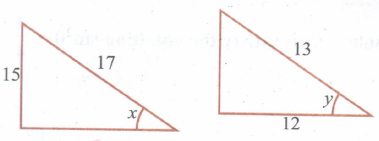 \(\sqrt { { 13 }^{ 2 }-{ 12 }^{ 2 } } =\sqrt { 169-144 } =\sqrt { 25 } \)=5
\(sin\quad x=\frac { 15 }{ 17 } \quad sin\quad y=\frac { 5 }{ 13 } \)
\(cos\quad x=\frac { 8 }{ 17 } \quad cos\quad y=\frac { 12 }{ 13 } \)
\(tan\quad x=\frac { 15 }{ 8 } \quad tan\quad y=\frac { 5 }{ 12 } \)
\(\frac { tanx+tany }{ 1-tanx.tany } =\frac { \frac { 15 }{ 8 } +\frac { 5 }{ 12 } }{ 1-\frac { 15 }{ 8 } .\frac { 5 }{ 12 } } =\frac { 180+40 }{ 96 } /\frac { 96-75 }{ 96 } =\frac { 220 }{ 21 } \)
11.
(b)
6
12.
(c)
\(\alpha=n\pi\pm(-1)^n\theta\)
13.
(d)
\({3}\over64\)
14.
(a)
cos x
15.
(b)
\(\frac { \sqrt { 3 } }{ 2 } \)
16.
In one second it rotates = 2 radians.
For 2 radians it takes 1 second.
\(\text { For } 2 \pi \text { ( } 1 \text { revolution) it will take } \frac{2 \pi}{2}=\pi \text { second. }\)
\(\therefore \text { For } 10 \text { revolutions it takes } 10 \pi \text { seconds. }\)
17.
\(\text { Numerator }=\cos 6 x+6 \cos 4 x+15 \cos 2 x+10\)
\(=(\cos 6 x+\cos 4 x)+5(\cos 4 x+\cos 2 x)+ 10(\cos 2 x+1) \)
\(=2 \cos 5 x \cos x+5(2 \cos 3 x \cdot \cos x)+10\left(2 \cos ^{2} x\right) \)
\(=2 \cos x[\cos 5 x+5 \cos 3 x+10 \cos x] \)
\(\therefore \frac{\mathrm{Nr}}{\mathrm{Dr}} =\frac{2 \cos x(\cos 5 x+5 \cos 3 x+10 \cos x)}{\cos 5 x+5 \cos 3 x+10 \cos x} \)
\(=2 \cos x \)
18.
\(\text { Since }|\cos x|<1\)
\(\text { From option (4), }\)
\(\sec \theta=\frac{1}{4}\)
\(\Rightarrow \cos \theta=4 \text { is not possible. }\)
19.
\(\mathrm{f}_{4}(x)-\mathrm{f}_{6}(x)=\frac{1}{4}\left[\sin ^{4} x+\cos ^{4} x\right]-\frac{1}{6}\left[\sin ^{6} x+\cos ^{6} x\right] \)
\(=\frac{1}{4}\left[\left(\sin ^{2} x+\cos ^{2} x\right)^{2}-2 \sin ^{2} x \cos ^{2} x\right]-\frac{1}{6}\left[\left(\sin ^{2} x+\cos ^{2} x\right)^{3}\right. \)
\(\left.=-3 \sin ^{2} x \cos ^{2} x+\left(\sin ^{2} x+\cos ^{2} x\right)\right] \)
\(=\frac{1}{4}\left(1-2 \sin ^{2} x \cos ^{2} x\right)-\frac{1}{6}\left(1-3 \sin ^{2} x \cos ^{2} x\right) \)
\(=\frac{1}{4}-\frac{1}{2} \sin ^{2} x \cos ^{2} x-\frac{1}{6}+\frac{1}{2} \sin ^{2} x \cos ^{2} x \)
\(=\frac{1}{4}-\frac{1}{6} \)
\(=\frac{3-2}{12}=\frac{1}{12} \)
20.
\(\frac{\tan 140^{\circ}-\tan 130^{\circ}}{1+\tan 140^{\circ} \tan 130^{\circ}} =\tan \left(140^{\circ}-130^{\circ}\right) \)
\(=\tan 10^{\circ} \ldots \ldots(1) \)
\(\tan 40^{\circ} =\lambda \)
\(\tan 80^{\circ}=\frac{2 \tan 40^{\circ}}{1-\tan ^{2} 40^{\circ}} =\frac{2 \lambda}{1-\lambda^{2}} \)
\(\tan \left(90^{\circ}-10^{\circ}\right) =\frac{2 \lambda}{1-\lambda^{2}} \)
\(\cot 10^{\circ} =\frac{2 \lambda}{1-\lambda^{2}} \)
\(\Rightarrow \tan 10^{\circ} =\frac{1-\lambda^{2}}{2 \lambda} \)
\(\frac{\tan 140^{\circ}-\tan 130^{\circ}}{1+\tan 140^{\circ} \tan 130^{\circ}} \)
\(=\frac{1-\lambda^{2}}{2 \lambda}\)

11th Standard Syllabus & Materials
11th Standard
TN 11th Tamil பீடு பெற நில் - செய்யுள் - காவடிச்சிந்து Important Questions And Answers Study Material - QB365 Set A
NEW11th Standard
TN 11th Tamil பீடு பெற நில் - உரைநடை - மலை இடப்பெயர்கள் : ஓர் ஆய்வு Important Questions And Answers Study Material - QB365 Set A
NEW11th Standard
TN 11th Tamil மாமழை போற்றுதும் - துணைப்பாடம் - யானை டாக்டர் Important Questions And Answers Study Material - QB365 Set A
NEW11th Standard
TN 11th Tamil மாமழை போற்றுதும் - செய்யுள் - ஐங்குறுநூறு Important Questions And Answers Study Material - QB365 Set A



Tamilnadu Stateboard 11th Standard Subjects
Maths

Commerce

Economics

Biology

Business Maths and Statistics

Accountancy

Computer Science

Physics

Chemistry
Maths
Biology
Economics
Physics
Chemistry

History
Business Maths and Statistics

Computer Science
Accountancy

Computer Applications
History
Computer Technology
Commerce
Computer Applications
Computer Technology

Tamil

English

French
Tamilnadu Stateboard Standards

