
 100% FREE ACCESS
11th Standard Syllabus & Materials
11th Standard
TN 11th Tamil இயற்கை வேளாண்மை,சுற்றுச்சூழல் -செய்யுள் - மனோன்மணீயம் Important Questions And Answers Study Material - QB365 Set A
NEW11th Standard
TN 11th Tamil என்னுயிர் என்பேன் -துணைப்பாடம் - இசைத்தமிழர் இருவர் Important Questions And Answers Study Material - QB365 Set A
NEW11th Standard
TN 11th Tamil மொழி கலை -செய்யுள் - ஒவ்வொரு புல்லையும் Important Questions And Answers Study Material - QB365 Set A
NEW11th Standard
TN 11th Tamil பீடு பெற நில் - இலக்கணம் - பகுபத உறுப்புகள் Important Questions And Answers Study Material - QB365 Set A
NEW11th Standard
TN 11th Tamil பீடு பெற நில் - துணைப்பாடம் - வாடிவாசல் Important Questions And Answers Study Material - QB365 Set A
NEW11th Standard
TN 11th Tamil பீடு பெற நில் - செய்யுள் - குறுந்தொகை Important Questions And Answers Study Material - QB365 Set A

Published on: 29/09/2018
Important 3 mark question
Download Tamil Nadu 11th Standard Maths question papers, model tests, one-mark questions, important questions, and public exam papers in PDF format. Free study materials and answer keys for TN State Board students.
Questions + Answers key
Take MCQ Maths Test1.
Determine the values of a so that the following matrices are singular: A =\(\begin{bmatrix} 7& 3 \\ -2 & a \end{bmatrix}\)
2.
Express the following matrices as the sum of a symmetric matrix and a skew-symmetric matrix:
\(\begin{bmatrix} 4 & -2 \\ 3& -5 \end{bmatrix}\)
3.
Write the nth term of the following sequences
2,2,4,4,6,6
4.
If (n-1)P3 :n P4 = 1 : 10, find n
5.
In a triangle ABC, if \(\begin{vmatrix} 1& 1 &1 \\1+sin A &1+sin B &1+sin C \\ sinA(1+sin A) &sin B(1+sin B) &sin C(1+sin C) \end{vmatrix}=0,\)
prove that \(\triangle\)ABC is an isosceles triangle.
6.
Prove that \(\begin{vmatrix} 1& a & a^2-bc \\1 &b &b^2-ca \\ 1 & c & c^2-ab \end{vmatrix}=0.\)
7.
A fruit shop keeper prepares 3 different varieties of gift packages. Pack-I contains 6 apples, 3 oranges, and 3 pomegranates. Pack-II contains 5 apples, 4 oranges and 4 pomegranates and Pack –III contains 6 apples, 6 oranges and 6 pomegranates. The cost of an apple, an orange and a pomegranate respectively are Rs. 30, Rs. 15 and Rs. 45. What is the cost of preparing each package of fruits?
8.
The seventh term of an arithmetic progression is 30 and tenth term is 21.
(i) Find the first three terms of an A.P.
(ii) Which term of the A.P. is zero (if exists)
(iii) Find the relationship between Slope of the straight line and common difference of A.P.
9.
If θ is a parameter, find the equation of the locus of a moving point, whose coordinates are (a(θ - sin θ), a(1 - cos θ)).
10.
If (n+2)C7 : (n-1)P4 = 13 : 24 find n.
11.
A family is using Liquefied petroleum gas (LPG) of weight 14.2 kg for consumption. (Full weight 29.5kg includes the empty cylinders tare weight of 15.3kg.). If it is use with constant rate then it lasts for 24 days. Then the new cylinder is replaced.
(i) Find the equation relating the quantity of gas in the cylinder to the days.
(ii) Draw the graph for first 96 days.
12.
A spring was hung from a hook in the ceiling. A number of different weights were attached to the spring to make it stretch, and the total length of the spring was measured each time shown in the following table.
| Weight, (kg) | 2 | 4 | 5 | 8 |
| Length, (cm) | 3 | 4 | 4.5 | 6 |
(i) Draw a graph showing the results.
(ii) Find the equation relating the length of the spring to the weight on it.
(iii) What is the actual length of the spring.
(iv) If the spring has to stretch to 9 cm long, how much weight should be added?
(v) How long will the spring be when 6 kilograms of weight on it?
13.
Find the sum of all 4-digit numbers that can be formed using digits 0, 2, 5, 7, 8 without repetition?
14.
Find the matrix A which satisfies the matrix relation A\(\begin{bmatrix} 1 & 2&3 \\4 & 5&6 \end{bmatrix}\)=\(\begin{bmatrix} -7 & -8&-9 \\2 & 4&6 \end{bmatrix}\)
15.
Sum up to n terms the series:
7 + 77 + 777 + 7777 + ...
16.
Five boys and 5 girls form a line. Find the number of ways of making the seating arrangement under the following condition.
| C1 | C2 | ||
| (a) | Boys and girls sit alternate | (i) | 5! \(\times\) 6! |
| (b) | No two girls sit together | (ii) | 10! - 5! 6! |
| (c) | All the girls sit together | (iii) | (5 !)2 + (5!)2 |
| (d) | All the girls are never together | (iv) | 2! 5! 5! |
17.
Find the 18th and 25th terms of the sequence defined by
an = {\(n(n+2),\quad if\quad n\quad is\quad even\quad natural\quad number\\ \frac { 4n }{ { n }^{ 2 }+1 } ,\ if\ n\ is\ odd\ natural\ number\\ \)
18.
Expand (1+ x)\(2\over 3\) up to four terms for |x| < 1.
19.
For what value of n, the nth term of the series "3 + 10 + 17 +..+ and 63 + 65 + 67 +... are equal
1.
Given A is singular
\(\therefore|A|=0\)
\(\left|\begin{array}{cc}
7 & 3 \\
-2 & a
\end{array}\right|=0\)
7a + 6 = 0
7a = -6
\(a=\frac{-6}{7} .\)
2.
\(\text { (i) } \mathrm{A}=\left[\begin{array}{ll} 4 & -2 \\ 3 & -5 \end{array}\right]\)
\(We \ can \ write \ A=\frac{1}{2}\left(A+A^T\right)+\frac{1}{2}\left(A-A^T\right) (1)\)
\(A^T=\left[\begin{array}{cc} 4 & 3 \\ -2 & -5 \end{array}\right]\)
\(A+A^{\top}=\left[\begin{array}{cc} 4 & -2 \\ 3 & -5 \end{array}\right]+\left[\begin{array}{cc} 4 & 3 \\ -2 & -5 \end{array}\right]=\left[\begin{array}{cc} 8 & 1 \\ 1 & -10 \end{array}\right]\)
\(A-A^T=\left[\begin{array}{cc} 4 & -2 \\ 3 & -5 \end{array}\right]-\left[\begin{array}{cc} 4 & 3 \\ -2 & -5 \end{array}\right]=\left[\begin{array}{cc} 0 & -5 \\ 5 & 0 \end{array}\right]\)
\(\therefore A=\frac{1}{2}\left[\begin{array}{cc} 8 & 1 \\ 1 & -10 \end{array}\right]+\frac{1}{2}\left[\begin{array}{cc} 0 & -5 \\ 5 & 0 \end{array}\right]\)
3.
2,2,4,4,6,6
Given sequences is 2, 2, 4, 4, 6, 6,
the odd term are 2, 4, 6 .. and even terms are also 2, 4, 6
\(\therefore { \ a }_{ n= }\begin{cases} n+1 \\ 1 \end{cases}\)
if n is odd
if n is even
4.
Given (n-1)P3 :n P4 = 1 : 10
⇒ \(\frac { (n-1){ P }_{ 3 } }{ n{ P }_{ 4 } } =\frac { 1 }{ 10 } \)
⇒ 10.(n-1)P3 = 1.nP4 \(\left[ \because npr\quad =\frac { n! }{ (n-r)! } \right] \)
⇒ \(10\times \frac { (n-1)! }{ (n-1-3)! } =\frac { n! }{ (n-4)! } \)
⇒ \(\frac { 10\times (n-1)! }{ (n-4)! } =\) \(\frac { 10\times (n-1)! }{ (n-4)! }\)⇒\(\frac { n(n-1)! }{ (n-4)! } \)
⇒10 = n
∴ n = 10.
5.
By putting sin A = sin B, we get
\(\begin{vmatrix} 1& 1 &1 \\1+sin A &1+sin B &1+sin C \\ sinA(1+sin A) &sin B(1+sin B) &sin C(1+sin C) \end{vmatrix}=0\)
That is, by putting sin A = sin B we see that, the given equation is satisfied.
Similarly by putting sin B = sin C and sin C = sin A, the given equation is satisfied.
Thus, we have A = B or B = C or C = A.
In all cases atleast two angles are equal. Thus the triangle is isosceles.
6.
LHS = \(\begin{vmatrix} 1& a & a^2-bc \\1 &b &b^2-ca \\ 1 & c & c^2-ab \end{vmatrix}\)\(=\left| \begin{matrix} 1 & a & { a }^{ 2 } \\ 1 & b & { { b }^{ 2 } } \\ 1 & c & { c }^{ 2 } \end{matrix} \right| -\left| \begin{matrix} 1 & a & bc \\ 1 & b & ca \\ 1 & c & ab \end{matrix} \right| \) [By proverty 7]
Multiplying and dividing R1, R2 and R3 of second determinant by a, b, c respectively.
LHS \(=\left| \begin{matrix} 1 & a & { a }^{ 2 } \\ 1 & b & { { b }^{ 2 } } \\ 1 & c & { c }^{ 2 } \end{matrix} \right| -\frac { 1 }{ abc } \left| \begin{matrix} a & { a }^{ 2 } & 1 \\ b & { b }^{ 2 } & 1 \\ c & { c }^{ 2 } & 1 \end{matrix} \right| \)
In II determinant, Take abe from C3
\(=\left| \begin{matrix} 1 & a & { a }^{ 2 } \\ 1 & b & { { b }^{ 2 } } \\ 1 & c & { c }^{ 2 } \end{matrix} \right| -\frac { abc }{ abc } \left| \begin{matrix} a & { a }^{ 2 } & 1 \\ b & { b }^{ 2 } & 1 \\ c & { c }^{ 2 } & 1 \end{matrix} \right| \)
Applying C1 ↔️ C3 in the second determinant,
Applying C3 ↔️ C2 in the second determinant
= \(\left| \begin{matrix} 1 & a & { a }^{ 2 } \\ 1 & b & { { b }^{ 2 } } \\ 1 & c & { c }^{ 2 } \end{matrix} \right| -\left| \begin{matrix} 1 & a & { a }^{ 2 } \\ 1 & b & { b }^{ 2 } \\ 1 & c & { c }^{ 2 } \end{matrix} \right| \) = 0 = RHS
Hence proved.
7.
Cost matrix A = [30 15 45], Fruit matrix
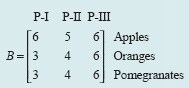
Cost of packages are obtained by computing AB. That is, by multiplying cost of each item in A (cost matrix A) with number of items in B (Fruit matrix B).
\(A B=\left[\begin{array}{lll} 30 & 15 & 45 \end{array}\right]\left[\begin{array}{lll} 6 & 5 & 6 \\ 3 & 4 & 6 \\ 3 & 4 & 6 \end{array}\right]=\left[\begin{array}{lll} 360 & 390 & 540 \end{array}\right]\)
Pack-I cost Rs. 360, Pack-II cost Rs. 390, Pack-III costs Rs. 540.
8.
Since there is a constant increase or decrease in arithmetic progression, it is a linear function.
Let the x-axis be the number of the term and the y-axis be the value of the term.
Let (x1, y1) and (x2, y2) be (7, 30) and (10, 21) respectively, using the equation
y - y1 = m(x -x1) we get
y - 30 = \(\frac{21-30}{10-7}\)(x-7)
y = -3x + 51...(1)
(i) Substituting x = 1, 2 and 3 in the, equation (1) we get the first three terms of AP as 48, 45 and 42.
(ii) Substituting y = 0 in equation (1) we get 0 = - 3x + 51 ⇒ x = 17
That is seventeenth term of A.P. is zero.
(iii) Clearly the slope of the line -3 is equal to the common difference A.P.
y - y1 = m(x - x1) ⇒ y =y1 + mx - mx1
⇒ y = mx + (y1 - mx1)
Put x = 1, 2, 3 the values of y are m + (y1 - mx1), 2m + (y1 - mx1), 3m + (y1 - mx1)
They are in A.P whose common difference in m.
9.
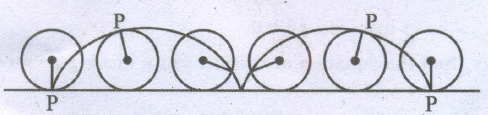
Let P (h, k) be any point on the required path. From the given information we have
h = a(θ - sin θ)...(1)
k = a(θ - cos θ)...(2)
Let us find the value of θ and sinθ from equation (2)
k = a(1 - cos θ)
cos θ = \(\frac{a-k}{a}\)
⇒ θ = cos-1\((\frac{a-k}{a})\) and sin θ = \(\frac{\sqrt{2ak-k^2}}{a}\)
Substituting above values in (1) we get h = a cos-1\((\frac{a-k}{a})-\sqrt{2ak-k^2}\)
x = a cos-1\((\frac{a-y}{a})-\sqrt{2ay-y^2}\)
10.
(n+2)C7 : (n-1)P4 = 13 : 24
\(\frac { { (n+2) }_{ C_{ 7 } } }{ { (n+2) }_{ P_{ 4 } } } =\frac { 13 }{ 24 } \)
\(\frac { (n+2)! }{ (n-5)!7! } \times \frac { (n-5)! }{ (n-1)! } =\frac { 13 }{ 24 } \)
\(\frac { (n+2)(n+1)n(n-1)! }{ (n-1)!.7! } =\frac { 13 }{ 24 } \)
\((n+2)(n+1)(n)=\frac{13}{24} \times 7 !=\frac{13}{24} \times 7 \times 6 \times 5 \times 4 \times 3 \times 2 \times 1\)
\((n+2)(n+1)(n)=13 \times 14 \times 15\)
n + 2 = 15 \(\Longrightarrow\) n = 13.
11.
(i) Let the variable x represents the quantity of gas, and y represents the number of days.
By the given data,
| x1 (0) Kg |
| x2 (14.2) Kg |
| y1 (0) |
| y2 (24) |
Using two - point form, the linear relationship between quantity of gas in the cylinder to the number of days is
\(\frac { y-0 }{ 24-0 } =\frac { x-0 }{ 14.2-0 } \ \left[ \because \ \frac { y-{ y }_{ 1 } }{ { y }_{ 2 }-{ y }_{ 1 } } =\frac { x-{ x }_{ 1 } }{ { x }_{ 2 }-{ x }_{ 1 } } \right] \)
\(\frac { y }{ 24 } =\frac { x }{ 14.2 } \)
\(\Rightarrow\) 14.2 y = 24x
\(\Rightarrow\) 24x - 14.2y = 0
\(\Rightarrow\) 12x - 7.1y = 0 ....(1)
Which is the required linear relation...(2)
Find the equation relating the quantity of gas in the cylinder to the days.
To find the Time taken to cross the pole, put y = 0
\(\Rightarrow \ \therefore \ 12.5x\ =\ 150\ \ \Rightarrow \ x=\frac { 150 }{ 12.5 } =12\ sec\)
(ii) Draw the graph for first 96 days
.JPG)
y = f(x) is a periodic function with period 24.
Therefore, f(x) = f(x + 24)
12.
(i) Let the x - axis represent the weight and the y-axis represent the length
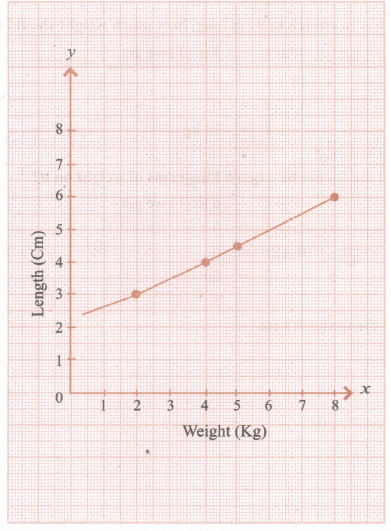
(ii) Consider the point \(\begin{pmatrix} { x }_{ 1 } & { y }_{ 1 } \\ 2 & 3 \end{pmatrix}\begin{pmatrix} { x }_{ 2 } & { y }_{ 2 } \\ 4 & 4 \end{pmatrix}\)
Equation of the straight line using two point form is
\(\frac { y-{ y }_{ 1 } }{ { y }_{ 2 }-{ y }_{ 1 } } =\frac { x-{ x }_{ 1 } }{ { x }_{ 2 }-{ x }_{ 1 } } \)
\(\Rightarrow \quad \frac { y-3 }{ 4-3 } =\frac { x-2 }{ 4-2 } \)
\(\Rightarrow \quad \frac { y-3 }{ 1 } =\frac { x-2 }{ 2 } \)
\(\Rightarrow\) 2y - 6 = x-2
\(\Rightarrow\) x - 2y + 4 = 0
(iii) To find the actual length of the spring,
Put x = 0
\(\Rightarrow\) 0 - 2y + 4 = 0
\(\Rightarrow\) -2y = -4
\(\Rightarrow\) y = 2 cm
(iv) Put y = 9 in (1) we get
\(\Rightarrow\) x - 18 + 4 = 0
\(\Rightarrow\) x - 14 = 0
\(\Rightarrow\) x = 14 kg
\(\therefore\) 14 Kg must be added
(v) Put x = 6 in (1) we get,
\(\Rightarrow\) 6 - 2y + 4 = 0
\(\Rightarrow\) 10 - 2y = 0
\(\Rightarrow\) 10 = 2y
\(\Rightarrow\) y = 5
\(\therefore\) Length of the spring = 5 cm
13.
| tho | hun | tens | uni |
| 4 | 5 | 5 | 5 |
Since 0 cannot be in the thousand's place
Let us find the sum of all these 500 numbers.
By filling 0 is the unit place, the remaining 3 places can be filled with remaining 4 digits is \(4\times 4\times 4=64\) in unit place.
∴ Sum of all the unit digits
= \((64\times 0)+(64\times 2)+(64\times 5)+(64\times 7)+(64\times 8)\)
= 64(0 + 2 + 5 + 7 + 8) = 64 (22) = 1408
Similarly sum of the tens digits =\(14408\times 10\) = 144080
Sum of all the hundred's digits = \(14408\times 100\) = 1440800
By filling 2 in the thousand's place, remaining 3 places can be filled with remaining 3 digits in \(3\times 3\times 3\) 27 ways [since 0 cannot be in thousands place]
∴ Sum of the digits in the thousands place
= \(27(2+5+7+8)=27(22)\times 1000\) = 594000
Hence sum of all the 4-digit numbers formed by using the digits 0, 2,5, 7, 8 is 1408 + 14080 + 140800 + 594000
= 1408 (1 + 10 + 100) + 594000
= \(1408\times 11+594000\)
= 750288
14.
\(A_{m \times n}\left[\begin{array}{ccc} 1, & 2 & 3 \\ 4 & 5 & 6 \end{array}\right]_{2 \times 3}=\left[\begin{array}{ccc} -7 & -8 & -9 \\ 2 & 4 & 6 \end{array}\right]_{2 \times 3}\)
\(n=2 \\ m=2\ [Since \ 2 \times 2.2 \times 3 \Rightarrow 2 \times 3 ]\\ \therefore A \ is \ of\ order \ 2 \times 2\)
Let us take
\(A=\left[\begin{array}{ll} a & b \\ c & d \end{array}\right]\)
\(\left[\begin{array}{ll} a & b \\ c & d \end{array}\right]\left[\begin{array}{lll} 1 & 2 & 3 \\ 4 & 5 & 6 \end{array}\right]=\left[\begin{array}{ccc} -7 & -8 & -9 \\ 2 & 4 & 6 \end{array}\right]\)
\(\left[\begin{array}{ccc} a+4 b & 2 a+5 b & 3 a+6 b \\ c+4 d & 2 c+5 d & 3 c+6 d \end{array}\right]=\left[\begin{array}{ccc} -7 & -8 & -9 \\ 2 & 4 & 6 \end{array}\right]\)
\(a+4 b=-7 ..........(1)\\ 2 a+5 b =-8 .........(2)\\ c+4 d=2 ............(3)\\ 2 c+5 d =4 ...........(4)\)
\(\text { (1) } \times 2 \Rightarrow 2 a+8 b=-14\)
\(\text { (2) } x-1 \Rightarrow-2 a-5 b=8\)
3b = -6
b = -2
Put in (1)
\(a+4(-2)=-7\)
\(a-8=-7\)
\(a=-7+8\)
a = 1
\(2 \times(3) \Rightarrow 2 c+8 d=4\)
\(-2 c-5 d=-4\)
\(3 \mathrm{~d} =0 \)
d = 0
Put in (3)
C + 0 2
C = 2
\(\therefore A=\left[\begin{array}{ll} a & b \\ c & d \end{array}\right]=\left[\begin{array}{cc} 1 & -2 \\ 2 & 0 \end{array}\right]\)
15.
7 + 77 + 777 + 7777 + ...
Sn = 7 + 77 + 777 + 7777 + ... to n terms
= \(\frac{7}{9}[9+99+999+9999+\)...to n terms]
= \(\frac{7}{9}[(10-1)+(10^{2}-1)+(10^{3}-1)+(10^{4}-1)+..\).to n terms]
= \(\frac{7}{9}[(10+10^{2}+10^{3}+... to n terms)-(1+1+1+... n terms)]\)
= \(\frac{7}{9}[\frac{10(10^{n}-1)}{10-1}-n]=\frac{7}{9}[\frac{10}{9}(10^{n}-1)-n]\)
= \(\frac{7}{81}[10^{n+1}-9n-10]\)
16.
(a) Total number of arrangement when boys and girls alternate = (5!)2 + (5!)2
(b) No two girls sit together = 5! 6!
(c) All the girls sit together = 2! 5! 5!
(d) All the girls sit never together = 10! - 5! 6!
Hence, the required matching is
(a)\(\leftrightarrow\)(iii), (b)\(\leftrightarrow\)(i), (c) \(\leftrightarrow\)(iv), (d)\(\leftrightarrow\)(ii)
17.
When n = 18 (even)
an = n (n + 2) = 18 (18 + 2) = 18 (20) = 360
When n = 25 (odd)
\(a_{n}=\frac{4n}{n^{2}+1}=\frac{4(25)}{(25)^{2}+1}=\frac{100}{625+1}=\frac{100}{626}=\frac{50}{313}\)
18.
Here n = \(2\over 3\)
\({n(n-1)\over 2!}={{2\over3}({2\over3})-1\over 2!}={{2\over3}({-1\over3})\over 2}={-1\over9}\)
\({n(n-1)(n-1)\over 2!}={{2\over 3}({2\over 3}-1)({2\over 3}-2)\over 3!}={{2\over 3}({-1\over 3})({-4\over 3})\over 6}={4\over 18}\)
Thus(1+x)\(2\over3\) = \(1+{2\over3}x-{1\over 9}x^2+{4\over 81}x^3+.....\)
19.
Given 3 + 10 + 17 +...
a1 = 3, d1 = 10 - 3 = 7
∴ Tn = a1(n-1)d1 = 3 + (n-1)7 = 7n-4 ...(1)
Also, given 63 + 65 + 67+..
a2 = 63, d2 = 65 - 63 = 2
∴ Tn = a2+(n-1)d2 = 63 + (n-1) 2 = 2n + 61 ..(2)
Let nth term of given series be equal
⇒ 7n - 4 =2n + 61
⇒ 5n = 65 [From (1) and (2)]
⇒ n = 13

11th Standard Syllabus & Materials
11th Standard
TN 11th Tamil பீடு பெற நில் - செய்யுள் - காவடிச்சிந்து Important Questions And Answers Study Material - QB365 Set A
NEW11th Standard
TN 11th Tamil பீடு பெற நில் - உரைநடை - மலை இடப்பெயர்கள் : ஓர் ஆய்வு Important Questions And Answers Study Material - QB365 Set A
NEW11th Standard
TN 11th Tamil மாமழை போற்றுதும் - துணைப்பாடம் - யானை டாக்டர் Important Questions And Answers Study Material - QB365 Set A
NEW11th Standard
TN 11th Tamil மாமழை போற்றுதும் - செய்யுள் - ஐங்குறுநூறு Important Questions And Answers Study Material - QB365 Set A



Tamilnadu Stateboard 11th Standard Subjects
Maths

Commerce

Economics

Biology

Business Maths and Statistics

Accountancy

Computer Science

Physics

Chemistry
Maths
Biology
Economics
Physics
Chemistry

History
Business Maths and Statistics

Computer Science
Accountancy

Computer Applications
History
Computer Technology
Commerce
Computer Applications
Computer Technology

Tamil

English

French
Tamilnadu Stateboard Standards

