
 100% FREE ACCESS
11th Standard Syllabus & Materials
11th Standard
TN 11th Tamil இயற்கை வேளாண்மை,சுற்றுச்சூழல் -செய்யுள் - மனோன்மணீயம் Important Questions And Answers Study Material - QB365 Set A
NEW11th Standard
TN 11th Tamil என்னுயிர் என்பேன் -துணைப்பாடம் - இசைத்தமிழர் இருவர் Important Questions And Answers Study Material - QB365 Set A
NEW11th Standard
TN 11th Tamil மொழி கலை -செய்யுள் - ஒவ்வொரு புல்லையும் Important Questions And Answers Study Material - QB365 Set A
NEW11th Standard
TN 11th Tamil பீடு பெற நில் - இலக்கணம் - பகுபத உறுப்புகள் Important Questions And Answers Study Material - QB365 Set A
NEW11th Standard
TN 11th Tamil பீடு பெற நில் - துணைப்பாடம் - வாடிவாசல் Important Questions And Answers Study Material - QB365 Set A
NEW11th Standard
TN 11th Tamil பீடு பெற நில் - செய்யுள் - குறுந்தொகை Important Questions And Answers Study Material - QB365 Set A

Published on: 29/09/2018
Important 3 mark question 5
Download Tamil Nadu 11th Standard Maths question papers, model tests, one-mark questions, important questions, and public exam papers in PDF format. Free study materials and answer keys for TN State Board students.
Questions + Answers key
Take MCQ Maths Test1.
Find the equation of a straight line cutting an intercept of 5 from the negative direction of the y-axis and is inclined at an angle 1500 to the x-axis.
2.
Find the principal solution of cos \(\theta ={1\over 2}\)
3.
Prove that \(\sin { 4\alpha } =4\tan { \alpha } \frac { 1-\tan ^{ 2 }{ \alpha } }{ { \left( 1+\tan ^{ 2 }{ \alpha } \right) }^{ 2 } } \)
4.
Find the principal solution and general solutions of the following : sin\(\theta\) = \(-\frac { 1 }{ \sqrt { 2 } } \)
5.
Find the principal value of \(sin^{ -1 }\left( \frac { 1 }{ \sqrt { 2 } } \right) \).
6.
Prove that \({ tan }^{ -1 }\left( \frac { m }{ n } \right) -{ tan }^{ -1 }\left( \frac { m-n }{ m+n } \right) =\frac { \pi }{ 4 } \)
7.
Prove that \(\frac { sin(A-B) }{ sin(A+B) } =\frac { { a }^{ 2 }-{ b }^{ 2 } }{ { c }^{ 2 } } \)
8.
Show that 3x2+10xy+8y2+14x+22y+15=0 represents a pair of straight lines and the angle between them is tan-1\(\left( \frac { 2 }{ 11 } \right) \).
9.
Find the equation of the straight line passing through intersection of the straight lines 5x - 6y = 1 and 3x + 2y + 5 = 0 and perpendicular to the straight line 3x - 5y + 11=0.
10.
A circular wire of radius 3 cm is cut and bent so as to lie along the circumference of a sector whose radius is 48 cm, Find in degrees the angle which is subtended at the centre of the sector.
11.
Find the equations of the straight lines, making the y-intercept of 7 and angle between the line and the y-axis is 30°.
12.
A straight line cuts intercepts from the axes of co-ordinates the sum of whose reciprocals is a constant. Show that it always passes through a fixed point.
13.
An airplane propeller rotates 1000 times per minute. Find the number of degree that a point on the edge of the propeller will rotate in 1 second
14.
A town has 2 fire engines operating independently. The probability that a fire engine is available when needed is 0.96.
(i) What is the probability that a fire engine is available when needed?
(ii) What is the probability that neither is available when needed?
15.
A problem in Mathematics is given to three students whose chances of solving \(\frac { 1 }{ 3 } ,\frac { 1 }{ 4 } \) and \(\frac { 1 }{ 5 } \) (i) What is the probability that the problem is solved? (ii) What is the probability that exactly one of them will solve it?
16.
A student when walks from his house, at an average speed of 6 kmph, reaches his school ten minutes before the school starts. When his average speed is 4 kmph, he reaches his school five minutes late. If he starts to school every day at 8.00 A.M, then find
(i) the distance between his house and the school
(ii) the minimum average speed to reach the school on time and time taken to reach the school
(iii) the time the school gate closes
(iv) the pair of straight lines of his path of walk.
17.
A 150 m long train is moving with constant velocity of 12.5 m/s. Find
(i) the equation of the motion of the train
(ii) time taken to cross a pole
(iii) The time taken to cross the bridge of length 850m is?
18.
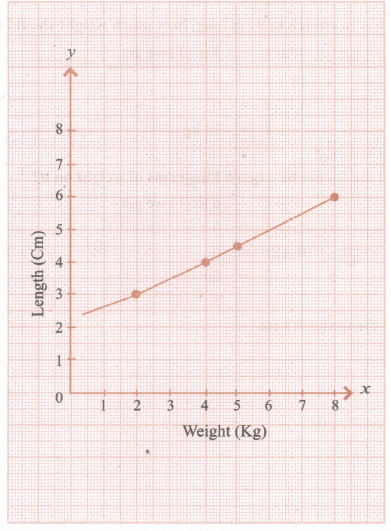
A spring was hung from a hook in the ceiling. A number of different weights were attached to the spring to make it stretch, and the total length of the spring was measured each time shown in the following table.
| Weight, (kg) | 2 | 4 | 5 | 8 |
| Length, (cm) | 3 | 4 | 4.5 | 6 |
(i) Draw a graph showing the results.
(ii) Find the equation relating the length of the spring to the weight on it.
(iii) What is the actual length of the spring.
(iv) If the spring has to stretch to 9 cm long, how much weight should be added?
(v) How long will the spring be when 6 kilograms of weight on it?
19.
Solve the following equations sin 5x - sin x = cos3x
20.
Show that \(\cot { \left( 7\frac { 1° }{ 2 } \right) } =\sqrt { 2 } +\sqrt { 3 } +\sqrt { 4 } +\sqrt { 6 } \)
1.
Given that the negative y intercept is 5 i.e., b = -5 and a = 1500,
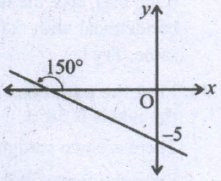
Slope m = tan 1500 = tan(180° - 300) = -tan 300 = -\(\frac{1}{\sqrt{3}}\)
Slope and intercept form of the equation is y = mx + b
That is y = -\(\frac{1}{\sqrt{3}}\)x - 5
\(x+\sqrt{3}y+5\sqrt{3}=0\)
2.
cos \(\theta ={1\over 2}\)
Principal value of cos θ lies in the I and II quadrant.
Since cos \(\theta ={1\over 2}\) > 0, the principal value of cos \(\theta \) lies in the interval [ 0, \({\pi \over 2}\)]
cos \(\theta ={1\over 2}\)= cos \(={\pi \over 2}\)
Thus, \(\theta\) = \(\pi \over 3\)is the principal solution.
3.
LHS = \(\sin { 4\alpha } =sin2(2\alpha)\)
= \(2\left( \frac { 2\tan { \alpha } }{ 1+\tan ^{ 2 }{ \alpha } } \right) \left( \frac { 1-\tan ^{ 2 }{ \alpha } }{ 1+\tan ^{ 2 }{ \alpha } } \right) \)
= \(4\tan { \alpha } .\frac { 1-\tan ^{ 2 }{ \alpha } }{ { \left( 1+\tan ^{ 2 }{ \alpha } \right) }^{ 2 } } \) = RHS
Hence proved.
4.
Given sin\(\theta\) = \(-\frac { 1 }{ \sqrt { 2 } } \)
sin\(\theta\) = \(-\frac { 1 }{ \sqrt { 2 } } \) < 0, so principal value lies in the IV quadrant.
sin \(\theta\) = -sin\(\frac { \pi }{ 4 } \)- sin(-\(\frac { \pi }{ 4 } \))
\(\Rightarrow \) \(\theta\) = - \(\frac { \pi }{ 4 } \) is the principal solution
5.
Let \(sin^{ -1 }\left( \frac { 1 }{ \sqrt { 2 } } \right) \) = y, where \(-\frac { \pi }{ 2 } \le y\le \frac { \pi }{ 2 } \)
⇒ sin y = \(\frac { 1 }{ \sqrt { 2 } } \)
⇒ sin y = sin \(\frac { \pi }{ 4 } \)
⇒ y = \(\frac { \pi }{ 4 } \)
Thus the principal value of \(sin^{ -1 }\left( \frac { 1 }{ \sqrt { 2 } } \right) \)= \(\frac { \pi }{ 4 } \) .
6.
\({ LHS=tan }^{ -1 }\left( \frac { m }{ n } \right) -{ tan }^{ -1 }\left( \frac { m-n }{ m+n } \right) \)
\(={ tan }^{ -1 }\left( \frac { \frac { m }{ n } -\frac { m-n }{ m+n } }{ 1+\frac { m }{ n } \times \frac { m-n }{ m+n } } \right) ={ tan }^{ -1 }\left( \frac { { m }^{ 2 }+mn-mn+{ n }^{ 2 } }{ mn+{ n }^{ 2 }+{ m }^{ 2 }-mn } \right) \)
\(={ tan }^{ -1 }\left( \frac { { m }^{ 2 }+{ n }^{ 2 } }{ { m }^{ 2 }+{ n }^{ 2 } } \right) ={ tan }^{ -1 }(1)=\frac { \pi }{ 4 } \)
7.
By sine formula \(\frac { a }{ sinA } =\frac { b }{ sinB } =\frac { c }{ sinC } =2R\)
\(\frac { { a }^{ 2 }-{ b }^{ 2 } }{ { c }^{ 2 } } =\frac { { (2RsinA) }^{ 2 }-{ (2RsinB) }^{ 2 } }{ { (2RsinC) }^{ 2 } } \)
\(=\frac { 4{ R }^{ 2 }{ sin }^{ 2 }A-4{ R }^{ 2 }{ sin }^{ 2 }B }{ 4{ R }^{ 2 }{ sin }^{ 2 }C } =\frac { { sin }^{ 2 }A-{ sin }^{ 2 }B }{ { sin }^{ 2 }C } \)
\(=\frac { sin(A+B)sin(A-B) }{ { sin }^{ 2 }C } [\because sinC=sin(A+B)]\)
\(=\frac { sin(A+B)sin(A-B) }{ { sin }^{ 2 }(A+B) } =\frac { sin(A-B) }{ sin(A+B) } \)
8.
3x2+10xy+8y2+14x+22y+15=0
a= 3, h = 5, b = 8, g = 7, f= 11, c = 15
The condition is af2+bg2+ch2 abc-2fgh = 0
3(11)2 +8(7)2 +15(5)2 -(3)(8)(15)-2(11)(7)(5)=363+392+375-360-770=0
Hence the equation represents a pair of straight lines
tanθ=\(\frac { \pm 2\sqrt { { h }^{ 2 }-ab } }{ a+b } =\frac { \pm 2\sqrt { 25-3(8) } }{ 3+8 } =\pm \frac { 2 }{ 11 } \)
tanθ=\(\frac { 2 }{ 11 } \)
⇒ θ=tan-1\(\left( \frac { 2 }{ 11 } \right) \).
9.
Equation of line through the intersection of straight lines 5x - 6y = 1 and 3x + 2y + 5
5x - 6y - 1 + k (3x + 2y + 5) = 0
x (5 + 3k) + y (-6 + 2k) + (-1 + 5k) = 0
This is perpendicular to 3x - 5y + 11 = 0
That is, the product of their slopes is -1
-\(\left( \frac { 5+3k }{ -6+2k } \right) \left( -\frac { 3 }{ -5 } \right) \)=-1
⇒ \(\frac { 15+9k }{ -30+10k } \)=1
45=k
Required equation is 5x - 6y -1 + 45 (3x + 2y + 5) = 0
140x + 84y + 224 = 0
20x + 12y + 32 = 0
5x+ 3y+ 8 = 0.
10.
Length of arc = Circumference of wire of radius = 3 cm
\(\therefore l=2\pi r=2\pi\times3\ cm=6\pi cm\)
The radius of the sector (r) = 48cm
\(\theta=\frac{l}{r}=\frac{6\pi}{48}=\frac{\pi}{8}\ radians\)
\(\therefore\) Angle in degrees which is subtended at the centre of the sector
\(=(\frac{\pi}{8}\times\frac{180^°}{\pi})^°=(\frac{45}{2})^°=22°30'\)
11.
There are two straight lines making 30° with the y-axis.
From the figure, it is clear that the two lines make the angles 60° and 120° with the x-axis
Let m1 be tan 60° = √3 and
m2 be tan 120° = tan( 180° - 60°)
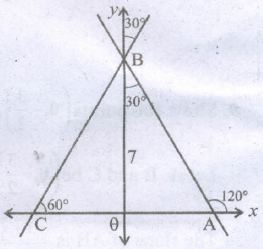
= -tan60°= -√3
m1 = √3, m2 = -√3 and b = 7
Equations of lines are y = m1x + b and y = m2x + b
y = √3x + 7 and y = -√3x + 7
12.
Let the equation of the line in intercept form be \(\frac{x}{a}+\frac{y}{b}=1\)
Its intercepts on x and y axes are a and b.
Given that \(\frac{1}{a}+\frac{1}{b}\) = constant = K
\(\therefore \frac{1}{K_a}+\frac{1}{K_b}=1\)
\(\Rightarrow \frac{\frac{1}{K}}{a}+\frac{\frac{1}{K}}{b}=1\)
\(\Rightarrow (\frac{1}{k},\frac{1}{k})\) satisfies the equation \(\frac{x}{a}+\frac{y}{b}=1\)
Hence the equation (1), passes through the fixed point \( (\frac{1}{k},\frac{1}{k})\).
13.
One completed rotation = 3600
∴ Number of degree taken in 1 = 1000 \(\times\) 3600
ie Number of degree taken in 60'' = 1000 \(\times\) 3600 [∵ 1' = 60'']
Number of degree taken in 1 = \(\frac { 1000\times 360 }{ 60 } \)
= 1000 \(\times\) 60o
= 6000o
14.
Let A'and B be the availability of first and second fire engine respectively, then A and B are independent.
Then \(P(A)=P(B)=0.96 \)
\(P(\bar{A})=P(\bar{B})=1-0.96=0.04\)
(i) P(a fire engine is available when needed)
\(=P(A \cap \bar{B})+P(\bar{A} \cap B)+P(A \cap B)\)
\(=P(A) \cdot P(\bar{B})+P(\bar{A}) \cdot P(B)+P(A) \cdot P(B)\)
\(=0.96 \times 0.04+0.04 \times 0.96+0.96 \times 0.96\)
\(=0.96(0.04+0.04+0.96) \)
\(=0.96 \times 1.04 \)
\(=0.9984\)
(ii) P (Neither is available when needed)
\(=P(\bar{A} \cap \bar{B}) \)
\(=P(\bar{A}) \cdot P(\bar{B})\)
\(=0.04 \times 0.04\)
\(=0.0016\)
15.
Let A, B, C be the events that the problems solved by 3 students. Then,
\(P(A)=\frac{1}{3}, P(B)=\frac{1}{4}, P(C)=\frac{1}{5}\)
(i) P (Problem is solved) \(=P(A \cup B \cup C)\)
\(=1-P(\overline{A \cup B \cup C})\)
\(=1-P(\bar{A} \cap \bar{B} \cap \bar{C})\)
\(=1-P(\bar{A}) P(\bar{B}) P(\bar{C})\)
\(=1-\frac{2}{3} \times \frac{3}{4} \times \frac{4}{5} \)
\(=1-\frac{2}{5}=\frac{3}{5}\)
(ii) P (exactly one of them will solve)
\(=P(A \bar{B} \bar{C} \cup \bar{A} B \bar{C} \cup \bar{A} \bar{B} C)\)
\(=P(A) \cdot P(\bar{B}) \cdot P(\bar{C})+P(\bar{A}) \cdot P(B) \cdot P(\bar{C})
+P(\bar{A}) \cdot P(\bar{B}) \cdot P(C)\)
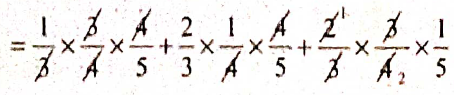
\(=\frac{1}{5}+\frac{2}{15}+\frac{1}{10}=\frac{1}{5}\left(1+\frac{2}{3}+\frac{1}{2}\right) \)
\(=\frac{6+4+3}{30}=\frac{13}{30}\)
16.
Let x-axis be the time in hours and y-axis be the distance in kilometer.
From the given information, we have
y = \(6\left( x-\frac { 10 }{ 60 } \right) \) ⇒ y = 6x - 1
y = \(4\left( x+\frac { 5 }{ 60 } \right) \) ⇒ y = 4x + \(\frac { 1 }{ 3 } \)
Solving the above two equations, we get (x, y) = \(\left( \frac { 2 }{ 3 } ,3 \right) \)
x = \(\frac { 2 }{ 3 } \) hour = 40 minutes, y = 3 km
(i) the distance between house and the school is 3km
(ii) the minimum average speed to reach the school on time is \(\frac { 60 }{ 40 } \) \(\times\) 3 = 4.5 kmph and time taken is hours \(\frac { 2 }{ 3 } \) or 40 miniutes
(iii) the school gate closes at 8.40 AM
(iv) the pair of straight lines of his path of walk to school is
(6x - y - 1)(4x - y + \(\frac { 1 }{ 3 } \)) = 0
72x2- 30xy + 3y2- 6x + 2y - 1 = 0
17.
(i) Let x-axis be the time in seconds and y-axis be the distance in meters.
Let the train be at the origin
ஃ Length of train = 150m is the negative y-intercept
Slope of the motion of the train m = 12.5m/sec
Since we are given slope and y-intercept, the equation of the line is y = mx - c
Equation of the motion of the train ஃ y = 12.5x-150
(ii) To find the Time taken to cross the pole, put y = 0
⇒ ஃ 12.5x = 150
⇒ x = \(\frac{150}{12.5}\) = 12 sec
(iii) Time taken to cross the bridge of length 850m is,
850 = 12.5x - 150
⇒ 850 + 150 = 12.5x
= \(\frac{1000}{12.5}=x\)
⇒ x = 80 sec
18.
(i) Let the x - axis represent the weight and the y-axis represent the length
(ii) Consider the point \(\begin{pmatrix} { x }_{ 1 } & { y }_{ 1 } \\ 2 & 3 \end{pmatrix}\begin{pmatrix} { x }_{ 2 } & { y }_{ 2 } \\ 4 & 4 \end{pmatrix}\)
Equation of the straight line using two point form is
\(\frac { y-{ y }_{ 1 } }{ { y }_{ 2 }-{ y }_{ 1 } } =\frac { x-{ x }_{ 1 } }{ { x }_{ 2 }-{ x }_{ 1 } } \)
\(\Rightarrow \quad \frac { y-3 }{ 4-3 } =\frac { x-2 }{ 4-2 } \)
\(\Rightarrow \quad \frac { y-3 }{ 1 } =\frac { x-2 }{ 2 } \)
\(\Rightarrow\) 2y - 6 = x-2
\(\Rightarrow\) x - 2y + 4 = 0
(iii) To find the actual length of the spring,
Put x = 0
\(\Rightarrow\) 0 - 2y + 4 = 0
\(\Rightarrow\) -2y = -4
\(\Rightarrow\) y = 2 cm
(iv) Put y = 9 in (1) we get
\(\Rightarrow\) x - 18 + 4 = 0
\(\Rightarrow\) x - 14 = 0
\(\Rightarrow\) x = 14 kg
\(\therefore\) 14 Kg must be added
(v) Put x = 6 in (1) we get,
\(\Rightarrow\) 6 - 2y + 4 = 0
\(\Rightarrow\) 10 - 2y = 0
\(\Rightarrow\) 10 = 2y
\(\Rightarrow\) y = 5
\(\therefore\) Strength of the spring = 5 cm
19.
\(2cos\left( \frac { 5x+x }{ 2 } \right) .sin\left( \frac { 5x-x }{ 2 } \right) =cos3x\)
2cos 3x.sin 2x = cos 3x
2cos 3x sin 2x - cos 3x = 0
cos 3x = 0 or 2sin 2x = 1
sin 2x =\(\frac{1}{2}\)
case (i)
when cos 3x = 0
3x = (2n +1)\(\frac{\pi}{2}\), n∈z
x = (2n + 1)\(\frac{\pi}{6}\), n∈z
case (ii)
sin 2x = \(\frac{1}{2}\)
sin 2x = sin\(\frac{\pi}{6}\)
2x = nπ + (-1)n, \(\frac{\pi}{6}\), n∈z
x = \(\frac{n\pi}{2}+(-1)^n\frac{\pi}{12}\), n∈z
Hence the solutions are x = (2n + 1)\(\frac{\pi}{6}\)or \(\frac{n\pi}{2}\)+(-1)n\(\frac{\pi}{12}\), n∈z
20.
LHS = \(cot{ \left( 7\frac { 1 }{ 2 } \right) }^{ ° }\)
= \(\frac { cos{ 7\frac { 1 }{ 2 } }^{ ° } }{ sin{ 7\frac { 1 }{ 2 } }^{ ° } } \)
Multiplying the numerator and denominator by 2sin(\({ 7\frac { 1 }{ 2 } }^{ ° }\))
\(\frac { 2sin{ 7\frac { 1 }{ 2 } }^{ ° }cos{ 7\frac { 1 }{ 2 } }^{ ° } }{ 2{ sin }^{ 2 }{ 7\frac { 1 }{ 2 } }^{ ° } } =\frac { sin15° }{ 1-cos15° } \)
\(\frac { sin\left( 45-30° \right) }{ 1-cos\left( 45-30° \right) } =\frac { sin45cos30-cos45°sin30° }{ 1-\left( cos45°cos30°+sin45sin30 \right) } \)
= \(\frac { \frac { 1 }{ \sqrt { 2 } } .\frac { \sqrt { 3 } }{ 2 } -\frac { 1 }{ \sqrt { 2 } } .\frac { 1 }{ 2 } }{ 1-\left( \frac { 1 }{ 2 } .\frac { \sqrt { 3 } }{ 2 } +\frac { 1 }{ \sqrt { 2 } } .\frac { 1 }{ 2 } \right) } =\frac { \sqrt { 3 } -1 }{ 2\sqrt { 2 } } /1-\left( \frac { \sqrt { 3 } +1 }{ 2\sqrt { 2 } } \right) \)
= \(\frac { \sqrt { 3 } -1 }{ 2\sqrt { 2 } } \times \frac { 2\sqrt { 2 } }{ 2\sqrt { 2 } -\sqrt { 3 } -1 } =\frac { \sqrt { 3 } -1 }{ 2\sqrt { 2 } -\sqrt { 3 } -1 } \)
= \(\frac { \sqrt { 3 } -1 }{ 2\sqrt { 2 } -\sqrt { 3 } -1 } \times \frac { 2\sqrt { 2 } +\sqrt { 3 } +1 }{ 2\sqrt { 2 } +\sqrt { 3 } +1 } \)
\(\frac { \left( \sqrt { 3 } -1 \right) \left( 2\sqrt { 2 } +\sqrt { 3 } +1 \right) }{ { \left( 2\sqrt { 2 } \right) }^{ 2 }-{ \left( \sqrt { 3 } +1 \right) }^{ 2 } } =\frac { 2\sqrt { 6 } +3-2\sqrt { 3 } -\sqrt { 3 } -1 }{ 8-\left( 1+3+2\sqrt { 3 } \right) } \)
= \(\frac { 2\sqrt { 6 } +2-2\sqrt { 2 } }{ 4-2\sqrt { 3 } } =\frac { \sqrt { 6 } +1-\sqrt { 2 } }{ 2-\sqrt { 3 } } \times \frac { 2+\sqrt { 3 } }{ 2+\sqrt { 3 } } \)
= \(\frac { 2\sqrt { 6 } +2-2\sqrt { 2 } +\sqrt { 18 } +\sqrt { 3 } -\sqrt { 6 } }{ 4-2\sqrt { 3 } } =\frac { \sqrt { 6 } +1-\sqrt { 2 } }{ 2-\sqrt { 3 } } \times \frac { 2+\sqrt { 3 } }{ 2+\sqrt { 3 } } \)
= \(\frac { 2\sqrt { 6 } +2-2\sqrt { 2 } +\sqrt { 18 } +\sqrt { 3 } -\sqrt { 6 } }{ 4-3 } =2\sqrt { 6 } +2-2\sqrt { 2 } +3\sqrt { 2 } +\sqrt { 3 } -\sqrt { 6 } \)
= \(\sqrt { 6 } +\sqrt { 3 } +2-2\sqrt { 2 } +3\sqrt { 2 } =\sqrt { 6 } +\sqrt { 3 } +2+2\sqrt { 2 } \)
= \(\sqrt { 2 } +\sqrt { 3 } +\sqrt { 4 } +\sqrt { 6 } \) = RHS
Hence proved.

11th Standard Syllabus & Materials
11th Standard
TN 11th Tamil பீடு பெற நில் - செய்யுள் - காவடிச்சிந்து Important Questions And Answers Study Material - QB365 Set A
NEW11th Standard
TN 11th Tamil பீடு பெற நில் - உரைநடை - மலை இடப்பெயர்கள் : ஓர் ஆய்வு Important Questions And Answers Study Material - QB365 Set A
NEW11th Standard
TN 11th Tamil மாமழை போற்றுதும் - துணைப்பாடம் - யானை டாக்டர் Important Questions And Answers Study Material - QB365 Set A
NEW11th Standard
TN 11th Tamil மாமழை போற்றுதும் - செய்யுள் - ஐங்குறுநூறு Important Questions And Answers Study Material - QB365 Set A



Tamilnadu Stateboard 11th Standard Subjects
Maths

Commerce

Economics

Biology

Business Maths and Statistics

Accountancy

Computer Science

Physics

Chemistry
Maths
Biology
Economics
Physics
Chemistry

History
Business Maths and Statistics

Computer Science
Accountancy

Computer Applications
History
Computer Technology
Commerce
Computer Applications
Computer Technology

Tamil

English

French
Tamilnadu Stateboard Standards

