
 100% FREE ACCESS
11th Standard Syllabus & Materials
11th Standard
TN 11th Tamil இயற்கை வேளாண்மை,சுற்றுச்சூழல் -செய்யுள் - மனோன்மணீயம் Important Questions And Answers Study Material - QB365 Set A
NEW11th Standard
TN 11th Tamil என்னுயிர் என்பேன் -துணைப்பாடம் - இசைத்தமிழர் இருவர் Important Questions And Answers Study Material - QB365 Set A
NEW11th Standard
TN 11th Tamil மொழி கலை -செய்யுள் - ஒவ்வொரு புல்லையும் Important Questions And Answers Study Material - QB365 Set A
NEW11th Standard
TN 11th Tamil பீடு பெற நில் - இலக்கணம் - பகுபத உறுப்புகள் Important Questions And Answers Study Material - QB365 Set A
NEW11th Standard
TN 11th Tamil பீடு பெற நில் - துணைப்பாடம் - வாடிவாசல் Important Questions And Answers Study Material - QB365 Set A
NEW11th Standard
TN 11th Tamil பீடு பெற நில் - செய்யுள் - குறுந்தொகை Important Questions And Answers Study Material - QB365 Set A

Published on: 06/09/2019
Introduction To Probability Theory
Download Tamil Nadu 11th Standard Maths question papers, model tests, one-mark questions, important questions, and public exam papers in PDF format. Free study materials and answer keys for TN State Board students.
Questions + Answers key
Take MCQ Maths Test1.
If \(P(A)=0.6, P(B)=0.5\), and \(P(A \cap B)=0.2\) Find \( P(\bar{A} / B)\)
2.
A single card is drawn from a pack of 52 cards. What is the probability that
The card will be 6 or smaller?
3.
Can two events be mutually exclusive and independent simultaneously?
4.
A die is thrown twice. Let A be the event, ‘First die shows 5’ and B be the event 'second die shows 5’. Find \(P(A\cup B)\) .
5.
A coin is tossed twice. Events E and F are defined as follows E= Head on first toss, F = Head on second toss. Find.
(i) \(P(E \cup F)\)
(ii) \(P(E / F)\)
(iii) \(P(\bar{E} / F)\)
(iv) Are the events E and F independent
6.
One bag contains 5 white and 3 black balls. Another bag contains 4 white and 6 black balls. If one ball is drawn from each bag, find the probability that (i) both are white (ii) both are black (iii) one white and one black.
7.
There are three events A, B, and C of which one and only one can happen. If the odds are 7 to 4 against A and 5 to 3 against B, then odds against C is
23: 65
65: 23
23: 88
88: 23
8.
If two events A and B are independent such that P(A) = 0.35 and \(P(A\cup B)=0.6\), then P(B) is
\({5\over 13}\)
\({1\over 13}\)
\({4\over 13}\)
\({7\over 13}\)
9.
A matrix is chosen at random from a set of all matrices of order 2, with elements 0 or 1 only. The probability that the determinant of the matrix chosen is non zero will be
\({3\over 16}\)
\({3\over 8}\)
\({1\over 4}\)
\({5\over 8}\)
10.
Two items are chosen from a lot containing twelve items of which four are defective, then the probability that at least one of the item is defective
\({19\over 33}\)
\({17\over 33}\)
\({23\over 33}\)
\({13\over 33}\)
11.
12.
The probability that a girl, preparing for competitive examination will get a State Government service is 0.12, the probability that she will get a Central Government job is 0.25, and the probability that she will get both is 0.07. Find the probability that (i) she will get atleast one of the two jobs (ii) she will get only one of the two jobs.
13.
A man has 2 ten rupee notes, 4 hundred rupee notes and 6 five hundred rupee notes in his pocket. If 2 notes are taken at random, what are the odds in favour of both notes being of hundred rupee denomination and also its probability?
1.
\(P(\bar{A} / B) =\frac{P(\bar{A} \cap B)}{P(B)} \)
\(=\frac{P(B)-P(A \cap B)}{P(B)} \)
\(=\frac{0.5-0.2}{0.5}=\frac{0.3}{0.5}=\frac{3}{5}\)
2.
P(card will be 6 or smaller)
= \(\frac{5+5+5+5}{52}=\frac{20}{52}=\frac{5}{13}\) [∵ 5 cards which are 6 or smaller from each variety]
3.
If A and B are mutually exclusive, then
\(P(A \cap B)=0\)
But if A and B are independent, then
\(P(A \cap B)=P(A) \cdot P(B)\)
So if A and B are non empty, then they are not mutually exclusive and independent simultaneously.
4.
When'a die is thrown twice, then the sanmple space
\(S=\{(1,1),(1,2),(1,3),(1,4),(1,5),(1,6),\\
(2,1),(2,2),(2,3),(2,4),(2,5),(2,6), \\
(3,1),(3,2),(3,3),(3,4),(3,5),(3,6), \\
(4,1),(4,2),(4,3),(4,4),(4,5),(4,6), \\
(5,1),(5,2),(5,3),(5,4),(5,5),(5,6), \\
(6,1),(6,2),(6,3),(6,4),(6,5),(6,6)\}\)
n(S) = 36
A be the event, first die shows 5 and
B be the event, second die shows 5 then,
\(A =\{(5,1),(5,2),(5,3),(5,4),(5,5),(5,6)\}\)
\(n(A) =6\)
\(B =\{(1,5),(2,5),(3,5),(4,5),(5,5),(6,5)\} \)
\(n(B) =6 \)
\(A \cap B =\{(5,5)\}, \quad n(A \cap B)=1\)
Now, \(P(A \cup B) =P(A)+P(B)-P(A \cap B) \)
\(=\frac{n(A)}{n(S)}+\frac{n(B)}{n(S)}-\frac{n(A \cap B)}{n(S)} \)
\(=\frac{6}{36}+\frac{6}{36}-\frac{1}{36} \)
\(=\frac{11}{36}\)
5.
The sample space is S = {H, T} \(\times\) {H, T}
\(S=\{(H, H),(H, T),(T, H),(T, T)\}\)
and E = {{H, H), (H, T)}
F = {(H, H), (T, H)}
E\(\cup \)F = {(H, H), (H, T), (T, H)}
E\(\cap \)F = {(H, H)}
(i) P(E\(\cup \)F) = P(E) + P(F) - P(E\(\cap \)F) or \(\left( \frac { n(E\cup F) }{ n(S) } \right) \)
=\(\frac { 2 }{ 4 } +\frac { 2 }{ 4 } -\frac { 1 }{ 4 } =\frac { 3 }{ 4 } \)
(ii) P(E/F) =\(\frac { P(E\cap F) }{ P(F) } =\frac { (1/4) }{ (2/4) } =\frac { 1 }{ 2 } \)
(iii) \(P(\bar { E } /F)=\frac { P(\bar { E } \cap F) }{ P(F) } \)
=\(\frac { P(F)-P(E\cap F) }{ P(F) } \)
=\(\frac { (2/4)-(1/4) }{ (2/4) } \)
=\(\frac { 1 }{ 2 } \)
We have \(P(E\cap F)=\frac { 1 }{ 4 } \)
P(E) = \(\frac{2}{4}\), P(F) = \(\frac{2}{4}\)
P(E)P(F) = \(\frac { 2 }{ 4 } .\frac { 2 }{ 4 } =\frac { 2 }{ 5 } \)
⇒ P(E\(\cap \)F) =P(E).P(F)
Therefore E and F are independent events.
6.
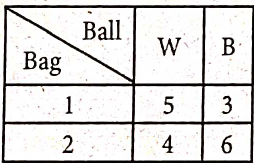
Let W, W, be the event that the white ball is drawn from bag. 1 and bag 2 respectively. Also let B,B, be the event that the black ball is drawn from bag 1 and 2 respectively.
Then \(P\left(W_1\right)=\frac{5}{8}, \quad P\left(W_2\right)=\frac{4}{10}\)
\(P\left(B_1\right)=\frac{3}{8}, \quad P\left(B_2\right)=\frac{6}{10}\)
(i) P (Both are white \(=P\left(W_1 \cap W_2\right)\)
\(=P\left(W_1\right) \cdot P\left(W_2\right)\)
\(=\frac{5}{8} \times \frac{4}{10}=\frac{1}{4}\)
(ii) P (Both are black) \(=P\left(B_1 \cap B_2\right) \)
\(=P\left(B_1\right) \cdot P\left(B_2\right) \)
\(=\frac{3}{8} \times \frac{6}{10}=\frac{9}{40}\)
(ii) P (One white and one black) \(=P\left(W_1 \cap B_2\right)+P\left(W_2 \cap B_1\right) \)
\(=P\left(W_1\right) \cdot P\left(B_2\right)+P\left(W_2\right) \cdot P\left(B_1\right) \)
\(=\frac{5}{8} \times \frac{6}{10}+\frac{4}{10} \times \frac{3}{8} \)
\(=\frac{3}{8}+\frac{3}{20}=\frac{15+6}{40}=\frac{21}{40}
\)
7.
(b)
65: 23
8.
\(\mathrm{P}(\mathrm{A} \cup \mathrm{B}) =\mathrm{P}(\mathrm{A})+\mathrm{P}(\mathrm{B})-\mathrm{P}(\mathrm{A} \cap \mathrm{B}) \)
\(0.6 =0.35+\mathrm{P}(\mathrm{B})-\mathrm{P}(\mathrm{A}) \cdot \mathrm{P}(\mathrm{B}) \)
\(0.25 =\mathrm{P}(\mathrm{B})-0.35 \mathrm{P}(\mathrm{B}) \)
\(=\mathrm{P}(\mathrm{B})(1-0.35) \)
\(=\mathrm{P}(\mathrm{B})(0.65) \)
\(\mathrm{P}(\mathrm{B}) =\frac{0.25}{0.65}=\frac{5}{13} \)
9.
\(n(S) =2^{14}=16 \)
\(A =\left\{\begin{array}{ll} 1 & 0 \\ 0 & 1 \end{array}|,| \begin{array}{ll} 0 & 1 \\ 1 & 0 \end{array}|,| \begin{array}{ll} 1 & 1 \\ 0 & 1 \end{array}|,| \begin{array}{ll} 1 & 0 \\ 1 & 1 \end{array}|,| \begin{array}{ll} 0 & 1 \\ 1 & 1 \end{array}|,| \begin{array}{ll} 1 & 1 \\ 1 & 0 \end{array} \mid\right\} \)
\(n(A) =6 \)
\(P(A) =\frac{6}{16}=\frac{3}{8} \)
10.
Defective = 4
Not Defective = 8
\(\mathrm{n}(\mathrm{S})=12 \mathrm{C}_{2}=\frac{12 \times 11}{1 \times 2}=66\)
\(\mathrm{P} \text { (one defective) }=\frac{4 \mathrm{C}_{1} \times 8 \mathrm{C}_{1}}{12 \mathrm{C}_{2}}=\frac{32}{66}\)
\(\mathrm{P} \text { (two defective) }=\frac{4 \mathrm{C}_{2}}{12 \mathrm{C}_{2}}=\frac{6}{66}\)
\(P \text { (atleast one defective) }=\frac{32}{66}+\frac{6}{66}=\frac{19}{33}\)
11.
(d)
12.
Let I be the event of getting State Government service and C be the event of getting Central Government job.
Given that P(I) = 0.12, P(C) = 0.25, and \(P(I \cap C)\) = 0.07
(i) P( at least one of the two jobs) \(=P(I \text { or } C)=P(I \cup C)\)
\(=P(I)+P(C)-P(I \cap C) \)
\(=0.12+0.25-0.07=0.30\)
(ii) P(only one of the two jobs) = P [only I or only C]
=\(P\left( I\cap \overline { C } \right) +P\left( \overline { I } \cup C \right) \)
\(=\{0.12-0.07\}+\{0.25-0.07\}\)
\(=0.23 \)

13.
Let S be the sample space and A be the event of taking 2 hundred rupee note.
THerefore, n(S) = 12c2 = 66, n(A) = 4c2 = 6 and \(\left( \overline { A } \right) \) = 66 - 6 = 60
Therefore, odds in favour of A is 6 : 60
That is, odds in favour of A is 1 : 10, and P(A) = \(\frac { 1 }{ 11 } \)

11th Standard Syllabus & Materials
11th Standard
TN 11th Tamil பீடு பெற நில் - செய்யுள் - காவடிச்சிந்து Important Questions And Answers Study Material - QB365 Set A
NEW11th Standard
TN 11th Tamil பீடு பெற நில் - உரைநடை - மலை இடப்பெயர்கள் : ஓர் ஆய்வு Important Questions And Answers Study Material - QB365 Set A
NEW11th Standard
TN 11th Tamil மாமழை போற்றுதும் - துணைப்பாடம் - யானை டாக்டர் Important Questions And Answers Study Material - QB365 Set A
NEW11th Standard
TN 11th Tamil மாமழை போற்றுதும் - செய்யுள் - ஐங்குறுநூறு Important Questions And Answers Study Material - QB365 Set A



Tamilnadu Stateboard 11th Standard Subjects
Maths

Commerce

Economics

Biology

Business Maths and Statistics

Accountancy

Computer Science

Physics

Chemistry
Maths
Biology
Economics
Physics
Chemistry

History
Business Maths and Statistics

Computer Science
Accountancy

Computer Applications
History
Computer Technology
Commerce
Computer Applications
Computer Technology

Tamil

English

French
Tamilnadu Stateboard Standards

