
 100% FREE ACCESS
11th Standard Syllabus & Materials
11th Standard
TN 11th Tamil இயற்கை வேளாண்மை,சுற்றுச்சூழல் -செய்யுள் - மனோன்மணீயம் Important Questions And Answers Study Material - QB365 Set A
NEW11th Standard
TN 11th Tamil என்னுயிர் என்பேன் -துணைப்பாடம் - இசைத்தமிழர் இருவர் Important Questions And Answers Study Material - QB365 Set A
NEW11th Standard
TN 11th Tamil மொழி கலை -செய்யுள் - ஒவ்வொரு புல்லையும் Important Questions And Answers Study Material - QB365 Set A
NEW11th Standard
TN 11th Tamil பீடு பெற நில் - இலக்கணம் - பகுபத உறுப்புகள் Important Questions And Answers Study Material - QB365 Set A
NEW11th Standard
TN 11th Tamil பீடு பெற நில் - துணைப்பாடம் - வாடிவாசல் Important Questions And Answers Study Material - QB365 Set A
NEW11th Standard
TN 11th Tamil பீடு பெற நில் - செய்யுள் - குறுந்தொகை Important Questions And Answers Study Material - QB365 Set A

Published on: 29/09/2018
Important questions-Introduction To Probability Theory
Download Tamil Nadu 11th Standard Maths question papers, model tests, one-mark questions, important questions, and public exam papers in PDF format. Free study materials and answer keys for TN State Board students.
Questions + Answers key
Take MCQ Maths Test1.
A consulting firm rents car from three agencies such that 50% from agency L, 30% from agency M and 20% from agency N. If 90% of the cars from L, 70% of cars from M and 60% of the cars from N are in good conditions
(i) what is the probability that the firm will get a car in good condition?
(ii) if a car is in good condition, what is probability that it has come from agency N?
2.
For a sports meet, a winners’ stand comprising of three wooden blocks is in the form as shown in figure. There are six different colours available to choose from and three of the wooden blocks is to be painted such that no two of them has the same colour. Find the probability that the smallest block is to be painted in red, where red is one of the six colours.

3.
If A and B are mutually exclusive events P(A) = \(\frac{3}{8}\) and P(B) = \(\frac{1}{8}\) , then find (i) P(\(\bar { A } \)) (ii) \(P(A\cup B)\) (iii) \(P(\bar { A } \cap B)\) (iv) \(P(\bar { A } \cup \bar { B } )\)
4.
When a pair of fair dice is rolled, what are the probabilities of getting the sum (i)7 (ii) 7 or 9 (iii) 7 or 12?
5.
An advertising executive is studying television viewing habits of married men and women during prime time hours. Based on the past viewing records he has determined that during prime time wives are watching television 60% of the time. It has also been determined that when the wife is watching television, 40% of the time the husband is also watching. When the wife is not watching the television, 30% of the time the husband is watching the television. Find the probability that
(i) the husband is watching the television during the prime time of television
(ii) if the husband is watching the television, the wife is also watching the television.
6.
7.
Suppose a fair die is rolled. Find the probability of getting (i) an even number (ii) multiple of three.
8.
Two thirds of students in a class are boys and rest girls. It is known that the probability of a girl getting a first grade is 0.85 and that of boys is 0.70. Find the probability that a student chosen at random will get first grade marks.
9.
A problem in Mathematics is given to three students whose chances of solving \(\frac { 1 }{ 3 } ,\frac { 1 }{ 4 } \) and \(\frac { 1 }{ 5 } \) (i) What is the probability that the problem is solved? (ii) What is the probability that exactly one of them will solve it?
10.
If two events A and B are independent such that P(A) = 0.35 and \(P(A\cup B)=0.6\), then P(B) is
\({5\over 13}\)
\({1\over 13}\)
\({4\over 13}\)
\({7\over 13}\)
11.
A number x is chosen at random from the first 100 natural numbers. Let A be the event of numbers which satisfies\({(x-10)(x-50)\over x-30}\ge0\), then P(A) is
0.20
0.51
0.71
0.70
12.
A man has 3 fifty rupee notes, 4 hundred rupees notes, and 6 five hundred rupees notes in his pocket. If 2 notes are taken at random, what are the odds in favour of both notes being of hundred rupee denomination?
1:12
12:1
13:1
1:13
13.
Two items are chosen from a lot containing twelve items of which four are defective, then the probability that at least one of the item is defective
\({19\over 33}\)
\({17\over 33}\)
\({23\over 33}\)
\({13\over 33}\)
14.
15.
If an experiment has exactly the three possible mutually exclusive outcomes A, B, and C, check in each case whether the assignment of probability is permissible.
\(P(A)=\frac { 4 }{ 7 } ,P(B)=\frac { 1 }{ 7 } ,P(C)=\frac { 2 }{ 7 } \)
16.
The probability that a girl, preparing for competitive examination will get a State Government service is 0.12, the probability that she will get a Central Government job is 0.25, and the probability that she will get both is 0.07. Find the probability that (i) she will get atleast one of the two jobs (ii) she will get only one of the two jobs.
17.
An experiment has the four possible mutually exclusive and exhaustive outcomes A, B, C, and D. Check whether the following assignments of probability are permissible.
P(A) = \(\frac { 2 }{ 5 } \), P(B) = \(\frac { 3 }{ 5 } \), P(C) = -\(\frac { 1 }{ 5 } \), P(D) = \(\frac { 1 }{ 5 } \)
18.
An experiment has the four possible mutually exclusive and exhaustive outcomes A, B, C, and D. Check whether the following assignments of probability are permissible.
P(A) = 0.15, P(B) = 0.30, P(C) = 0.43 , P(D) = 0.12
19.
1.
Let A1, A2, and A3 be the events that the cars are rented from the agencies X, Y, and Z respectively.
Let G be the event of getting a car in good condition.
We have to find
(i) the total probability of event G that is, P(G)

(ii) find the conditional probability A3 given G that is, P(A3 /G)
We have P(A1) = 0.50,P(G/A1) = 0.90
P(A2) = 0.30, P(G/A2) = 0.70
P(A3) = 0.20, P(G/A3) =0.60.
(i) Since A1,A2, and A3 are mutually exclusive and exhaustive events and G is an event in S,then the total probability of event G is P(G).
P(G) = P(A1)P(G/A1) + P(A2)P(G/A2) + P(A3)P(G/A3)
P(G) = (0.50)(0.90) + (0.30)(0.70) + (0.20)(0.60)
P(G) = 0.78
(ii) The conditional probability A3 given G is P(A3 /G)
By Bayes’theorem,
P(A3/G)\(={P(A_3)P(G/A_3)\over P(A_1)P(G/ A_1)+P(A_2)P(G/A_2)+P(A_3)P(G/ A_3)}\)
P(A3/G) = \({(0.20)(0.60)\over(0.50)(0.90)+(0.30)(0.70)+(0.20)(0.60)}\)
\(={2\over13}\)
2.
Let S be the sample space and A be the event that the smallest block is to be painted in red.
n(S) = 6 P3 = 6 \(\times\) 5 \(\times\) 4 = 120
n(A) = 5 \(\times\) 4 = 20
P(A) = \(\frac { n(A) }{ n(S) } =\frac { 20 }{ 120 } =\frac { 1 }{ 6 } \)

3.
\((i) P(\bar{A})=1-P(A)=1-\frac{3}{8}=\frac{5}{8}\)
\((ii) P(A \cup B)=p(A)+P(B)=\frac{3}{8}+\frac{1}{8}=\frac{4}{8}=\frac{1}{2}\)
\((iii) P(\bar{A} \cap B)=P(B)-P(A \cap B) =P(B)=\frac{1}{8} \quad(\because P(A \cap B)=0)\)
\((iv) P(\bar{A} \cup \bar{B})=1-P(A \cap B)=1\)
4.
The sample space S = {1, 2, 3, 4, 5, 6} \(\times\) {1, 2, 3, 4, 5, 6}
S = {(1,1), (1,2), (1,3), (1,4), (1,5), (1,6), (2,1), (2,2), (2,3), (2,4), (2,5) ,(2,6), (3,1),(3,2),(3,3),(3,4),(3,5),(3,6), (4,1),(4,2),(4,3),(4,4),(4,5),(4,6), (5,1),(5,2),(5,3),(5,4),(5,5),(5,6) (6,1),(6,2),(6,3),(6,4),(6,5),(6,6)}
Number of possible outcomes = 62 =36 = n(S)
Let A be the event of getting sum 7,B be the event of getting the sum 9 and C be the event of getting sum 12. Then
A = {(1,6), (2,5), (3,4), (4,3), (5,2), (6,1) ⇒ n(A) = 6
B = {(3,6), (4,5), (5,4), (6,3)} ⇒ n(B) = 4
C = {(6,6)} ⇒ n(C) = 1
(i) P (getting sum 7) = P(A)
=\(\frac { n(A) }{ n(S) } =\frac { 6 }{ 36 } =\frac { 1 }{ 6 } \)
(ii) P (getting sum 7 or 9) = P(A or B) = P(A∪B)
= P(A) + P(B)
Since A and B are mutually exclusive that is, A ก B - Ø)
\(\frac { n(A) }{ n(S) } +\frac { n(B) }{ n(S) } =\frac { 6 }{ 36 } +\frac { 4 }{ 36 } =\frac { 5 }{ 18 } \)
(iii) P (getting sum 7 or 12) = P(A or C) = P⋃C)
= P(A) + P(C) Since A and C are mutually exclusive)
\(\frac { n(A) }{ n(S) } +\frac { n(C) }{ n(S) } =\frac { 6 }{ 36 } +\frac { 1 }{ 36 } =\frac { 7 }{ 36 } \)

5.
Let H be the event that the husband is watching television.
Let A1 be the event that the wife is watching television in the prime time.
Let A2 be the event that the wife is not watching television in the prime time.
Then. \(P\left(A_1\right)=\frac{60}{100}=0.6, P\left(A_2\right)=\frac{40}{100}=0.4\)
\(P\left(H / A_1\right)=\frac{40}{100}=0.4, P\left(A / A_2\right)=\frac{30}{100}=0.3\)
(i) P (husband is watching the television during the prime time)
\(P(H)=P\left(H / A_1\right) \cdot P\left(A_1\right)+P\left(H / A_2\right) \cdot P\left(A_2\right)\)
\(=0.6 \times 0.4+0.4 \times 0.3=0.4(0.6+0.3)\)
\(=0.4 \times 0.9=0.36=\frac{30}{100}=\frac{9}{25}\)
(ii) P (husband is watching the television, the wife is also watching the television)
\(P\left(A_1 / H\right)=\frac{P\left(A_1\right) \cdot P\left(H / A_1\right)}{P\left(A_1\right) \cdot P\left(H / A_1\right)+P\left(A_2\right) \cdot P\left(H / A_2\right)}\)
\(=\frac{0.6 \times 0.4}{0.36}=\frac{6}{9}=\frac{2}{3}\)
6.
7.
Let S be the sample space,
A be the event of getting an even number,
B be the event of getting multiple of three.
Therefore,
S = {1, 2, 3, 4, 5, 6} ⇒ n(S) =6
A = {2, 4, 6} ⇒ n(A) = 3
B = {3, 6} ⇒ n(B) = 2
The required probabilities are
(i) P (getting an even number) = P(A) = \(\frac { n(A) }{ n(S) } =\frac { 3 }{ 6 } =\frac { 1 }{ 2 } \)
(ii) P (getting multiple of three) = P(B) = \(\frac { n(B) }{ n(S) } =\frac { 2 }{ 6 } =\frac { 1 }{ 3 } \)
8.
Let B & G are the representation of boys & girls respectively.
Let F be the student taking first grade.
Then \(P(B)=\frac{2}{3}, P(G)=\frac{1}{3}\)
\(P(F / B)=0.70, P(F / G)=0.85\)
\(Now, P(F \cap B or F \cap G)=P(F \cap B)+P(F \cap G)\)
\(=P(B) \cdot P(F / B)+P(G)
.P(F / G)\)
\(=\frac{2}{3} \times 0.7+\frac{1}{3} \times 0.85\)
\(=\frac{1.4+0.85}{3} \)
\(
=\frac{2.25}{3}=\frac{225}{300} \)
\(=\frac{3}{4}=0.75\)
9.
Let A, B, C be the events that the problems solved by 3 students. Then,
\(P(A)=\frac{1}{3}, P(B)=\frac{1}{4}, P(C)=\frac{1}{5}\)
(i) P (Problem is solved) \(=P(A \cup B \cup C)\)
\(=1-P(\overline{A \cup B \cup C})\)
\(=1-P(\bar{A} \cap \bar{B} \cap \bar{C})\)
\(=1-P(\bar{A}) P(\bar{B}) P(\bar{C})\)
\(=1-\frac{2}{3} \times \frac{3}{4} \times \frac{4}{5} \)
\(=1-\frac{2}{5}=\frac{3}{5}\)
(ii) P (exactly one of them will solve)
\(=P(A \bar{B} \bar{C} \cup \bar{A} B \bar{C} \cup \bar{A} \bar{B} C)\)
\(=P(A) \cdot P(\bar{B}) \cdot P(\bar{C})+P(\bar{A}) \cdot P(B) \cdot P(\bar{C})
+P(\bar{A}) \cdot P(\bar{B}) \cdot P(C)\)
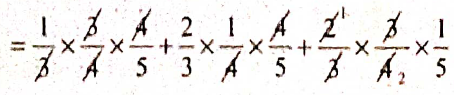
\(=\frac{1}{5}+\frac{2}{15}+\frac{1}{10}=\frac{1}{5}\left(1+\frac{2}{3}+\frac{1}{2}\right) \)
\(=\frac{6+4+3}{30}=\frac{13}{30}\)
10.
\(\mathrm{P}(\mathrm{A} \cup \mathrm{B}) =\mathrm{P}(\mathrm{A})+\mathrm{P}(\mathrm{B})-\mathrm{P}(\mathrm{A} \cap \mathrm{B}) \)
\(0.6 =0.35+\mathrm{P}(\mathrm{B})-\mathrm{P}(\mathrm{A}) \cdot \mathrm{P}(\mathrm{B}) \)
\(0.25 =\mathrm{P}(\mathrm{B})-0.35 \mathrm{P}(\mathrm{B}) \)
\(=\mathrm{P}(\mathrm{B})(1-0.35) \)
\(=\mathrm{P}(\mathrm{B})(0.65) \)
\(\mathrm{P}(\mathrm{B}) =\frac{0.25}{0.65}=\frac{5}{13} \)
11.
The equation is not valid for 1 to 9. 30 to 49
(i.e) for 9 + 20 = 29 numbers
Valid for 10 to 29 and 50 to 100 = 71 numbers
n(A) = 71, n(S) = 100
\(\mathrm{P}(\mathrm{A})=\frac{71}{100}=0.71\)
12.
Fifty rupee note = 3
Hundred rupee note = 4
500 rupee note = 6
Totsl = 13
\(\mathrm{n}(\mathrm{S})=13 \mathrm{C}_{2}=78\)
\(\text {No. of ways the event to occur }=4\)
\(n(A)=4 C_{2}=6\)
\(\text {No. of ways the event not to occur }=72\)
The odds of event are a:b
\(6: 72 \Rightarrow 1: 12\)
13.
Defective = 4
Not Defective = 8
\(\mathrm{n}(\mathrm{S})=12 \mathrm{C}_{2}=\frac{12 \times 11}{1 \times 2}=66\)
\(\mathrm{P} \text { (one defective) }=\frac{4 \mathrm{C}_{1} \times 8 \mathrm{C}_{1}}{12 \mathrm{C}_{2}}=\frac{32}{66}\)
\(\mathrm{P} \text { (two defective) }=\frac{4 \mathrm{C}_{2}}{12 \mathrm{C}_{2}}=\frac{6}{66}\)
\(P \text { (atleast one defective) }=\frac{32}{66}+\frac{6}{66}=\frac{19}{33}\)
14.
(d)
15.
Since the experiment has exactly the three possible mutually exclusive outcomes A, B and C, they must be exhaustive events.
\(\Rightarrow S=A\cup B\cup C\)
Therefore, by axioms of probability
\(P(A)\ge 0,P(B)\ge P(C)\ge 0\) and
\(P(A\cup B\cup C)=P(A)+P(B)+P(C)=P(S)=1\)
Given that \(P(A)=\frac { 4 }{ 7 } \ge 0,\quad P(B)=\frac { 1 }{ 7 } \ge 0,\quad P(C)=\frac { 2 }{ 7 } \ge 0\)
Also \(P(S)=P(A)+P(B)+P(C)=\frac { 4 }{ 7 } +\frac { 1 }{ 7 } +\frac { 2 }{ 7 } =1\)
Therefore the assignment of probability is permissible


16.
Let I be the event of getting State Government service and C be the event of getting Central Government job.
Given that P(I) = 0.12, P(C) = 0.25, and \(P(I \cap C)\) = 0.07
(i) P( at least one of the two jobs) \(=P(I \text { or } C)=P(I \cup C)\)
\(=P(I)+P(C)-P(I \cap C) \)
\(=0.12+0.25-0.07=0.30\)
(ii) P(only one of the two jobs) = P [only I or only C]
=\(P\left( I\cap \overline { C } \right) +P\left( \overline { I } \cup C \right) \)
\(=\{0.12-0.07\}+\{0.25-0.07\}\)
\(=0.23 \)

17.
\(P(A)>0 ; P(B)>0 ;P(C)<0\)
\(\therefore\) The assignment of probability are not permissible.
18.
\(
P(A)>0 ; P(B)>0 ; P(C)>0 ; P(D)>0 \) and
\(
P(A)+P(B)+P(C)+P(D)
=0.15+0.30+0.43+0.12=1.0
\)
\(\therefore\) The assignment of probability are permissible.
19.

11th Standard Syllabus & Materials
11th Standard
TN 11th Tamil பீடு பெற நில் - செய்யுள் - காவடிச்சிந்து Important Questions And Answers Study Material - QB365 Set A
NEW11th Standard
TN 11th Tamil பீடு பெற நில் - உரைநடை - மலை இடப்பெயர்கள் : ஓர் ஆய்வு Important Questions And Answers Study Material - QB365 Set A
NEW11th Standard
TN 11th Tamil மாமழை போற்றுதும் - துணைப்பாடம் - யானை டாக்டர் Important Questions And Answers Study Material - QB365 Set A
NEW11th Standard
TN 11th Tamil மாமழை போற்றுதும் - செய்யுள் - ஐங்குறுநூறு Important Questions And Answers Study Material - QB365 Set A



Tamilnadu Stateboard 11th Standard Subjects
Maths

Commerce

Economics

Biology

Business Maths and Statistics

Accountancy

Computer Science

Physics

Chemistry
Maths
Biology
Economics
Physics
Chemistry

History
Business Maths and Statistics

Computer Science
Accountancy

Computer Applications
History
Computer Technology
Commerce
Computer Applications
Computer Technology

Tamil

English

French
Tamilnadu Stateboard Standards

