
 100% FREE ACCESS
11th Standard Syllabus & Materials
11th Standard
TN 11th Tamil இயற்கை வேளாண்மை,சுற்றுச்சூழல் -செய்யுள் - மனோன்மணீயம் Important Questions And Answers Study Material - QB365 Set A
NEW11th Standard
TN 11th Tamil என்னுயிர் என்பேன் -துணைப்பாடம் - இசைத்தமிழர் இருவர் Important Questions And Answers Study Material - QB365 Set A
NEW11th Standard
TN 11th Tamil மொழி கலை -செய்யுள் - ஒவ்வொரு புல்லையும் Important Questions And Answers Study Material - QB365 Set A
NEW11th Standard
TN 11th Tamil பீடு பெற நில் - இலக்கணம் - பகுபத உறுப்புகள் Important Questions And Answers Study Material - QB365 Set A
NEW11th Standard
TN 11th Tamil பீடு பெற நில் - துணைப்பாடம் - வாடிவாசல் Important Questions And Answers Study Material - QB365 Set A
NEW11th Standard
TN 11th Tamil பீடு பெற நில் - செய்யுள் - குறுந்தொகை Important Questions And Answers Study Material - QB365 Set A

Published on: 27/12/2018
+1 Half Yearly Model Question
Download Tamil Nadu 11th Standard Maths question papers, model tests, one-mark questions, important questions, and public exam papers in PDF format. Free study materials and answer keys for TN State Board students.
Questions + Answers key
Take MCQ Maths Test1.
The ratio of the number of boys to the number of girls in a class is 1:2. It is known that the probability of a girl and a boy getting a first class are 0.25 and 0.28 respectively. Find the probability that a student chosen at random will get first class?
2.
Evaluate\(\lim _{ x\rightarrow 0 }{ \frac { { x }^{ \frac { 2 }{ 3 } }-9 }{ x-27 } } \)
3.
Show that the greatest integer function \(f(x)=\left\lfloor x \right\rfloor \) is not differentiable at any integer?
4.
Find \(\overrightarrow{a}\).\(\overrightarrow{b}\)when \(\overrightarrow{a}=2\hat{i}+2\hat{j}-\hat{k}\) and \(\overrightarrow{b}=6\hat{i}-3\hat{j}+2\hat{k}\)
5.
How many 3-digit even numbers can be made using the digits 1, 2, 3, 4, 6, 7 if no digit is repeated?
6.
In the binomial expansion of (1+a)m+n, Prove that the coefficients of am and an are equal.
7.
Let C be the set of all circles in a plane and define a circle C is related to a circle C', if the radius of C is equal to the radius of C'
8.
Prove that \(\sin { \left( \pi +\theta \right) } =-\sin { \theta } \)
9.
Evaluate \(\int { \frac { 1 }{ { x }^{ \frac { 1 }{ 2 } }+{ x }^{ \frac { 1 }{ 3 } } } } \)dx
10.
An insurance company insured 2000 scooter drivers, 4000 car drivers and 6000 truck drivers. The probability of an accident are 0.01, 0.03 and 0.15 respectively. One of the insured person meets with an accident. What is the probability that he is a scooter driver?
11.
\(If\quad x=4{ z }^{ 2 }+5,y=6{ z }^{ 2 }+7z+3,\quad find\quad \frac { d^{ 2 }y }{ dx^{ 2 } } \)
12.
show that \(\left| \begin{matrix} x & y & z \\ { x }^{ 2 } & { y }^{ 2 } & { z }^{ 2 } \\ { x }^{ 3 } & { y }^{ 3 } & { z }^{ 3 } \end{matrix} \right| \) = xyz(x - y)(y - z)(z - x)
13.
The chances of A, B, and C becoming manager of a certain company are 5 : 3: 2. The probabilities that the office canteen will be improved if A, B, and C become managers are 0.4, 0.5 and 0.3 respectively. If the office canteen has been improved, what is the probability that B was appointed as the manager?
14.
Integrate the following with respect to x : \((x+4)^5+{5\over (2-5x)^4}-cosec^2(3x-1)\)
15.
Which of the following functions f has a removable discontinuity at x = x0? If the discontinuity is removable, find a function g that agrees with f for x ≠ x0 and is continuous on R
\(f(x)={x^2-2x-8\over x+2},x_o=-2\)
16.
Evaluate the following limits :
\(lim_{x-1}{3\sqrt{7+x^3}-\sqrt{3+x^2}\over x-1}\)
17.
Find the value or values of m for which m (\(\hat{i}+\hat{j}+\hat{k}\)) is a unit vectors.
18.
Prove that \(\begin{vmatrix} 1 &x &x \\ x & 1 &x \\ x &x &1 \end{vmatrix}^2=\begin{vmatrix}1-2x^2 & -x^2 &-x^2 \\ -x^2 &-1 &x^2-2x \\ -x^2 &x^2-2x &-1 \end{vmatrix}\)
19.
Using cofactors of elements of second row, evaluate | A |, where A = \(\begin{bmatrix} 5 & 3 &8 \\ 2 & 0 & 1 \\1 &2 &3 \end{bmatrix}\)
20.
Using the Mathematical induction, show that for any integer
n\(\ge\) 2, 3n2 > (n + 1)2
21.
Solve the following equations sin θ + cos θ = \(\sqrt2\)
22.
\(\left| x-\frac { 1 }{ 4 } \right| <\left| \frac { 1 }{ 2 } x-\frac { 3 }{ 4 } \right| \)
23.
For what value of k does the equation 12x2 + 2kxy + 2y2 + 11x - 5y + 2 = 0 represent two straight lines.
24.
Compute the sum of first n terms of 1 + (1 + 4) + (1 + 4 + 42) + (1 + 4 + 42 + 43) + ...
25.
If f:R \(\rightarrow\) R is defined by f(x) = 3x - 5, prove that f is a bijection and find its inverse.
26.
Prove that \(sin\frac { \theta }{ 2 } sin\frac { 7\theta }{ 2 } +sin\frac { 3\theta }{ 2 } sin\frac { 11\theta }{ 2 } =sin2\theta sin5\theta \)
27.
The value of the expression \({ \left| \overrightarrow { a } \times \overrightarrow { b } \right| }^{ 2 }+{ (\overrightarrow { a } .\overrightarrow { b } ) }^{ 2 }\) is ___________ .
cos2 \(\theta\)
sin2 \(\theta\)
\({ |\overrightarrow { a } | }^{ 2 }|{ \overrightarrow { b } | }^{ 2 }\)
\({ (|\overrightarrow { a } |+|\overrightarrow { b } |) }^{ 2 }\)
28.
\(\int { \frac { sin\sqrt { x } }{ x } } \) dx = ________ +c.
2 cos \(\sqrt { x } \)
2 sin \(\sqrt { x } \)
-2 sin \(\sqrt { x } \)
-2 cos \(\sqrt { x } \)
29.
A box contains 10 good articles and 6 with defects. One item is drawn at random. The probability that it is either good or has a defect is
\(\frac { 64 }{ 64 } \)
\(\frac { 49 }{ 64 } \)
\(\frac { 40 }{ 64 } \)
\(\frac { 24 }{ 64 } \)
30.
The points of discontinuity of the function \(\frac { { x }^{ 2 }+6x+8\quad }{ { x }^{ 2 }-5x+6\quad } is\)
3,2
3,-2
-3,2
-3,-2
31.
A matrix which is not a square matrix is called a_________matrix.
singular
non-singular
non-square
rectangular
32.
There are three events A, B, and C of which one and only one can happen. If the odds are 7 to 4 against A and 5 to 3 against B, then odds against C is
23: 65
65: 23
23: 88
88: 23
33.
\(\int \sin \sqrt{x} d x\) is
\(2(-\sqrt{x}cos\sqrt{x}+sin\sqrt{x})+c\)
\(2(-\sqrt{x}cos\sqrt{x}-sin\sqrt{x})+c\)
\(2(-\sqrt{x}sin\sqrt{x}-cos\sqrt{x})+c\)
\(2(-\sqrt{x}sin\sqrt{x}+cos\sqrt{x})+c\)
34.
If \(f(x)= \begin{cases}2 a-x, & \text { for } \quad-a<x<a \\ 3 x-2 a & \text { for } \quad x \geq a\end{cases}\), then which one of the following is true?
f(x) is not differentiable at x = a
f(x) is discontinuous at x = a
f(x) is continuous for all x in R
f(x) is differentiable for all x \(\ge\) a
35.
\(lim_{x \rightarrow 3}\left\lfloor x \right\rfloor =\)
2
3
does not exist
0
36.
The matrix A satisfying the equation \(\begin{bmatrix} 1 & 3 \\ 0 & 1 \end{bmatrix}\) A = \(\begin{bmatrix} 1 & 1 \\ 0 & -1 \end{bmatrix}\) is
\(\begin{bmatrix} 1 & 4 \\ -1 & 0 \end{bmatrix}\)
\(\begin{bmatrix} 1 & -4 \\ 1 & 0 \end{bmatrix}\)
\(\begin{bmatrix} 1 & 4 \\ 0 & -1 \end{bmatrix}\)
\(\begin{bmatrix} 1 & -4 \\ 1 & 1 \end{bmatrix}\)
37.
The points (a, 0),(0, b) and (1, 1) will be collinear if ______________
a + b = 1
a + b = 2
\(\frac{1}{a}+\frac{1}{b}=1\)
a + b = 0
38.
Find the nearest point on the line 3x + y = 10 from the origin is ______________
(2, 1)
(1, 2)
(3, 1)
(1,3)
39.
40.
5c1 + 5c2 + 5c3 + 5c4 + 5c5 is equal to _________
30
31
32
33
41.
The number of rectangles that a chessboard has
81
99
1296
6561
42.
Which of the following is incorrect?
sin x = \(\frac { -1 }{ 5 } \)
cos x = 1
sec x = \(\frac { 1 }{ 2 } \)
tan x = 20
43.
If a and b are the real roots of the equation x2- kx + c = 0, then the distance between the points (a, 0) and (b, 0) is
\(\sqrt { { k }^{ 2 }-4c } \)
\(\sqrt { { 4k }^{ 2 }-c } \)
\(\sqrt { 4c-{ k }^{ 2 } } \)
\(\sqrt { k-8c } \)
44.
\(\left( 1+cos\frac { \pi }{ 8 } \right) \left( 1+cos\frac { 3\pi }{ 8 } \right) \left( 1+cos\frac { 5\pi }{ 8 } \right) \left( 1+cos\frac { 7\pi }{ 8 } \right) \) =
\(\frac { 1 }{ 8 } \)
\(\frac { 1 }{ 2 } \)
\(\frac { 1 }{ \sqrt { 3 } } \)
\(\frac { 1 }{ \sqrt { 2 } } \)
45.
If n(A) = 2 and n(B ∪ C) = 3, then n[(A \(\times\) B) ∪ (A \(\times\) C)] is
23
32
6
5
46.
Let R be a relation on the set N given by R = {(a,b) : a = b - 2, b > 6}. Then ____________
(2,4)∈R
(3,8)∈R
(6,8)∈R
(8,7)∈R
47.
If \({ x }^{ 2 }+2xy+{ y }^{ 3 }=42,\) find \(\frac { dy }{ dx } \)
48.
Find the integrals of the following : \(1\over \sqrt{x^2+4x+2}\)
49.
Integrate the following functions with respect to x : \({1\over 1+36x^2}\)
50.
If the mth term of a H.P is n and nth term is m, then show that its pth term is \(\frac{mn}{p}\).
51.
Find the equation of the straight line upon which the length of perpendicular from origin is \(3\sqrt{2}\) units and this perpendicular makes an angle of 75° with the positive direction of x-axis.
52.
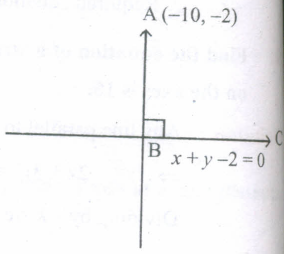
Find the length of the perpendicular and the coordinates of the foot of the perpendicular from (-10, -2) to the line x + y - 2 = 0
53.
Given log 2 = 0.3010, find the position of the first significant digit in the value of (0.5)10.
1.
Let E1 and E2 be the events of choosing a boy and a girl respectively from the class.
Given that the number of boys to the number of girls = 1: 2
\(\therefore P({ E }_{ 1 })=\frac { 1 }{ 1+2 } =\frac { 1 }{ 3 } \) and P(E2) = \(\frac { 2 }{ 1+12 } =\frac { 2 }{ 3 } \)
Let A be the event that a student chosen will get first class
Given P(A/E1) = 0.28 and P(A/E2) = 0.25
\(\therefore\) By theorem of total probability,
P(A) = P(E1).P(A/E1) + P(E2).P(A/E2)
\(\Rightarrow \quad =\frac { 1 }{ 3 } \times 0.28+\frac { 2 }{ 3 } \times 0.25\)
\(=\frac { 28 }{ 300 } +\frac { 50 }{ 300 } =\frac { 78 }{ 300 } =0.26\)
2.
\(\lim _{ x\rightarrow 0 }{ \frac { { x }^{ \frac { 2 }{ 3 } }-9 }{ x-27 } } =\lim _{ x\rightarrow 0 }{ \frac { { x }^{ \frac { 2 }{ 3 } }-{ (27) }^{ \frac { 2 }{ 3 } } }{ x-27 } } =\frac { 2 }{ 3 } { (27) }^{ \frac { 2 }{ 3 } -1 }=\frac { 2 }{ 3 } { (27) }^{ \frac { -1 }{ 3 } }\)
\(=\frac { 2 }{ 3(27)^{ \frac { 1 }{ 3 } } } =\frac { 2 }{ 3({ 3 }^{ 3 })^{ \frac { 1 }{ 3 } } } =\frac { 2 }{ 3(3) } =\frac { 2 }{ 9 } \)
3.
The greatest integer function \(f(x)=\lfloor x\rfloor\) is not continuous at every integer point n, since \(\left.\lim _{x \rightarrow n^{-}} \mid x\right\rfloor=n-1\) and \(\lim _{x \rightarrow n^{+}}\lfloor x\rfloor=n .\) Thus f'(n) does not exist.
4.
Given \(\overrightarrow{a}=2\hat{i}+2\hat{j}-\hat{k}\)
\(\overrightarrow{b}=6\hat{i}-3\hat{j}+2\hat{k}\)
\(\overrightarrow{a}.\overrightarrow{b}=(2\hat{i}+2\hat{j}-\hat{k})(6\hat{i}-3\hat{j}+2\hat{k})=12-6-2=12-8=4\)
5.
For 3-digit even numbers, the unit's place can be occupied by one of the 3 digits 2, 4 or 6. The remaining 5 digits can be arranged int he remaining 2 places in 5P2 ways.
\(\therefore\) By the multiplication rule, the required number of 3-digit even number is 3 \(\times\) 5P2 = 3 \(\times\) 5 \(\times\) 4 = 60.

6.
In the expansion of (1+a)m+n
Coefficient of am = m+nCm = \(\frac{(m+n)!}{m!(m+n-m)!}=\frac{(m+n)!}{m!n!}\) --- (1)
Coefficient of an = m+nCn = \(\frac{(m+n)!}{n!(m+n-m)!}=\frac{(m+n)!}{n!m!}\) --- (2)
(1) = (2) ⇒ Coefficient of am = Coefficient of an.
7.
In this example, it is easy to see that whenever a circle C1 is related to C2 then C2 is also related to C1. Hence the relation is symmetric, whereas in example 1 it does not hold as whenever 2 divides 4 then it does not imply 4 divides 2 as 4 does not divide 2.
8.
\(\sin { \left( \pi +\theta \right) } =-\sin { \theta } \)
\(\sin { \left( \pi +\theta \right) } =\sin { \pi } \cos { \theta } +\cos { \pi } \sin { \theta } \)
\(=\left( 0 \right) \cos { \theta } +\left( -1 \right) \sin { \theta } \)
\(=0-\sin { \theta } \)
\(\sin { \left( \pi +\theta \right) } =-\sin { \theta } \)
9.
Let I = \(\int { \frac { 1 }{ { x }^{ \frac { 1 }{ 2 } }+{ x }^{ \frac { 1 }{ 3 } } } } \)dx
Here, the exponents of x are \(\frac { 1 }{ 2 } \) and \(\frac { 1 }{ 3 } \) and the LCM of their denominator is 6.
So, to remove fractional exponents put x = t6 \(\Rightarrow\) dx = 6t5 dt.
I = \(\int { \frac { { 6t }^{ 5 } }{ { t }^{ 3 }+{ t }^{ 2 } } } dt=6\int { \frac { { t }^{ 5 }dt }{ { t }^{ 2 }\left( t+1 \right) } } =6\int { \frac { { t }^{ 3 } }{ t+1 } } dr=6\int { \frac { \left( { t }^{ 3 }+1 \right) -1 }{ t+1 } } dt\)
= \(\int { \frac { \left( t+1 \right) ^{ 3 }-3t\left( t+1 \right) -1 }{ t+1 } } dt=6\) \(\int { \left[ \frac { \left( t+1 \right) ^{ 3 } }{ t+1 } -\frac { 3t(t+1) }{ t+1 } -\frac { 1 }{ t+1 } \right] dt } \)
= \(6\left[ f\left( t+1 \right) ^{ 2 }-3t-\frac { 1 }{ t+1 } dt \right] 6\left[ f{ t }^{ 2 }+2t+1-3t-\frac { 1 }{ t+1 } dt \right] =6\left( f{ t }^{ 2 }-t+1-\frac { 1 }{ t+1 } \right) dt\)
= \(6\left( \frac { { t }^{ 3 } }{ 3 } -\frac { { t }^{ 2 } }{ 2 } +t-log|t+1| \right) +c\)
= \(2.\sqrt { x } -3x^{ \frac { 1 }{ 3 } }+6x^{ \frac { 1 }{ 6 } }-6log|{ x }^{ \frac { 1 }{ 6 } }+1|+c\)
10.
Consider the following events
E1: Company insured scooter driver
E2: Company insured a car driver
E3: Company insured a truck driver
\(\therefore P({ E }_{ 1 })=\frac { 2000 }{ 2000+4000+6000 } =\frac { 2000 }{ 12000 } =\frac { 1 }{ 6 } \)
\(P({ E }_{ 2 })=\frac { 4000 }{ 12000 } =\frac { 1 }{ 3 } ,\)
\(P({ E }_{ 3 })=\frac { 6000 }{ 12000 } =\frac { 1 }{ 2 } \)
It is given that
P(A/E1) = 0.01, P(A/E1) = 0.03 and P(A/E3) = 0.15
By Bayes' theorem,
\(P({ E }_{ 1 }/A)=\frac { P({ E }_{ 1 })P(A/{ E }_{ 1 }) }{ P({ E }_{ 1 }).P(A/{ E }_{ 1 })+P({ E }_{ 2 }).P(A/{ E }_{ 3 }).P(A/{ E }_{ 3 }) } \)
\(=\frac { \frac { 1 }{ 6 } \times \frac { 1 }{ 100 } }{ \frac { 1 }{ 6 } \times \frac { 1 }{ 100 } +\frac { 1 }{ 3 } \times \frac { 3 }{ 100 } +\frac { 1 }{ 2 } \times \frac { 15 }{ 100 } } =\frac { \frac { 1 }{ 600 } }{ \frac { 1 }{ 600 } +\frac { 1 }{ 100 } +\frac { 15 }{ 200 } } =\frac { \frac { 1 }{ 600 } }{ \frac { 52 }{ 600 } } \)
\(=\frac { 1 }{ 600 } \times \frac { 600 }{ 52 } =\frac { 1 }{ 52 } \)
11.
Given \(x=4{ z }^{ 2 }+5\)
\(\Rightarrow \frac { dx }{ dz } =8z\)
\( \Rightarrow y=6{ z }^{ 2 }+7z+3\)
\(\Rightarrow \frac { dy }{ dz } =12z+7\)
\(\therefore \frac { dy }{ dx } =\frac { dy }{ dz } /\frac { dx }{ dz } =\frac { 12z+7 }{ 8z } \)
Differentiating again with respect to 'x', we get
\(\frac { d^{ 2 }y }{ dx^{ 2 } } =\frac { 8z(12)-(12z+7)8 }{ 64{ z }^{ 2 } } .\frac { dz }{ dx } \)
\(=\frac { 96z-96z-56 }{ 64{ z }^{ 2 } } \times \frac { 1 }{ 8z } =\frac { -56 }{ 64{ z }^{ 2 }\times 8 } =\frac { -7 }{ 64{ z }^{ 3 } } \)
\(\therefore \frac { d^{ 2 }y }{ dx^{ 2 } } =\frac { -7 }{ 64{ z }^{ 3 } } \)
12.
Let \(\triangle\)=\(\left| \begin{matrix} x & y & z \\ { x }^{ 2 } & { y }^{ 2 } & { z }^{ 2 } \\ { x }^{ 3 } & { y }^{ 3 } & { z }^{ 3 } \end{matrix} \right| \)
Taking x, y, z common from C1, C2 and, C3 repectively.
\(\triangle =xyz\left| \begin{matrix} 1 & 1 & 1 \\ x & y & z \\ { x }^{ 2 } & { y }^{ 2 } & { z }^{ 2 } \end{matrix} \right| \)
Applying C2 ⟶ C2 - C1 and C3 ⟶ C3 - C1 we get,
\(\triangle =xyz\left| \begin{matrix} 1 & 0 & 1 \\ x & y-x & z-x \\ { x }^{ 2 } & { y }^{ 2 }-{ x }^{ 2 } & { z }^{ 2 }-{ x }^{ 2 } \end{matrix} \right| \)
Taking (y - x) and (z - x) common from C2 & C3 respectively|
\(\triangle\) = xyz(y - x)(z - x)\(\left| \begin{matrix} 1 & 0 & 0 \\ x & 1 & 1 \\ { x }^{ 2 } & y+x & z+x \end{matrix} \right| \)
Expanding along R1 we get,
\(\triangle\) = xyz(y - x)(z - x)[z + x - y - x]
\(\triangle\) = xyz(y - x)(z - x)[z - y]
\(\triangle\) = xyz(x - y)(y - z)(z - x)
Hence proved.
13.
Let A1, A2 and A3 be the event of A, B, C becoming managers of the company respectively. Let X be the event that the office canteen will be improved.
Then, \(P\left(A_1\right)=\frac{5}{10}=0.5 \)
\(P\left(A_2\right)=\frac{3}{10}=0.3 \)
\(P\left(A_3\right)=\frac{2}{10}=0.2 \)
\(P\left(X / A_1\right)=0.4 \)
\(P\left(X / A_2\right)=0.5\)
\(P\left(X / A_3\right)=0.3\)
\(P\left(A_2 / X\right)=\frac{P\left(A_2\right) P\left(X / A_2\right)}{P\left(A_1\right) P\left(X / A_1\right)+P\left(A_2\right) P\left(X / A_2\right)}+P\left(A_3\right) P\left(X / A_3\right)\)
\(=\frac{0.3(0.5)}{0.5(0.4)+0.3(0.5)+0.2(0.3)} \)
\(=\frac{0.15}{0.2+0.15+0.06} \)
\(=\frac{0.15}{0.41}=\frac{15}{41}\)
14.
\(
\int\left[(x+4)^5+\frac{5}{(2-5 x)^4}-\operatorname{cosec}^2(3 x-1)\right] d x
=\int(x+4)^5 d x+5 \int \frac{1}{(2-5 x)^4} d x\)
\(
=\frac{(x+4)^6}{6}+5\left(\frac{-1}{3(2-5 x)^3 \times(-5)}\right)
-\left(\frac{-\cot (3 x-1)}{3}\right)+c
\)
\(=\frac{(x+4)^6}{6}+\frac{1}{3(2-5 x)^3}+\frac{\operatorname{cosec} 2(3 x-1) d x}{-\left(\frac{-\cot (3 x-1)}{3}\right)+c}
\)
15.
Given \(f(x)={x^2-2x-8\over x+2}\)|
f(x) does not exist at x = - 2
\(\therefore\) It has a removable discontinuity at x = - 2
\(lim_{x\rightarrow -2}f(x)=lim_{x\rightarrow -2}{x^2-2x-8\over x+2}\)
\(lim_{x\rightarrow -2}f(x)=lim_{x\rightarrow -2}{(x-4)(x+2)\over (x+2)}=lim_{x\rightarrow-2}x-4=-2-4=-6\)
\(\therefore\) The continuous function g(x) can be written as
g(x) = {\(\begin{matrix} \frac { { x }^{ 2 }-2x-8 }{ x+2 } & if\ x\ \neq -2 \\ 6& if\quad x=-2 \end{matrix}\)
16.
\(lim_{x-1}{3\sqrt{7+x^3}-\sqrt{3+x^2}\over x-1}\)\(=lim_{x-1}{({7+x^3})^{1\over3}-8^{1\over3}\over 7+x^3-8} \times{x^3-1\over x-1}-{(3+x^2)^{1\over2}-4^{1\over2}\over 3+x^2-4}\times {x^2-1\over x-1}\)|

[\(\because\) when x\(\rightarrow\) 1, x3 \(\rightarrow\) 1 and 7 + x3\(\rightarrow\) 7+ 1 = 8, also when x \(\rightarrow\) 1, x2 \(\rightarrow\) 1 and 3 + x2\(\rightarrow\) 4]\(=lim_{7+x^3\rightarrow8}{({7+x^3})^{1\over3}-8^{1\over3}\over 7+x^3-8} (x^2+x+1)-lim_{3+x^2\rightarrow4}{(3+x^2)^{1\over2}-4^{1\over2}\over 3+x^2-4}\times(x+1)\)
\({1\over3}(8)^{{1\over3}-1}(1^2+1+1)-{1\over2}(4^{{1\over2}-1})(1+1)\) \([\because lim_{x \rightarrow a}x^na^n=na^{n-1}]\)
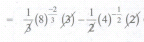
\(={1\over 8^{2\over3}}-{1\over 4^{1\over2}}={1\over (2^{3})^{2\over3}}-{1\over (2^{2})^{1\over2}}\)\(={1\over2^2}-{1\over2}={1\over4}-{1\over2}\)
\(={1-2\over4}={-1\over4}\)
\(\)
17.
Let \(\overrightarrow{a}=\) m (\(\hat{i}+\hat{j}+\hat{k}\))
\(|\overrightarrow{a}|=m\sqrt{1^2+1^2+1^2}=m\sqrt{3}\)
To make \(\overrightarrow{a}\) as a unit vector, \(|\overrightarrow{a}|=\pm1\)
\(\therefore m \sqrt{3} =\pm 1\Rightarrow m = \pm {1\over \sqrt{3}}.\)
18.
\(LHS=\begin{vmatrix} 1 &x &x \\ x & 1 &x \\ x &x &1 \end{vmatrix}^2=\begin{vmatrix} 1 &x &x \\ x & 1 &x \\ x &x &1 \end{vmatrix}\times \begin{vmatrix} 1 &x &x \\ x & 1 &x \\ x &x &1 \end{vmatrix}\)
\(=\begin{vmatrix} 1 &x &x \\ x & 1 &x \\ x &x &1 \end{vmatrix} \times(-1)(-1)\begin{vmatrix} 1 &x &x \\ -x & -1 &-x \\- x &-x &-1 \end{vmatrix} \)
= \(\begin{vmatrix} 1 &x &x \\ x & 1 &x \\ x &x &1 \end{vmatrix} \times \begin{vmatrix} 1 &x &x \\ -x & -1 &-x \\- x &-x &-1 \end{vmatrix} \)
= \(\begin{vmatrix} 1-x^2-x^2 &x-x-x^2 &x-x^2-x \\ x-x-x^2 & x^2-1-x^2 &x^2-x-x \\ x-x^2-x &x^2-x-x &x^2-x^2-1 \end{vmatrix}\)
= \(\begin{vmatrix} 1-2x^2 &-x^2 &-x^2 \\- x^2 & -1 &x^2-2x \\ -x^2 &x^2-2x &-1 \end{vmatrix}\)
= RHS.
19.
Given \(A=\left[\begin{array}{lll} 5 & 3 & 8 \\ 2 & 0 & 1 \\ 1 & 2 & 3 \end{array}\right]\left[\begin{array}{lll} + & - & + \\ - & + & - \\ + & - & + \end{array}\right]\)
Cofactors of elements of second row
\(|A|=-2\left|\begin{array}{ll} 3 & 8 \\ 2 & 3 \end{array}\right|+0-1\left|\begin{array}{ll} 5 & 3 \\ 1 & 2 \end{array}\right|\)
= 2(9-16)-1(10-3)
= -2(-7) - 1(7) = 14 - 7= 7
\(|A|=7\)
20.
Let p(n) be the statement that 3n2 > (n + 1)2 with n\(\ge\) 2. Therefore the first stage is n = 2.
Now, P(2) = 3 x 22 = 12 and 32 = 9. As 12> 9 we get P(2) is true.
We assume that p(n) is true for n = k.
Now,
P(k+ 1) 3(k+ 1)2 = 3k2 + 6k+ 3
P(k) + 6k+ 3
> (k + 1)2 + 6k + 3
k2 + 8k+4
k2 + 4k+4 + 4k
(k+ 2)2 + 4k
> (k+ 2)2 since k> 0.
This is the statement P(k + 1). The validity of P(k + 1) follows from that of P(k).
Therefore by the principle of mathematical induction, for all n\(\ge\) 2, 3n2 > (n + 1)2.
21.
sin θ + cos θ = \(\sqrt2\)
Multiplying by\(\frac{1}{\sqrt2}\) on both sides
\(\frac { 1 }{ \sqrt { 2 } } sin\theta +\frac { 1 }{ \sqrt { 2 } } cos\theta =\frac { 1 }{ \sqrt { 2 } } \sqrt { 2 } =1\)
\(cos\theta cos\frac { \pi }{ 4 } +sin\theta sin\frac { \pi }{ 4 } =1\)
The general soln is cos (θ - \(\pi\)/4) = 1
cos (θ - \(\pi\)/4) = cos θ
θ - \(\pi\)/4 = 2n\(\pi\) ± 0
θ = 2n\(\pi\)+ \(\pi\)/4
22.
\(x-\frac { 1 }{ 4 } >\frac { 1 }{ 2 } x-\frac { 3 }{ 4 } \) (or) \(x-\frac { 1 }{ 4 } <\frac { 3 }{ 4 } -\frac { 1 }{ 2 } \)
\(x-\frac { 1 }{ 2 } x>-\frac { 3 }{ 4 } -\frac { 1 }{ 4 } \left( =-\frac { 2 }{ 4 } =\frac { -1 }{ 2 } \right) \)
\({1\over 2}x>{-1\over 2}\)
⇒ x >-1 ....(1)
\(x+\frac { 1 }{ 2 } x<\frac { 3 }{ 4 } +\frac { 1 }{ 4 } =1\)
\(\frac { 3 }{ 2 } x<1\)
\(x<\frac { 2 }{ 3 } \) .....(2)
From (1) and (2)
\(-1
23.
If equation of line is 12x2 + 2kxy + 2y2 + 11x - 5y + 2 = 0
Here a = 12, 2h = 2k, b = 2, 2g = 11, 2f = -5 , c = 2
\(h=k\ g=\frac { 11 }{ 2 } f=\frac { -5 }{ 2 } ,c=-5\)
The condition for pair of straight line is abc + 2fgh - af2- bg2- ch2 = 0
\(\Rightarrow \quad 12(2)(2)+)-5)\left( \frac { 1 }{ 2 } \right) (k)-12\left( \frac { 25 }{ 4 } \right) -2\left( \frac { 121 }{ 4 } \right) -2\left( { k }^{ 2 } \right) =0\)
\(\Rightarrow \quad 48-\frac { 55k }{ 2 } -\frac { 300 }{ 4 } -\frac { 242 }{ 4 } -2{ k }^{ 2 }=0\)
Multiplying by 4 we get,
192 - 110k - 300 - 242 - 8k2 = 0
\(\Rightarrow\) -8k2-110k-350 = 0
\(\Rightarrow\) 4k2 + 55k + 175 = 0
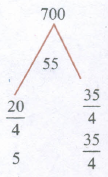
\(\Rightarrow\) (k-5)(4k + 35) = 0
\(\Rightarrow \ k=-5\ or\ k=\frac { -35 }{ 4 } \)
24.
Let Tn be the nth term of the given series
Then Tn = 1 + 4 + 42 + 43 + ...
\(=1\left(4^n-1\over 4-1\right)\)
\(={4^n-1\over 3}\)
Let Sn be the sum to n terms of the given series
Then \(S_n={\sum_{k=1}^n}T_k=\sum_{k=1}^n{4^n-3\over3}\)
\(⇒\ S_n={1\over3}\left[ \sum_{k=1}^n4^n-\sum_{k=1}^n3\right]\)
\(⇒\ S_n= {1\over3}[4^1+4^]+...+4^n-3^n\)
\(⇒\ S_n={1\over3}\left[ 4{(4^n-1)\over4-1}-3n\right]\)
\(⇒\ S_n={1\over3}\left[ 4{(4^n-1)\over4-1}-3n\right]={1\over 3}\left[4{(4^n-1)-9n\over3}\right]\)
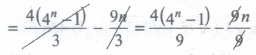
\({ S }_{ n }=\frac { 4 }{ 9 } \left[ \left( { 4 }^{ n }-1 \right) -n/3 \right] \)
25.
Let y = 3x -5.
\(\Rightarrow y+5=3x\Rightarrow \frac { y+5 }{ 3 } =x\)
Let g(y) = \(\frac { y+5 }{ 3 } \)
\(gof(x)=g(f(x))=g(3x-5)=\frac { 3x-5+5 }{ 3 } =\frac { 3x }{ 3 } =y\)
Also f o g(y) = f(g(y)) = \(f\left( \frac { y+5 }{ 3 } \right) =3\left( \frac { y+5 }{ 3 } \right) -5=y+5-5=y\)
Thus g o f = Ix and fog = Iy.
This implies that f and g are bijections and inverses to each other.
Hence f is a bijection and f-1(y) = \(\frac { y+5 }{ 3 } \)
Replacing y by x we get, f-1(x) = \(\frac { x+5 }{ 3 } \)
26.
\(LHS=sin\frac { \theta }{ 2 } sin\frac { 7\theta }{ 2 } +sin\frac { 3\theta }{ 2 } sin\frac { 11\theta }{ 2 } \)
\(=\frac { 1 }{ 2 } \left[ cos\left( \frac { \theta }{ 2 } -\frac { 7\theta }{ 2 } \right) -cos\left( \frac { \theta }{ 2 } -\frac { 7\theta }{ 2 } \right) \right] +\frac { 1 }{ 2 } \left[ cos\left( \frac { 3\theta }{ 2 } -\frac { 11\theta }{ 2 } \right) -cos\left( \frac { 3\theta }{ 2 } -\frac { 11\theta }{ 2 } \right) \right] \)
\(=\frac { 1 }{ 2 } \left[ cos(-3\theta )-cos(4\theta )+cos(-4\theta )-cos7\theta \right] \)
\(=\frac { 1 }{ 2 } \left[ cos3\theta -cos4\theta +cos4\theta -cos7\theta \right] \quad \quad \left[ \because cos(-\theta )=cos\theta \right] \)
\(=\frac { 1 }{ 2 } \left[ cos3\theta -cos7\theta \right] =\frac { 1 }{ 2 } \left[ 2sin\left( \frac { 3\theta +7\theta }{ 2 } \right) .sin\left( \frac { 7\theta -3\theta }{ 2 } \right) \right] \)
\(=sin5\theta .sin2\theta =RHS.\)
27.
(c)
\({ |\overrightarrow { a } | }^{ 2 }|{ \overrightarrow { b } | }^{ 2 }\)
28.
(d)
-2 cos \(\sqrt { x } \)
29.
(a)
\(\frac { 64 }{ 64 } \)
30.
(a)
3,2
31.
(d)
rectangular
32.
(b)
65: 23
33.
\(\text { Let } \sqrt{x}=t\)
\(\text { Then } x=t^{2}\)
\(\therefore \frac{d x}{d t}=2 t\)
\(\therefore d x=2 t d t\)
\(\therefore \int \sin \sqrt{x} d x=\int \sin t \times 2 t d t\)
\(=2 \int t \sin t d t\)
\(\text { Applying Bernoulli's formula }\)
\(=2[t(-\cos t)-1(-\sin t)]+c\)
\(\text { Putting } t=\sqrt{x}\)
\(=2[-\sqrt{x} \cos \sqrt{x}+\sin \sqrt{x}]+c\)
34.
\(f^{\prime}\left(a^{-}\right) =\lim _{x \rightarrow a^{-}} \frac{f(x)-f(a)}{x-a}=\lim _{x \rightarrow a^{-}} \frac{(2 a-x)-(2 a-a)}{x-a} \)
\(=\lim _{x \rightarrow a^{-}} \frac{-x+a}{x-a}=-1 \)
\(f^{\prime}\left(a^{+}\right) =\lim _{x \rightarrow a^{+}} \frac{f(x)-f(a)}{x-a} \)
\(=\lim _{x \rightarrow a^{-}} \frac{(3 x-2 a)-(3 a-2 a)}{x-a} \)
\(=\lim _{x \rightarrow a^{-}} \frac{3 x-2 a-a}{x-a}=\lim _{x \rightarrow a^{-}} \frac{3 x-3 a}{x-a}=3 \)
\(f^{\prime}\left(a^{-}\right) \neq f^{\prime}\left(a^{+}\right) \)
\(\therefore \text { It is not differentiable at } x=a\)
\(\therefore f^{\prime}(x) \text { does not exist }\)
35.
\(\lfloor x\rfloor= \begin{cases}2, & 2 \leq x<3 \\
3, & 3 \leq x<4\end{cases} \)
\(\therefore \lim _{x \rightarrow 3^{-}}\lfloor x\rfloor=2 \text { and } \lim _{x \rightarrow 3^{+}}\lfloor x\rfloor=3
\)
\(\therefore \text { Limit does not exist }\)
36.
\(\left[\begin{array}{ll} 1 & 3 \\ 0 & 1 \end{array}\right] A=\left[\begin{array}{cc} 1 & 1 \\ 0 & -1 \end{array}\right]\)
\(\text { Let } A=\left[\begin{array}{ll} a & b \\ c & d \end{array}\right]\)
\(\left[\begin{array}{ll} 1 & 3 \\ 0 & 1 \end{array}\right]\left[\begin{array}{ll} a & b \\ c & d \end{array}\right]=\left[\begin{array}{cc} 1 & 1 \\ 0 & -1 \end{array}\right]\)
\(\left[\begin{array}{cc} a+3 c & b+3 d \\ 0+c & 0+d \end{array}\right]=\left[\begin{array}{cc} 1 & 1 \\ 0 & -1 \end{array}\right]\)
\(c=0,d=-l\)
\(a+3 c=1 \quad b+3 d=1\)
\(a+0=1 \quad b-3=1\)
\(a=1 \quad b=4\)
\(\therefore A=\left[\begin{array}{cc} 1 & 4 \\ 0 & -1 \end{array}\right]\)
37.
(c)
\(\frac{1}{a}+\frac{1}{b}=1\)
38.
(c)
(3, 1)
39.
(d)
40.
(b)
31
41.
Number of rectangles in the chessboard is
\({ }^{9} C_{2} \times{ }^{9} C_{2} =\frac{9 \times 8}{1 \times 2} \times \frac{9 \times 8}{1 \times 2} \)
\(=36 \times 36=1296 \)
42.
(c)
sec x = \(\frac { 1 }{ 2 } \)
43.
\(x^{2}-\mathrm{k} x+\mathrm{c}=0\)
a and b are the roots
\(\therefore a+b=k, a b=c\)
To find
\(\sqrt{(a-b)^{2}+0^{2}}=a-b=\sqrt{(a+b)^{2}-4 a b}=\sqrt{k^{2}-4 c}\)
44.
\(\left(2 \cos ^{2} \frac{\pi}{16}\right)\left(2 \cos ^{2} \frac{3 \pi}{16}\right)\left(2 \cos ^{2} \frac{5 \pi}{16}\right)\left(2 \cos ^{2} \frac{7 \pi}{16}\right) \)
\(=2^{4}\left[\cos \frac{\pi}{16} \cos \frac{3 \pi}{16} \cos \frac{5 \pi}{16} \cos \frac{7 \pi}{16}\right]^{2} \)
\(=\left(\cos \frac{8 \pi}{16}+\cos \frac{6 \pi}{16}\right)^{2}\left(\cos \frac{8 \pi}{16}+\cos \frac{2 \pi}{16}\right)^{2} \)
\(=\left(\cos \frac{6 \pi}{16}\right)^{2}\left(\cos \frac{2 \pi}{16}\right)^{2} \)
\(=\left\{\frac{1}{2}\left[\cos \frac{8 \pi}{16}+\cos \frac{4 \pi}{16}\right]\right\}^{2} \)
\(=\frac{1}{4} \cdot \frac{1}{2}=\frac{1}{8} \)
45.
\(n[(A \times B) \cup(A \times C)]=n(A) \times n(B \cup C)\)
= 2 \(\times\) 3 = 6
46.
(c)
(6,8)∈R
47.
\({ x }^{ 2 }+2xy+{ y }^{ 3 }=42\)
Differentiating both sides with respect to 'x' we get,
\(2x+2\left[ x.\frac { dy }{ dx } +y(1) \right] +3{ y }^{ 2 }\frac { dy }{ dx } =0 \Rightarrow 2x+2x\frac { dy }{ dx } +2y+3{ y }^{ 2 }\frac { dy }{ dx } =0\)
\(\Rightarrow \frac { dy }{ dx } (2x+3{ y }^{ 2 })=-2x-2y \Rightarrow \frac { dy }{ dx } =\frac { -2\left( x+y \right) }{ 2x+3{ y }^{ 2 } } \)
48.
\(=x^2+4 x+2 \)
\(=\int \frac{1}{\sqrt{x^2+4 x+2}} d x \)
\(=\left(x^2+4 x\right)+2
\)
Completing the square on x
\(
=\left(x^2+4 x+2^2\right)-2^2+2\)
\(=(x+2)^2-2 \)
\(=(x+2)^2-(\sqrt{2})^2 \)
\(\therefore \int \frac{1}{\sqrt{x^2+4 x+2}} d x
=\int \frac{1}{\sqrt{(x+2)^2-(\sqrt{2})^2}} d x \)
\(=\int \frac{1}{\sqrt{u^2-a^2}} d u, u=x+2, a=\sqrt{2}\)
\(=\frac{1}{2 a} \log \left|u+\sqrt{u^2-a^2}\right|+c\)
\(=\frac{1}{2 \sqrt{2}} \log \left|x+2+\sqrt{x^2+4 x+2}\right|+c\)
49.
\(
\int \frac{1}{1+x^2} d x =\tan ^{-1} x+c\)
\(
\therefore \int \frac{1}{1+36 x^2} d x =\int \frac{1}{1+(6 x)^2} d x \)
\(=\frac{\tan ^{-1} 6 x}{6}+c
\)
50.
Let the H.P. be \(\frac{1}{a},\frac{1}{a+d},\frac{1}{a+2d},...\)
\(\therefore { T }_{ m }=\frac { 1 }{ a+\left( m-1 \right) d } =n\) and \(\therefore { T }_{ n }=\frac { 1 }{ a+\left( n-1 \right) d } =m\)
a + (m - 1)d = \(\frac{1}{n}(1)\) and a + (n - 1)d = \(\frac{1}{m}\)
(1) - (2) \(\Rightarrow\) (m - 1 - n + 1)d = \(\frac{1}{n}-\frac{1}{m}\) \(\Rightarrow\) (m - n) d = \(\frac{m-n}{mn}\Rightarrow d=\frac{1}{mn}\)
\({ T }_{ p }=\frac { 1 }{ a+\left( p-1 \right) d } =\frac { 1 }{ \frac { 1 }{ mn } +\left( b-1 \right) \frac { 1 }{ mn } } =\frac { mn }{ 1+p-1 } \)
\({ T }_{ p }=\frac { mn }{ p } \)
51.
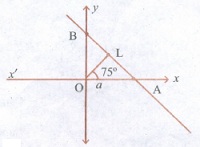
Let OL be the perpendicular from the origin to the required line.
Given OL = p = \(3\sqrt { 2 } \) and \(\angle XOL\) = 75o
p = \(3\sqrt { 2 } \) and \(\alpha \) = 75o
Equation of the line is normal form is \(x\cos { \alpha } +y\sin { \alpha } =p\)
\(\Rightarrow x\cos { { 75 }^{ o } } +y\sin { { 75 }^{ o } } =3\sqrt { 2 }......(1)\)
Now cos 75o = cos (45o + 30o)
= cos 45o cos 30o - sin 45o sin 30o
= \(\frac { \sqrt { 3 } }{ 2\sqrt { 2 } } -\frac { 1 }{ 2\sqrt { 2 } } =\frac { \sqrt { 3 } -1 }{ 2\sqrt { 2 } }.....(2)\)
sin 75o = sin (45o + 30o) = sin 45o cos 30o + cos 45o sin 30o
= \(\frac { \sqrt { 3 } }{ 2\sqrt { 2 } } +\frac { 1 }{ 2\sqrt { 2 } } =\frac { \sqrt { 3 } +1 }{ 2\sqrt { 2 } } .......(3)\)
Substituting (2) and (3) in (1) we get,
\(x\left( \frac { \sqrt { 3 } -1 }{ 2\sqrt { 2 } } \right) +y\left( \frac { \sqrt { 3 } +1 }{ 2\sqrt { 2 } } \right) =3\sqrt { 2 } \)
\(\Rightarrow x\left( \sqrt { 3 } -1 \right) +y\left( \sqrt { 3 } +1 \right) =3\sqrt { 2 } \times 2\sqrt { 2 } =12\)
\(\Rightarrow\) \(x(\sqrt{3}-1)+y(\sqrt{3}+1)\)=12 which is the required equation
52.
Given equation of line is x + y - 2 = 0 .......(1)
Any line perpendicular to x + y - 2 = 0 will be of the form x - y + k = 0
This line passes through (-10, -2)
\(\therefore\) - 10 + 2 + k = 0
\(\Rightarrow\) k = 8
\(\therefore\) Equation of AB is x - y + 8 = 0....(2)
The foot of the perpendicular is the point of intersection of (1) and (2).
(1) \(\Rightarrow \) x + y - 2 = 0
(2) \(\Rightarrow \) x - y + 8 = 0
________________
2x + 6 = 0
\(\Rightarrow \) x = -3
Substituting x = -3 in (1) we get,
-3 + y - 2 = 0
\(\Rightarrow \) y = 5
\(\therefore\) Co-ordinate of the foot of the perpendicular B is (-3, 5). ...(2)
Now length of the perpendicular from (-10, -2) to the line x + y - 2 = 0 is
\(=\pm \left( \frac { -10-2-2 }{ \sqrt { { 1 }^{ 2 }+{ 1 }^{ 2 } } } \right) =\pm \left( \frac { -14 }{ \sqrt { 2 } } \right) =\frac { 14 }{ \sqrt { 2 } } \)
\(\frac { 14 }{ \sqrt { 2 } } \times \frac { \sqrt { 2 } }{ \sqrt { 2 } } =\frac { 14\sqrt { 2 } }{ 2 } =7\sqrt { 2 } \)
[ Since length of the perpendicular cannot be negative]
\(=\frac { 14 }{ \sqrt { 2 } } \times \frac { \sqrt { 2 } }{ \sqrt { 2 } } =\frac { 14\sqrt { 2 } }{ 2 } =7\sqrt { 2 } \)
53.
Given log 2 = 0.3010
log (0.5)10 = \(log\left({{1}\over{2}} \right)^{10}=log\ 2^{-10}\)
= -10 log 2 = - 10 (0.3010) = - 3.010
= -3-0.0010- (-3-1) + (-0.010)
= -4 + 0.990 = 4.990.
\(\therefore\) Characteristic of log (0.5)10 = 4 ie -4
\(\therefore\) Number of Zeroes immediately after the decimal part = 4 - 1 = 3.
\(\therefore\) First significant digit is at 4th place after decimal.

11th Standard Syllabus & Materials
11th Standard
TN 11th Tamil பீடு பெற நில் - செய்யுள் - காவடிச்சிந்து Important Questions And Answers Study Material - QB365 Set A
NEW11th Standard
TN 11th Tamil பீடு பெற நில் - உரைநடை - மலை இடப்பெயர்கள் : ஓர் ஆய்வு Important Questions And Answers Study Material - QB365 Set A
NEW11th Standard
TN 11th Tamil மாமழை போற்றுதும் - துணைப்பாடம் - யானை டாக்டர் Important Questions And Answers Study Material - QB365 Set A
NEW11th Standard
TN 11th Tamil மாமழை போற்றுதும் - செய்யுள் - ஐங்குறுநூறு Important Questions And Answers Study Material - QB365 Set A



Tamilnadu Stateboard 11th Standard Subjects
Maths

Commerce

Economics

Biology

Business Maths and Statistics

Accountancy

Computer Science

Physics

Chemistry
Maths
Biology
Economics
Physics
Chemistry

History
Business Maths and Statistics

Computer Science
Accountancy

Computer Applications
History
Computer Technology
Commerce
Computer Applications
Computer Technology

Tamil

English

French
Tamilnadu Stateboard Standards

