
 100% FREE ACCESS
11th Standard Syllabus & Materials
11th Standard
TN 11th Tamil இயற்கை வேளாண்மை,சுற்றுச்சூழல் -செய்யுள் - மனோன்மணீயம் Important Questions And Answers Study Material - QB365 Set A
NEW11th Standard
TN 11th Tamil என்னுயிர் என்பேன் -துணைப்பாடம் - இசைத்தமிழர் இருவர் Important Questions And Answers Study Material - QB365 Set A
NEW11th Standard
TN 11th Tamil மொழி கலை -செய்யுள் - ஒவ்வொரு புல்லையும் Important Questions And Answers Study Material - QB365 Set A
NEW11th Standard
TN 11th Tamil பீடு பெற நில் - இலக்கணம் - பகுபத உறுப்புகள் Important Questions And Answers Study Material - QB365 Set A
NEW11th Standard
TN 11th Tamil பீடு பெற நில் - துணைப்பாடம் - வாடிவாசல் Important Questions And Answers Study Material - QB365 Set A
NEW11th Standard
TN 11th Tamil பீடு பெற நில் - செய்யுள் - குறுந்தொகை Important Questions And Answers Study Material - QB365 Set A

Published on: 29/09/2018
Pre Half yearly
Download Tamil Nadu 11th Standard Maths question papers, model tests, one-mark questions, important questions, and public exam papers in PDF format. Free study materials and answer keys for TN State Board students.
Questions + Answers key
Take MCQ Maths Test1.
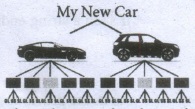
A person wants to buy a car. There are two brands of car available in the market and each brand has 3 variant models and each model comes in five different colours as in figure. In how many ways she can choose a car to buy?
2.
Write the first 6 terms of the sequences whose nth term an given below
\({ a }_{ n }=\begin{cases} n+1\quad if\quad n\quad is\quad odd \\ n\quad \quad if\quad n\quad is\quad even \end{cases}\)
3.
Find the total number of subsets of a set with [Hint: nC0 + nC1 + nC2 +...+nCn = 2n].
n elements.
4.
In a parking lot one hundred, one year old cars, are parked. Out of them five are to be chosen at random for to check its pollution devices. How many different set of five cars can be chosen?
5.
Determine the number of permutations of the letters of the word SIMPLE if all are taken at a time?
6.
Find the value of 4!+5!
7.
In how many ways 5 persons can be seated in a row?
8.
Find the number of strings of 5 letters that can be formed with the letters of the word PROPOSITION.
9.
If a,b,c are in geometric progressions and if \({ a }^{ \frac { 1 }{ x } }={ b }^{ \frac { 1 }{ y } }={ c }^{ \frac { 1 }{ z } }\) , then prove that x, y, z are in arithmetic progression
10.
The normal boiling point of water is 100°C or 212°F· and the freezing point of water is 0 °C or 32°F.
(i) Find the linear relationship between C and F.
(ii) Find the value of C for 98.6°F and
(iii) Find the value of F for 38°C.
11.
How many triangles can be formed by 15 points, in which 7 of them lie on one line and the remaining 8 on another parallel line?
12.
How many triangles can be formed by joining 15 points on the plane, in which no line joining any three points?
13.
In how many ways 4 mathematics books, 3 physics books, 2 chemistry books and 1 biology book can be arranged on a shelf so that all books of the same subjects are together.
14.
By the principle of mathematical induction, prove that for n > 1,
\(1^2+2^2+3^2+L+n^2>{n^3\over 3}\)
15.
In a certain town, a viral disease caused severe health hazards upon its people disturbing their normal life. It was found that on each day, the virus which caused the disease spread in Geometric Progression. The amount of infectious virus particle gets doubled each day, being 5 particles on the first day. Find the day when the infectious virus particles just grow over 1,50,000 units?
16.
Using the mathematical induction, show that for any natural number n > 2,
\(\left(1-{1\over 2^2} \right)\left(1-{1\over 3^2} \right)\left(1-{1\over 4^2} \right)...\left(1-{1\over n^2} \right)={n+1\over 2n}\)
17.
A candidate is required to answer 7 question out of 12 questions, which are divided into two groups each containing 6 questions. He is not permitted to attempt more than 5 questions from either group. Find the number of different ways of doing questions.
779
781
780
782
18.
\(\frac{1}{1!}+\frac{1}{3!}+\frac{1}{5!}+...\) is ______________
\(\frac{e^{-1}}{2}\)
\(\frac{e+e^{-1}}{2}\)
\(\frac{e-e^{-1}}{2}\)
none of these
19.
If nPr=k x n-1Pr-1 what is k:
r
n
n+1
r+1
20.
How many words can be formed using all the letters of the word ANAND _________
30
35
40
45
21.
The coefficient of x6 in (2 + 2x)10 is
10C6
26
10C626
10C6210
22.
If p(n):49n + 16n +\(\lambda \) is divisible by 64 for n \(\in \) N is true, then the least negative integral value of \(\lambda \) is _________
-3
-2
-1
-4
23.
If (a2- a)C2 = (a2- a)C4, then a = _________
2
3
4
none of these
24.
The product of r consecutive positive integers is divisible by _________
r!
r!+1
(r+1)
none of these
25.
The number of different signals which can be given from 6 flags of different colours taking one or more at a time is _________
1958
1956
16
64
26.
If the equation of the base opposite to the vertex (2, 3) of an equilateral triangle is x + y = 2, then the length of a side is
\(\sqrt{\frac{3}{2}}\)
6
\(\sqrt{6}\)
\(3\sqrt{2}\)
27.
If nC4,nC5,nC6 are in AP the value of n can be
14
11
9
5
28.
The slope of the line which makes an angle 45o with the line 3x- y = -5 are:
1, -1
\(\frac{1}{2},-2\)
\(1,\frac{1}{2}\)
\(2,-\frac{1}{2}\)
29.
In a plane there are 10 points are there out of which 4 points are collinear, then the number of triangles formed is
110
10C3
120
116
30.
The sum up to n terms of the series \(\frac { 1 }{ \sqrt { 1 } +\sqrt { 3 } } +\frac { 1 }{ \sqrt { 3 } +\sqrt { 5 } } +\frac { 1 }{ \sqrt { 5 } +\sqrt { 7 } } +\)....is
\(\sqrt { 2n+1 } \)
\(\frac { \sqrt { 2n+1 } }{ 2 } \)
\(\sqrt { 2n+1 } -1\)
\(\frac { \sqrt { 2n+1 } -1 }{ 2 } \)
31.
There are 10 points in a plane and 4 of them are collinear. The number of straight lines joining any two points is
45
40
39
38
32.
If pth term of an AP is q and qth term is p, find (p + q)th term.
33.
There are 10 bulbs in a room. Each one of them can be operated independently. Find the number of ways in which the room can be illuminated.
34.
If an electricity consumer has the consumer number say 238 :110 : 29, then describe the linking and count the number of house connections upto the 29th consumer connection linked to the larger capacity transformer number 238 subject to the condition that each smaller capacity transformer can have a maximal consumer link of say 100.
35.
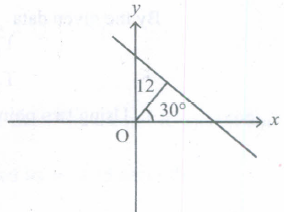
Find the equation of the line, if the perpendicular drawn from the origin makes an angle 30° with x-axis and its length is 12
36.
How many different selections of 5 books can be made from 12 different books if,
(i) Two particular books are always selected?
(ii) Two particular books are never selected?
1.
A car can be bought by choosing a brand, then a variant model, and then a colour. A brand can be chosen in 2 ways; a model can be chosen in 3 ways and a colour can be chosen in 5 ways. By the rule of product, the person can buy a car in 2 \(\times\) 3 \(\times\)5 = 30 different ways.
2.
\({ a }_{ n }=\begin{cases} n+1\quad if\quad n\quad is\quad odd \\ n\quad \quad if\quad n\quad is\quad even \end{cases}\)
a1 = 1 + 1 = 2, a2 = 2, a3 = 3 + 1 = 4
a4 = 4, a5 = 5 +1 = 6, a6 = 6
hence the first 6 terms are 4, 2, 2, 4, 6, 6...
3.
n elements.
Number of subsets with no element = nC0
Number of subsets with 1, 2, 3,4. elements are nCo + nC1 + nC2 + ... + nCn respectively
∴ Total number of subsets
= nC0+nC1+nC2+...+nCn
= Sum of the co-efficient in the binomial expansion (x + a)n
= 2n
4.
5 cars can be chosen out of 100 cars in 100C5 ways
=..jpg)
= 451725120
5.
There are 6 letters in the word 'SIMPLE'.
So, total number of words is equal to the number of arrangements of these letters, taken all at a time. Sum order of such arrangements is 6 P6 = 6! = 720
6.
= 4 \(\times\) 3 \(\times\) 2 \(\times\) 1 + 5 \(\times\) 4 \(\times\) 3 \(\times\) 2 \(\times\) 1
= 4 \(\times\) 3 \(\times\) 2 \(\times\) 1 (1+5)
= 24 \(\times\) 6 = 144
7.
To arrange 5 persons in a row, we need 5 place.
Number of ways of 1st person can be seated in a row = 5
Number of ways of 2nd person can be seated in a row = 4
Number of ways of 3rd person can be seated in a row = 3
Number of ways of 4th person can be seated in a row = 2
Number of ways of 5th person can be seated in a row = 1
∴ Number of ways of 5 persons' can be seated in a row = 5 \(\times\) 4 \(\times\) 3 \(\times\) 2 \(\times\) 1 = 5!
= 120
8.
There are 11 letters in the word, with respect to number of repetitions of letters there are 4 distinct letters (R, S, T, N), 2 sets of two alike letters (PP, II), 1 set of three alike letters (OOO). The following table will illustrate the combination of these sets and the number of words.
| S.No | Letter options | Selections | Arrangements |
|---|---|---|---|
| 1 | 5 distinct (R, S, T, N, P, I, O) | 7C5 | 7C5 \(\times\) 5! = 2520 |
| 2 | 1 set of 3 alike (OOO), 1 set of 2 alike (PP, II) | 1C1 \(\times\)2C1 | 1C1 \(\times\)2C1 \(\times\)\(\frac { 5! }{ 3!\times 2! } =20\) |
| 3 | 1 set of 3 alike (OOO), 2 distinct (R, S, T, N, P, I) | 1C1 \(\times\)6C2 | 1C1 \(\times\)6C1 \(\times\)\(\frac { 5! }{ 3! } = 300\) |
| 4 | sets of 2 alike (PP, II, OO), 1 distinct (R, S, T, N and remaining one in 2 alike) | 3C2 \(\times\)5C1 | 3C2 \(\times\)5C1 \(\times\)\(\frac { 5! }{ 2!\times 2! } =450\) |
| 5 | 1 set of 2 alike (PP, II, OO); 3 distinct (R, S, T, N and remaining two in 2 alike) |
3C1 \(\times\)6C3 | 3C1 \(\times\)6C3 \(\times\)\(\frac { 5! }{ 2! } =3600\) |
Hence, the total number of strings are 2520 + 20 + 300 + 450 + 3600 = 6890.
9.
a = kx , b = ky and c = kz
Also, given that a,b, c are in GP
\(\frac { b }{ a } =\frac { c }{ b } \Rightarrow { b }^{ 2 }=ac\)
ky2 = kx .kz
k2y = kx+z
2y = x +z
y + y = x + z
y - x = z - y
Common difference is same for x, y, z
∴ x, y, z are in arithmetic progression
10.
(i) Find the linear relationship between C and F.
By the given data
x1 (100°C) y1(212°F)
x2(0°C) y2(32°F)
Using two point form, the linear relationship between C and F is
\(\frac { y-{ y }_{ 1 } }{ { y }_{ 2 }-{ y }_{ 1 } } =\frac { x-{ x }_{ 1 } }{ { x }_{ 2 }-{ x }_{ 1 } } \)
\(\frac { y-212 }{ 32-212 } =\frac { x-100 }{ 0-100 } \)
\(\Rightarrow \quad \frac { y-212 }{ -180 } =\frac { x-100 }{ -100 } \)
\(\Rightarrow \quad \frac { y-212 }{ 9 } =\frac { x-100 }{ 5 } =\frac { 5 }{ 9 } (y-212)=x-100\)
\(\Rightarrow \quad x=\frac { 5 }{ 9 } (y-212)+100\quad \Rightarrow \quad x=\frac { 5 }{ 9 } y-\frac { 5 }{ 9 } \times 212+100\)
\(\Rightarrow \quad x=\frac { 5 }{ 9 } y-118+100\quad \Rightarrow x=\frac { 5 }{ 9 } y-18\)
\(\Rightarrow \quad x=\frac { 5 }{ 9 } (y-32) \Rightarrow C=\frac { 5 }{ 9 } (F-32)\quad .....(1)\)
[\(\because \) x represents Celsius and y represents Fahrenheit]
Which is the required relationship between C and F.
(ii) Find the value of C for 98.6°F and
Find C when F = 98.6° F
Substituting F = 98.6° in (1) we get,
C = \(\frac{5}{9}(98.6-32)=\frac{5}{9}(66.6)=\frac{333}{9}=37°\)
(iii) Find the value of F for 38°C.
Substituting C = 38° in (1) we get,
38=\(\frac{5}{9}(F-32)\)
⇒ \(\frac{342}{5}+32\) = F
⇒ F = 100.4°C
11.
To form a triangle we need 3 points.
Considering 7 points as group A and the remaining 8 points as Group B, the following choices are possible
| A(7Points) | B(8Points) | Combination | |
| (a) | 2 | 1 | \({ 7C }_{ 2 }\times { 8C }_{ 1 }\) |
| (b) | 1 | 2 | \({ 7C }_{ 1 }\times { 8C }_{ 2 }\) |
∴ Required number of ways of forming the triangle
= \({ 7C }_{ 2 }\times { 8C }_{ 1 }+{ 7C }_{ 1 }+{ 8C }_{ 2 }\)
= \(\frac { 7\times 6 }{ 2\times 1 } \times 8+\frac { 7\times 8\times 7 }{ 2\times 1 } \)
= \(21\times 8+7\times 4\times 7\)
= 168 + 196
= 364
12.
To form a triangle we need minimum 3 non-collinear points.
points can be selected from 15 non-collinear points in 15C3 ways.
= \(\frac { 15\times 14\times 13 }{ 3\times 2\times 1 } \)
= 455
13.
Four subjects can be arranged on the shelf in 4! ways.
The books on mathematics can be arranged in 4! ways, physics on 3! ways, chemistry on 2! ways and Biology on 1! ways.
Hence, total number of ways of arranging the books
= 4! 4! 3! 2! 1!
= \((4\times 3\times 2\times 1)(4\times 3\times 2\times 1)(3\times 2)(2\times 1)\)
= (24)(24)(6)(2)
= 6912
14.
Let p( n) be the statement \(1^2+2^2+3^2+L+n^2>{n^3\over 3}\)
Step1: Putting n = 1, we get
\(1>{1^3\over 3}⇒1>{1\over 3}\) Which is true
∴ p(l) is true.
Step 2:
Let us Assume that p(k) is true.
∴ \(1^2+2^2+3^2+...+k^2>{k^3\over 3}\)
Step 3:
To prove that p( k + 1) is true.
ie to P.T. \(1^2+2^2+3^2+ ... k^2+(k+1)^2>{(k+1)^3\over3}\)
Consider 12 + 22 + 32 + ... k2 + (k + 1)2
\(>{K^3\over 3}+(k+1)^2\) [using (1)]
\(> {k^3\over 3}+k^2+2k+1\)
\(>{1\over 3}[k^2 + 3k^2 + 6k + 3]\)
[∴ (a + b)3 = a3+ 3a2 b + 3 ab2 + b3]
\(>{1\over 3}{k+1}^3\)
∴ p(k + 1) is true
Hence, by the principle of mathematical induction,p(n) is true for all values of m.
15.
Given a = 5
Since the particle gets doubled, the G.P will be 5, 10,20,40, ... 1,50,000
⇒ a.rn-1 > 1,50,000
⇒ a.(2n-1) > 1,50,000
⇒ 5(2n-1) > 1,50,000
⇒ \(2^{n-1}>{1,50,000\over5}\)
⇒ 2n-1 > 30,000
⇒ 2n-1 > 24 x 1875
⇒ \({2^{n-1}\over24}>1875\)
⇒ 2n-5 > 1875
⇒ (n - 5) log 2 > log 1875
⇒ \(n-5>{log1875\over log2}\)
⇒ \(n-5>{3.2730\over 0.3010}\)
⇒ n-5 > 10.873
⇒ n > 10.873 + 5
⇒ n > 15.873
⇒ n = 15
Hence the 15th day, the infectious Virus particles just grow over 1,50,000 units.
16.
Let P(n) be the statement \(\left(1-{1\over 2^2} \right)\left(1-{1\over 3^2} \right)\left(1-{1\over 4^2} \right)...\left(1-{1\over n^2} \right)={n+1\over 2n}\)
Step 1:
Putting n = 2, we get
\(\left(1-{1\over2^2}\right)\left(1-{1\over3^2}\right)={2+2\over 2(2)+2}\)
\(⇒\ \left(1-{1\over4}\right)\left(1-{1\over9}\right)={4\over 6}\)
\(⇒\ \left(3\over4\right)\left(8\over9\right)={2\over3}⇒{2\over3}={2\over3}\)
∵ p(1) is true
Step 2:
Let we assume that p(k) is true
\(∵\ \left(1-{1\over 2^2}\right)\left(1-{1\over 2^2}\right)...\left(1-{1\over (K+1^2)}\right)={K+2\over 2K+2}\)
Step 3:
To prove that p(K+1) is true
i.e to P.T \(\left(1-{1\over2^2}\right)\left(1-{1\over 3^2}\right)...\left(1-{1\over (K+1)^2}\right)\left(1-{1\over (K+2)^2}\right)={K+3\over 2(K+1)+2}={k+3\over 2K+4}\)
\(LHS=\left(1-{1\over 2^2}\right)\left(1-{1\over 3^2}\right)...\left(1-{}1\over (K+1)^2\right)\left(1-{1\over (K+2)^2}\right)\)
\(={K+2\over 2K+2}\left(1-{1\over (K+2)^2}\right)\)
\({K+2\over 2K+2}\left({(K+2)^2-1\over (KK+2)^2}\right)\) [Using (1)]
\(={K+2\over 2K+2}\left(K^2+4+4K-1\over (K+2)^2\right)\)
\(={K+2\over 2K+2}\left(K^2+4K+3\over (K+2)^2\right)={K+2\over 2(K+1)}{{(K+1)(K+3)\over (K+2)^2}}\)
\(={K+3\over 2(K+2)}={K+3\over 2K+4}=RHS\)
∵ p(K+1) is true
Hence by mathematical induction, p(n) is true for all values of n.
17.
(c)
780
18.
(c)
\(\frac{e-e^{-1}}{2}\)
19.
(b)
n
20.
(a)
30
21.
\((2+2 x)^{10} \text { Term containing } x^{6} \text { is }\)
\({ }^{10} \mathrm{C}_{6}(2)^{10-6}(2 x)^{6}={ }^{10} \mathrm{C}_{6} 2^{4} 2^{6} x^{6}\)
\(\text { Coefficient of } x^{6} \text { is }{ }^{10} \mathrm{C}_{6} 2^{10}\)
22.
(c)
-1
23.
(b)
3
24.
(a)
r!
25.
(b)
1956
26.
Perpendicular distance from vertex to the opposite side is \(\frac{2+3-2}{\sqrt{1+1}}=\frac{3}{\sqrt{2}}\)
\(\frac{3}{\sqrt{2}}=\frac{\sqrt{3}}{2} a\)
\(\Rightarrow a =\frac{6}{\sqrt{6}} \)
\(\therefore a =\sqrt{6}\)
27.
\(\text { Given }{ }^{n} C_{4},{ }^{n} C_{5},{ }^{n} C_{6} \text { are in A.P }\)
\({ }^{2 n} \mathrm{C}_{5}={ }^{n} \mathrm{C}_{4}+{ }^{n} \mathrm{C}_{6}\)
\(\frac{2\lfloor n}{\lfloor n-5\lfloor 5}=\frac{\lfloor n}{\lfloor n -4\lfloor 4}+\frac{n}{\lfloor n -6\lfloor 6}\)
\(\frac{2}{\lfloor n-5\lfloor 5} =\frac{1}{\operatorname{\lfloor n}-4\lfloor 4}+\frac{1}{\lfloor n-6\lfloor 6}\)
\(\frac{2(n-4) 6}{(n-4)\lfloor n-5\lfloor 5.6}=\frac{5.6}{\lfloor-45.6\lfloor 4}+ \frac{(n-4)(n-5)}{\lfloor 6(n-4)(n-5) \lfloor n-6}\)
\(\Rightarrow \frac{12(n-4)}{\lfloor n-4\lfloor 6}=\frac{30}{\lfloor n-4\lfloor 6}+ \frac{(n-4)(n-5)}{\lfloor n-4 \lfloor 6}\)
\(12 n-48 =30+n^{2}-9 n+20 \)
\(n^{2}-21 n+98 =0 \)
\((n-14)(n-7) =0 \)
\(n=14(\text { or }) n =7 \)
28.
\(\text { Slope of } 3 x-y+5=0 \text { is } \frac{-3}{-1}=3=m_{1}\)
Let m2 be the slope of the second line
\(\text {Given } \tan \theta=\tan 45^{\circ}=1 \Rightarrow \frac{m_{1}-m_{2}}{1+m_{1} m_{2}}=\pm 1\)
\(\frac{3-m_{2}}{1+3 m_{2}}=1 \quad \frac{m_{2}-3}{1+3 m_{2}}=1\)
\(3-m_{2}=1+3 m_{2} \quad m_{2}-3=1+3 m_{2}\)
\(2=4 m_{2} \quad-2 m_{2}=4\)
\(\mathrm{m}_{2}=\frac{1}{2} \quad \mathrm{~m}_{2}=-2\)
\(\left(\frac{1}{2},-2\right)\)
29.
\(\text { Number of triangles }={ }^{10} \mathrm{C}_{3}-{ }^{4} \mathrm{C}_{3}\)
\(=\frac{10 \times 9 \times 8}{1 \times 2 \times 3}-4 \)
\(=120-4 =116 \)
30.
\(\frac{1}{\sqrt{1}+\sqrt{3}} =\frac{1}{\sqrt{3}+\sqrt{1}} \times \frac{\sqrt{3}-1}{\sqrt{3}-1}=\frac{\sqrt{3}-1}{2} \)
\(\frac{1}{\sqrt{3}+\sqrt{5}} =\frac{1}{\sqrt{5}+\sqrt{3}} \times \frac{\sqrt{5}-\sqrt{3}}{\sqrt{5}-\sqrt{3}} \)
\(=\frac{\sqrt{5}-\sqrt{3}}{2} \)
\(\text { Sum to } \mathrm{n} \text { terms }=\frac{(\sqrt{3}-1)}{2}+\frac{(\sqrt{5}-\sqrt{3})}{2}+\ldots . .\left(\frac{\sqrt{2 n+1}-\sqrt{2 n-1}}{2}\right)\)
\(=\frac{\sqrt{2 n+1}-1}{2}\)
31.
\(\text { No. of lines }{ }^{10} \mathrm{C}_{2}-{ }^{4} \mathrm{C}_{2}+1=45-6+1=40\)
32.
zero
33.
Each of the 10 bulbs are operated independently means that each bulb can be operated in two ways. That is in off mode or on mode. The total number of doing this are 210 which includes the case in which 10 bulbs are off. Keeping all 10 bulbs in "off" mode, the room cannot be illuminated. Hence, the total number of ways are 210 - 1 = 1024 - 1 = 1023.
34.
The following figure illustrates the electricity distribution network.
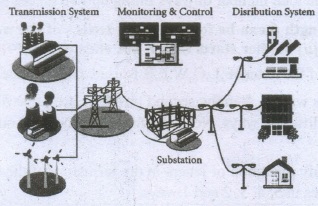
There are 110 smaller capacity transformer attached to a larger capacity transformer. As each smaller capacity transformer can be linked with only 100 consumers, we have for the 109 transformers, there will be 109 \(\times\)100 = 10900 links. For the 110th transformer, there are only 29 consumers linked. Hence, the total number of consumer linked to the 238th larger capacity transformer is 10900 + 29 = 10929.
35.
Given \(\alpha\) = 30° and p = 12
Equation of the straight line in normal form is x cos\(\alpha\)+y sin \(\alpha\) = p
⇒ x cos 30°+ y sin 30° = 12
⇒ \(x(\frac{\sqrt{3}}{2})+y(\frac{1}{2})=12\)
\(\frac{\sqrt{3}x+y}{2}=12\)
√3x + y = 24
36.
(i) Two particular books are always selected
Two particular books are always selected, the remaining 3 books can be selected from 10 books in 10C3 ways.
..jpg)
(ii) Two particular books are never selected
Since two books are never to be selected, the selection of 5 books from 10 books are done in 10C5 ways
\(\frac { 10! }{ 5!5! } =\frac { 10\times 9\times 8\times 7\times 6\times 5\times ! }{ 5!5\times 4\times 3\times 2\times 1 } \)
= \(\frac { 10\times 9\times 8\times 7\times 6\times }{ 5\times 4\times 3\times 2 } \)
= 252

11th Standard Syllabus & Materials
11th Standard
TN 11th Tamil பீடு பெற நில் - செய்யுள் - காவடிச்சிந்து Important Questions And Answers Study Material - QB365 Set A
NEW11th Standard
TN 11th Tamil பீடு பெற நில் - உரைநடை - மலை இடப்பெயர்கள் : ஓர் ஆய்வு Important Questions And Answers Study Material - QB365 Set A
NEW11th Standard
TN 11th Tamil மாமழை போற்றுதும் - துணைப்பாடம் - யானை டாக்டர் Important Questions And Answers Study Material - QB365 Set A
NEW11th Standard
TN 11th Tamil மாமழை போற்றுதும் - செய்யுள் - ஐங்குறுநூறு Important Questions And Answers Study Material - QB365 Set A



Tamilnadu Stateboard 11th Standard Subjects
Maths

Commerce

Economics

Biology

Business Maths and Statistics

Accountancy

Computer Science

Physics

Chemistry
Maths
Biology
Economics
Physics
Chemistry

History
Business Maths and Statistics

Computer Science
Accountancy

Computer Applications
History
Computer Technology
Commerce
Computer Applications
Computer Technology

Tamil

English

French
Tamilnadu Stateboard Standards

