
 100% FREE ACCESS
11th Standard Syllabus & Materials
11th Standard
TN 11th Tamil இயற்கை வேளாண்மை,சுற்றுச்சூழல் -செய்யுள் - மனோன்மணீயம் Important Questions And Answers Study Material - QB365 Set A
NEW11th Standard
TN 11th Tamil என்னுயிர் என்பேன் -துணைப்பாடம் - இசைத்தமிழர் இருவர் Important Questions And Answers Study Material - QB365 Set A
NEW11th Standard
TN 11th Tamil மொழி கலை -செய்யுள் - ஒவ்வொரு புல்லையும் Important Questions And Answers Study Material - QB365 Set A
NEW11th Standard
TN 11th Tamil பீடு பெற நில் - இலக்கணம் - பகுபத உறுப்புகள் Important Questions And Answers Study Material - QB365 Set A
NEW11th Standard
TN 11th Tamil பீடு பெற நில் - துணைப்பாடம் - வாடிவாசல் Important Questions And Answers Study Material - QB365 Set A
NEW11th Standard
TN 11th Tamil பீடு பெற நில் - செய்யுள் - குறுந்தொகை Important Questions And Answers Study Material - QB365 Set A

Published on: 17/01/2020
Download Tamil Nadu 11th Standard Maths question papers, model tests, one-mark questions, important questions, and public exam papers in PDF format. Free study materials and answer keys for TN State Board students.
Questions + Answers key
Take MCQ Maths Test1.
Find the derivation : sin 5 + log10 x + 2 sec x
2.
Evaluate\(\lim _{ x\rightarrow 0 }{ \frac { \sqrt { 1+x } +\sqrt { 1-x } }{ 1+x } } \)
3.
If P(\(\bar { A } \)) = 0.6 P(B) = 0.7 and \(P\left( \frac { B }{ A } \right) =0.4\) , then find \(P\left( \frac { A }{ B } \right) \)and \(P(A\cup B)\)
4.
Find x, y, z and w such that \(\begin{bmatrix} x-y & 2z+w \\ 2x-y & 2x+w \end{bmatrix}=\begin{bmatrix} 5 & 3 \\ 12 & 15 \end{bmatrix}\)
5.
Integrate the following with respect to x : \({1\over cos^2 \ x}\)
6.
Find the derivatives of the following : y = xcosx
7.
How many 3-digit even numbers can be made using the digits 1, 2, 3, 4, 6, 7 if no digit is repeated?
8.
Find the nth term of the series 3 - 6 + 9 -12 + ...
9.
The length L (in cm) of a copper rod is a linear function of its Celsius temperature C. In an experiment if L = 124.942 when C = 20 and L = 125.134 when C = 110, express L in terms of C.
10.
There are 3 types of toy car and 2 types of toy train available in a shop. Find the number of ways a baby can buy a toy car and a toy train?
11.
Evaluate \(\left( \left[ (256)^{ \frac { -1 }{ 2 } } \right] ^{ \frac { -1 }{ 4 } } \right) ^{ 3 }\)
12.
Out of 10 outstanding students in a school there are 6 girls and 4 boys. A team of 4 students is selected at random for a quiz programme. Find the probability that there are atleast two girls.
13.
Find the distance
between two parallel lines 3x + 4y = 12 and 6x + 8y + 1 = 0.
14.
Determine k, so that \(f\left( x \right) =\begin{cases} k{ x }^{ 2 },\quad x\le 2 \\ 3,\quad x>2 \end{cases}\) is continuous.
15.
Let a, b, c denote the sides BC, CA and AB respectively of \(\triangle\)ABC. If \(\left| \begin{matrix} 1 & a & b \\ 1 & c & a \\ 1 & b & c \end{matrix} \right| \) = 0 then find the value of sin2A + sin2B + sin2C.
16.
Integrate the following with respect to x : \({x+2\over \sqrt{x^2-1}}\)
17.
If \(\overrightarrow{a},\overrightarrow{b},\overrightarrow{c}\)are position vectors of the vertices A, B, C of a triangle ABC, show that the area of the triangle ABC is \({1\over 2}|\overrightarrow{a}\times \overrightarrow{b}+ \overrightarrow{b}+\overrightarrow{c}+\overrightarrow{c}\times \overrightarrow{a}|\). Also deduce the condition for collinearity of the points A, B, and C.
18.
Determine the region in the Plane determined by the inequalities x+y≤9,y>x,x≥0
19.
Prove that \(\frac { (2n)! }{ n! } \) = 2n (1.3.5...(2n - 1)).
20.
Using principle of mathematical induction, prove that 41n -14n is a multiple of 27.
21.
Prove that \({ C }_{ 0 }^{ 2 }+{ C }_{ 1 }^{ 2 }+{ C }_{ 2 }^{ 2 }+...=\frac { (2n)! }{ (n)! } \)
22.
Prove that \(\sqrt { \frac { 1-x }{ 1+x } } \) is approximately equal to 1 - x + \(\frac{x^2}{2}\) when x is very small.
23.
If f:R \(\rightarrow\) R is defined by f(x) = 3x - 5, prove that f is a bijection and find its inverse.
24.
On the set of natural numbers let R be the relation defined by aRb if 2a + 3b = 30. Write down the relation by listing all the pairs. Check whether it is reflexive
25.
Prove that \(log_{10}2+16log_{10}\frac { 16 }{ 15 } +12log_{10}\frac { 25 }{ 24 } +7log_{10}\frac { 81 }{ 80 } =1\)
26.
Eliminate \(\theta\) from the equation a sec \(\theta\) - c tan \(\theta\) = b and b sec \(\theta\) + d tan \(\theta\) = C
27.
Find the odd one out of the following
matrix multiplication
vector cross product
Subtraction
Matrix Addition
28.
The first and last term of an A. P. are 1 and 11. If the sum of its terms is 36, then the number of terms will be ______________
5
6
7
8
29.
The vector in the direction of the vector\(\hat{i}-2\hat{j}+2\hat{k}\) that has magnitude 9 is _________ .
\(\hat{i}-2\hat{j}+2\hat{k}\)
\(\frac { \hat { i } -2\hat { j } +2\hat { k } }{ 3 } \)
3(\(\hat{i}-2\hat{j}+2\hat{k}\))
9(\(\hat{i}-2\hat{j}+2\hat{k}\))
30.
\(\int { \frac { sin\sqrt { x } }{ x } } \) dx = ________ +c.
2 cos \(\sqrt { x } \)
2 sin \(\sqrt { x } \)
-2 sin \(\sqrt { x } \)
-2 cos \(\sqrt { x } \)
31.
A flash light has 8 batteries out of which 3 are dead. If 2 batteries are selected without replacement and tested, the probability that both are dead is
\(\frac { 3 }{ 28 } \)
\(\frac { 1 }{ 14 } \)
\(\frac { 9 }{ 64 } \)
\(\frac { 33 }{ 56 } \)
32.
The points of discontinuity of the function \(\frac { { x }^{ 2 }+6x+8\quad }{ { x }^{ 2 }-5x+6\quad } is\)
3,2
3,-2
-3,2
-3,-2
33.
Choose the correct or the most suitable answer from the given four alternatives.
If \(y=\sqrt { \sin { x+y } } \quad then\quad \frac { dy }{ dx }\) is _________
\(\frac { \sin { x } }{ 2y-1 } \)
\(\frac { \sin { x } }{ 1-2y } \)
\(\frac { \cos { x } }{ 1-2y } \)
\(\frac { \cos { x } }{ 2y-1 } \)
34.
The product of any matrix by the scalar_________is the null matrix.
1
0
I
matrix itself
35.
A letter is taken at random from the letters of the word ‘ASSISTANT’ and another letter is taken at random from the letters of the word ‘STATISTICS’. The probability that the selected letters are the same is
\({7\over 45}\)
\({17\over 90}\)
\({29\over 90}\)
\({19\over 90}\)
36.
\(\int \frac{1}{x \sqrt{(\log x)^2-5}} d x\) is
\(log|x+\sqrt{x^2-5}|+c\)
\(log|logx+\sqrt{logx-5}|+c\)
\(log|logx+\sqrt{(logx)^2-5}|+c\)
\(log|logx-\sqrt{(logx)^2-5}|+c\)
37.
If f(x) = \(\left\{\begin{matrix} x+2& -1<x<3\\ 5,& x=3\\ 8-x,& x>3\\ \end{matrix}\right.\), then at x = 3, f'(x) is:
1
-1
0
does not exist
38.
At x \(={3\over 2}\) the function \(f(x)={|2x-3|\over 2x-3}\) is
continuous
discontinuous
differentiable
non-zero
39.
If \(\begin{vmatrix}2a & x_1 &y_1 \\ 2b & x_2 & y_2 \\ 2c & x_3 &y_3 \end{vmatrix}={abc\over 2}\neq 0,\) then the area of the triangle whose vertices are \(\begin{pmatrix} {x_1\over a}, {y_1\over a} \end{pmatrix}\), \(\begin{pmatrix} {x_2\over b}, {y_2\over b} \end{pmatrix}\), \(\begin{pmatrix} {x_3\over c}, {y_3\over c} \end{pmatrix}\) is
\({1\over 4}\)
\({1\over 4} abc\)
\({1\over 8}\)
\({1\over 8}abc\)
40.
If ABCD is a cyclic quadrilateral then cos A + cos B + cos C + cos D = _______________
1
-1
0
None
41.
Which one of the following is not a singleton set?
A = {x : 3x - 5 = 0, x ∈ Q}
B = {| x | = 1 / x ∈ Z}
{x : x3 - 1 = 0, x ∈ R}
{x : 30x = 60, x ∈ N}
42.
The equation of a line which makes an angle of 135° with positive direction of x-axis and passes through the point (1, 1) is ______________
x+y=2
x-y=0
\(2\sqrt {2x}-\sqrt {2y}=0\)
x-3y=0
43.
The length of the perpendicular from origin to line is \(\sqrt{3}x-y+24=0\) is ______________
2\(\sqrt{3}\)
8
24
12
44.
Expansion of \(log(\sqrt \frac{1+x}{1-x})\) is ______________
\(x+\frac{x^3}{3}+\frac{x^5}{5}+...\)
\(1.\frac{x^2}{2}+\frac{x^4}{4}+...\)
\(1-x+\frac{x^2}{2}+\frac{x^3}{5}+...\)
\(x-\frac{x^2}{3}+\frac{x^3}{3}+...\)
45.
In 2nC3 : nC3 = 11 : 1 then n is
5
6
11
7
46.
The value of \({ log }_{ \sqrt { 2 } }512\) is
16
18
9
12
47.
Evaluate the integrate \(\cfrac { 1 }{ 7-(4x+1)^{ 2 } } \)
48.
A and B are two events such that P(A) \(\neq \) 0. Find P(B/A) if (i) A is a subset of B (ii) A\(\cap \)B = \(\phi \)
49.
Evaluate \(\lim _{ x\rightarrow 1 }{ \frac { (2x-3)\sqrt { x } -1 }{ { 2x }^{ 2 }+x-3 } } \)
50.
If \(\overrightarrow{a},\overrightarrow{b}\) are unit vectors and \(\theta\) is the angle between them, show that \(sin {\theta \over 2}={1\over2}|\overrightarrow{a}-\overrightarrow{b}|\)
51.
Simplify : \(\frac { 1 }{ 2+\sqrt { 3 } } +\frac { 3 }{ 4-\sqrt { 5 } } +\frac { 6 }{ 7-\sqrt { 8 } } \)
52.
A straight rod of the length 6 units, slides with its ends A and B always on the x and y axes respectively. If O is the origin, then find the locus of the centroid of ΔOAB.
53.
Evaluate \(\frac { (2n)! }{ n! } \)
54.
The angles of a triangle ABC, are in arithmetic progression and if b:c = \(\sqrt { 3 } :\sqrt { 2 } \) , find \(\angle A.\)
1.
y = sin 5 + log10 x + 2 sec x
\(\therefore \cfrac { dy }{ dx } =0+\left( \cfrac { 1 }{ x } \right) { log }_{ 10 }e+2\left[ secxtanx \right] =\cfrac { { log }_{ 10 }e }{ x } +2secxtanx\)
2.
\(\lim _{ x\rightarrow 0 }{ \frac { \sqrt { 1+x } +\sqrt { 1-x } }{ 1+x } } =\frac { \sqrt { 1+0 } +\sqrt { 1-0 } }{ 1+0 } =\frac { \sqrt { 1 } +\sqrt { 1 } }{ 1 } =\frac { 2 }{ 1 } =2\)
3.
Given \(P(\bar { A } )=0.6\)
\(\Rightarrow P(A)=1-P(\bar { A } )=1-0.6=0.4\)
P(B) = 0.7 and P(B/A) = 0.4
We know that P(B/A) = \(\frac { P(A\cap B) }{ P(A) } \)
\(\Rightarrow 0.4=\frac { P(A\cap B) }{ 0.4 } \)
\(\Rightarrow P(A\cap B)=0.16\)
Now, P(A/B) = \(\frac { P(A\cap B) }{ P(B) } =\frac { 0.16 }{ 0.7 } =0.2286\)
Also, P(A\(\cup \) B) = P(A) + P(B) - P(A\(\\ \cap \)B)
= 0.4 + 0.7 - 0.16 = 1.1 - 0.16 = 0.94
4.
Given \(\begin{bmatrix} x-y & 2z+w \\ 2x-y & 2x+w \end{bmatrix}=\begin{bmatrix} 5 & 3 \\ 12 & 15 \end{bmatrix}\)
Equating the corresponding entries on both sides, we get

Substituting x=7 in (1) we get,
7-y = 5 \(\Rightarrow\)y=2
2z + w = 3
2x + w =15 ....(3)
2(7) + w =15 \(\Rightarrow\)4+w=15...(4)
\(\Rightarrow\) w=1
Substituting w=1 in (3) we get,
2z + 1 =3 \(\Rightarrow\)2z= 2 \(\Rightarrow\)z = 1
\(\therefore\)x=7, y=2, z=1 and w=1
5.
\(\int \frac{1}{\cos ^2 x} d x=\int \sec ^2 x d x\)
= tan x + c
6.
\(y=x^{\cos x}\)
Take log on both sides.
\(\log y =\log \left(x^{\cos x}\right) \)
\(
\log y =\cos x \cdot \log x \)
\(
\frac{1}{y} \frac{d y}{d x} =\cos x \frac{d}{d x}(\log x)+\log x \frac{d}{d x}(\cos x) \)
\(
\frac{1}{y} \frac{d y}{d x} =\cos x \cdot \frac{1}{x}+\log x(-\sin x) \)
\(
\frac{d y}{d x} =y\left[\frac{\cos x}{x}-\log x(\sin x)\right] \)
\(=x^{\cos x}\left[\frac{\cos x}{x}-\log x(\sin x)\right]
\)
7.
For 3-digit even numbers, the unit's place can be occupied by one of the 3 digits 2, 4 or 6. The remaining 5 digits can be arranged int he remaining 2 places in 5P2 ways.
\(\therefore\) By the multiplication rule, the required number of 3-digit even number is 3 \(\times\) 5P2 = 3 \(\times\) 5 \(\times\) 4 = 60.

8.
Given series is 3 - 6 + 9 - 12+ ...
= 3 (1) + 6 (- 1) + 9 (-1)2 + 12 (- 1)3+ . . .
This is an arithmetic geometric (AG) series with corresponding A.P 3, 6, 9, 12 ... and G.P 1, -1, (-1)2,(-1)3.
\(\therefore\). nth term of the given A. G. series is
= (nth term of 3, 6, 9, ... ) (nth term of 1, - 1, (-1)2, ... )
= [3 + (n - 1)3] [1 (-1)n-1] [\(\because\) For AP, a = 3, d = 3 for GP = a = 1, r = -1]
= (3 + 3n - 3) (-1)n-1
= 3n (-1)n-1.
9.
Given L1 = 124.942, C1 = 20 \(\Rightarrow\) (124.942,20)
and L2 = 125.134, C2 = 110 \(\Rightarrow\) (125.134,110)
Using two point form,
\(\frac{L-L_1}{L_2-L_1}=\frac{C-C_1}{C_2-C_1}\Rightarrow\frac{L-124.942}{125.134-124.942}\)
\(=\frac{C-20}{110-20}\)
\(\Rightarrow\frac{L-124.942}{0.192}=\frac{C-20}{90}\)
\(\Rightarrow L-124.942=\frac{0.192}{90}(C-20)\)
\(\Rightarrow\) L-124.942 = 0.0021 (C - 20)
\(\Rightarrow\) L-124.942 = 0.0021 (C - 20)
\(\Rightarrow\) L-124.942 = 0.0021C-.042
\(\Rightarrow\) L = 0.0021C - 0.042 + 124.942
\(\Rightarrow\) L = 0.0021C + 124.9
10.
Number of ways of buying a toy car from 3 types of car = 3
Number of ways of buying a toy train from 2 types of train = 2.
∴ By fundamental principle of multiplication, number of ways of buying a toy car and a toy train = 3 \(\times\) 2 = 6.
11.
\(\left( \left[ (256)^{ \frac { -1 }{ 2 } } \right] ^{ \frac { -1 }{ 4 } } \right) ^{ 3 }\) = \((256)^{ \frac { -1 }{ 2 } \times \frac { -1 }{ 4 } \times 3 }\) \([\because \frac { { a }^{ m } }{ { a }^{ n } } ={ a }^{ m-n }]\)
= \((256)^{ \frac { 3 }{ 8 } }=({ 2 }^{ 8 })^{ \frac { 3 }{ 8 } }={ 2 }^{ 8\times \frac { 3 }{ 8 } }={ 2 }^{ 3 }=8\)
12.
Let A, Band C be the three possible events of selections. The number of combinations are shown below:
| Event | Combination of 4 students |
No. of ways the combination is formed |
Total number of ways the selection can be done | ||
| Boys (4) |
Girls (6) |
B (4) |
G (6) |
B G (4) (6) |
|
| 2 | 2 | 4C2 | 6C2 | 4C2X6C2 | |
| 1 | 2 | 4C1 | 6C3 | 4C1X6C3 | |
| 0 | 4 | 4C0 | 6C4 | 4C0X6C4 | |
n(S) = Selecting 4 from 10 students = \(^{ 10 }{ C }_{ 4 }=\cfrac { 10\times 9\times 8\times 7 }{ 4\times 3\times 2\times 1 } =210\)
\(n\left( A\cup B\cup \right) C=n(A)+n(B)+n(C)\)
= 4C2C4C2+4C1X6C1+4C0X6C4
\(^{ 4 }{ C }_{ 2 }=\cfrac { 4\times 3 }{ 2\times 1 } =6;^{ 4 }{ C }_{ 1 }=4;^{ 4 }{ C }_{ 0 }=1\)
\(^{ 6 }{ C }_{ 2 }=\cfrac { 6\times 5 }{ 2\times 1 } =15;^{ 6 }{ C }_{ 3 }=\cfrac { 6\times 5\times 4 }{ 3\times 2\times 1 } =20.^{ 6 }{ C }_{ 4 }=^{ 6 }{ C }_{ 2 }=15\)
\(n\left( A\cup B\cup C \right) =(6)(15)+(4)(20)+(1)(15)=90+80+15=185\)
\(\therefore P(A\cup B\cup C)=\cfrac { 185 }{ 210 } =\cfrac { 37 }{ 42 } \)
13.
Distance between two parallel lines a1x + b1y + c1 = 0 and a1x + b1y + c2 = 0 is
D = \(\frac{|c_1-c_2|}{\sqrt{a_1^2+b_1^2}}\)
Given lines can be written as 3x + 4y - 12 = 0 and 3x + 4y+\(\frac{1}{2}\)=0
Here a1 = 3, b1 = 4, c1 = \(\frac{1}{2}\)
D = \(\frac{|c_1-c_2|}{\sqrt{a_2^1+b_2^1}}=\left|\frac{-12-\frac{1}{2}}{\sqrt{3^2+4^2}}\right|=\frac{25}{2\times5}\) = 2.5 units
14.
Since polynomial function and a constant function are continuous, the given function is continuous for all x < 2 and for all x>2.
At x=2,
\(\lim _{ x\rightarrow { 2 }^{ - } }{ f\left( x \right) } =\lim _{ x\rightarrow { 2 }^{ - } }{ k{ x }^{ 2 } } =k{ (2) }^{ 2 }=4k\)
\(\lim _{ x\rightarrow { 2 }^{ + } }{ f\left( x \right) } =\lim _{ x\rightarrow { 2 }^{ + } }{ 3 } =3\)
\(Also,\quad f(2)=k{ (2) }^{ 2 }=4k\)
\(Since\quad f\left( x \right) is\quad continuous\quad at\quad x=2,\)
\(\lim _{ x\rightarrow { 2 }^{ - } }{ f\left( x \right) } =\lim _{ x\rightarrow { 2 }^{ + } }{ f\left( x \right) } =f(2)\)
\(\Rightarrow 4k=3\)
\(k=\frac { 3 }{ 4 } \)
15.
Given \(\left| \begin{matrix} 1 & a & b \\ 1 & c & a \\ 1 & b & c \end{matrix} \right| \)=0
Applying R2-R2-R1 and R3-R3-R1 we get,
\(\left| \begin{matrix} 1 & a & b \\ 1 & c-a & a-b \\ 1 & b-a & c-b \end{matrix} \right| =0\)
Expanding along C1 we get,
\(1\left| \begin{matrix} c-a & a-b \\ b-a & c-b \end{matrix} \right| =0\)
\(\Rightarrow\) (c - a)(c - b)(b - a)(a - b) = 0
\(\Rightarrow\) (c2- cb - ac + ab)-(ab - b2- a2+ ab) = 0

\(\Rightarrow\) a2 + b2 + c2 - ab - bc - ca = 0
Multiplying both sides by 2, we get,
\(\Rightarrow\) 2a2 + 2b2 + 2c2 - 2ab - 2bc - 2ca = 0
\(\Rightarrow\) (a - b)2+(b - a)2+ (c - a)2 = 0
\(\Rightarrow\) a- b = 0, b - c = 0, c - a = 0
\(\Rightarrow\) a = b = c
ABC is equilateral
A = B = C =\(\frac{\pi}{3}\)
sin2A + sin2B + sin2C =3 sin2\(\frac{\pi}{3}\) = 3\({ \left( sin\frac { \pi }{ 3 } \right) }^{ 2 }\)
= 3 \(\times\)\({ \left( \frac { \sqrt { 3 } }{ 3 } \right) }^{ 2 }=\frac { 3\times 3 }{ 4 } =\frac { 9 }{ 4 } \)
16.
\(\int \frac{x+2}{\sqrt{x^2-1}} d x=\int \frac{x}{\sqrt{x^2-1}} d x+\int \frac{2}{\sqrt{x^2-1}} d x \)
\(=\frac{1}{2} \int \frac{1}{\sqrt{x^2-1}} \times 2 x d x+2 \int \frac{1}{\sqrt{x^2-1}} d x \)
\(=\frac{1}{2}\left(2 \sqrt{x^2-1}\right)+2 \log \left|x+\sqrt{x^2-1}\right|+c\)
\(=\sqrt{x^2-1}+2 \log \left|x+\sqrt{x^2-1}\right|+c
\)
17.
Given that the position vector of the \(\triangle\)ABC is \(\vec{a}\), \(\vec{b}\)and \(\vec{c}\)
\(\therefore \vec { OA } =\vec { a } ,\vec { OB } =\vec { b } \ and \ \vec { OC } =\vec { c } \)
\(\vec { AB } =\vec { OB } -\vec { OA } =\vec { b } -\vec { a } \)
\(\vec { AC } =\vec { OC } -\vec { OA } =\vec { c } -\vec { a } \)
\(\therefore \vec { AB } \times \vec { AC } =(\vec { b } -\vec { a } )\times (\vec { c } -\vec { a } )=\vec { b } \times \vec { c } -\vec { b } \times \vec { a } -\vec { a } \times \vec { c } +\vec { a } \times \vec { a } \)
= \(\vec { b } \times \vec { c } +\vec { a } \times \vec { b } +\vec { c } \times \vec { a } +\vec { 0 } \)
\(\left| \vec { AB } \times \vec { AC } \right| =\left| \vec { a } \times \vec { b } +\vec { b } \times \vec { c } +\vec { c } \times \vec { a } \right| \)
\(\therefore\) Area of \(\triangle\)ABC = \(\frac { 1 }{ 2 } \left| \vec { a } \times \vec { b } +\vec { b } \times \vec { c } +\vec { c } \times \vec { a } \right| \)
Condition for the points A, B, C to be collinear is area of \(\triangle\)ABC = 0
\(\Rightarrow \frac { 1 }{ 2 } \left| \vec { a } \times \vec { b } +\vec { b } \times \vec { c } +\vec { c } \times \vec { a } \right| =0\)
\(\Rightarrow \left| \vec { a } \times \vec { b } +\vec { b } \times \vec { c } +\vec { c } \times \vec { a } \right| =0\) which is the required condition.
18.
The given inequality is x+y≤9
Draw the graph of the line x+y =9
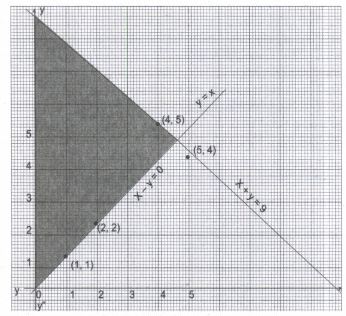
Table of values satisfying the equation
x+y = 9
| x | 5 | 4 |
| y | 4 | 5 |
Putting (0, 0) in the given inequation, we have 0+0≤9⇒0≤9, is towards is origin
∴ Half plane of x+y≤9 is away from origin
Also, the given inequality is x-y < 0
Draw the graph of the line x - y = 0.
Table of values satisfying the equation
x-y =0
| x | 1 | 2 |
| y | 1 | 2 |
Putting (0, 3) in the given inequation, we have 0-3-0<0⇒-3<0 which is true.
∴ Half plane of x-y < 0 containing the points (0,3).
19.
\(\frac { (2n)! }{ n! } =\frac { 1.2.3.4...(2n-2).(2n-1)2n }{ n! } \)
= \(\frac { (1.3.5...(2n-1))(2.4.6...(2n-2).2n) }{ n! } \) (Grouping the odd and even numbers separately)
= \(\frac { (1.3.5...(2n-1))\times 2^{ n }\times (1.2.3...(n-1).n) }{ n! } \) (taking out the 2's)
= \(\frac { (1.3.5...(2n-1)\times 2^{ n }\times n! }{ n! } \)
= 2n(1.3.5...(2n - 1))
20.
Let p(n) be the statement 41n - 14n is a multiple of 27.
Step 1: p(1): 411- 141 is a multiple of 27.
⇒ p(1): 27 is a multiple of 27.
⇒ p(1) is true.
Step 2: Let p(m) be true.
Then 41m - 14m is a multiple of 27.
⇒ 41m -14m=⋋.27
Step 3: To prove that p(m + 1) is true.
i.e. to prove that 41m+1- 14m+1 is a multiple of 27
Consider 41m+1- 14m+1
41m+1 - 41 x 14m + 41 x 14m - 14m+1 [Adding and subtracting 41 x 14m]
= 41m . 41 - 41.14m + 41 x 14m - 14m. 14
= 41(41m -14m) + 14m (41 - 14)
= 41 (⋋.27) + 14m(27)
= 27 (41⋋ + 14m) which is a multiple of 27
⇒ p(m + 1) is true. ,
Hence, by the principle of mathematical induction, p(n) is true for all n E N.
21.
We have (1 + x)n = nCo(1)n + nC1(1)n-1 . x1 + nC2(1)n-2 x2 + ...+ nCnxn;
⇒ (1 + x)n = C0 + C1x + C2x2+ ...+ Cnnxn ...(i)
Similarly, (x + 1)n = C0xn + C1xn-1 + C2xn-1 + ...+ Cn
Multiplying equations (1) and (2) we get
(1 + x)n (x + 1)n = [Co + C1x + C2x2 + ...+Cnxn] [C0xn + C1xn-1 + C2xn-2+...+ Cn]
(1 + x)2n = [C0 + C1x + C2x2+ ... +Cnxn][C0xn + C1xn-1 + C2xn-2 +...+ Cn] ...(3)
This relation is true for all values of n. Let us equate the co-efficients of xn both sides
General term in (1 + x)2n is Tr+1 = 2nCr(1)2n-rxr
Putting r = n we get
Tn+1= 2nCn.xn
⇒ Co-efficient of xn of LHS of(3) is 2nCn
Now, co-efficient of xn in RHS of (3) is
\(C_0^2+C_1^2+C_2^2+...+C_n^2\)
\(∴\ C_0^2+C_1^2+C_2^2+...+C_n^2=2_nC_n\)
\(⇒\ C_0^2+C_1^2+C_2^2+...+C_n^2={(2n)!\over n!n!}\left[ ∵ nC_r={n!\over r!(n-r)!}\right]\)
\(={(2n)!\over (n!)^2}\)
Hence \({ C }_{ 0 }^{ 2 }+{ C }_{ 1 }^{ 2 }+{ C }_{ 2 }^{ 2 }+...C_{ n }^{ 2 }=\frac { (2n)! }{ (n)! } \)
22.
LHS = \(\sqrt { \frac { 1-x }{ 1+x } } \)
\(\sqrt { \frac { 1-x }{ 1+x } } =\sqrt{(1-x)(1-x)\over(1+x)(1-x)}\)
\(={1-x\over\sqrt{1-x^2}}\)
\(=(1-x)(1-x^2)^{-1\over2}\)
\(=(1-x)\left[ 1+{-1\over2}(-x^2)-{\left(-1\over2\right)\left({-1\over2}-1\right)\over2.1}(-x^2)+... \right]\)∵ x is very small, [x2 is also very small]
\(=(1-x)\left[ 1+{x^2\over2}+{\left(1\over2\right)\left(3\over2\right)\over1.2}(x^4)+... \right]\)
\(=(1-x)\left[1+{x^2\over2}+{3\over8}x^4+...\right]=1-x+{x^2\over2}-{x^2\over2}+{3\over8}x^4+...\)
\(\left( 1-x+\frac { { x }^{ 2 } }{ 2 } \right) \) approximately
RHS.
Hence proved.
23.
Let y = 3x -5.
\(\Rightarrow y+5=3x\Rightarrow \frac { y+5 }{ 3 } =x\)
Let g(y) = \(\frac { y+5 }{ 3 } \)
\(gof(x)=g(f(x))=g(3x-5)=\frac { 3x-5+5 }{ 3 } =\frac { 3x }{ 3 } =y\)
Also f o g(y) = f(g(y)) = \(f\left( \frac { y+5 }{ 3 } \right) =3\left( \frac { y+5 }{ 3 } \right) -5=y+5-5=y\)
Thus g o f = Ix and fog = Iy.
This implies that f and g are bijections and inverses to each other.
Hence f is a bijection and f-1(y) = \(\frac { y+5 }{ 3 } \)
Replacing y by x we get, f-1(x) = \(\frac { x+5 }{ 3 } \)
24.
2a + 3b = 30
R = {(3, 8), (6, 6), (9, 4). (12, 2)}
Not reflexive, Not Symmetric, transitive, hence not an equivalence relation.
25.
LHS = \(log2+16log{16\over 15}+12log{25\over 24}+7log{81\over 80}\)
\(=log2+log\left(16\over 15\right)^{16}+log\left(25\over 24\right)^{12}+log \left(81\over 80\right)^7\)
\(=log2\times{(2^4)^{16}\over (3\times5)^{16}}\times{(5^2)^{12}\over (2^2\times3)^{12}}\times{(3^4)^7\over 2^{28}\times5^7}\)
\(=log2^1\times{2^{64}\over 3^{16}}\times{5^{24}\over 2^{36}\times3^{12}}\times{3^{28}\over 2^{28}\times5^7}\)
\(=log{2^{1+64}.5^{24}.3^{28}\over 3^{16+12}.5^{16+7}.2^{36+28}}\) \(\left[∵\ {a^m\over a^n}=a^{m-n} \right]\)
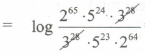
= log 265-64 x 524-23 = log 21 \(\times\) 51 = log1010 = 1 = RHS
26.
a sec θ - c tan θ = b...(1)
b sec θ + d tan θ = c...(2)
| (1) \(\times\) b ⇾ | ab secθ - bc tan θ | = b2 |
| (1) \(\times\)a ⇾ | ab secθ + ad tan θ | = ac |
| -tan θ (bc + ad) | = b2- ac |
tan θ = \(\frac{ac-b^2}{bc+ad}\)
| (1) \(\times\) d ⇾ | ad secθ - cd tan θ | = bd |
| (1) \(\times\)c ⇾ | bc secθ + cd tan θ | = c2 |
| (ad+bc) secθ | = bd + c2 |
secθ = \(\frac{bd+c^2}{ad+bc}\)
We know sec2θ - tan2θ = 1
⇒ \((\frac{bd+c^2}{ad+bc})^2-(\frac{ac-b^2}{bc+ad})^2=1\)
⇒ \(\frac{(bd+c^2)^2}{(ad+bc)^2}-\frac{(ac-b^2)^2}{(bc+ad)^2}=1\)
⇒ \(\frac{(bd+c^2)^2-(ac-b^2)^2}{(ad+bc)^2}=1\)
⇒ (bd + c2)2- (ac - b2)2 = (ad + bc)2
⇒ (c2+bd)2 = (ad + bc)2 + (ac - b2)2
Thus θ is eliminated.
27.
(d)
Matrix Addition
28.
(b)
6
29.
(c)
3(\(\hat{i}-2\hat{j}+2\hat{k}\))
30.
(d)
-2 cos \(\sqrt { x } \)
31.
(a)
\(\frac { 3 }{ 28 } \)
32.
(a)
3,2
33.
(d)
\(\frac { \cos { x } }{ 2y-1 } \)
34.
(b)
0
35.
Assistant Statistics
\(\begin{array}{ll} A=2 & S=3 \\ S=3 & T=3 \\ T=2 & A=1 \\ I=1 & I=2 \\ N=1 & C=1 \end{array}\)
\(\mathrm{n}(\mathrm{S})=9 \mathrm{C}_{1} \times 10 \mathrm{C}_{1}=90\)
One letter in I word and another letter (same) in II word the combinations are
\(\begin{array}{ll} \mathrm{AA} & \mathrm{A} \\ \mathrm{SSS} & \mathrm{SSS} \\ \mathrm{TT} & \mathrm{TTT} \\ \mathrm{I} & \mathrm{II} \end{array}\)
No. of doublets are
AA, AA, SS, SS, SS, SS, SS, SS, S$ SS, SS, TT TT,
TT, TT, TT, TT, II, II
n(A) = 19
\(P(A) =\frac{n(A)}{n(S)} \)
\(=\frac{19}{90} \)
36.
\(\int \frac{1}{x \sqrt{(\log x)^{2}-5}} d x =\int \frac{1}{\sqrt{(\log x)^{2}-5}} \times \frac{1}{x} d x \)
\(=\int \frac{1}{\sqrt{u^{2}-5}} d u, \quad u=\log x \)
\(=\log \left|u+\sqrt{u^{2}-5}\right|+c \)
\(=\log \left|\log x+\sqrt{(\log x)^{2}-5}\right|+c \)
37.
\(f^{\prime}\left(3^{-}\right)=\lim _{x \rightarrow 3^{-}} \frac{f(x)-f(3)}{x-3}=\lim _{x \rightarrow 3^{-}} \frac{x+2-5}{x-3}\)
\(=\lim _{x \rightarrow 3^{-}} \frac{x-3}{x-3}=1\)
\(f^{\prime}\left(3^{+}\right)=\lim _{x \rightarrow 3^{+}} \frac{f(x)-f(3)}{x-3}=\lim _{x \rightarrow 3^{+}} \frac{8-x-5}{x-3}\)
\(=\lim _{x \rightarrow 3^{+}} \frac{3-x}{x-3} \)
\(=\lim _{x \rightarrow 3^{+}} \frac{-(x-3)}{(x-3)}=-1 \)
\(\text { by }(1) \text { and }(2), f^{\prime}\left(3^{-}\right) \neq f^{\prime}\left(3^{+}\right)\)
\(\text { It is not differentiable }\)
\(\therefore f^{\prime}(x) \text { does not exist }\)
38.
\(f(x)=\frac{|2 x-3|}{2 x-3} \text { is not defined at } x= \frac{3}{2}\)
\(\therefore f(x) \text { is not continuous at } x=\frac{3}{2}\)
39.
\(\text { Area of triangle }=\frac{1}{2}\left|\begin{array}{lll} \frac{x_{1}}{a} & \frac{y_{1}}{a} & 1 \\ \frac{x_{2}}{b} & \frac{y_{2}}{b} & 1 \\ \frac{x^{3}}{c} & \frac{y_{3}}{c} & 1 \end{array}\right|\)
\(=\frac{1}{2 a b c}\left|\begin{array}{lll} x_{1} & y_{1} & a \\ x_{2} & y_{2} & b \\ x_{3} & y_{3} & c \end{array}\right| \text { Multiply }R_{1}, R_{2} \& R_{3} \text { by } a, b, c\text { respectively }\)
\(=\frac{1}{2 a b c} \frac{1}{(2)}\left|\begin{array}{ccc} 2 a & x_{1} & y_{1} \\ 2 b & x_{2} & y_{2} \\ 2 c & x_{3} & y_{3} \end{array}\right|=\frac{1}{4 a b c}\left(\frac{a b c}{2}\right)\)
\(=\frac{1}{8}\)
40.
(c)
0
41.
(b)
B = {| x | = 1 / x ∈ Z}
42.
(a)
x+y=2
43.
(d)
12
44.
(a)
\(x+\frac{x^3}{3}+\frac{x^5}{5}+...\)
45.
\(\frac{{ }^{2 n} C_{3}}{{ }^{n} C_{3}} =\frac{11}{1} \)
\(\frac{(2 n)(2 n-1)(2 n-2)}{n(n-1)(n-2)} =\frac{11}{1} \)
\(\frac{2 n(2 n-1) 2(n-1)}{n(n-1)(n-2)} =11 \)
\(4(2 n-1) =11(n-2) \)
\(8 n-4 =11 n-22 \)
\(18 =3 n \)
\(n = 6\)
46.
\(\text { Let } \log _{\sqrt{2}} 512=x\)
\(\text { Then }(\sqrt{2})^{x}=2^{9}\)
\(\Rightarrow 2^{\frac{x}{2}}=2^{9} \Rightarrow x / 2=9 \Rightarrow x=18\)
47.
\(I=\int { \cfrac { 1 }{ 7-(4x+1)^{ 2 } } dx=\int { \cfrac { dx }{ \left( \sqrt { 7 } \right) ^{ 2 }-(4x+1)^{ 2 } } } } \)
= \(\cfrac { 1 }{ 2\sqrt { 7 } } =\cfrac { log\frac { \sqrt { 7 } +\left( 4x+1 \right) }{ \sqrt { 7 } -\left( 4x-1 \right) } }{ 4 } =\cfrac { 1 }{ 8\sqrt { 7 } } log\left( \cfrac { \sqrt { 7 } +\left( 4x+1 \right) }{ \sqrt { 7 } -\left( 4x+1 \right) } \right) +c\)
48.
(i) If A is a subset of B, then
A\(\cap \)B = A
\(\Rightarrow\) n(A\(\cap \)B) = n(A)
\(\Rightarrow\) P(A\(\cap \)B) = P(A)
\(\therefore P(B/A)=\frac { P(A\cap B) }{ P(A) } =\frac { P(A) }{ P(A) } =1\)
(ii) If \(A\cap B=\phi \) then n(A\(\cap \)B) = 0 \(\Rightarrow\) P(A\(\cap \)B) = 0
\(\therefore P(B/A)=\frac { P(A\cap B) }{ P(A) } =\frac { 0 }{ P(A) } =0\)
49.
\(\lim _{ x\rightarrow 1 }{ \frac { (2x-3)\sqrt { x } -1 }{ { 2x }^{ 2 }+x-3 } } =\lim _{ x\rightarrow 1 }{ \frac { (2x-3)(\sqrt { x } -1)(\sqrt { x } +1) }{ (x-1){ (2x }+3)(\sqrt { x } +1) } } =\lim _{ x\rightarrow 1 }{ \frac { (2x-3)(x-1) }{ (x-1){ (2x }+3)(\sqrt { x } +1) } } \)
\(=\lim _{ x\rightarrow 1 }{ \frac { 2x-3 }{ { (2x }+3)(\sqrt { x } +1) } } =\frac { -1 }{ (2+3)(1+1) } \)
\(=\frac { -1 }{ 5(2) } =\frac { -1 }{ 10 } \)
50.
Let \(\overrightarrow{a}\) and \(\overrightarrow{b}\) be the unit vectors and\(\theta\) is the angle between \(\overrightarrow{a}\) and \(\overrightarrow{b}\).
Consider \(|\overrightarrow{a}-\overrightarrow{b}|^2=|\overrightarrow{a}|^2+|\overrightarrow{b}|^2-2(\overrightarrow{a}.\overrightarrow{b})\) \([\because |\overrightarrow{a}|=1;|\overrightarrow{b}|=1]\)
\(=1+1-2|\overrightarrow{a}||\overrightarrow{b}|cos \theta =2-2cos \theta\)
\(=2(1-cos \theta)=2.2sin^2{\theta \over2}=4sin^2{\theta \over2}\)
\(|\overrightarrow{a}-\overrightarrow{b}|=2sin{\theta \over2}\)
\(sin{\theta \over2}={1\over 2}|\overrightarrow{a}-\overrightarrow{b}|\)
51.
\(\frac { 1 }{ 2+\sqrt { 3 } } \)=\(\frac { 1 }{ 2+\sqrt { 3 } } \times \frac { 2-\sqrt { 3 } }{ 2-\sqrt { 3 } } =\frac { 2-\sqrt { 3 } }{ 4-3 } =2-\sqrt { 3 } \)
\(\frac { 3 }{ 4-\sqrt { 5 } } =\frac { 3 }{ 4-\sqrt { 5 } } \times \frac { 4+\sqrt { 5 } }{ 4+\sqrt { 5 } } =\frac { 12+3\sqrt { 5 } }{ 16-5 } =\frac { 12+3\sqrt { 5 } }{ 11 } \)
\(\frac { 6 }{ 7-\sqrt { 8 } } =\frac { 6 }{ 7-\sqrt { 8 } } \times \frac { 7+\sqrt { 8 } }{ 7+\sqrt { 8 } } =\frac { 42+6\sqrt { 8 } }{ 49-8 } =\frac { 42+6\sqrt { 8 } }{ 41 } \)
∴ \(\frac { 1 }{ 2-\sqrt { 3 } } +\frac { 3 }{ 4-\sqrt { 5 } } +\frac { 6 }{ 7-\sqrt { 8 } } =2-\sqrt { 3 } +\frac { 12+3\sqrt { 5 } }{ 11 } +\frac { 42+6\sqrt { 8 } }{ 41 } \)
52.
Let the coordinates of the points 0, A and B are (0, 0), (a, 0) and (0, b) respectively.
Observed that the points A and B are moving points.
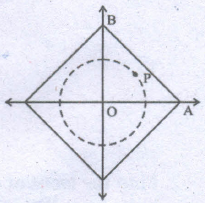
Let (h, k) be a centroid of ΔOAB
Centroid of ΔOAB is \((\frac{0+a+0}{3},\frac{0+0+b}{3})=(h,k)\)
\(\frac{a}{3}\) = h ⇒ a = 3h, \(\frac{b}{3}\) = k ⇒ b = 3k
From right ΔOAB, OA2 + OB2 = AB2
(3h)2 + (3k)2 = (6)2 ⇒ h2 + k2 = 4
Locus of (h, k) is a circle, x2 + y2 = 4
53.
\(\frac { (2n)! }{ n! } =\frac { (2n)(2n-1)(2n-2)...4.3.2.1 }{ n! } \)
\(=\frac { (2n)(2n-2)(2n-4)..4.2(2n-1)(2n-3)....3.1 }{ n!\quad n! } \) [Separating odd and even terms]
\(=\frac { { 2 }^{ n }.(2n-1)(2n-3)...3.1 }{ n! } \)
54.
Given that ㄥA, ㄥB, ㄥC are in A.P.
ஃ 2ㄥB = ㄥA + ㄥC
3ㄥB = 180°
ㄥB = \(\frac{180}{3}\) = 60°
Now \(\frac { b }{ c } =\frac { sinB }{ sinC } \)
\(\Rightarrow \frac { \sqrt { 3 } }{ \sqrt { 2 } } =\frac { sin60° }{ sinC } \)
\(\Rightarrow \frac { \sqrt { 3 } }{ \sqrt { 2 } } =\frac { \frac { \sqrt { 3 } }{ \sqrt { 2 } } }{ sinC } \)
\(\Rightarrow sinC=\frac { \sqrt { 3 } }{ 2\sqrt { 3 } } \times \sqrt { 2 } =\frac { \sqrt { 2 } }{ 2 } =\frac { \sqrt { 2 } }{ \sqrt { 2 } \times \sqrt { 2 } } =\frac { 1 }{ \sqrt { 2 } } \)
⇒ ㄥC = 45°
ㄥA = 180°-(ㄥB+ㄥC) = 180 - (60 + 45) = 75°
ㄥA = 75°, ㄥB = 60° and ㄥC = 45°

11th Standard Syllabus & Materials
11th Standard
TN 11th Tamil பீடு பெற நில் - செய்யுள் - காவடிச்சிந்து Important Questions And Answers Study Material - QB365 Set A
NEW11th Standard
TN 11th Tamil பீடு பெற நில் - உரைநடை - மலை இடப்பெயர்கள் : ஓர் ஆய்வு Important Questions And Answers Study Material - QB365 Set A
NEW11th Standard
TN 11th Tamil மாமழை போற்றுதும் - துணைப்பாடம் - யானை டாக்டர் Important Questions And Answers Study Material - QB365 Set A
NEW11th Standard
TN 11th Tamil மாமழை போற்றுதும் - செய்யுள் - ஐங்குறுநூறு Important Questions And Answers Study Material - QB365 Set A



Tamilnadu Stateboard 11th Standard Subjects
Maths

Commerce

Economics

Biology

Business Maths and Statistics

Accountancy

Computer Science

Physics

Chemistry
Maths
Biology
Economics
Physics
Chemistry

History
Business Maths and Statistics

Computer Science
Accountancy

Computer Applications
History
Computer Technology
Commerce
Computer Applications
Computer Technology

Tamil

English

French
Tamilnadu Stateboard Standards

