
 100% FREE ACCESS
11th Standard Syllabus & Materials
11th Standard
TN 11th Tamil இயற்கை வேளாண்மை,சுற்றுச்சூழல் -செய்யுள் - மனோன்மணீயம் Important Questions And Answers Study Material - QB365 Set A
NEW11th Standard
TN 11th Tamil என்னுயிர் என்பேன் -துணைப்பாடம் - இசைத்தமிழர் இருவர் Important Questions And Answers Study Material - QB365 Set A
NEW11th Standard
TN 11th Tamil மொழி கலை -செய்யுள் - ஒவ்வொரு புல்லையும் Important Questions And Answers Study Material - QB365 Set A
NEW11th Standard
TN 11th Tamil பீடு பெற நில் - இலக்கணம் - பகுபத உறுப்புகள் Important Questions And Answers Study Material - QB365 Set A
NEW11th Standard
TN 11th Tamil பீடு பெற நில் - துணைப்பாடம் - வாடிவாசல் Important Questions And Answers Study Material - QB365 Set A
NEW11th Standard
TN 11th Tamil பீடு பெற நில் - செய்யுள் - குறுந்தொகை Important Questions And Answers Study Material - QB365 Set A

Published on: 13/09/2019
Download Tamil Nadu 11th Standard Maths question papers, model tests, one-mark questions, important questions, and public exam papers in PDF format. Free study materials and answer keys for TN State Board students.
Questions + Answers key
Take MCQ Maths Test1.
Solve \((x+1)^{ \frac { 1 }{ 3 } }=\sqrt { x-3 } \)
2.
Prove that for any natural number n, an - bn is divisible by a-b, where a > b.
3.
If the equation 12x2-10xy+2y2+14x-5y+c=0 represents a pair of straight lines, find the value of c. Find the separate equations of the straight lines and also the angle between them.
4.
Find the sum to n terms of the series 1 - 5 + 9 - 13+ ......
5.
Using the mathematical induction show that for any natural number n, x2n - y2n is divisible by (x + y).
6.
Show that the relation R on the set A = {x ∈ Z : 0 < x < 12} given by R = {(a, b) : |a - b| is a multiple of 4} is an equivalence relation
7.
Show that \(\sin ^{ 2 }{ \frac { \pi }{ 18 } } +\sin ^{ 2 }{ \frac { \pi }{ 9 } } +\sin ^{ 2 }{ \frac { 7\pi }{ 18 } } +\sin ^{ 2 }{ \frac { 4\pi }{ 9 } } =2\)
8.
The co-ordinates of a point on x + y + 3 = 0 whose distance from x + 2y + 2 = 0 is \(\sqrt 5\), is ______________
(9, 6)
(-9, 6)
(6, -9)
(-9, -6)
9.
The numerical value of tan-11 + tan-12 + tan-13 = _______________
\(\pi\)
\(\frac{\pi}{2}\)
0
\(\frac{\pi}{4}\)
10.
The maximum value of 3 sin θ+4 cos θ is _______________
1
3
4
5
11.
If tan θ = \(\frac{-4}{3}\), then sin θ is _____________
\(\frac{-4}{5}\)
\(\frac{4}{5}\)
\(\frac{-4}{5}\quad or\quad \frac{4}{5}\)
None
12.
If A and B are any two finite sets having m and n elements respectively then the cardinality of the power set of A \(\times\) B is ___________
2m
2n
mn
2mn
13.
The number of positive integral solution of \(x\times y\times z=30\) is _________
3
1
9
27
14.
A candidate is required to answer 7 question out of 12 questions, which are divided into two groups each containing 6 questions. He is not permitted to attempt more than 5 questions from either group. Find the number of different ways of doing questions.
779
781
780
782
15.
The value of nC0 - nC1 + nC2 - nC3 ... + (-1)nnCn is ______________
2n+1
n
2n
0
16.
1 - 2x + 3x2 - 4x3 + ..., Ixl< 1 is ______________
(1-x)-2
(1+x)-2
(1-x)2
(1+x)2
17.
If sin(45 ° + 10°) - sin(45° -10°) = \(\sqrt{2}\)sin x then x is ___________
0o
5°
10°
15°
18.
If \(\frac{x}{x^2-5x+6}=\frac{A}{x-2}+\frac{B}{x-3}\) then value of A is _____________
2
0
3
-2
19.
\(n(A\cap B)=4\) and \((A\cup B)=11\) then \(n(p(A\triangle B))\) is __________
44
256
64
128
20.
\(\theta\) is acute angle between the lines x2- xy - 6y2 = 0, then \(\frac{2\cos\theta+3\sin\theta}{4\sin\theta+5\cos\theta}\) is
1
\(-\frac{1}{9}\)
\(\frac{5}{9}\)
\(\frac{1}{9}\)
21.
The value of the series\(\frac { 1 }{ 2 } +\frac { 7 }{ 4 } +\frac { 13 }{ 8 } +\frac { 19 }{ 16 } +\).....is
14
7
4
6
22.
2tan-1\(\left( \frac { 1 }{ 5 } \right) \) is equal to _______________
tan\(\left( \frac { 5 }{ 12 } \right) \)
\(\frac { 5 }{ 12 } \)
\(\tan^{-1}\left({5 \over 12}\right)\)
tan-1\(\frac { 2 }{ 5 } \)
23.
If the angles of a triangle are in A.P., then the measure of one of the angles in radians is ___________
\(\frac { \pi }{ 6 } \)
\(\frac { \pi }{ 3 } \)
\(\frac { \pi }{ 2 } \)
\(\frac { 2\pi }{ 3 } \)
24.
If 8 and 2 are the roots of x2+ ax + c = 0 and 3, 3 are the roots of x2 + dx + b = 0; then the roots of the equation x2+ ax + b = 0 are
1, 2
-1, 1
9, 1
-1, 2
25.
26.
If A = {1, 2, 3}, B = {1, 4, 6, 9} and R is a relation from A to B defined by "x is greater than y". The range of R is __________
{1, 4, 6, 9}
{4, 6, 9}
{1}
None of these
27.
The number of constant functions from a set containing m elements to a set containing n elements is
mn
m
n
m+n
28.
Find the domain and range of the function f(x) = \(\frac { { x }^{ 2 }-9 }{ x-3 } \).
29.
Find the middle term in \({ \left( x-\frac { 1 }{ 2y } \right) }^{ 10 }\)
30.
Find the equation of the line perpendicular to x-axis and having intercept -2 on x-axis.
31.
Evaluate sin\(\left( \frac { -11\pi }{ 3 } \right) \).
32.
Write the set {-1, 1} in set builder form.
33.
Prove that cos 20° cos 40° cos 60° cos 80°
34.
If one root of the equation 3x2+ kx - 81= 0 is the square of the other then find k
35.
Out of 18 points in a plane, no three are in the same line except five points which are collinear. Find the number of lines that can be formed joining the points.
36.
Write the first six terms of the sequences given by a1 = 4, an+1 = 2nan.
37.
Area of the triangle formed by a line with the coordinate axes, is 36 square units. Find the equation of the line if the perpendicular drawn from the origin to the line makes an angle of 45° with positive the x-axis.
38.
Find the domain of \(\frac { 1 }{ 1-2sinx } \)
39.
Let A={1,2,3,4} and B = {a,b,c,d}. Give a function from A\(\rightarrow\)B for each of the following:
neither one-to-one and nor onto.
40.
In a ∆ABC, if a = 12 cm, b = 8 cm and C = 3
41.
If \(\theta\) is an acute angle, then find \(\sin { \left( \frac { \pi }{ 4 } +\frac { \theta }{ 2 } \right) } \) when \(\sin { \theta } =\frac { 8 }{ 9 } \)
1.
\((x+1)^{1\over 3} = (x-3)^{1\over 2}\)
L.C.M. of 2 and 3 is 6 & Raising to the power 6
\(\left\{ (x+1)^{ \frac { 1 }{ 3 } } \right\} ^{ 6 }=\left\{ (x-3)^{ \frac { 1 }{ 2 } } \right\} ^{ 6 }\)
(x+1)2 = (x-3)3
x2+2x+1 =x3-9x2+27x-27
0 = x3-9x2+27x-27-x2-2x-1
x3-10x2+25x-28 =0
since constant term is - 28
we can have a factor as (x ± 2) or (x ± 4) or (x ± 7)
By trial and error method we find that (x - 7) is a factor
Using synthetic division
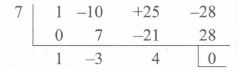
we get x3-10x2+25x-28=(x-7)(x2-3x+4)
solving x2-3x+4 =0
x=\(\frac { 3\pm \sqrt { 9-16 } }{ 2 } =\frac { 3\pm \sqrt { -7 } }{ 2 } \)
the roots are x =7 x=\(\frac { 3\pm \sqrt { -7 } }{ 2 } \)
2.
Let, p(n) : = an - bn, is divisible by a - b.
Substituting the value of n = 1, in the statement we get,
P(1) = a - b,
which is divisible by a-b. Hence, P(1) is true. Let us assume that the statement is true for n = k.
Then P(k) = ak- bk, is divisible by a - b. We can write
P(k) = ak- bk = \(\lambda\)(a - b), \(\lambda\)\(\in\) N.
We need to show that P(k + 1) = ak + 1- bk+1, is divisible by a - b.
P(k+1) = ak+1-bk+1
= ak+ 1- abk + abk - bk+1
a(ak - bk + bk (a - b)
a(\(\lambda\)(a - b)) + bk (a - b)
= (a - b)(a\(\lambda\) + bk)
(a - b) \(\lambda_1,\) \(\lambda_1\) = a\(\lambda\) + bk, \(\lambda_1\)\(\in\)N.
which is divisible by a-b. This implies that P(k + 1) is true. The validity of P(k + 1) follows from that of P(k).
Therefore by the principle of mathematical induction, an - bn is divisible by a - b, where a > b, for all natural numbers n.
3.
12x2-10xy+2y2+14x-5y+c=0
ax2 +2hxy+ by2 +2gx+2fy+c = 0
\(\left| \begin{matrix} 2h=-10 \\ h=-5 \end{matrix} \right| b=2\left| \begin{matrix} 2g=14 \\ g=7 \end{matrix} \right| \left| \begin{matrix} 2f=-5 \\ f=\frac { -5 }{ 2 } \end{matrix} \right| \)
af2 +bg2 +ch2 -2fgh-abc=0 is the condition
12\(\left( \frac { 25 }{ 4 } \right) \)+2(7)2+c(-5)2-2\(\left( \frac { -5 }{ 2 } \right) \)(7)(-5)-12(2)(c)=0
75+98+25c-175-24c=0, c=2
The equation is 12x2-10xy+2y2+14x-5y+2=0
12x2-10xy+2y=(3x-y)(4x-2y)
Let 12x2-10xy+2y2+14x-5y+2=(3x-y+l)(4x-2y+m)
So that 4l+3m=14, -2l-m=-5
On solving we get t=\(\frac { 1 }{ 2 } \), m=4
∴ The separate equations are 3x-y+\(\frac { 1 }{ 2 } \)=0 ⇒ 6x-2y+1=0 and
4x-2y+4=0 ⇒ 2x-y+2=0
m1=\(\frac { -6 }{ -2 } \)=3; m2=\(\frac { -2 }{ -1 } \)=2
∴ tanθ=\(\left| \frac { { m }_{ 1 }-{ m }_{ 2 } }{ 1+{ m }_{ 1 }{ m }_{ 2 } } \right| =\left| \frac { 3-2 }{ 1+3.2 } \right| =\frac { 1 }{ 7 } \)
θ=tan-1\(\left( \frac { 1 }{ 7 } \right) \).
4.
The given series is 1 + 5(-1)+9(1)+13(-1)+....
= 1 + 5(-1)+9(-1)2+13(-1)3+....
This is an arithmetic - geometric series with corresponding A.P. 1, 5, 9, 13.... and G.P. 1, -1, (-1)2, (-1)3, ....
\(\therefore\) Tn of A.G. series = (Tn of A.P) (Tn of G.P)
= [ 1 + ( n - 1)4 ] [ 1 (-1)n-1] [ \(\because\) Tn in A.P. is a + (n - 1)d, Tn in G.P. is a rn-1 ]
= (4n-3)(-1)n-1
Let Sn be the Sum of the first n terms of AG series
Sn = T1 + T2 + T3 + ... Tn-1 + Tn
Sn = 1 + 5(-1)+9(-1)2 + .. + (4n-7)(-1)n-2 + (4n-3) (-1)n-1 ...(2)
Multiplying by (-1) we get,
-1 Sn = 1 + 5(-1)+9(-3)3 + .. + (4n-7)(-1)n-1 + 4n-3(-1)n
(2)-(3) we get,
Sn + Sn = 1 + [4(-1) + 4(-1)2]+...+4(-1)n-1]-(4n-3)(-1)n
\(\Rightarrow\) \(2S_n=1+{4(-1)[1-(-1)^{n-1}]\over1-(-1)}-(4n-3)(-1)^n\) \(\begin{bmatrix} \because For\ GP, S_N={a(1-r^n)\over 1-r} \\a=1,r=-1 \end{bmatrix}\)
\(\Rightarrow\) \(2S_n=1-2()1-(-1)^{n-1}-(4n-3){(-1)}^{n}\)
\(\Rightarrow\) \(S_n={1\over 2}-1+{(-1)}^{n-1}-{4n-3\over 2}{(-1)}^{n-1}(-1)\)
\(\Rightarrow\) \(S_n={-{1\over 2}}+{2+4n-3\over 2}{(-1)}^{n-1}\)
\(\Rightarrow\) \(S_n={1\over 2}[-1+(4n-14){(--1)}^{n-1}].\)
5.
Let p(n) be the statement
x2n - y2n is divisible
Step 1: Putting n = 1, we get
x2 - y2 = (x +y) (x - y) which is divisible by (x +y).
∴ p(1) is true
Step 2: Let us assume that p(k) is true
∴. x2k - y2k is divisible by (x +y)
⇒ x2k = m(x +y) + y2k for some scalars
Step 3: To prove that p(k+ 1) is true.
i.e to P. T. x2(k+1) - y2(k+1) is divisible by (x + y).
Consider x2(k + l) - y2(k + l)
X2(k+1) - y2(k+2) = x2. x2k - y2k+2
x2 [m (x +y) +y2k) - y2k+2
m (x+ y) (x2) + x2 y2k - y2k.y2
m (x+ y) x2 + y2k (x2 - y2)
m (x+ y) x2 + y2k (x + y) (x - y)
(x + y) [mx2 + (x - y) y2k] which is divisible by (x + y).
∴ x2(k+1) - y2(k+1) is divisible by (x +y).
∴ p(k+ 1) is true.
Hence by the principle of mathematical induction, p(n) is true for all values of n.
6.
Given R = {(a, b) : |a - b| is a multiple of 4}
Reflexivity: Where a, b ∈ A = {0, 1, 2, ... 12}. For any a ∈ A, we have |a - a| = 0 which is a multiple of 4.
⇒ (a, a) ∈ A for all a ∈ A
∴ R is reflexive
Symmetry: Let (a, b) ∈ R. Then
(a, b) ∈ R
⇒ |a - b| is a multiple of 4.
⇒ |a - b| = 4⋋- for some ⋋∈N.
⇒ |b - a| = 4⋋- for some ⋋∈N.
⇒ (b, a) ∈N
∴ R is symmetric Transitivity: Let (a, b) ∈ R and (b, c) ∈ R
Then (a, b) ∈ R and (b, c) ∈ R
⇒ |a - b| is a multiple of 4 and |b - c| is a multiple of 4.
⇒ |a - b| = 4⋋ and |b - c| = 4μ for some ⋋ μ∈ N
⇒ a-b = ±4 -and b-c = ±4μ for some ⋋, μ ∈ N
⇒ a-c = ±4⋋ ±4μ for some ⋋, μ ∈ N
⇒ |a - c| is a multiple of 4.
⇒ (a-c)∈R
∴ R is transitive.
Hence, R is an equivalence relation.
7.
LHS = \(\sin ^{ 2 }{ \frac { \pi }{ 18 } } +\sin ^{ 2 }{ \frac { \pi }{ 9 } } +\sin ^{ 2 }{ \frac { 7\pi }{ 18 } } +\sin ^{ 2 }{ \frac { 4\pi }{ 9 } } \)
\(=\sin ^{ 2 }{ \left( \frac { \pi }{ 18 } \times \frac { 180 }{ \pi } \right) } +\sin ^{ 2 }{ \left( \frac { \pi }{ 9 } \times \frac { 180 }{ \pi } \right) } +\sin ^{ 2 }{ \left( \frac { 7\pi }{ 18 } \times \frac { 180 }{ \pi } \right) } +\sin ^{ 2 }{ \left( \frac { 4\pi }{ 9 } \times \frac { 180 }{ \pi } \right) } \)
= sin2 10o + sin2 20o + sin2 70o + sin2 80o
= [sin (90 - 80o)]2 + [sin (90 - 70)]2 + sin2 70o + sin2 80o
= cos2 80o + cos2 70o + sin2 70o +sin2 80o
= (cos2 80o + sin2 80o) + (cos2 70 + sin2 70)
= 1 + 1 = 2 = RHS
Hence proved.
8.
(b)
(-9, 6)
9.
(a)
\(\pi\)
10.
(d)
5
11.
(c)
\(\frac{-4}{5}\quad or\quad \frac{4}{5}\)
12.
(d)
2mn
13.
(d)
27
14.
(c)
780
15.
(d)
0
16.
(b)
(1+x)-2
17.
(c)
10°
18.
(d)
-2
19.
(d)
128
20.
\(\tan \theta=\frac{2 \sqrt{b^{2}-a b}}{a+b}=\frac{2 \sqrt{\left(\frac{-1}{2}\right)^{2}+6}}{-5}\)
\(=\left|\frac{2 \sqrt{\frac{1}{4}+6}}{-5}\right|\)
\(=\frac{2\left(\frac{5}{2}\right)}{5}=1 \Rightarrow \theta=45^{\circ}\)
\(\frac{2 \cos \theta+3 \sin \theta}{4 \sin \theta+5 \cos \theta}=\frac{\frac{2}{\sqrt{2}}+\frac{3}{\sqrt{2}}}{\frac{4}{\sqrt{2}}+\frac{5}{\sqrt{2}}}=\frac{5}{9}\)
21.
\(\mathrm{a} =1, \quad \mathrm{~d}=6, \quad \mathrm{r}=\frac{1}{2} \)
\(\mathrm{~S}_{\infty} =\frac{a}{1-\mathrm{r}}+\frac{\mathrm{dr}}{(1+\mathrm{r})^{2}} \)
\(=\frac{1}{1-\frac{1}{2}}+\frac{6 \times \frac{1}{2}}{\left(\frac{1}{2}\right)^{2}} \)
\(=2+(3 \times 4)=14 \)
22.
(c)
\(\tan^{-1}\left({5 \over 12}\right)\)
23.
(b)
\(\frac { \pi }{ 3 } \)
24.
\(x^{2}+a x+c=0 \)
\(x^{2}+d x+b=0 \)
\(8 \& 2 \text { are the roots }\)\(\text { 3. } 3 \text { are the roots }\)
\(\therefore a=-10 ; c=16 \quad d=-6, \quad b=9\)
\(x^{2}+a x+b =0 \)
\(x^{2}-10 x+9 =0 \)
\(\Rightarrow(x-1)(x-9) =0 \)
\(\therefore x =1 \text { (or) } 9 \)
25.
(b)
26.
(c)
{1}
27.
(c)
n
28.
We have f(x) = \(\frac { { x }^{ 2 }-9 }{ x-3 } \)
Domain of f : Clearly f(x) is not defined for x - 3 = 0 i.e. x = 3. Therefore, Domain (f) = R- {3}
Range of f: Let f(x) = y. Then,
f(x) = y ⇒ \(\frac { { x }^{ 2 }-9 }{ x-3 } \)=y ⇒ x+3 = y
it follows from the above relation that y takes all real values except 6 when x takes values in the ser R - {3}. Therefore, Range (f) = R {6}.
29.
Given \({ \left( x-\frac { 1 }{ 2y } \right) }^{ 10 }\)
Here n = 10, x = x and \(a=\left( \frac { -1 }{ 2y } \right) \)
Middle term = \({ T }_{ \frac { 10+2 }{ 2 } }={ T }_{ 6 }\)
General term is \({ T }_{ r+1 }=nCr{ x }^{ n-r }{ a }^{ r }\)
Putting r = 5 we get,
\({ T }_{ 6 }=10{ C }_{ 5 }{ x }^{ 10-5 }{ \left[ -\frac { 1 }{ 2y } \right] }^{ 5 }=\frac { 10\times 9\times 8\times 7\times 6 }{ 5\times 4\times 3\times 2\times 1 } .{ x }^{ 5 }\left( \frac { -1 }{ 32.{ y }^{ 5 } } \right) \)
\(=-225.{ x }^{ 5 }.\frac { 1 }{ 32{ y }^{ 5 } } { T }_{ 6 }=\frac { -63{ x }^{ 5 } }{ 8{ y }^{ 5 } } \)
30.
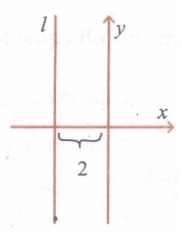
Since the given line, is perpendicular to x-axis, it will be parallel to y-axis.
\(\therefore\) Equation of the line is x = -2
31.
sin\(\left( \frac { -11\pi }{ 3 } \right) =-sin\frac { 11\pi }{ 3 } \)
= \(-sin\left( \frac { 11\times 180 }{ 3 } \right) \) = -sin(6600)
= -sin(2 \(\times\) 3600 - 600)
= -(-sin(600)) [Angle is in the IV quadrant and sine is negative
= sin 600 = \(\frac { \sqrt { 3 } }{ 2 } \).
32.
Let p = {-1, 1}
\(\Rightarrow\) P = {x \(\in \) R : x is a root of the equation x2-1 = 0}
33.
= cos 20° cos 40° \((\frac{1}{2})\)cos 80°
\(=\frac{1}{4}\)(cos 20° cos 40° cos 80°)
\(=\frac{1}2(\frac{1}{8})\)
\(=\frac{1}{16}\)
34.
Let the roots be α and α2
sum of the roots α + α2 = \(\frac { -k }{ 3 } \) ...(1)
product of the roots α(α2) = (α3) = \(\frac { -81 }{ 3 } \) = -27
α3 = -27=(-3)3 ⇒ α = -3
substituting α value in (1) we get
-3 + (-3)2 = \(\frac { -k }{ 3 } \)
(i.e) -3 + 9 = \(\frac { -k }{ 3 } \)
(i.e) \(\frac { -k }{ 3 } \) = 6 ⇒ k = -18
35.
Total number of points = 18
Out of 18 numbers, 5 are collinear and we get a straight line by joining any two points.
\(\therefore\) Total number of straight line formed by joining 2 points out of 18 points = 18C2
Number of straight lines formed by joining 2 points out of 5 points = 5C2
But 5 points are collinear and we get only one line when they are joined pairwise.
So, the required number of straight lines are
=18C2 -5C2 +1 = \({18 ·17\over2.1}-{5·4\over2.1}+1= 153 -10 + 1-144\)
Hence, the total number of straight lines = 144
36.
Here a1 = 4, and an+1 = 2nan.
Putting n = 1, a2 = 2 \(\times\) 1\(\times\) a1 = 2 \(\times\) 1\(\times\) 4 = 8
Putting n = 2, a3 =2\(\times\)2\(\times\)a2 = 4 \(\times\) 8 = 32
Putting n = 3, a4 = 2\(\times\)3\(\times\)a3 = 6 \(\times\) 32 = 192
Putting n = 4, a5 = 2\(\times\)4\(\times\)a4 = 8 \(\times\) 192 = 1536
Putting n = 5, a6 = 2\(\times\) 5\(\times\) a5 = 10\(\times\)1536 = 15360
37.
Let p be the length of the perpendicular drawn from the origin to the required line.
The perpendicular makes 45° with the x-axis.
The equation of the required line is of the form,
x cos \(\alpha\) + y sin \(\alpha\) = p
⇒ x cos 45° +y sin 45° = p
x + y = √2p
This equation cuts the coordinate axes at A(√2p, 0) and B(0, √2p)
Area of the ΔOAB is \(\frac{1}{2}\times\sqrt{2}p\times\sqrt{2}p=36\)
p = 6
Therefore the equation of the required line is x + y = 6\(\sqrt{2}\)
38.
Let f(x) = \(\frac { 1 }{ 1-2sinx } \)
When the denominator is 0,
1-2 sin x = 0
\(\Rightarrow\) 1 = 2 sin x
\(\Rightarrow sin\quad x=\frac { 1 }{ 2 } \)
\(\Rightarrow sin\quad x=sin\frac { \pi }{ 6 } \)
\(\Rightarrow x=n\pi +{ (-1) }^{ n }\frac { \pi }{ 6 } n\in Z\) \(\left[ \because sin\quad x=sin\alpha \Rightarrow x=n\pi +{ (-1) }^{ n }\alpha \quad n\in Z \right] \)
Domain of f(x) is R - \(\left( n\pi +{ (-1) }^{ n }\frac { \pi }{ 6 } \right) ,n\in Z\)
39.
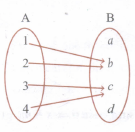
Let f = {(1, b) (2, b) (3, c) (4, d)}
Different elements in A does not have different images in B
∴ f is not one-one
Now, Co-domain = {a, b, c, d}, Range = {b, c}
Co-domain ≠ range
∴ f is not onto. Hence f is neither one-one and nor onto.
40.
Area of ΔABC = \(\frac{1}{2}\)ab sin C
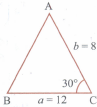
= \(\frac{1}{2}\) \(\times\) 12 \(\times\) 8 sin 30°
Δ = 6 \(\times\) 8 \(\times\) \(\frac{1}{2}\)= 24 sq.cm
41.
Given \(sin\theta =\frac { 8 }{ 9 } \)
\(cos\theta =\sqrt { 1-{ sin }^{ 2 }\theta } =\sqrt { 1-\frac { 64 }{ 81 } } =\sqrt { \frac { 81-64 }{ 81 } } =\frac { \sqrt { 17 } }{ 9 } \)
\(sin\frac { \theta }{ 2 } =\sqrt { \frac { 1-cos\theta }{ 2 } } =\sqrt { \frac { 1-\frac { \sqrt { 17 } }{ 9 } }{ 2 } } =\sqrt { \frac { 9-\sqrt { 17 } }{ 18 } } \)
\(cos\frac { \theta }{ 2 } =\sqrt { \frac { 1+cos\theta }{ 2 } } =\sqrt { \frac { 1+\frac { \sqrt { 17 } }{ 9 } }{ 2 } } =\sqrt { \frac { 9+\sqrt { 17 } }{ 18 } } \)
consider \(cos\left( \frac { \pi }{ 4 } -\frac { \theta }{ 2 } \right) =cos\frac { \pi }{ 4 } cos\frac { \theta }{ 2 } -sin\frac { \pi }{ 4 } sin\frac { \theta }{ 2 } \)
\(\frac { 1 }{ \sqrt { 2 } } cos\frac { \theta }{ 2 } -\frac { 1 }{ \sqrt { 2 } } sin\frac { \theta }{ 2 } =\frac { 1 }{ \sqrt { 2 } } \left( cos\frac { \theta }{ 2 } -sin\frac { \theta }{ 2 } \right) \)
= \(\frac { 1 }{ \sqrt { 2 } } \left( \sqrt { \frac { 9+\sqrt { 17 } }{ 18 } } -\sqrt { \frac { 9-\sqrt { 17 } }{ 18 } } \right) =\frac { 1 }{ 3\sqrt { 2 } } \left( \sqrt { \frac { 9+\sqrt { 17 } }{ 18 } } -\sqrt { \frac { 9-\sqrt { 17 } }{ 18 } } \right) \)

11th Standard Syllabus & Materials
11th Standard
TN 11th Tamil பீடு பெற நில் - செய்யுள் - காவடிச்சிந்து Important Questions And Answers Study Material - QB365 Set A
NEW11th Standard
TN 11th Tamil பீடு பெற நில் - உரைநடை - மலை இடப்பெயர்கள் : ஓர் ஆய்வு Important Questions And Answers Study Material - QB365 Set A
NEW11th Standard
TN 11th Tamil மாமழை போற்றுதும் - துணைப்பாடம் - யானை டாக்டர் Important Questions And Answers Study Material - QB365 Set A
NEW11th Standard
TN 11th Tamil மாமழை போற்றுதும் - செய்யுள் - ஐங்குறுநூறு Important Questions And Answers Study Material - QB365 Set A



Tamilnadu Stateboard 11th Standard Subjects
Maths

Commerce

Economics

Biology

Business Maths and Statistics

Accountancy

Computer Science

Physics

Chemistry
Maths
Biology
Economics
Physics
Chemistry

History
Business Maths and Statistics

Computer Science
Accountancy

Computer Applications
History
Computer Technology
Commerce
Computer Applications
Computer Technology

Tamil

English

French
Tamilnadu Stateboard Standards

