
 100% FREE ACCESS
11th Standard Syllabus & Materials
11th Standard
TN 11th Tamil இயற்கை வேளாண்மை,சுற்றுச்சூழல் -செய்யுள் - மனோன்மணீயம் Important Questions And Answers Study Material - QB365 Set A
NEW11th Standard
TN 11th Tamil என்னுயிர் என்பேன் -துணைப்பாடம் - இசைத்தமிழர் இருவர் Important Questions And Answers Study Material - QB365 Set A
NEW11th Standard
TN 11th Tamil மொழி கலை -செய்யுள் - ஒவ்வொரு புல்லையும் Important Questions And Answers Study Material - QB365 Set A
NEW11th Standard
TN 11th Tamil பீடு பெற நில் - இலக்கணம் - பகுபத உறுப்புகள் Important Questions And Answers Study Material - QB365 Set A
NEW11th Standard
TN 11th Tamil பீடு பெற நில் - துணைப்பாடம் - வாடிவாசல் Important Questions And Answers Study Material - QB365 Set A
NEW11th Standard
TN 11th Tamil பீடு பெற நில் - செய்யுள் - குறுந்தொகை Important Questions And Answers Study Material - QB365 Set A

Published on: 16/09/2019
Download Tamil Nadu 11th Standard Maths question papers, model tests, one-mark questions, important questions, and public exam papers in PDF format. Free study materials and answer keys for TN State Board students.
Questions + Answers key
Take MCQ Maths Test1.
Find the equations of straight lines which are perpendicular to the line 3x + 4y - 6 = 0 and are at a distance of 4 units from (2, 1).
2.
Resolve the following rational expressions into partial fractions.
\({{1}\over{x^2-a^2}}\)
3.
Show that \(\frac { sin8x\ cosx-sin6x\ cos3x }{ cos2x\ cosx-sin3x\ sin4x } =tan2x\)
4.
Discuss the following relations for reflexivity, symmetricity and transitivity :
The relation R defined on the set of all positive integers by "mRn if m divides n".
5.
Using the mathematical induction, show that for any natural number n,\(\frac { 1 }{ 1.2 } +\frac { 1 }{ 2.3 } +\frac { 1 }{ 3.4 } +...+\frac { 1 }{ n(n+1) } =\frac { n }{ n+1 } \).
6.
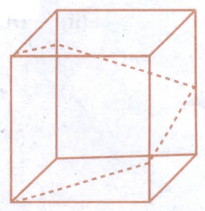
In a shopping mall there is a hall of cuboid shape with dimension 800 \(\times\)800 \(\times\)720 units, which needs to be added the facility of an escalator in the path as shown by the dotted line in the figure. Find
(i) the minimum total length of the escalator.
(ii) the heights at which the escalator changes its direction.
(iii) the slopes of the escalator at the turning points.
7.
Compute the sum of first n terms of the following series 6 + 66 + 666 + .......
8.
How many strings can be formed using the letters of the word LOTUS if the word
(i) either starts with L or ends with S?
(ii) neither starts with L nor ends with S?
1.
Given equation of line is 3x + 4y - 6 = 0.
Any line perpendicular to 3x + 4y - 6 = 0 will be of the form 4x - 3y + k = 0 ....(1)
Given perpendicular distance is 4 units from (2,1) to line (1)
\(\therefore\)4 = \(\pm \frac { (4(2)-3(1)+k) }{ \sqrt { { 4 }^{ 2 }+{ \left( -3 \right) }^{ 2 } } } \)
\(\Rightarrow\) 4 = \(\pm \left( \frac { 8-3+k }{ \sqrt { 16+9 } } \right) \)
\(\Rightarrow\) 4 = \(\pm \left( \frac { 5+k }{ 5 } \right) \)
\(\therefore\) 20 = +(5 + k) or 20 = -(5+ k)
\(\Rightarrow\) k = 20 - 5 or k = -(20 + 5)
\(\Rightarrow\) k = 15 or k = -25
\(\therefore\) Required equation of the lines are 4x - 3y + 15 = 0 and 4x - 3y - 25 = 0.
2.
\({{1}\over{x^2-a^2}}={{1}\over{(x+a)(x-a)}}-={{A}\over{x+a}}+{{B}\over{x+a}}\)
\({{1}\over{x^2-a^2}}={{A(x-a)B(x+a)}\over{(x+a)(x-a)}}\)
\(\Rightarrow\) 1 = A(x - a) + B(x + a)
Putting x = a in (1) we get,
\(1=B(2a)\Rightarrow A=-{{1}\over{2a}}\)
Putting x = -a in (1) we get,
\(1=A(-2a)\Rightarrow A=-{{1}\over{2a}}\)
\(\therefore{{1}\over{x^2-a^2}}={{-{{1}\over{2}}a}\over{x+a}}+{{{{1}\over{2}}a}\over{x-a}}={{-1}\over{2a(x+a)}}+{{1}\over{2a(x-a)}}\)
3.
\(LHS=\frac { sin8x\quad cosx-sin6x\quad cos3x }{ cos2x\quad cosx-sin3x\quad sin4x } \)
\(=\frac { \frac { 1 }{ 2 } \left[ sin9x+sin(7x) \right] -\frac { 1 }{ 2 } \left[ sin9x+sin3x \right] }{ \frac { 1 }{ 2 } \left[ cos\quad 3x+cos\quad x) \right] -\frac { 1 }{ 2 } \left[ cos\quad (x)-cos7x) \right] } \quad \left[ \therefore sinAcosB=\frac { 1 }{ 2 } (sin(A+B)+sin(A-B)) \right] \)
\(=\frac { \frac { 1 }{ 2 } \left[ sin9x+sin7x-sin9x-sin3x \right] }{ \frac { 1 }{ 2 } \left[ cos3x+cosx-cosx+cos7x \right] } =\frac { sin7x-sin3x }{ cos3x+cos7x } \)
\(=\frac { 2cos\left( \frac { 7x+3x }{ 2 } \right) sin\left( \frac { 7x-3x }{ 2 } \right) }{ 2cos\left( \frac { 7x+3x }{ 2 } \right) .cos\left( \frac { 7x-3x }{ 2 } \right) } =\frac { 2cos5x.sin2x }{ 2cos5x.cos2x } \)
\(\left[ \because sinC-sinD=2cos\left( \frac { C+D }{ 2 } \right) sins\left( \frac { C-D }{ 2 } \right) andcosC+cosD=2cos\left( \frac { C+D }{ 2 } \right) coss\left( \frac { C-D }{ 2 } \right) \right] \)
= tan 2x = RHS
4.
The relation R defined on the set of all positive integers by "mRn" if m divides n".
Given relation is "mRn if m divides n".
Reflexivity : mRm since m divides m for all positive integers m.
\(\therefore\) R is reflexive.
Symmetricity: mRn \(\Rightarrow\) nRm.
m divides n \(\Rightarrow\) n divides m but 'n' does not divide 'm'
\(\therefore\) R is not symmetric
Transitive : mRn and nRp \(\Rightarrow\) mRp.
m divides n and n divides p \(\Rightarrow\) m divides p.
\(\therefore\) R is transitive.
\(\therefore\) R is reflexive, and transitive.
5.
Let P(n) = \(\frac { 1 }{ 1.2 } +\frac { 1 }{ 2.3 } +\frac { 1 }{ 3.4 } +...+\frac { 1 }{ n(n+1) } =\frac { n }{ n+1 } \)
Substituting the value of n = 1, in the statement we get
P(1) = \(\frac { 1 }{ 1.2 } =\frac{1}{2}\)
Hence, P(1) is true. Let us assume that the statement is true for n = k. Then
P(k) = \(\frac { 1 }{ 1.2 } +\frac { 1 }{ 2.3 } +\frac { 1 }{ 3.4 } +...+\frac { 1 }{ k(k+1) } =\frac { k }{ k+1 } \)
We need to show that P(k + 1) is true. Consider,
\(P(k+1) =\underbrace{\frac { 1 }{ 1.2 } +\frac { 1 }{ 2.3 } +\frac { 1 }{ 3.4 } ...+\frac { 1 }{ k(k+1) }} +\frac { 1 }{ (k+1)(k+2) } \)
= \(P(k)+\frac{1}{(k+1)(k+2)}\)
= \(\frac{ k} {(k + 1)} + \frac{1}{ (k + 1)(k + 2)}\)
= \(\frac{1} {k + 1} (\frac{ k}{ 1} + \frac{1} {k + 2})\)
= \(\frac{1} {k + 1} (\frac{ k ^2 + 2k + 1}{ k + 2 })\)
= \(\frac{1}{(k+1) }\frac{(k+1)^2}{k+2}=\frac{k+1}{k+2}\)
This implies, P(k + 1) is true
The validity of P(k + 1) follows from that of P(k)
Therefore by the principle of mathematical induction, for any natural number n,
\(\frac { 1 }{ 1.2 } +\frac { 1 }{ 2.3 } +\frac { 1 }{ 3.4 } +...+\frac { 1 }{ n(n+1) } =\frac { n }{ n+1 } \).
6.
Shape of the hall in the shopping mall is cuboid. When you open out the cuboid, the net of the cuboid will be as shown in the following diagram.
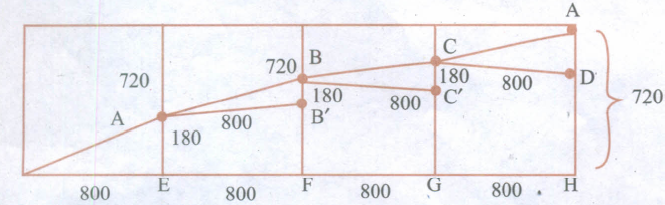
The path of the escalator is from OA to AB to BC to CD
In OAE, OA2 = AE2 + OE2
\(\Rightarrow{ OA }^{ 2 }={ \left[ \frac { 1 }{ 4 } (720) \right] }^{ 2 }+{ OE }^{ 2 }\)
\(\Rightarrow\) OA2 = (180)2 + (800)2
\(\Rightarrow\) OA2 = (20\(\times\)9)2 + (20 \(\times\) 40)2
\(\Rightarrow\) OA2 = 202 + (92+ 402)
\(\Rightarrow\) OA2 = 202 \(\times\) 1681
\(\Rightarrow\) OA2 = 202 \(\times\) 412
\(\Rightarrow\) OA2 = 20 \(\times\) 41 = 820
\(\therefore\) Total length of the escalator = OA + A + BC + CD
= 4 \(\times\) OA (since \(\Delta\)OAE \(\equiv \) \(\Delta\)ABB' \(\equiv \) \(\Delta\)BCC' \(\equiv \) \(\Delta\)CDD')
= 4 \(\times\) 820
The minimum length = 3280 units
(ii) The height at which the escalator changes its direction.
\(AE=\frac { 1 }{ 4 } (720)=180\quad units\)
\(BE=\frac { 1 }{ 2 } (720)=360\quad units\quad and\quad GE=\frac { 3 }{ 4 } (7200=540\quad units\)
(iii) Slope of the escalator at the turning points
Let \(\angle \)AOE = \(\theta\)
\(In\ \Delta OAE,\ tan\theta =\frac { opp }{ adj } =\frac { AE }{ DE } =\frac { 180 }{ 800 } =\frac { 9 }{ 40 } \)
\(\therefore \ Slope\ at\ the\ point\ A=\frac { 9 }{ 40 } \)
\(Since\ \Delta OAE\equiv \Delta ABB'\equiv \Delta BCC'\equiv \Delta CDD'\)
Slope at the points B, C will be \(\frac{9}{40}\)
7.
Let = 6 + 66 + 666 + ... upto n terms
= 6 (1 + 11 + 111+ ....) upto n terms
\(={6\over9}(9+99+999+ ...)\) upto n terms
\(={63\over 6}[(10 -1) + (10^2-1) + (10^3 -1) + ...]\) upto n terms
\(={6\over 9}[(10+ 10^2 + 10^3+ ...) - (1+ 1+1...)]\) upto n terms
\(={6\over9}\left[{ 10(10^n-1)\over 10-1}n\right]\)[In a G.P with a = 10 r = 10, \(S_n={(r^n-1)\over r-1}\)]
\(={6\over9}\left[{ 10(10^n-1)\over 10-1}n\right]={6\over9}\left[ 10(10^n-1)-9n\over9\right]\)
\({ S }_{ n }=\frac { 6 }{ 81 } \left[ 10\left( { 10 }^{ n }-1 \right) -9n \right] \)
8.
(i) Either starts with L or ends with S.
| 1 | 4 | 3 | 2 | 1 |
| L |
Since the words starts with L, the remaining 4 boxes can be filled in 4 x 3 x 2 x 1 ways by the remaining letters o, T, U, S.
∴ Number of words starting with L
= 1 \(\times\) 4 \(\times\) 3 \(\times\) 2 \(\times\) 1 = 24.
| 1 | 2 | 3 | 4 | 1 |
| S |
Here also, the remaining 4 boxes can be filled in 4 \(\times\) 3 \(\times\) 2 \(\times\) 1 ways = 24.......(1)
Number of words ending with S = 24 ....(2)
Number of words starting with L and end with S are 3 \(\times\) 2 \(\times\) 1 = 6...(3)
∴ By fundamental principle of addition, number of words either starts with L nor ends with S = 24 + 24 - 6 = 48 - 6 = 42
| 3 | 2 | 1 | ||
| F | S |
(ii) Neither starts with L nor ends with S.
Total number of words formed by the letters of the word LOTUS is 5 \(\times\) 4 \(\times\) 3 \(\times\) 2\(\times\) 1 = 120.
Now, number of words neither starts with L nor end with S.
= (Total number of words) - (Number of words starts with either L nor ends with S)
= 120 - 42
= 78.

11th Standard Syllabus & Materials
11th Standard
TN 11th Tamil பீடு பெற நில் - செய்யுள் - காவடிச்சிந்து Important Questions And Answers Study Material - QB365 Set A
NEW11th Standard
TN 11th Tamil பீடு பெற நில் - உரைநடை - மலை இடப்பெயர்கள் : ஓர் ஆய்வு Important Questions And Answers Study Material - QB365 Set A
NEW11th Standard
TN 11th Tamil மாமழை போற்றுதும் - துணைப்பாடம் - யானை டாக்டர் Important Questions And Answers Study Material - QB365 Set A
NEW11th Standard
TN 11th Tamil மாமழை போற்றுதும் - செய்யுள் - ஐங்குறுநூறு Important Questions And Answers Study Material - QB365 Set A



Tamilnadu Stateboard 11th Standard Subjects
Maths

Commerce

Economics

Biology

Business Maths and Statistics

Accountancy

Computer Science

Physics

Chemistry
Maths
Biology
Economics
Physics
Chemistry

History
Business Maths and Statistics

Computer Science
Accountancy

Computer Applications
History
Computer Technology
Commerce
Computer Applications
Computer Technology

Tamil

English

French
Tamilnadu Stateboard Standards

