
 100% FREE ACCESS
11th Standard Syllabus & Materials
11th Standard
TN 11th Tamil இயற்கை வேளாண்மை,சுற்றுச்சூழல் -செய்யுள் - மனோன்மணீயம் Important Questions And Answers Study Material - QB365 Set A
NEW11th Standard
TN 11th Tamil என்னுயிர் என்பேன் -துணைப்பாடம் - இசைத்தமிழர் இருவர் Important Questions And Answers Study Material - QB365 Set A
NEW11th Standard
TN 11th Tamil மொழி கலை -செய்யுள் - ஒவ்வொரு புல்லையும் Important Questions And Answers Study Material - QB365 Set A
NEW11th Standard
TN 11th Tamil பீடு பெற நில் - இலக்கணம் - பகுபத உறுப்புகள் Important Questions And Answers Study Material - QB365 Set A
NEW11th Standard
TN 11th Tamil பீடு பெற நில் - துணைப்பாடம் - வாடிவாசல் Important Questions And Answers Study Material - QB365 Set A
NEW11th Standard
TN 11th Tamil பீடு பெற நில் - செய்யுள் - குறுந்தொகை Important Questions And Answers Study Material - QB365 Set A

Published on: 21/09/2019
Download Tamil Nadu 11th Standard Maths question papers, model tests, one-mark questions, important questions, and public exam papers in PDF format. Free study materials and answer keys for TN State Board students.
Questions + Answers key
Take MCQ Maths Test1.
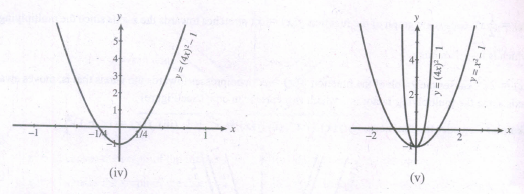
Compare and contrast the graph y = x2 - 1, y = 4(x2 - 1) and y = (4x)2 = 1.
2.
A polygon has 90 diagonals. Find the number of its sides?
3.
Write the first 4 terms of the logarithmic series of log (1 + 4x). Find the intervals on which the expansions are valid
4.
Show that sin 12o sin 48o sin 54o = \(\frac{1}{8}\)
5.
Show that \(\frac { (cos\theta -cos3\theta )(sin8\theta +sin2\theta ) }{ (sin5\theta -sin\theta )(cos4\theta -cos6\theta ) } =1\)
6.
If(1, 3) (2,1) (9, 4) are collinear then a is ______________
\(\frac{1}{2}\)
2
0
-\(\frac{1}{2}\)
7.
1 - 2x + 3x2 - 4x3 + ..., Ixl< 1 is ______________
(1-x)-2
(1+x)-2
(1-x)2
(1+x)2
8.
In a \(\triangle\) ABC, C = 90° then the value of sin A + sin B - 2\(\sqrt{2} cos{A\over2}cos {B\over 2}is\) _______________
-1
1
0
\({1\over 2}\)
9.
If a vertex of a square is at the origin and its one side lies along the line 4x + 3y - 20 = 0, then the area of the square is
20 sq. units
16 sq. units
25 sq. units
4 sq. units
10.
If Pr stands for r Pr then the sum of the series 1+ P1 + 2P2 + 3P3 +...+ nPn is
Pn+1
Pn+1-1
Pn-1+1
(n+1)P(n-1)
11.
The HM of two positive numbers whose AM and GM are 16, 8 respectively is
10
6
5
4
12.
The number of roots of (x + 3)4+ (x + 5)4 = 16 is
4
2
3
0
13.
If tan400 = λ, then \(\frac { tan{ 140 }^{ 0 }-tan{ 130 }^{ 0 } }{ 1+tan{ 140 }^{ 0 }.tan{ 130 }^{ 0 } } \) =
\(\frac { 1-\lambda ^{ 2 } }{ \lambda } \)
\(\frac { 1+{ \lambda }^{ 2 } }{ \lambda } \)
\(\frac { 1+{ \lambda }^{ 2 } }{ 2\lambda } \)
\(\frac { 1-{ \lambda }^{ 2 } }{ 2\lambda } \)
14.
Let f:R➝R be defined by f(x) = 1 - |x|. Then the range of f is
R
(1,∞)
(-1,∞)
(-∞,1]
15.
Find the values of \(sin(-\frac{11\pi}{3})\).
16.
Find sin15°, cos15° and tan15°. Hence evaluate cot75° + tan75°.
17.
A Mathematics club has 15 members. In that 8 are girls. 6 of the members are to be selected for a competition and half of them should be girls. How many ways of these selections are possible?
18.
Check the following functions for one-to-oneness and ontoness.
(i) \(f:N\rightarrow N\) defined by f(n) = n2.
(ii) \(f: \mathbb{R} \rightarrow \mathbb{R}\) defined by f(n) = n2.
19.
Suppose 8 people enter an event in a swimming meet. In how many ways could the gold, silver and bronze prizes be awarded?
20.
Express each of the following as a product.
sin 50o + sin 40o
21.
How many two-digit numbers can be formed using 1, 2, 3, 4, 5 without repetition of digits?
22.
Prove that \(\sin { 4\alpha } =4\tan { \alpha } \frac { 1-\tan ^{ 2 }{ \alpha } }{ { \left( 1+\tan ^{ 2 }{ \alpha } \right) }^{ 2 } } \)
23.
Find the real roots of x4 = 16
24.
By taking suitable sets A, B, C, verify the following results:
(A\(\times\) B)\(\cap \)(B\(\times\)A) = (A\(\cap \)B) \(\times\) (B\(\cap \)A)
25.
Find the principal value of sec-1\(\left( -\sqrt { 2 } \right) \)
26.
State whether the following sets are finite or infinite.
{x \(\in \) N : x is an even prime number}
27.
In the binomial expansion of (a+b)n the coefficients of the 4th and 13th terms are equal to each other, find n.
28.
Solve (2x + 1)2- (3x + 2)2 = 0
1.
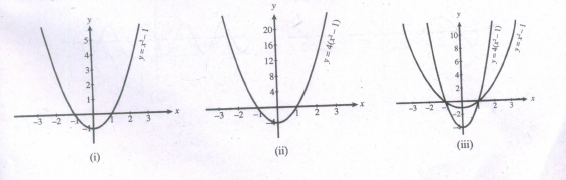
The graphs figures (i) and (ii) look identical until we compare the scales on the y-axis. The scale in figure(ii) is four times as large, reflecting the multiplication of the original function by 4 (i).
The effect looks different when the functions are plotted on the same scale as in figure(iii).
The graph of y = (4x)2 - 1 is shown in figure (iv). Can you spot the difference between figure (i) and figure (iv)? In this case, x-scale has now changed, by the same factor of 4 as in the function (figure (iv)).
To see this, note that substituting \(x={1\over 4}\) into (4x)2 - 1 produces 12 - 1, 1, exactly the same as substituting x = 1 into the original function (figure (i)), When plotted on the same set of axes (as in figure (v» the parabola y = (4x)2 - 1 looks thinner.
Here, the x-intercepts are different, but y-intercepts are the same.
2.
Let there be n sides of the polygon. We know that the number of diagonals of n sided polygon is \(\frac { n(n-3) }{ 2 } \)
⇒ Given \(\frac { n(n-3) }{ 2 } =90\)
⇒ n2-2n = 180
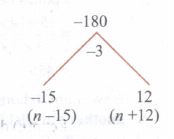
⇒ n2-3n-180 = 0
⇒ (n-15) (n+12) = 0
⇒ n = 15 or n = -12
⇒ There are 15 sides for the polygon which has 90 diagonals.
3.
We have log (1 + x) = \(x-\frac { { x }^{ 2 } }{ 2 } +\frac { { x }^{ 2 } }{ 3 } -\frac { { x }^{ 4 } }{ 4 } +...\)
\(\therefore \log { \left( 1+4x \right) } =4x-\frac { { \left( 4x \right) }^{ 2 } }{ 2 } +\frac { { \left( 4x \right) }^{ 3 } }{ 3 } -\frac { { \left( 4x \right) }^{ 4 } }{ 4 } +\frac { { \left( 4x \right) }^{ 5 } }{ 5 } -\frac { { \left( 4x \right) }^{ 6 } }{ 6 } +...\)
\(=4x-\frac { { 16x }^{ 2 } }{ 2 } +\frac { { 64x }^{ 3 } }{ 3 } -\frac { 256x^{ 4 } }{ 4 } +\frac { { 1024x }^{ 5 } }{ 5 } -\frac { { 4096x }^{ 6 } }{ 6 } +...\)
\(=4x-{ 8x }^{ 2 }+\frac { { 64x }^{ 3 } }{ 3 } -{ 64x }^{ 4 }+\frac { { 1024x }^{ 5 } }{ 5 } -\frac { { 2048x }^{ 6 } }{ 3 } +...\)
The series is valid only when \(\left| 4x \right| <1\)
\(\Rightarrow \left| x \right| <\frac { 1 }{ 4 } \)
Hence, This series is valid only in the interval \(-\frac { 1 }{ 4 }
4.
LHS = sin 12o sin 48o sin 54o
= \(\frac{1}{2}\) [cos (12 - 48o) - cos (12 + 48o)] sin 54o
= \(\frac{1}{2}\) [cos (-36)o - cos 60o] sin 54o
= \(\frac { 1 }{ 2 } \left[ \frac { \sqrt { 5 } +1-2 }{ 4 } \right] \left[ \frac { \sqrt { 5 } +1 }{ 4 } \right] =\frac { 1 }{ 2 } \left[ \frac { \sqrt { 5 } -1 }{ 4 } \right] \left[ \frac { \sqrt { 5 } +1 }{ 4 } \right] \)
= \(\frac { 1 }{ 32 } \left[ { \left( \sqrt { 5 } \right) }^{ 2 }-{ 1 }^{ 2 } \right] =\frac { 1 }{ 32 } \left( 5-1 \right) =\frac { 4 }{ 32 } =\frac { 1 }{ 8 } \) = RHS
Hence proved.
5.
\(LHS=\frac { (cos\theta -cos3\theta )(sin8\theta +sin2\theta ) }{ (sin5\theta -sin\theta )(cos4\theta -cos6\theta ) } \)
\(=\frac { 2sin\left( \frac { \theta +3\theta }{ 2 } \right) sin\left( \frac { 3\theta -\theta }{ 2 } \right) .2sin\left( \frac { 8\theta +2\theta }{ 2 } \right) cos\left( \frac { 8\theta -2\theta }{ 2 } \right) }{ 2cos\left( \frac { 5\theta +\theta }{ 2 } \right) sin\left( \frac { 5\theta -\theta }{ 2 } \right) .2sin\left( \frac { 4\theta +6\theta }{ 2 } \right) sin\left( \frac { 6\theta -4\theta }{ 2 } \right) } \)
\(=\frac { sin2\theta .sin\theta .sin5\theta .cos3\theta }{ cos3\theta .sin2\theta .sin5\theta .sin\theta } =1=RHS\)
6.
(a)
\(\frac{1}{2}\)
7.
(b)
(1+x)-2
8.
(a)
-1
9.
Perpendicular distance from origin to the line is
4x + 3y - 20 = 0 is
\(\left(\frac{-20}{\sqrt{16+9}}\right)=\frac{20}{\sqrt{25}}=\frac{20}{5}=4 \text { units }\)
Area of the square = 4 \(\times\) 4 = 16 sq. units.
10.
\(1+1 \mid 1+2\lfloor 2+3\lfloor 3+\ldots \ldots . n\lfloor n \quad=\lfloor n+1\)
\(\text { Let } \mathrm{n}=1, \quad \text { L.H.S }=1+1=2\)
\(\text { R.H.S }=\lfloor 2=2\)
It is true for n = 1, In fact it is true for n = 0 also let us assume that it is true for n=k
\(1+1 \mid 1+2\lfloor 2+3\lfloor 3+\ldots \ldots . n\lfloor n=\lfloor k+1\)
\(1+1 \mid 1+2\lfloor 2+3\lfloor 3+\ldots \ldots k \mid k+(k+1)\lfloor k+1\)
\(=\lfloor k+1+(k+1)\lfloor k+1=\lfloor k+1[1+k+1]\)
\(\lfloor k+1 (k+ 2)\)
\(\lfloor k+2\)
It is true for (k + 1)
Also by mathematical induction, it is true for all value of \(n \geq 0, n \in Z\)
11.
\(\mathrm{AM}=16, \quad \mathrm{GM}=8, \quad \mathrm{HM}=?\)
\(\frac{a+b}{2}=16 \Rightarrow a+b=32\)
\(\sqrt{a b}=8 \Rightarrow a b=64\)
\(\therefore \mathrm{HM} =\frac{2 a b}{a+b} \)
\(=\frac{2(64)}{32}= 4 \)
12.
(a)
4
13.
\(\frac{\tan 140^{\circ}-\tan 130^{\circ}}{1+\tan 140^{\circ} \tan 130^{\circ}} =\tan \left(140^{\circ}-130^{\circ}\right) \)
\(=\tan 10^{\circ} \ldots \ldots(1) \)
\(\tan 40^{\circ} =\lambda \)
\(\tan 80^{\circ}=\frac{2 \tan 40^{\circ}}{1-\tan ^{2} 40^{\circ}} =\frac{2 \lambda}{1-\lambda^{2}} \)
\(\tan \left(90^{\circ}-10^{\circ}\right) =\frac{2 \lambda}{1-\lambda^{2}} \)
\(\cot 10^{\circ} =\frac{2 \lambda}{1-\lambda^{2}} \)
\(\Rightarrow \tan 10^{\circ} =\frac{1-\lambda^{2}}{2 \lambda} \)
\(\frac{\tan 140^{\circ}-\tan 130^{\circ}}{1+\tan 140^{\circ} \tan 130^{\circ}} \)
\(=\frac{1-\lambda^{2}}{2 \lambda}\)
14.
\(\mathrm{f}: \mathbb{R} \rightarrow \mathbb{R} \text { is defined by }\)
\(\mathrm{f}(x)=1-|x|\)
\(\text { The range is }(-\infty, 1] \text { as } f(-\infty)=-\infty\)
\(f(0)=1\)
\(f(\infty) =-\infty\)
15.
\(sin(-\frac{11\pi}{3})=-sin\frac{11\pi}{3}=-sin\frac{11}{3}\times180\)
\(=-sin\frac{11}{3}\times\frac{360}{2}=-sin360(\frac{11}{6})\)
\(=-sin360(2-\frac{1}{6})\)
\(=-[sin(360\times2)-\frac{360}{2}]\)
\(=-(-sin60)=\frac{\sqrt 3}{2}\)
16.
\({\sqrt{3}-1\over2\sqrt{2}},{\sqrt{3}+1\over2\sqrt{2}},{\sqrt{3}-1\over \sqrt{3}+1},4\)
17.
There are 8 girls and 7 boys in the mathematics club.
The number of ways of selecting 6 members in that half of them girls (3 girls and 3 others) is 8C3 \(\times\) 7C3 = 56 \(\times\) 35 = 1960.
18.
(i) f( m) = f( n) \(\Rightarrow\) m2 = n2 \(\Rightarrow\) m = n since \(m,\ n\in N.\) Thus f is one-to-one. But, non-perfect square elements in the co-domain do not have pre-images and hence not onto.
(ii) Two different elements in the domain have same images and hence f is not one-to-one. Clearly the range of f is a proper subset of R. Thus it is not onto.
19.
Gold medal can be awarded to anyone of the 8 candidates in 8 ways.
Silver medal can be awarded to anyone of the remaining 7 candidates in 7 ways.
Bronze medal can be awarded to anyone of the remaining 6 candidates in 6 ways.
∴ Total numbers of ways of awarding the prize
= 8 \(\times\) 7 \(\times\) 6 = 336
20.
sin 50o + sin 40o = \(2\sin { \left( \frac { 50+40 }{ 2 } \right) } .\cos { \left( \frac { 50-40 }{ 2 } \right) } \)
= 2 sin 45o cos 5o
= \(2\frac { 1 }{ \sqrt { 2 } } \cos { { 5 }^{ o } } =\sqrt { 2 } \cos { { 5 }^{ o } } \)
21.
| tens | one's |
| 4 | 5 |
The one's place can be filled up in 5 ways using 1,2,3,4,5 and tens place can be filled up in 4 ways.
∴ Number of two digit numbers using the digits 1,2,3,4,5 is 4 x 5 = 20.
22.
LHS = \(\sin { 4\alpha } =sin2(2\alpha)\)
= \(2\left( \frac { 2\tan { \alpha } }{ 1+\tan ^{ 2 }{ \alpha } } \right) \left( \frac { 1-\tan ^{ 2 }{ \alpha } }{ 1+\tan ^{ 2 }{ \alpha } } \right) \)
= \(4\tan { \alpha } .\frac { 1-\tan ^{ 2 }{ \alpha } }{ { \left( 1+\tan ^{ 2 }{ \alpha } \right) }^{ 2 } } \) = RHS
Hence proved.
23.
Given equation is x4 = 16
\(\Rightarrow\) x4 = 16 = 0
\(\Rightarrow\) (x2)2- (4)2 = 0
\(\Rightarrow\) (x2 + 4)(x2- 4) = 0 [ \(\because\) a2- b2 = (a + b)(a - b) ]
\(\Rightarrow\) x = -4,
\(\Rightarrow\) x2 = 4 When
\(\Rightarrow\) x2 = -4,
x = \(\pm\sqrt{-4}=\pm2\) i where \(i=\sqrt{-1}\) when
\(\Rightarrow\) x2 = 4,
x = \(\pm\sqrt{4}=\pm2\)
Hence the four roots of the given equation are x = 2, -2, 2i, -2i
24.
(A\(\times\) B) = {(1,4) (1,5) (1,6) (1,7) (2,4) (2,5) (2,6) (2,7) (3,4) (3,5) (3,6) (3,7)}
(B\(\times\)A) = {(4,1) (4,2) (4,3) (5,1) (5,2) (5,3) (6,1) (6,2) (6,3) (7,1) (7,2) (7,3)}
LHS = (A\(\times\)B)\(\cap \)(B\(\times\)A) = { }....(1)
(A\(\cap \)B) = { }, (B\(\cap \)A) = { }
\(\therefore\) RHS = (A\(\cap \)B) \(\times\) (B\(\cap \)A) = { }.....(2)
From (1) and (2), LHS = RHS
25.
Let sec-1\(\left( -\sqrt { 2 } \right) \) = y
⇒ -\(\sqrt { 2 } \) = sec y
⇒ sec y = -sec\(\frac { \pi }{ 4 } \)
⇒ sec y = sec\(\left( \pi -\frac { \pi }{ 4 } \right) \) [∵ sec is negative in the II quad]
⇒ y = \(\frac { 3\pi }{ 4 } \)
Thus, the principal value of sec-1(\(\sqrt { 2 } \)) is \(\frac { 3\pi }{ 4 } \) .
26.
Let A = { x \(\in \) N: x is an even prime number}
\(\Rightarrow\) A = {2}
\(\Rightarrow\) A is a finite set.
27.
In (a+b)n, the general term is Tr+1 = nCr an-r br
To find the Coefficient of 4th term, put r = 3 in (1)
∴ T4 = nC3 an-3 b3
To find the Coefficient of 13th term
Put r = 12 in (1)
T13 = nC12 an-12 b12
Given nC3 = nC12
3 +12 = n
n = 15
28.
Given equation is (2x + 1)2- (3x + 2)2 = 0
\(\Rightarrow\) (2x+1+3x+2)(2x+1-3x-2) = 0 [ \(\because\) a2- b2 = (a + b) (a - b) ]
\(\Rightarrow\) (5x + 3) (-x - 1) = 0
\(\Rightarrow\) (5x + 3) (x + 1) = 0
\(\Rightarrow\) x = \({{}-3\over{5}}\) or -1
\(\therefore\) Solution set is \(\left\{-1,{{-3}\over5} \right\} \)

11th Standard Syllabus & Materials
11th Standard
TN 11th Tamil பீடு பெற நில் - செய்யுள் - காவடிச்சிந்து Important Questions And Answers Study Material - QB365 Set A
NEW11th Standard
TN 11th Tamil பீடு பெற நில் - உரைநடை - மலை இடப்பெயர்கள் : ஓர் ஆய்வு Important Questions And Answers Study Material - QB365 Set A
NEW11th Standard
TN 11th Tamil மாமழை போற்றுதும் - துணைப்பாடம் - யானை டாக்டர் Important Questions And Answers Study Material - QB365 Set A
NEW11th Standard
TN 11th Tamil மாமழை போற்றுதும் - செய்யுள் - ஐங்குறுநூறு Important Questions And Answers Study Material - QB365 Set A



Tamilnadu Stateboard 11th Standard Subjects
Maths

Commerce

Economics

Biology

Business Maths and Statistics

Accountancy

Computer Science

Physics

Chemistry
Maths
Biology
Economics
Physics
Chemistry

History
Business Maths and Statistics

Computer Science
Accountancy

Computer Applications
History
Computer Technology
Commerce
Computer Applications
Computer Technology

Tamil

English

French
Tamilnadu Stateboard Standards

