
 100% FREE ACCESS
11th Standard Syllabus & Materials
11th Standard
TN 11th Tamil இயற்கை வேளாண்மை,சுற்றுச்சூழல் -செய்யுள் - மனோன்மணீயம் Important Questions And Answers Study Material - QB365 Set A
NEW11th Standard
TN 11th Tamil என்னுயிர் என்பேன் -துணைப்பாடம் - இசைத்தமிழர் இருவர் Important Questions And Answers Study Material - QB365 Set A
NEW11th Standard
TN 11th Tamil மொழி கலை -செய்யுள் - ஒவ்வொரு புல்லையும் Important Questions And Answers Study Material - QB365 Set A
NEW11th Standard
TN 11th Tamil பீடு பெற நில் - இலக்கணம் - பகுபத உறுப்புகள் Important Questions And Answers Study Material - QB365 Set A
NEW11th Standard
TN 11th Tamil பீடு பெற நில் - துணைப்பாடம் - வாடிவாசல் Important Questions And Answers Study Material - QB365 Set A
NEW11th Standard
TN 11th Tamil பீடு பெற நில் - செய்யுள் - குறுந்தொகை Important Questions And Answers Study Material - QB365 Set A

Published on: 18/07/2019
Download Tamil Nadu 11th Standard Maths question papers, model tests, one-mark questions, important questions, and public exam papers in PDF format. Free study materials and answer keys for TN State Board students.
Questions + Answers key
Take MCQ Maths Test1.
If U = {x : 1 ≤ x ≤ 10, x ∈ N}, A = {1, 3, 5, 7, 9} and B = {2, 3, 5, 9, 10} then find A'UB'.
2.
Check whether the following sets are disjoint where p = {x : x is a prime < 15} and Q = {x : x is a multiple of 2 and x < 16}
3.
By taking suitable sets A, B, C, verify the following results:
A \(\times\) (B\(\cap \)C) = (A\(\times\)B) \(\cap \) (A\(\times\)C)
4.
Write the following in roster form.
\(\left\{ x:\frac { x-4 }{ x+2 } =3,x\in R-\{ -2\} \right\} \)
5.
Write the following in roster form {x\(\in \)N : 4x + 9 < 52}
6.
Which of the following sets are finite and which are infinite?
Set of concentric circles in a plane.
7.
Find the pairs of equal sets from the following sets. A = {0}, B = {x : x > 15 and x < 5}, C = {x : x - 5 = 0}, D = {x : x2 = 25}, E = {x : x is an integral positive root of the equation x2 - 2x - 15 = 0}.
8.
Write the steps to obtain the graph of the function y = 3(x-1)2+5 from the graph y = x2
9.
The formula for converting from Fahrenheit to Celsius temperatures is \(y={5x\over 9}-{160\over 9}\). Find the inverse of this function and determine whether the inverse is also a function.
10.
The total cost of airfare on a given route is comprised of the base cost C and the fuel surcharge S in rupee. Both C and S functions of the mileage m; C(m) = 0.4m + 50 and S(m) = 0.03m. Determine a function for the total cost of a ticket in terms of the mileage and find the airfare for flying 1600 miles.
11.
Show that the relation R on the set R of all real numbers defined as R = {(a, b): a < b2} is neither reflexive, nor symmetric nor transitive.
12.
The cartesian product A \(\times\) A has 9 elements among which are found (-1, 0) and (0, 1). Find the set A and the remaining elements of A \(\times\)A.
13.
Graph the function f(x) = x3 and \(g(x)=\sqrt[3]x\) on the same co-ordinate plane. Find f o g and graph it on the plane as well. Explain your results.
14.
A simple cipher takes a number and codes it, using the function f(x) = 3x - 4. Find the inverse of this function, determine whether the inverse is also a function and verify the symmetrical property about the line y = x(by drawing the lines)
15.
The shaded region in the adjoining diagram represents.

A\B
B\A
AΔB
A'
16.
Given A = {5,6,7,8}. Which one of the following is incorrect?
Ø ⊆ A
A⊆A
{7,8,9}⊆A
{5}⊆A
17.
If the function f:[-3,3]➝S defined by f(x) = x2 is onto, then S is
[-9,9]
R
[-3,3]
[0,9]
18.
The function f:[0,2π]➝[-1,1] defined by f(x) = sin x is
one-to-one
onto
bijection
cannot be defined
19.
The number of constant functions from a set containing m elements to a set containing n elements is
mn
m
n
m+n
1.
Given U = {1, 2, 3, 4, 5, 6, 7, 8, 9, 10}
A = {1, 3, 5, 7, 9}
B = {2, 3, 5, 9, 10}
A' = {2, 4, 6, 8, 10}
B' = {1, 4, 6, 7, 8}
A'UB' = {1, 2, 4, 6, 7, 8, 10}
2.
Given P = {1, 2, 3, 5, 7, 11, 13}
and Q = {2, 4, 6, 8, 10, 12, 14}
Now P⋂Q = {2}
Since P⋂Q ≠ Ø, the given sets are not disjoint.
3.
A \(\times\) (B\(\cap \)C) = (A\(\times\)B) \(\cap \) (A\(\times\)C)
Let A = {1,2,3}, B = (4,5,6,7} C = {4,3,5,9} and \(\cup\) = {1,2,3,4,5,6,7,8,9}
LHS = A x (B\(\cap \)C)
= A \(\times\) {4,5} [∴B\(\cap \)C = {4, 5}]
= {1,2,3} \(\times\) {4,5}
= {(1,4) (1,5) (2,4) (2,5) (3,4) (3,5)}......(1)
A x B = {1,2,3} x {4,5,6,7}
= {(1,4) (1,5) (1,6) (1,7) (2,4) (2,5) (2,6) (2,7) (3,4) (3,5) (3,6) (3,7)}
A \(\times\) C = {1,2,3} \(\times\) {3,4,5,6,9}
= {(1,3) (1,4) (1,5) (1,9) (2,3) (2,4) (2,5) (2,6) (2,9) (3,3) (3,4) (3,5) (3,9)}
RHS = (A \(\times\) B) \(\cap \) (A \(\times\) C) = {(1,4) (1,5) (2,4) (2,5) (3,4) (3,5) }
From (1) and (2), LHS = RHS. Hence Verified....(2)
4.
\(\left\{ x:\frac { x-4 }{ x+2 } =3,x\in R-\{ -2\} \right\} \)
Let D = \(\left\{ x:\frac { x-4 }{ x+2 } =3,x\in R-\{ -2\} \right\} \)
\(\Rightarrow\) D = {x: x - 4 = 3x + 6, x \(\in \) R}
\(\Rightarrow\) D = {x:-4-6 = 3x-x, x \(\in \) R}
\(\Rightarrow\) D = {x:2x = -10, x \(\in \) R}
\(\Rightarrow\) D = {x:x = -5, x\(\in \)R}
\(\Rightarrow\) D = {-5}
5.
{x \(\in \) N : 4x + 9 < 52}
Let C = {x\(\in \)N:4x + 9 < 52}
\(\Rightarrow\) C = {x\(\in \)N:4x < 52 - 9}
\(\Rightarrow\) C = {x\(\in \)N: 4x < 43}
\(\Rightarrow\) C = \(\left\{ x\in N:x<\frac { 43 }{ 4 } \right\} \) \(\Rightarrow\) C = {x \(\in \) N : x < 10.75}
\(\Rightarrow\) C = {1,2,3,4,5,6,7,8,9,10}.
6.
Set of concentric circles in a plane is an infinite set since number of concentric circles in a plane is infinite
7.
Given A = {0} ...(1)
B = {x : x > 15 and x < 5} ⇒ B = Ф ...(2)
C = {x : x-5 = 0} ⇒ B = {5} ...(3)
D = { x : x2 = 25} ⇒ D = {-5, 5} ...(4)
E = {x : x is an integral positive root of x2 - 2x - 15 = 0}
⇒ E = {5} ...(5)
From (3) and (5), clearly C = E.
Hence C and E are equal sets
8.
Step 1 :
Draw the Graph of y = x2
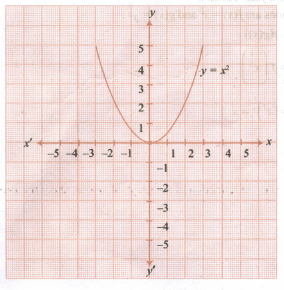
Step 2 :
The graph of y =(x -1)2, shifts to the right for one unit.
Step 3 :
The graph of y = 3 (x - 1)2, compresses towards the Y-axis that is moves away from the X-axis since the multiplying factor is 3 which is greater than 1.
Step 4:
The graph of y = 3 (x - 1)2+ 5, causes the shift to the upward for 5 units.
9.
Let \(f(x)={5x-160\over 9}\)
Given \(y={5x\over 9}-{160\over 9}\)
\(⇒\ \ y={5x-160\over 9}\)
Then 9y = 5x - 160 ⇒ 5x = 9y + 160 ⇒ \(x={9y+160\over5}\)
Let \(g(y)={9y+160\over 5}\)
Now gof(x) = \(g[f(x)=g\left(5x-160\over 6\right)\)
\(={9\left(5x-160\over 9\right)+160\over 5}={5x-160+160\over 5}={5x\over 5}=x\)
and fog(y) = f(g(y)) =\(f\left(9y+160\over 5\right)={5\left(9y+160\over5\right)-160\over 5}={9y+160-160\over 9}=y\)
Thus gof = Ix and fog = Iy
This implies that f and g are bijections and inverses to each other
\(f^{-1}(y)={9y+160\over5}\)
Replacing y by x, we get f-1 (x) = \(\frac { 9x+160 }{ 5 } \)
10.
Given cost function and fuel surcharge function are as follows
c(m) = 0.4m + 50 and s(m) = 0.03m
∴ total cost of a ticket = c(m) + s(m)
∴ f(x) = 0.4m + 50 + 0.03m
= 0.43m + 50
Given m = 1600 miles
Airfare for flying 1600 miles
= 0.43(1600) + 50
= Rs. 738
11.
Given R = {(a, b): a < b2} where a, b ∈ R
reflexivity: We know that \(\left(1\over 2\right)\le\left(1\over 2\right)^2\)is not true
\(⇒\ \left({1\over 2},{1\over 2}\right)∉R\)
⇒ R is not reflexive
Symmetry: We know that -1< 32 but 3 ≰ (-1)2 is not true
⇒ (-1, 3) ∈ R but (3, -1)∉R
∴ R is not symmetric
Transitive: We observe that 2< (-3)2 and -3< (1)2 but 2 ≰ (1)2 is not true
⇒ (2, -3) ∈ R and (-3, 1) ∈ R but (2, 1) ∉ R
⇒ R is not transitive
∴ R is neither reflexive nor symmetric nor transitive.
12.
Given (-1, 0) ∈ A x A and (0, 1) ∈ A \(\times\) A
(-1,0) ∈ A \(\times\) A ⇒ -1,0 ∈ A and (0, 1) ∈ A \(\times\) A ⇒ 0, 1 ∈ A
∴ -1,0,1 ∈ A
∴ A = {-1, 0, 1}
Also it is given that A\(\times\) A has 9 elements.
∴ A has exactly three elements.
∴ A {-1, 0, 1}
∴ A \(\times\) A = {(-1, -1) (-1, 0) (-1, 1) (0, -1) (0, 0) (0, 1) (1, -1) (1, 0) (1, 1)}
13.
Given functions are f(x) = x3 and g(x) = \(x^{ ^{ \frac { 1 }{ 3 } } }\)
Now, f o g(x) = f(g(x)
= \(f\left( { x }^{ \frac { 1 }{ 3 } } \right) \)
= \(\left( { x }^{ 3 } \right) ^{ \frac { 1 }{ 3 } }=x\)
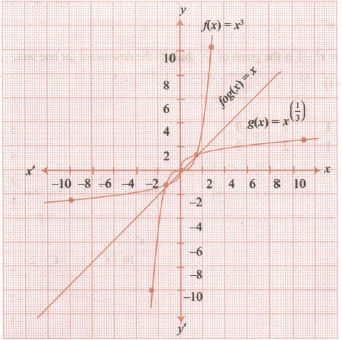
Since f o g(x) = x is symmetric about the line y = x, g(x) is the inverse of f(x)
∴ g(x) = f-1(x).
where f o g(x) = g o f(x) = x so that
(i) f o g is bijective.
(ii) both f(x) and g(x) also bijective.
(iii) f and g are symmetrical about y = x
14.
Given f(x) = 3x - 4
Let y = 3x - 4 ⇒ y + 4 = 3x
\(⇒ x={y+4\over 3}\)
Let g(y) = \(y+4\over 3\)
Now gof(n) = g(f(n)) = g(3\(\times\) -4) = \({3x-4+4\over 3}={3x\over 3}=x\)
and fog(y) = f(g(y)) = \(f\left(y+4\over 4\right)=3\left(y+4\over 3\right)-4=y+4-4=y\)
Thus, gof(x) = Ix and fog (y) = Iy
This implies that f and g are bijections and inverses to each other
Hence f is bijection and \(f^{-1} (x)={y+4\over 3}\)
Replacing y by x, we get f-1 (x) = \(\frac { x+4 }{ 3 } \)
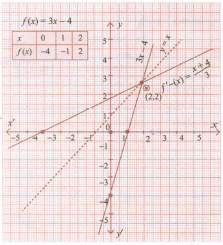
Hence, the graph of y = f-1(x) is the reflection of the graph of f in y = x
15.
(c)
AΔB
16.
(c)
{7,8,9}⊆A
17.
f(0) = 0, f(-3) = 9 and f(3) = 9
.'. S is [0,9]
18.
It is onto not one-one
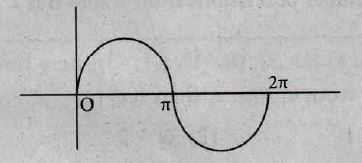
\(\text { Since } \sin 30^{\circ}=\frac{1}{2}\)
\(\sin 150^{\circ}=\frac{1}{2}\)
19.
(c)
n

11th Standard Syllabus & Materials
11th Standard
TN 11th Tamil பீடு பெற நில் - செய்யுள் - காவடிச்சிந்து Important Questions And Answers Study Material - QB365 Set A
NEW11th Standard
TN 11th Tamil பீடு பெற நில் - உரைநடை - மலை இடப்பெயர்கள் : ஓர் ஆய்வு Important Questions And Answers Study Material - QB365 Set A
NEW11th Standard
TN 11th Tamil மாமழை போற்றுதும் - துணைப்பாடம் - யானை டாக்டர் Important Questions And Answers Study Material - QB365 Set A
NEW11th Standard
TN 11th Tamil மாமழை போற்றுதும் - செய்யுள் - ஐங்குறுநூறு Important Questions And Answers Study Material - QB365 Set A



Tamilnadu Stateboard 11th Standard Subjects
Maths

Commerce

Economics

Biology

Business Maths and Statistics

Accountancy

Computer Science

Physics

Chemistry
Maths
Biology
Economics
Physics
Chemistry

History
Business Maths and Statistics

Computer Science
Accountancy

Computer Applications
History
Computer Technology
Commerce
Computer Applications
Computer Technology

Tamil

English

French
Tamilnadu Stateboard Standards

