
 100% FREE ACCESS
11th Standard Syllabus & Materials
11th Standard
TN 11th Tamil இயற்கை வேளாண்மை,சுற்றுச்சூழல் -செய்யுள் - மனோன்மணீயம் Important Questions And Answers Study Material - QB365 Set A
NEW11th Standard
TN 11th Tamil என்னுயிர் என்பேன் -துணைப்பாடம் - இசைத்தமிழர் இருவர் Important Questions And Answers Study Material - QB365 Set A
NEW11th Standard
TN 11th Tamil மொழி கலை -செய்யுள் - ஒவ்வொரு புல்லையும் Important Questions And Answers Study Material - QB365 Set A
NEW11th Standard
TN 11th Tamil பீடு பெற நில் - இலக்கணம் - பகுபத உறுப்புகள் Important Questions And Answers Study Material - QB365 Set A
NEW11th Standard
TN 11th Tamil பீடு பெற நில் - துணைப்பாடம் - வாடிவாசல் Important Questions And Answers Study Material - QB365 Set A
NEW11th Standard
TN 11th Tamil பீடு பெற நில் - செய்யுள் - குறுந்தொகை Important Questions And Answers Study Material - QB365 Set A

Published on: 12/08/2019
Binomial Theorem, Sequences and Series
Download Tamil Nadu 11th Standard Maths question papers, model tests, one-mark questions, important questions, and public exam papers in PDF format. Free study materials and answer keys for TN State Board students.
Questions + Answers key
Take MCQ Maths Test1.
Sum of the binomial coefficients is ______________
2n
n2
2n
n+17
2.
The ratio of the coefficient of x 15 to the term independent of x in \([x^2+(\frac{2}{x})]^{15}\) is ______________
1:16
1:8
1:32
1:64
3.
The coefficient of x6 in (2 + 2x)10 is
10C6
26
10C626
10C6210
4.
The series for log \(\left( \frac { 1+x }{ 1-x } \right) is\) ______________
\(x+\frac { { x }^{ 3 } }{ 3 } +\frac { { x }^{ 5 } }{ 5 } +...+\infty \)
\(2\left[ x+\frac { { x }^{ 3 } }{ 3 } +\frac { { x }^{ 5 } }{ 5 } +...+\infty \right] \)
\(\frac { { x }^{ 2 } }{ 2 } +\frac { { x }^{ 4 } }{ 4 } +\frac { { x }^{ 6 } }{ 6 } +...+\infty \)
\(2\left[ \frac { { x }^{ 2 } }{ 2 } +\frac { { x }^{ 4 } }{ 4 } +\frac { { x }^{ 6 } }{ 6 } +...+\infty \right] \)
5.
If \(\Sigma n=210\) then \(\Sigma { n }^{ 2 }\)= ______________
2870
2160
2970
none of these
6.
If in an infinite G. P. first term is equal to 10 times the sum of all successive terms, then its common ratio is ______________
\(\frac { 1 }{ 10 } \)
\(\frac { 1 }{ 11 } \)
\(\frac { 1 }{ 9 } \)
\(\frac { 1 }{ 20 } \)
7.
If \(\frac { { T }_{ 2 } }{ { T }_{ 3 } } \)is the expansion of (a+b)n and \(\frac { { T }_{ 3 } }{ { T }_{ 4 } } \) is the expansion of (a+b)n+3 are equal, then n = ______________
3
4
5
6
8.
The value of the series\(\frac { 1 }{ 2 } +\frac { 7 }{ 4 } +\frac { 13 }{ 8 } +\frac { 19 }{ 16 } +\).....is
14
7
4
6
9.
The sum up to n terms of the series \(\frac { 1 }{ \sqrt { 1 } +\sqrt { 3 } } +\frac { 1 }{ \sqrt { 3 } +\sqrt { 5 } } +\frac { 1 }{ \sqrt { 5 } +\sqrt { 7 } } +\)....is
\(\sqrt { 2n+1 } \)
\(\frac { \sqrt { 2n+1 } }{ 2 } \)
\(\sqrt { 2n+1 } -1\)
\(\frac { \sqrt { 2n+1 } -1 }{ 2 } \)
10.
If a, 8, b are in AP, a, 4, b are in GP, and if a, x, b are in HP then x is
2
1
4
16
11.
If S1, S2, S3 be respectively the sums of n, 2n, 3n, terms of a G.P. , then prove that S1 (S3 - S2) = (S2 - S1)2.
12.
If S n denotes that Sum of n terms of a G. P., prove that (s10-s20 )2 = s10 (s30 - s20)
13.
A man repays an amount of Rs. 3250 by paying Rs. 20 in the first month and then increases the payment by Rs.15 per month. How long will it take him to clear the amount?
14.
If the roots of the equation (q - r) x2 + (r - p)x + p - q = 0 are equal, then show that p, q and r are in A.P.
15.
Prove that in the expansion of (1+x)n, the Co-efficient of terms equidistant from the beginning and from the end are equal
16.
The first three terms in the expansion of (1 + ax)n are 1 + 12x + 64x2. Find n and a
17.
If n is a positive integer and R is a nonnegative integer. prove that the co-efficients of xr and xn-r Expansion of (1+x)n are equal
18.
if n is an odd positive integer, prove that the Co-efficients of the middle terms in the expansion equal
19.
Find the general terms and sum to n terms of the sequence 1, \(\frac{4}{3},\frac{7}{9},\frac{10}{27},....\)
20.
Expand \(\left( { 2x }^{ 2 }-\frac { 3 }{ x } \right) ^{ 3 }\)
21.
Find the \(\sqrt [ 3 ]{ 126 } \) approximately to two decimal places.
22.
Find the middle terms in the expansion of (x + y)7.
23.
Find the 5th term in the sequence whose first three terms are 3, 3, 6 and each term after the second is the sum of the two terms preceding it.
1.
(c)
2n
2.
(c)
1:32
3.
\((2+2 x)^{10} \text { Term containing } x^{6} \text { is }\)
\({ }^{10} \mathrm{C}_{6}(2)^{10-6}(2 x)^{6}={ }^{10} \mathrm{C}_{6} 2^{4} 2^{6} x^{6}\)
\(\text { Coefficient of } x^{6} \text { is }{ }^{10} \mathrm{C}_{6} 2^{10}\)
4.
(b)
\(2\left[ x+\frac { { x }^{ 3 } }{ 3 } +\frac { { x }^{ 5 } }{ 5 } +...+\infty \right] \)
5.
(a)
2870
6.
(b)
\(\frac { 1 }{ 11 } \)
7.
(a)
3
8.
\(\mathrm{a} =1, \quad \mathrm{~d}=6, \quad \mathrm{r}=\frac{1}{2} \)
\(\mathrm{~S}_{\infty} =\frac{a}{1-\mathrm{r}}+\frac{\mathrm{dr}}{(1+\mathrm{r})^{2}} \)
\(=\frac{1}{1-\frac{1}{2}}+\frac{6 \times \frac{1}{2}}{\left(\frac{1}{2}\right)^{2}} \)
\(=2+(3 \times 4)=14 \)
9.
\(\frac{1}{\sqrt{1}+\sqrt{3}} =\frac{1}{\sqrt{3}+\sqrt{1}} \times \frac{\sqrt{3}-1}{\sqrt{3}-1}=\frac{\sqrt{3}-1}{2} \)
\(\frac{1}{\sqrt{3}+\sqrt{5}} =\frac{1}{\sqrt{5}+\sqrt{3}} \times \frac{\sqrt{5}-\sqrt{3}}{\sqrt{5}-\sqrt{3}} \)
\(=\frac{\sqrt{5}-\sqrt{3}}{2} \)
\(\text { Sum to } \mathrm{n} \text { terms }=\frac{(\sqrt{3}-1)}{2}+\frac{(\sqrt{5}-\sqrt{3})}{2}+\ldots . .\left(\frac{\sqrt{2 n+1}-\sqrt{2 n-1}}{2}\right)\)
\(=\frac{\sqrt{2 n+1}-1}{2}\)
10.
\(a+b= 16, a b=16, x=\frac{2 a b}{a+b}
\)
\(x=\frac{2 \times 16}{16}\)
\(x=2\)
11.
Let a be the first term and r be the common ratio of G.P.
∴ \(S_{1}=\frac{a(r^{n}-1)}{r-1}, S_{2}=\frac{a(r^{2n}-1)}{r-1}, S_{3}=\frac{a(r^{3n}-1)}{r-1}\)
where r ≠ 1
\(S_{3}-S_{2}= \frac{a}{r-1}(r^{3n}-r^{2n})=\frac{a(r^{n}-1)}{r-1}r^{2n}\)
\(S_{1}(S_{3}-S_{2})\frac{a(r^{n}-1)}{r-1}\times \frac{a(r^{n}-1)}{r-1}r^{2n}\)
=\([\frac{a(r^{n}-1)}{r-1}.r^{n}]^{2}\) --- (1)
\((S_{2}-S_{1})=\frac{a}{r-1}(r^{2n}-r^{n})=\frac{a(r^{n}-1)}{r-1}r^{n}\) --- (2)
∴ \(S_{1}(S_{3}-S_{2})=(S_{2}-S_{1})^{2}\) [From (1) and (2)]
When r = 1, S1 = na, S2 = 2na and S3 = 3 na
Then, \((S_{2}-S_{1})^{2}=2(na-na)^{2}=n^{2}a^{2}\) and \(S_{1}(S_{3}-S_{2})=na(3na-2na)\)
= na(na) = n2 a2
∴ S1 (S3 - S2) = (S2 - S1)2
12.
Let a and r be the first term and common ratio of the G.P.
\(\therefore\) \({S}_{n}={a(1-r^n)\over1-r},n\epsilon N\)
LHS \(={{S}_{10}-{S}_{20}}^{2}=\left[ {a(1-{r}^{10})\over1-r}-{a(1-{r}^{20})\over1-r} \right]^{2}\)
\(={{a}^{2}\over{{(1-r)}^{2}}}[1-{r}^{10}-1+{r}^{20}]^2\)
\(={{a}^{2}\over{(1-r)}^{2}}.{r}^{20}{({r}^{10}-1)}^{2}={{a^2.{r}^{20}.{({r}^{10}-1)}^{2}}\over{{(1-r)}^{2}}}\)
RHS = S10 (S30 - S20)
\(={a(1-{r}^{10}\over1-r)}\left[ {a(1-{r}^{30})\over1-r}-{{a(1-{r}^{30})}\over{1-r}} \right]\)
\(={{a^2}\over{(1-r^2)}}(1-{r}^{10})[1-{r}^{30}-1+{r}^{20}]={{a^2(1-{r}^{10})}\over{{(1-r)}^{2}}}.{r}^{20}(1-{r}^{10})\)
\(={{a^3.{r}^{20}(1-{r}^{10})^2}\over{{(1-r)}^{2}}}={{{a}^{2}.{r}^{20}{({r}^{10}-1)}^{2}}\over{{(1-r)}^{2}}}\)
\(\therefore\) LHS = RHS.
13.
Suppose the loan is cleared in n months. Clearly the amount forms an A.P. with a = 20 and d = 15
∴ Sum of the amounts = 3250
Sn = 3250
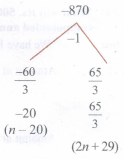
\(⇒\ {n\over2}[2a + (n -1)d]=3250\)
\(⇒\ {n\over2}[40+(n-1)15]=3250\)
⇒ n(40 + 15n - 15) = 6500
⇒ n (15n + 25) = 6500
⇒ 15n2 + 25n = 6500
⇒ 15n2 + 25n = 6500
⇒ 3n2 + 5n - 1300 = 0
⇒ (n - 20) (3n + 65) = 0
⇒ n = 20 or \(n={-65\over 3}\) which is not possible
∴ n = 20
Thus, the amount is cleared in 20 months.
14.
Given equation is (q - r).x2+ (r - p)x +p - q = 0
a = q - r, b = r - p, c = p - q
Since the roots of the quadratic equation are equal, b2 - 4ac = 0
\(\Rightarrow\) (r - p)2 - 4(q - r)(p - q) = 0
\(\Rightarrow\) r2 +p2 - 2rp - 4(pq - q2 - rp + rq) = 0
\(\Rightarrow\) r2 + p2 - 2rp - 4pq + 4q2 + 4rp - 4rq = 0
\(\Rightarrow\) r2 + p2 + 4q2 + 2rp - 4pq - 4rq = 0
\(\Rightarrow\) (r + p - 2q)2 = 0
\(\Rightarrow\) r + p - 2q = 0
\(\Rightarrow\) 2q = r + p
\(\Rightarrow\) q - p = r - p
\(\Rightarrow\) common difference is equal for p, q, r
Hence p, q, r are in A.P.
15.
In (1 + x)n, (r + 1)th term from the beginning.
Tr+1 = nCr 1n-r. xr = nCrxr ....(1)
Its co-efficient is nCr
In (1 + x)n, there are (n + 1) terms
So, the (r +1)th term from the end will have (n + 1) - (r + 1) = n - r terms
∴ Tn-r+1 = nCn-r 1n-(n-r).xn-r = nCn-rxn-r ...(2)
Its Co-efficient is nCn-r
From (1) and (2), the Co-efficient of (r + 1)th term from the beginning and from the end are equal
16.
Using binomial theorem, we have
(1 + ax)n-1 + nC1(ax) + nC2(ax)2+.......+anxn
= \(1+nax+{{n(n-1)}\over{2}}a^2x^2+....a^nx^n\)
Given (1 + ax)n = 1 + 12x + 64x2 +....
Comparing the Co-efficient of x and x2, we get
n a = 12
and \({n(n-1)\over 2}a^2=64\)
\((n-1).{na.a\over2}=64\Rightarrow(n-1){(12)a\over2}=64\)
\((n-1)6a=64\Rightarrow(n-1)a={{64}\over{6}}\) \(\left[ \because na=12\Rightarrow a={12\over n} \right]\)
\(\Rightarrow(n-1)\left( {12\over n} \right)={64 \over 6}\)
\(={n-1\over n}={ 64 \over 6\times 12}\Rightarrow{n-1\over n}={8\over 9}\)
\(\Rightarrow\) 9n - 9 = 8n
\(\Rightarrow\) n = 9 and \(a=\frac { 12 }{ n } =\frac { 12 }{ 9 } =\frac { 4 }{ 3 } \)
17.
In (1+x)n, n = n, x = 1, A = x
general terms tr+1 = nCr, Xn-r ar
tr+1 = nCr, (1)n-r ar
tr+1 = nCr xr
∴ Co-efficient of Xr is nCr
Putting r = n -r in (1) we get
Tn-r+1 = nCn-r Xn-r
Co-efficient of xn-r is nCn-r
But nCr = nCn-r Using the property of combination
ஃ Coefficients of xr and Co-efficients of xn-r are equal
18.
Given (x + y)n
If n is odd, the two middle terms in (x + y)n are \({T_{n-1}\over 2}\ and \ {T_{n+1}\over 2}\)
\({T_{n-1}\over 2}=nC_{n+1\over 2}x^{n+1\over 2}y^{n-1\over 2}\ and\ {T_{n+1}\over2}=nC_{n-1\over2}x^{n-1\over 2}y^{n+1\over 2}\)
The co-efficients of middle terms are \(nC_{n+1\over2}\ and \ nC_{n-1\over2}\)
\(nC_{n+1\over2}=nC_{n-1\over2}⇒{n+1\over2}={n-1\over 2}\ or\ {n+1\over2}+{n-1\over 2}=n\)
[∴ nCx = nCy ⇒ x = y or x + y = n]
\(⇒\ {n+1\over 2}={n-1\over 2}0=2\) which is not possible
Also, \({n+1\over 2}+{n-1\over 2}=n⇒{n+n+1-1\over 2}=n\)
⇒ \({2n\over 2}=n⇒ n=n\)
∴ \(nC_{n+1\over 2}=nC_{n-1\over 2}\). Hence the coefficients of two middle terms are equal
19.
Let Tn be the nth term of the given sequence.
Given sequence is \({1\over1},{4\over3},{7\over9},{10\over27}....\)
Consider the terms in the numerator
1, 4, 7, 10,...
Here a = 1, d = 3
The terms in the denominator are \({1\over3^0},{1\over3^1},{1\over 3^2}\), which is a G.P with \(r={1\over3}\)
∴ The given sequence can be written in the form of a, (a + d)r, (a + 2d)r2,(a + 3d), r3, ...
This is an arithmetic - geometric progression.
∴ Tn = [a+(n-1)d]rn-1
\(=[1+(n -1)3]\left(1\over3\right)^{n-1}\)
\(=({1+3n-3})\left(1\over 3^{n-1}\right)={3n-2\over 3^{n-1}}\)
\(∴\ T_n={3n-2\over 3^{n-1}}\)
Let Sn be the sum to n terms of the given sequence
\(S_n=\sum_{k=1}^n{3k-2\over 3^{k-1}}\)
\(={\sum_{k=1}^n3k-2.{1\over{\sum_{k=1}^n}3^{k-1}}}\)
\(= 3[1+ 2 + 3+ ...+ n] - 2n \left[ 1\over3^0+3^2+...+3^{r-1}\right]\)
\(=\left[ 3{n(n+1)\over2}-2n\right]\left[ 1\over 1\left(3^n-1\over 3-1\right)\right]\)
\(=\left[{3n^2+3n\over2}-2n\right]\left[2\over 3^n-1\right]={3n^2+3n-4n\over2}\times{2\over3^n-1}\)
\(\frac { { 3n }^{ 2 }-n }{ { 3 }^{ n }-1 } =\frac { n\left( n-1 \right) }{ { 3 }^{ n }-1 } \)
20.
=[(x-a)n = xn + nC1xn-1(-a)1+nC2xn-1(-a)2+.....(-a)n]
= \(\left({ 2x }^{ 2 } \right) ^{ 3 }+3C_{ 1 }\left( { 2x }^{ 2 } \right) ^{ 2 }\left( \frac { 3 }{ x } \right) ^{ 1 }+{ 3C }_{ 2 }\left( { 2x }^{ 2 } \right) ^{ 1 }\left( \frac { 3 }{ x } \right) ^{ 2 }+\left( -\frac { 3 }{ x } \right) ^{ 3 }\)
= \({ 8x }^{ 6 }+3\left( { 4x }^{ 4 } \right) \left( -\frac { 3 }{ x } \right) +\frac { 3\times 2 }{ 2\times 1 } \left( { 2x }^{ 2 } \right) \left( \frac { 9 }{ { x }^{ 2 } } \right) -\frac { 27 }{ { x }^{ 3 } } \)
= \({ 8x }^{ 6 }-{ 36x }^{ 3 }+54-\frac { 27 }{ { x }^{ 3 } } \)
21.
\(\sqrt [ 3 ]{ 126 } ={ (125) }^{ 1/3 }=(125+1)^{ 1/3 }=\left\{ 125\left( 1+\frac { 1 }{ 125 } \right) \right\} ^{ 1/3 }=(125)^{ 1/3 }\left[ 1+\frac { 1 }{ 125 } \right] ^{ 1/3 }\)
\(=5\left[ 1+\frac { 1 }{ 3 } \times \frac { 1 }{ 125 } +... \right] \left( \therefore \frac { 1 }{ 125 } <1 \right) =5\left[ 1+\frac { 1 }{ 3 } (0.008) \right] =5(1+0.002666)=5.01\)
22.
As n = 7 which is odd, the terms containing x4y3 and x3y4 are the two middle terns.
They are 7C3 x4y3 and 7C4x3y4 which are equal 35x4y3 and 35x3y4.
23.
Let Tn be the nth term of the sequence
Then, given T1 = 3, T2 = 3, T3 = 6 and
Tn = Tn-1 + Tn-2, n > 2.
T3 = T2 + T1 = 3 + 3 = 6
T4 = T3 + T2 = 6 + 3 = 9
T5 = T4 + T3 = 9 + 6 = 15.

11th Standard Syllabus & Materials
11th Standard
TN 11th Tamil பீடு பெற நில் - செய்யுள் - காவடிச்சிந்து Important Questions And Answers Study Material - QB365 Set A
NEW11th Standard
TN 11th Tamil பீடு பெற நில் - உரைநடை - மலை இடப்பெயர்கள் : ஓர் ஆய்வு Important Questions And Answers Study Material - QB365 Set A
NEW11th Standard
TN 11th Tamil மாமழை போற்றுதும் - துணைப்பாடம் - யானை டாக்டர் Important Questions And Answers Study Material - QB365 Set A
NEW11th Standard
TN 11th Tamil மாமழை போற்றுதும் - செய்யுள் - ஐங்குறுநூறு Important Questions And Answers Study Material - QB365 Set A



Tamilnadu Stateboard 11th Standard Subjects
Maths

Commerce

Economics

Biology

Business Maths and Statistics

Accountancy

Computer Science

Physics

Chemistry
Maths
Biology
Economics
Physics
Chemistry

History
Business Maths and Statistics

Computer Science
Accountancy

Computer Applications
History
Computer Technology
Commerce
Computer Applications
Computer Technology

Tamil

English

French
Tamilnadu Stateboard Standards

