
 100% FREE ACCESS
11th Standard Syllabus & Materials
11th Standard
TN 11th Tamil இயற்கை வேளாண்மை,சுற்றுச்சூழல் -செய்யுள் - மனோன்மணீயம் Important Questions And Answers Study Material - QB365 Set A
NEW11th Standard
TN 11th Tamil என்னுயிர் என்பேன் -துணைப்பாடம் - இசைத்தமிழர் இருவர் Important Questions And Answers Study Material - QB365 Set A
NEW11th Standard
TN 11th Tamil மொழி கலை -செய்யுள் - ஒவ்வொரு புல்லையும் Important Questions And Answers Study Material - QB365 Set A
NEW11th Standard
TN 11th Tamil பீடு பெற நில் - இலக்கணம் - பகுபத உறுப்புகள் Important Questions And Answers Study Material - QB365 Set A
NEW11th Standard
TN 11th Tamil பீடு பெற நில் - துணைப்பாடம் - வாடிவாசல் Important Questions And Answers Study Material - QB365 Set A
NEW11th Standard
TN 11th Tamil பீடு பெற நில் - செய்யுள் - குறுந்தொகை Important Questions And Answers Study Material - QB365 Set A

Published on: 09/10/2019
Vector Algebra I
Download Tamil Nadu 11th Standard Maths question papers, model tests, one-mark questions, important questions, and public exam papers in PDF format. Free study materials and answer keys for TN State Board students.
Questions + Answers key
Take MCQ Maths Test1.
Find the cosine and sine angle between the vectors \(\overrightarrow{a}=2\hat{i}+\hat{j}+3\hat{k}\) and \(\overrightarrow{b}=4\hat{i}-2\hat{j}+2\hat{k}\).
2.
Show that the points (4, - 3, 1), (2, - 4, 5) and (1, - 1, 0) form a right angled triangle.
3.
Show that the following vectors are coplanar 5\(\hat{i}\) +6\(\hat{j}\) +7\(\hat{k}\) ,7 \(\hat{i}\) -8\(\hat{j}\) +9 \(\hat{k}\),3\(\hat{i}\)+20\(\hat{j}\) +5\(\hat{k}\) .
4.
Show that the following vectors are coplanar \(\hat{i}\) − 2\(\hat{j}\) + 3\(\hat{k}\), - 2\(\hat{i}\) + 3\(\hat{j}\) - 4\(\hat{k}\) ,-\(\hat{j}\) + 2\(\hat{k}\) .
5.
Find the value of \(\lambda\) for which the vectors \(\overrightarrow{a}=3\hat{i}+2\hat{j}+9\hat{k} \) and \(\overrightarrow{b}=\overrightarrow{i}+\lambda \overrightarrow{j}+3\overrightarrow{k}\) are parallel.
6.
If \(|\overrightarrow{a}|=5,|\overrightarrow{b}|=6,|\overrightarrow{c}|=7\) and \(\overrightarrow{a}+\overrightarrow{b}+\overrightarrow{c} =\overrightarrow{0}\), find \(\overrightarrow{a}.\overrightarrow{b}+\overrightarrow{b}.\overrightarrow{c}+\overrightarrow{c}.\overrightarrow{a}\).
7.
If \(\overrightarrow{a},\overrightarrow{b},\overrightarrow{c}\)are three vectors such that \(\overrightarrow{a}+2\overrightarrow{b}+\overrightarrow{c}=\overrightarrow{0}\) and \(|\overrightarrow{a}|=3,|\overrightarrow{b}|=4,|\overrightarrow{c}|=7,\) find the angle between \(\overrightarrow{a}\) and \(\overrightarrow{b}\).
8.
Find the angle between the vectors \(5\hat{i}+3\hat{j}+4\hat{k}\) and \(6\hat{i}-8\hat{j}-\hat{k}\).
9.
For any vector \(\overrightarrow{r}\) prove that \(\overrightarrow{r}\) = (\(\overrightarrow{r}.\hat{i}\)) \(\hat{i}\) + (\(\overrightarrow{r}.\hat{j}\)) \(\hat{j}\) + (\(\overrightarrow{r}.\hat{k}\)) \(\hat{k}\).
10.
If \(|\overrightarrow{a}+\overrightarrow{b}|=|\overrightarrow{a}-\overrightarrow{b}|\) prove that \(\overrightarrow{a}\) and \(\overrightarrow{b}\) are perpendicular.
1.
Let \(\theta\) be the angle between \(\overrightarrow{a} \) and \( \overrightarrow{b}\)
\(\overrightarrow{a}.\overrightarrow{b}=(2\hat{i}+\hat{j}+3\hat{k}).\)\((4\hat{i}-2\hat{j}+2\hat{k})\) = 8 - 2 + 6 = 12
\(|\overrightarrow{a}|=|2\hat{i}+\hat{j}+3\hat{k}|=\sqrt{14};\) \(|\overrightarrow{b}|=|4\hat{i}-2\hat{j}+2\hat{k}|=\sqrt{24}\)
\(cos \theta ={\overrightarrow{a}.\overrightarrow{b}\over |\overrightarrow{a}||\overrightarrow{b}|}={12\over \sqrt{14}\sqrt{24}}=\sqrt{3\over 7}\)
\(\overrightarrow{a}\times\overrightarrow{b} =\)\(\begin{vmatrix} \hat { i } & \hat { j } & \hat { k } \\ 2 & 1 & 3 \\ 4 & -2 & 2 \end{vmatrix}\) \(=\hat{i}(2+6)-\hat{j}(4-12)+\hat{k}(-4-4)=8\hat{i}+8\hat{j}-8\hat{k}\)
\(|\overrightarrow{a}\times\overrightarrow{b} |=|8\hat{i}+8\hat{j}-8\hat{k}|=8\sqrt{3}\)
\(sin \theta={|\overrightarrow{a}\times \overrightarrow{b}|\over |\overrightarrow{a}|| \overrightarrow{b}|}={8\sqrt{3}\over \sqrt{14}\sqrt{24}}={4\sqrt{3}\over \sqrt{7}\sqrt{12}}={2\over \sqrt{7}}\).
2.
Trivially they form a triangle. It is enough to prove one angle is \({\pi\over2}\). So find the sides of the triangle.
Let O be the point of reference and A, B, C be (4, - 3, 1), (2, - 4, 5) and (1, - 1, 0) respectively.
\(\overrightarrow{OA}=4\hat{i}-3\hat{j}+\hat{k}\),\(\overrightarrow{OB}=2\hat{i}-4\hat{j}+5\hat{k}\), \(\overrightarrow{OC}=\hat{i}-\hat{j}\)
Now, \(\overrightarrow{AB}=\overrightarrow{OB}-\overrightarrow{OA}=-2\hat{i}-\hat{j}+4\hat{k}\)
Similarly, \(\overrightarrow{BC}=-\hat{i}+3\hat{j}-5\hat{k};\overrightarrow{CA}=3\hat{i}-2\hat{j}+\hat{k}\)
Clearly, \(\overrightarrow{AB}.\overrightarrow{CA}=0\)
Thus one angle is \({\pi\over2}\). Hence they form a right angled triangle.
3.
Let \(\overrightarrow{a}=5\hat{i}+6\hat{j}+7\hat{k}\)
\(\overrightarrow{b}=\)7 \(\hat{i}\) -8\(\hat{j}\) +9 \(\hat{k}\)
\(\overrightarrow{c}=\)3\(\hat{i}\)+20\(\hat{j}\) +5\(\hat{k}\)
Let \(\overrightarrow{a}=s\overrightarrow{b}+t \overrightarrow{c}\)
\(\Rightarrow 5\hat { i } +6\hat { j } +7\hat { k } =s(7\hat { i } -8\hat { j } +9\hat { k } )+t(3\hat { i } +20\hat { j } +5\hat { k } )\)
\(\Rightarrow 5\hat { i } +6\hat { j } +7\hat { k } =(7s+3t)\hat { i } +(-8s+20t)\hat { j } +(9s+5t)\hat { k } \)
Equating the like components, both sides we get.
5 = 7s + 3t .....(1)
-8s + 20t = 6 ....(2)
9s + 5t = 7 ......(3)
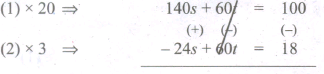
164s = 82 \(\Rightarrow \quad s=\frac { 82 }{ 164 } =\frac { 1 }{ 2 } \)
Substituting \(\\ s=\frac { 1 }{ 2 } \) in (1) we get,
\(7\left( \frac { 1 }{ 2 } \right) +3t=5\quad \Rightarrow 3t=5-\frac { 7 }{ 2 } =\frac { 10-7 }{ 2 } =\frac { 3 }{ 2 } \)
\(\Rightarrow t=\frac { 3 }{ 2\times 3 } =\frac { 1 }{ 2 } \)
Substituting \(s=\frac { 1 }{ 2 } ,t=\frac { 1 }{ 2 } \) in (3) we get,
\(9\left( \frac { 1 }{ 2 } \right) +5\left( \frac { 1 }{ 2 } \right) =7\)
\(\Rightarrow \frac { 9 }{ 2 } +\frac { 5 }{ 2 } =7\)
\(\Rightarrow \frac { 14 }{ 2 } =7\)
\(\Rightarrow\) 7 = 7 which satisfies the (3) equation.
Thus, one vector is a linear combination of other two vectors.
Hence, the given vectors are co-planar.
4.
Let \(\overrightarrow {a}=\hat{i}\) − 2\(\hat{j}\) + 3\(\hat{k}\), \(\overrightarrow{b}=\) -2\(\hat{i}\) + 3\(\hat{j}\) - 4\(\hat{k}\), \(\overrightarrow{c}=\) -\(\hat{j}\) + 2\(\hat{k}\) .
Let \(\overrightarrow {a}=s\overrightarrow{b}+t\overrightarrow{c}\)
\(\Rightarrow \hat{i}-2\hat{j}+3\hat{k}=s(-2\hat{i}+3\hat{j}-4\hat{k})+t(-\hat{j}+2\hat{k})\)
\(\Rightarrow \hat{i}-2\hat{j}+3\hat{k}=(-2s)\hat{i}+(3s-t)\hat{j}+(-4s +2t)\hat{k}\)
Equating the like components both sides, we get
-2s = 1 ....(1)
3s - t = -2 .....(2)
-4s + 2t = 3 ......(3)
From(1), s = \(-{1\over2}\)
Substituting s = \(-{1\over2}\) in (2) we get,
3\(({-1\over2})-t=-2 \Rightarrow -{3\over2}-t=-2\)
\(-t=-2+{3\over2}\)
\(-t={-4+3\over2}={-1\over2}\)
\(t={1\over2}\)
Substituting s = \(-{1\over2}\),\(t={1\over2}\) in (3) we get,
\(-4({-1\over2})+2({1\over2})=+3\)
\(\Rightarrow 2+1=3\)
\(\Rightarrow{3=3}\)
which satisfies the (3) equation.
Thus, one vector is a linear combination of other two vectors.
Hence, the given vectors are co-planar.
5.
Given \(\overrightarrow{a}=3\hat{i}+2\hat{j}+9\hat{k} \), \(\overrightarrow{b}=\overrightarrow{i}+\lambda \overrightarrow{j}+3\overrightarrow{k}\)
Given \(\overrightarrow{a}||\overrightarrow{b}\)
\(\therefore \overrightarrow{a}=\) (some scalar) \(\overrightarrow{b}\)
\(\Rightarrow \overrightarrow{a}= 3\hat{i}+2\hat{j}+9\hat{k}=3(\hat{i}+{2\over3}\hat{j}+3\hat{k})\)
\(\overrightarrow{a}=3(\overrightarrow{b})\)
\(\overrightarrow{b}=\hat{i}+{2\over3}\hat{j}+3\hat{k}\)
Comparing this\(\hat{i}+\lambda \hat{j}+3\hat{k}\) with we get
\(\lambda ={2\over3}\)
6.
Given \(|\overrightarrow{a}|=5,|\overrightarrow{b}|=6,|\overrightarrow{c}|=7\) and \(\overrightarrow{a}+\overrightarrow{b}+\overrightarrow{c} =\overrightarrow{0}\)
\(|\overrightarrow{a}+\overrightarrow{b}+\overrightarrow{c}| =|\overrightarrow{a}|^2+|\overrightarrow{b}|^2+|\overrightarrow{c}|^2+2(\overrightarrow{a}.\overrightarrow{b})+2(\overrightarrow{b}.\overrightarrow{c})+2(\overrightarrow{c}.\overrightarrow{a})\)
\(=25+36+49+2(\overrightarrow{a}.\overrightarrow{b}+\overrightarrow{b}.\overrightarrow{c}+\overrightarrow{c}.\overrightarrow{a})=\overrightarrow{0}\)
\(\Rightarrow -110=2(\overrightarrow{a}.\overrightarrow{b}+\overrightarrow{b}.\overrightarrow{c}+\overrightarrow{c}.\overrightarrow{a})\)
\(\Rightarrow {-110\over 2}=\overrightarrow{a}.\overrightarrow{b}+\overrightarrow{b}.\overrightarrow{c}+\overrightarrow{c}.\overrightarrow{a}\)
\(\Rightarrow \overrightarrow{a}.\overrightarrow{b}+\overrightarrow{b}.\overrightarrow{c}+\overrightarrow{c}.\overrightarrow{a}=-55\)
7.
Given \(\overrightarrow{a}+2\overrightarrow{b}+\overrightarrow{c}=\overrightarrow{0}\)
and \(|\overrightarrow{a}|=3,|\overrightarrow{b}|=4\) and \(|\overrightarrow{c}|=7\)
Let \(\theta\) be the angle between \(\overrightarrow{a}\) and \(\overrightarrow{b}\).
\(\Rightarrow \overrightarrow{a} +2\overrightarrow{b}=-\overrightarrow{c}\)
\(\Rightarrow |\overrightarrow{a} +2\overrightarrow{b}|^2=|-\overrightarrow{c}|^2\)
\(\Rightarrow |\overrightarrow{a}|^2 +4|\overrightarrow{b}|^2+4(\overrightarrow{a}.\overrightarrow{b})=|\overrightarrow{c}|^2\)
\(\Rightarrow 9+4(16)+4(\overrightarrow{a}.\overrightarrow{b})=49\)
\(9+64+4(\overrightarrow{a}.\overrightarrow{b})=49\)
\(\Rightarrow 73+4(\overrightarrow{a}.\overrightarrow{b})=49\)
\(\Rightarrow 4(\overrightarrow{a}.\overrightarrow{b})=49-73\)
\(\Rightarrow 4|\overrightarrow{a}||\overrightarrow{b}|cos \theta=-24\)
\(\Rightarrow 4(3)(4)cos \theta=-24\)

\(\Rightarrow cos \theta =cos(\pi-{\pi\over 3})=cos{2\pi\over 3}\)
\(\Rightarrow \theta ={2\pi\over 3}\)
8.
Let \(\overrightarrow{a}=5\hat{i}+3\hat{j}+4\hat{k},\) and \(\overrightarrow{b}=6\hat{i}-8\hat{j}-\hat{k}\) .
Let \(\theta\) be the angle between them.
\(cos \theta ={\overrightarrow{a}.\overrightarrow{b}\over|\overrightarrow{a}||\overrightarrow{b}|}={30-24-4\over \sqrt{50}\sqrt{101}}={\sqrt{2}\over 5\sqrt{101}}\Rightarrow \theta =cos^{-1}\left[ \sqrt{2}\over 5\sqrt{101} \right] \).
9.
Let \(\overrightarrow{r}=x\hat{i}+y\overrightarrow{j}+z\hat{k}\)
\(\overrightarrow{r}.\hat{i}=(x\hat{i}+y\hat{j}+z\hat{k}).\hat{i}=x\)
\(\overrightarrow{r}.\hat{j}=(x\hat{i}+y\hat{j}+z\hat{k}).\hat{j}=y\)
\(\overrightarrow{r}.\hat{k}=(x\hat{i}+y\hat{j}+z\hat{k}).\hat{k}=z\)
\((\overrightarrow{r}.\hat{i})\hat{i}+(\overrightarrow{r}.\hat{j})\hat{j}+(\overrightarrow{r}.\hat{k})\hat{k}=x\hat{i}+y\hat{j}+z\hat{k}=\overrightarrow{r}\)
Thus \(\overrightarrow{r}=(\overrightarrow{r}.\hat{i})\hat{i}+(\overrightarrow{r}.\hat{j})\hat{j}+(\overrightarrow{r}.\hat{k})\hat{k}\) .
10.
\(|\overrightarrow{a}+\overrightarrow{b}|=|\overrightarrow{a}-\overrightarrow{b}|\)
\(|\overrightarrow{a}+\overrightarrow{b}|^2=|\overrightarrow{a}-\overrightarrow{b}|^2\)
\(|\overrightarrow{a}|^2+|\overrightarrow{b}|^2+2\overrightarrow{a}.\overrightarrow{b}=|\overrightarrow{a}|^2+|\overrightarrow{b}|^2-2\overrightarrow{a}.\overrightarrow{b}\)
\(\Rightarrow 4\overrightarrow{a}.\overrightarrow{b}=0\)
\(\overrightarrow{a}.\overrightarrow{b}=0\)
Hence \(\overrightarrow{a}\) and \(\overrightarrow{b}\)are perpendicular.

11th Standard Syllabus & Materials
11th Standard
TN 11th Tamil பீடு பெற நில் - செய்யுள் - காவடிச்சிந்து Important Questions And Answers Study Material - QB365 Set A
NEW11th Standard
TN 11th Tamil பீடு பெற நில் - உரைநடை - மலை இடப்பெயர்கள் : ஓர் ஆய்வு Important Questions And Answers Study Material - QB365 Set A
NEW11th Standard
TN 11th Tamil மாமழை போற்றுதும் - துணைப்பாடம் - யானை டாக்டர் Important Questions And Answers Study Material - QB365 Set A
NEW11th Standard
TN 11th Tamil மாமழை போற்றுதும் - செய்யுள் - ஐங்குறுநூறு Important Questions And Answers Study Material - QB365 Set A



Tamilnadu Stateboard 11th Standard Subjects
Maths

Commerce

Economics

Biology

Business Maths and Statistics

Accountancy

Computer Science

Physics

Chemistry
Maths
Biology
Economics
Physics
Chemistry

History
Business Maths and Statistics

Computer Science
Accountancy

Computer Applications
History
Computer Technology
Commerce
Computer Applications
Computer Technology

Tamil

English

French
Tamilnadu Stateboard Standards

