
 100% FREE ACCESS
11th Standard Syllabus & Materials
11th Standard
TN 11th Tamil இயற்கை வேளாண்மை,சுற்றுச்சூழல் -செய்யுள் - மனோன்மணீயம் Important Questions And Answers Study Material - QB365 Set A
NEW11th Standard
TN 11th Tamil என்னுயிர் என்பேன் -துணைப்பாடம் - இசைத்தமிழர் இருவர் Important Questions And Answers Study Material - QB365 Set A
NEW11th Standard
TN 11th Tamil மொழி கலை -செய்யுள் - ஒவ்வொரு புல்லையும் Important Questions And Answers Study Material - QB365 Set A
NEW11th Standard
TN 11th Tamil பீடு பெற நில் - இலக்கணம் - பகுபத உறுப்புகள் Important Questions And Answers Study Material - QB365 Set A
NEW11th Standard
TN 11th Tamil பீடு பெற நில் - துணைப்பாடம் - வாடிவாசல் Important Questions And Answers Study Material - QB365 Set A
NEW11th Standard
TN 11th Tamil பீடு பெற நில் - செய்யுள் - குறுந்தொகை Important Questions And Answers Study Material - QB365 Set A

Published on: 29/09/2018
Model question-Vector Algebra - I
Download Tamil Nadu 11th Standard Maths question papers, model tests, one-mark questions, important questions, and public exam papers in PDF format. Free study materials and answer keys for TN State Board students.
Questions + Answers key
Take MCQ Maths Test1.
Find the direction cosines of a vector whose direction ratios are 1, 2, 3
2.
The direction ratios of a vector are 2, 3, 6 and it’s magnitude is 5. Find the vector
3.
Can a vector have direction angles 30°, 45°, 60°?
4.
Find a direction ratio and direction cosines of the following vectors \(3\hat{i}+4\hat{j}-6\hat{k}\)
5.
Represent graphically the displacement of 80km, 60° south of west.
6.
Three vectors \(\overrightarrow{a},\overrightarrow{b}\)and \(\overrightarrow{c}\) are such that \(|\overrightarrow{a}|=2,|\overrightarrow{b}|=3,|\overrightarrow{c}|=4,\) and \(\overrightarrow{a}+\overrightarrow{b}+\overrightarrow{c}=\overrightarrow{0}\) .Find \(4\overrightarrow{a}.\overrightarrow{b}+3\overrightarrow{b}.\overrightarrow{c}+3\overrightarrow{c}.\overrightarrow{a}.\)
7.
Show that the following vectors are coplanar 5\(\hat{i}\) +6\(\hat{j}\) +7\(\hat{k}\) ,7 \(\hat{i}\) -8\(\hat{j}\) +9 \(\hat{k}\),3\(\hat{i}\)+20\(\hat{j}\) +5\(\hat{k}\) .
8.
If (a, a + b, a + b + c) is one set of direction ratios of the line joining (1, 0, 0) and (0, 1, 0), then find a set of values of a, b, c.
9.
Show that the points whose position vectors are 2\(\hat{i}\) + 3\(\hat{j}\) − 5\(\hat{k}\), 3\(\hat{i}\) + \(\hat{j}\) − 2\(\hat{k}\) and, 6\(\hat{i}\) − 5\(\hat{j}\) + 7\(\hat{k}\) are collinear
10.
11.
Let \(\vec a\) and \(\vec b\) be the position vectors of the points A and B. Prove that the position vectors of the points which trisects the line segment AB are \(\frac{\vec{a}+2 \vec{b}}{3} \text { and } \frac{\vec{b}+2 \vec{a}}{3} \text {. }\)
12.
Find the unit vectors perpendicular to each of the vectors \(\overrightarrow{a}+\overrightarrow{b}\) and \(\overrightarrow{a}-\overrightarrow{b}\), where \(\overrightarrow{a}=\hat{i}+\hat{j} +\hat{k} \) and \(\overrightarrow{b} =\hat{i}+2\hat{j} +3\hat{k} \).
13.
Find the vectors of magnitude \(10\sqrt{3}\) that are perpendicular to the plane which contains \(\hat{i}+2\hat{j}+\hat{k}\) and\(\hat{i}+3\hat{j}+4\hat{k}\)
14.
If \(\overrightarrow{a},\overrightarrow{b}\) are unit vectors and \(\theta\) is the angle between them, show that \(tan {\theta \over 2}={|\overrightarrow{a}-\overrightarrow{b}|\over|\overrightarrow{a}+\overrightarrow{b}|}\)
15.
If \(\overrightarrow{a},\overrightarrow{b}\) are unit vectors and \(\theta\) is the angle between them, show that \(cos {\theta \over 2}={1\over2}|\overrightarrow{a}+\overrightarrow{b}|\)
16.
Find the angle between the vectors \(\hat{i}-\hat{j}\) and \(\hat{j}-\hat{k}\).
17.
If \(\overrightarrow{a}=2\hat{i}+2\hat{j}+3\hat{k},\) \(\overrightarrow{b}=-\hat{i}+2\hat{j}+\hat{k}\) and \(\overrightarrow{c}=3\hat{i}+\hat{j}\) be such that \(\overrightarrow{a}+\lambda \overrightarrow{b}\) is perpendicular to \(\overrightarrow{c}\) then find \(\lambda\).
18.
If \(\overrightarrow{a}=\hat{i}+\hat{j}+\hat{k},\overrightarrow{b}=2\hat{i}+x\hat{j}+\hat{k},\overrightarrow{c}=\hat{i}-\hat{j}+4\hat{k}\) and \(\overrightarrow{a}.(\overrightarrow{b}\times \overrightarrow{c})=70,\) then x is equal to
5
7
26
10
19.
If the projection of \(5\hat{i}-\hat{j}-3\hat{k}\) on the vector \(\hat{i}+3\hat{j}+\lambda\hat{k}\) is same as the projection of \(\hat{i}+3\hat{j}+\lambda\hat{k}\) on \(5\hat{i}-\hat{j}-3\hat{k}\), then \(\lambda\) is equal to
\(\pm 4\)
\(\pm 3\)
\(\pm 5\)
\(\pm 1\)
20.
If \(\overrightarrow{a}\) and \(\overrightarrow{b}\) are two vectors of magnitude 2 and inclined at an angle 60°, then the angle between \(\overrightarrow{a}\) and \(\overrightarrow{a}+\overrightarrow{b}\) is
30°
60°
45°
90°
21.
If \(\overrightarrow{a}\) and \(\overrightarrow{b}\) having same magnitude and angle between them is 60° and their scalar product is \({1\over2}\) then \(|\overrightarrow{a}|\) is
2
3
7
1
22.
Two vertices of a triangle have position vectors \(3\hat{i}+4\hat{j}-4\hat{k}\) and \(2\hat{i}+3\hat{j}+4\hat{k}\) . If the position vector of the centroid is \(\hat{i}+2\hat{j}+3\hat{k}\), then the position vector of the third vertex is
\(-2\hat{i}-\hat{j}+9\hat{k}\)
\(-2\hat{i}-\hat{j}-6\hat{k}\)
\(2\hat{i}-\hat{j}+6\hat{k}\)
\(-2\hat{i}+\hat{j}+6\hat{k}\)
23.
If \(\overrightarrow{a},\overrightarrow{b}\) are the position vectors A and B, then which one of the following points whose position vector lies on AB, is
\(\overrightarrow{a}+\overrightarrow{b}\)
\({2\overrightarrow{a}-\overrightarrow{b}\over 2}\)
\({2\overrightarrow{a}+\overrightarrow{b}\over 3}\)
\({\overrightarrow{a}-\overrightarrow{b}\over 3}\)
24.
One of the diagonals of parallelogram ABCD with \(\overrightarrow{a}\) and \(\overrightarrow{b}\) as adjacent sides is \(\overrightarrow{a}+\overrightarrow{b}\) The other diagonal \(\overrightarrow{BD}\) is
\(\overrightarrow{a}-\overrightarrow{b}\)
\(\overrightarrow{b}-\overrightarrow{a}\)
\(\overrightarrow{a}+\overrightarrow{b}\)
\(\overrightarrow{a}+\overrightarrow{b}\over 2\)
25.
The vectors \(\overrightarrow{a}-\overrightarrow{b},\overrightarrow{b}-\overrightarrow{c},\overrightarrow{c}-\overrightarrow{a}\) are
parallel to each other
unit vectors
mutually perpendicular vectors
coplanar vectors.
26.
The unit vector parallel to the resultant of the vectors \(\hat{i}+\hat{j}-\hat{k}\) and \(\hat{i}-2\hat{j}+\hat{k}\) is
\({\hat{i}-\hat{j}+\hat{k}\over\sqrt{5}}\)
\({2\hat{i}+\hat{j}\over\sqrt{5}}\)
\({2\hat{i}-\hat{j}+\hat{k}\over\sqrt{5}}\)
\({2\hat{i}-\hat{j}\over\sqrt{5}}\)
27.
The value of \(\overrightarrow{AB}+\overrightarrow{BC}+\overrightarrow{DA}+\overrightarrow{CD}\) is
\(\overrightarrow{AD}\)
\(\overrightarrow{CA}\)
\(\overrightarrow{0}\)
\(-\overrightarrow{AD}\)
1.
Given direction ratios are 1, 2, 3
Let x = 1, y = 2, z = 3
r = \(\sqrt{x^2+y^2+z^2}=\sqrt{1+4+9}=\sqrt{14}\)
The direction cosines are \({x\over r},{y\over r},{z\over r}\)
Thus, the direction cosines are \({1\over \sqrt{14}},{2\over \sqrt{14}},{3\over \sqrt{14}}\)
2.
The direction cosines are \({2\over7},{3\over7},{6\over7}.\)
The unit vector is \({2\over7}\hat{i}+{3\over7}\hat{j}+{6\over7}\hat{k}.\)
The required vector is \({5\over7}(2\hat{i}+3\hat{j}+6\hat{k})\).
3.
The condition is cos2\(\alpha\) + cos2\(\beta\) + cos2\(\gamma\) = 1
Here \(\alpha =30^o,\beta =45^o,\gamma=60^o\)
cos2\(\alpha\) + cos2\(\beta\) + cos2\(\gamma\) \(={3\over 4}+{1\over2}+{1\over4}\neq1.\)
There fore they are not direction angles of any vector.
4.
The direction ratios of \(3\hat{i}+4\hat{j}-6\hat{k}\) are 3, 4, -6.
The direction cosines are \({x\over r},{y\over r},{z\over r},\) where r = \(\sqrt{x^2+y^2+z^2}\) .
Therefore, the direction cosines are \({3\over \sqrt{61}},{4\over \sqrt{61}},{-6\over \sqrt{61}}\)
5.
80km, 60° south of west
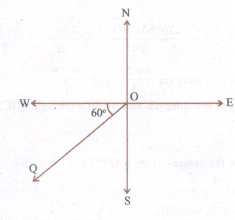
The vector \(\overrightarrow{OQ}\) represents a displacement of 80 km, 60° south of west.
6.
Given \(|\overrightarrow{a}|=2,|\overrightarrow{b}|=3,|\overrightarrow{c}|=4,\)and \(\overrightarrow{a}+\overrightarrow{b}+\overrightarrow{c}=\overrightarrow{0}\Rightarrow \overrightarrow{a}+\overrightarrow{b}=-\overrightarrow{c}\)
\(\therefore |\overrightarrow{a}+\overrightarrow{b}|^2=|\overrightarrow{c}|^2\)
\(\Rightarrow |\overrightarrow{a}|^2+|\overrightarrow{b}|^2+2(\overrightarrow{a}.\overrightarrow{b})=|\overrightarrow{c}|^2\)
\(\Rightarrow 4+9+2(\overrightarrow{a}.\overrightarrow{b})=16\)
\(\Rightarrow 13+2(\overrightarrow{a}.\overrightarrow{b})=16\)
\(\Rightarrow 2(\overrightarrow{a}.\overrightarrow{b})=16-13=3\)
\(\Rightarrow \overrightarrow{a}.\overrightarrow{b}={3\over2}\)
\(\Rightarrow4( \overrightarrow{a}.\overrightarrow{b})=4\times {3\over2}=6\).....(1)
Also \(\overrightarrow{b}+\overrightarrow{c}=-\overrightarrow{a}\)
\(|\overrightarrow{b}+\overrightarrow{c}|^2=|-\overrightarrow{a}|^2\)
\(|\overrightarrow{b}|^2+|\overrightarrow{c}|^2+2(\overrightarrow{b}.\overrightarrow{c})=|-\overrightarrow{a}|^2\)
\(9+16+2(\overrightarrow{b}.\overrightarrow{c})=4\)
\(25+2(\overrightarrow{b}.\overrightarrow{c})=4\)
\(2(\overrightarrow{b}.\overrightarrow{c})=4-25=-21\)
\((\overrightarrow{b}.\overrightarrow{c})={-21\over 2}\)
\(3(\overrightarrow{b}.\overrightarrow{c})=3({-21\over 2})={-63\over2}\)..(2)
Also, \(\overrightarrow{c}+\overrightarrow{a}=-\overrightarrow{b}\)
\(|\overrightarrow{c}+\overrightarrow{a}|=|-\overrightarrow{b}|\)
\(|\overrightarrow{c}+\overrightarrow{a}|^2=|-\overrightarrow{b}|^2\)
\(|\overrightarrow{c}|^2+|\overrightarrow{a}|^2+2(\overrightarrow{c}.\overrightarrow{a})=|\overrightarrow{b}|^2\)
\(16+4+2(\overrightarrow{c}.\overrightarrow{a})=9\)
\(20+2(\overrightarrow{c}.\overrightarrow{a})=9\)
\(\Rightarrow 2(\overrightarrow{c}.\overrightarrow{a})=9-20=-11\)
\((\overrightarrow{c}.\overrightarrow{a})={-11\over2}\)
\(\therefore 3(\overrightarrow{c}.\overrightarrow{a})=3({-11\over2})={-33\over2}\)....(3)
Adding (1), (2) and (3) we get,
\(4\overrightarrow{a}.\overrightarrow{b}+3\overrightarrow{b}.\overrightarrow{c}+3\overrightarrow{c}.\overrightarrow{a}=\)\(6-{63\over2}-{33\over2}={12-63-33\over 2}={12-96\over2}={-84\over2}=-42\)
\(\therefore 4\overrightarrow{a}.\overrightarrow{b}+3\overrightarrow{b}.\overrightarrow{c}+3\overrightarrow{c}.\overrightarrow{a}=-42\)
7.
Let \(\overrightarrow{a}=5\hat{i}+6\hat{j}+7\hat{k}\)
\(\overrightarrow{b}=\)7 \(\hat{i}\) -8\(\hat{j}\) +9 \(\hat{k}\)
\(\overrightarrow{c}=\)3\(\hat{i}\)+20\(\hat{j}\) +5\(\hat{k}\)
Let \(\overrightarrow{a}=s\overrightarrow{b}+t \overrightarrow{c}\)
\(\Rightarrow 5\hat { i } +6\hat { j } +7\hat { k } =s(7\hat { i } -8\hat { j } +9\hat { k } )+t(3\hat { i } +20\hat { j } +5\hat { k } )\)
\(\Rightarrow 5\hat { i } +6\hat { j } +7\hat { k } =(7s+3t)\hat { i } +(-8s+20t)\hat { j } +(9s+5t)\hat { k } \)
Equating the like components, both sides we get.
5 = 7s + 3t .....(1)
-8s + 20t = 6 ....(2)
9s + 5t = 7 ......(3)
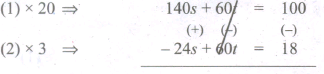
164s = 82 \(\Rightarrow \quad s=\frac { 82 }{ 164 } =\frac { 1 }{ 2 } \)
Substituting \(\\ s=\frac { 1 }{ 2 } \) in (1) we get,
\(7\left( \frac { 1 }{ 2 } \right) +3t=5\quad \Rightarrow 3t=5-\frac { 7 }{ 2 } =\frac { 10-7 }{ 2 } =\frac { 3 }{ 2 } \)
\(\Rightarrow t=\frac { 3 }{ 2\times 3 } =\frac { 1 }{ 2 } \)
Substituting \(s=\frac { 1 }{ 2 } ,t=\frac { 1 }{ 2 } \) in (3) we get,
\(9\left( \frac { 1 }{ 2 } \right) +5\left( \frac { 1 }{ 2 } \right) =7\)
\(\Rightarrow \frac { 9 }{ 2 } +\frac { 5 }{ 2 } =7\)
\(\Rightarrow \frac { 14 }{ 2 } =7\)
\(\Rightarrow\) 7 = 7 which satisfies the (3) equation.
Thus, one vector is a linear combination of other two vectors.
Hence, the given vectors are co-planar.
8.
Given points are A(1, 0, 0) and B(0, 1, 0) and one set of direction ratios are a, a+b, a+b+c.
Case (i): \(\overrightarrow{AB}=\overrightarrow{OB}-\overrightarrow{OA}=(0\hat{i}+\hat{j}+0\hat{k})-(\hat{i}+0\hat{j}+0\hat{k})=-\hat{i}+\hat{j}\)
\(\therefore \) Direction ratios of the line \(\overrightarrow{AB}\) are (-1, 1, 0)
Given (-1, 1, 0) = (a, a + b, a + b + c)
Equating the like components both sides, we get
a = -1, a + b = 1, a + b + c = 0
a = -1, -1 + b = 1 \(\Rightarrow\) b = 2
-1 + 2 + c = 0 \(\Rightarrow\) c = -1
\(\therefore \) a = -1, b = 2, c = -1
Case (ii): \(\overrightarrow{BA}=\overrightarrow{OA}-\overrightarrow{OB}=(\hat{i}+0\hat{j}+0\hat{k})-(0\hat{i}+\hat{j}+0\hat{k})=\hat{i}-\hat{j}\)
\(\therefore \) Direction ratios of the line\(\overrightarrow{BA}\) are (1, -1, 0)
Given (1, -1, 0) = (a, a + b, a + b + c)
Equation the like components both sides, we get
a = 1, a + b = -1, a + b + c = 0
a = 1,1 + b = -1 \(\Rightarrow\) b = -2
1 - 2 + c = 0 \(\Rightarrow\) c = 1
\(\therefore \) a = 1, b = -2, c = 1
9.
Let O be the origin and let \(\overrightarrow{OA}\), \(\overrightarrow{OB}\), and\(\overrightarrow{OC}\) be the vectors 2\(\hat{i}\) + 3\(\hat{j}\) − 5\(\hat{k}\), 3\(\hat{i}\) + \(\hat{j}\) − 2\(\hat{k}\) and, 6\(\hat{i}\) − 5\(\hat{j}\) + 7\(\hat{k}\) respectively. Then
\(\overrightarrow{AB}=\hat{i}-2\hat{j}+3\hat{k} \ and \ \overrightarrow{AC}=4\hat{i}-8\hat{j}+12\hat{k}\).
Thus \(\overrightarrow{AC}=4\overrightarrow{AB}\) and hence \(\overrightarrow{AB}\) and\(\overrightarrow{AC}\) are parallel. They have a common point namely A. Thus, the three points are collinear.
Alternative method
Let O be the point of reference.
Let \(\overrightarrow {OA} = 2\hat i+3\hat j-5\hat k, \) \(\overrightarrow {OB} = 3 \hat j+\hat j-2\hat k\ and\ \overrightarrow {OC} = 6\hat i-5\hat j+7\hat k \)
\(\overrightarrow {AB} = \hat i- 2\hat j+3\hat k; \overrightarrow {BC} = 3\hat i-6\hat j+9\hat k; \overrightarrow {CA} = -4\hat i+8\hat j-12 \hat k\\ |\overrightarrow {AB}| = \sqrt 14; |\overrightarrow {BC}|= \sqrt 126 = 3 \sqrt 14; |\overrightarrow {CA}|= \sqrt 224 = 4 \sqrt 4\)
Thus, AC = AB + BC.
Hence A, B, C are lying on the same line. That is, they are collinear.
10.
11.
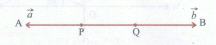
Let \(\overrightarrow{a}\) and \(\overrightarrow{b}\) be the position vectors of the points A and B.
\(\Rightarrow \overrightarrow{OA}=\overrightarrow{a}\) and \( \overrightarrow{OB}=\overrightarrow{b}\).
Let P divides the line segment AB in the ratio 1:2 and Q divides the line segment AB in the ratio 2 : 1
\(\therefore \overrightarrow{OP}={1.(\overrightarrow{OB})+2(\overrightarrow{OA})\over 1+2}={1(\overrightarrow{b})+2(\overrightarrow{a})\over 3}={\overrightarrow{b}+2\overrightarrow{a}\over 3}\)
and \( \overrightarrow{OQ}={2(\overrightarrow{OB})+1(\overrightarrow{OA})\over 2+1}={2\overrightarrow{b}+\overrightarrow{a}\over 3}={\overrightarrow{a}+2\overrightarrow{b}\over 3}\)
Hence, the required position vectors are \({\overrightarrow{b}+2\overrightarrow{a}\over 3}\)and \({\overrightarrow{a}+2\overrightarrow{b}\over 3}\).
12.
Given \(\vec{a}\)= \(\hat{i}+\hat{j}+\hat{k}\) and \(\vec{b}=\hat{i}+2\hat{j}+3\hat{k}\)
\(\vec { a } +\vec { b } =2\hat { i } +3\hat { j } +4\hat { k } \)
\(\vec { a } -\vec { b } =-\hat{j}-2\hat{k}\)
A unit vector which is perpendicular to \((\vec { a } +\vec { b } )\) and \((\vec { a } +\vec { b } )\) is
\(\left| \begin{matrix} \hat { i } & \hat { j } & \hat { k } \\ 2 & 3 & 4 \\ 0 & -1 & -1 \end{matrix} \right| =\hat { i } (-6+4)-\hat { j } (-4+0)+\hat { k } (-2+0)\)
= -2 \(\hat{i}\)+4\(\hat{j}\)-2\(\hat{k}\)
Its magnitude is \(\sqrt { { (-2) }^{ 2 }+{ 4 }^{ 2 }+{ (-2) }^{ 2 } } =\sqrt { 4+16+4 } =\sqrt { 24 } =\sqrt { 4\times 6 } =2\sqrt { 6 } \)
\(\therefore\) The unit vector which is perpendicular to\((\vec { a } +\vec { b } )\) and \((\vec { a } +\vec { b } )\) is
\(\pm \frac { (-2\hat { i } +4\hat { j } -2\hat { k } ) }{ 2\sqrt { 6 } } =\pm \frac { (-\hat { i } +2\hat { j } -\hat { k } ) }{ \sqrt { 6 } } \)
13.
Let \(\vec{a}\)= \(\hat{i}+2\hat{j}+\hat{k}\)
\(\vec{b}\)= \(\hat{i}+3\hat{j}+4\hat{k}\)
A unit vector which is perpendicular to the vector \(\vec{a}\) and \(\vec{b}\) is \(\frac { \vec { a } \times \vec { b } }{ \left| \vec { a } \times \vec { b } \right| } \)
\(\vec { a } \times \vec { b } =\left| \begin{matrix} \hat { i } & \hat { j } & \hat { k } \\ 1 & 2 & 1 \\ 1 & 3 & 4 \end{matrix} \right| \)= \(\hat{i}\)(8-3)-\(\hat{j}\)(4-1)+ \(\hat{k}\)(3-2) = 5\(\hat{i}\)-3\(\hat{j}\)+\(\hat{k}\)
\(\left| \vec { a } \times \vec { b } \right| =\sqrt { { 5 }^{ 2 }+{ (-3) }^{ 2 }+{ 1 }^{ 2 } } =\sqrt { 25+9+1 } =\sqrt { 35 } \)
A unit vector which is perpendicular to the vector \(\vec{a}\) and \(\vec{b}\) is \(\frac { 5\hat { i } -3\hat { j } +\hat { k } }{ \sqrt { 35 } } \)
Hence, a vector of magnitude 10\(\sqrt{3}\) , which is perpendicular to the vectors \(\vec{a}\) and \(\vec{b}\) is \(\pm \frac { 10\sqrt { 3 } }{ \sqrt { 35 } } \left( 5\hat { i } -3\hat { j } +\hat { k } \right) \)
14.
\(tan {\theta \over 2}={sin{\theta \over2}\over cos {\theta \over 2}}={{1\over 2}|\overrightarrow{a}-\overrightarrow{b}|\over {1\over2}|\overrightarrow{a}+\overrightarrow{b}| }\)
\(tan {\theta \over 2}={|\overrightarrow{a}-\overrightarrow{b}|\over|\overrightarrow{a}+\overrightarrow{b}|}\)
Hence, proved.
15.
Let \(\overrightarrow{a}\)and \(\overrightarrow{b}\) be the unit vectors and \(\theta\) is the angle between \(\overrightarrow{a}\) and \(\overrightarrow{b}\).
Consider \(|\overrightarrow{a}-\overrightarrow{b}|^2=|\overrightarrow{a}|^2+|\overrightarrow{b}|^2-2(\overrightarrow{a}.\overrightarrow{b})\) \([\because |\overrightarrow{a}|=1;|\overrightarrow{b}|=1]\)
\(=1+1-2|\overrightarrow{a}||\overrightarrow{b}|cos \theta =2+2cos \theta\)
\(=2(1+cos \theta)=2.2cos^2{\theta \over2}=4cos^2{\theta \over2}\)
\(\therefore |\overrightarrow{a}+\overrightarrow{b}|=2cos{\theta \over2}\)
\(\Rightarrow cos{\theta \over2}={1\over 2}|\overrightarrow{a}+\overrightarrow{b}|\)
16.
Let \(\overrightarrow{a}=\hat{i}-\hat{j}\) and \(\overrightarrow{b}=\hat{j}-\hat{k}\)
\(\overrightarrow{a}.\overrightarrow{b}=(\hat{i}-\hat{j}).(\hat{j}-\hat{k})=\)1(0)-1(1)+0(-1)=-1
\(|\overrightarrow{a}|=\sqrt{1^2+(-1)^2}=\sqrt{1+1}=\sqrt{2}\)
\(|\overrightarrow{b}|=\sqrt{1^2+(-1)^2}=\sqrt{1+1}=\sqrt{2}\)
Let \(\theta\) be the angle between the vectors \(\overrightarrow{a}\) and \(\overrightarrow{b}\)
\(\therefore cos \theta ={\overrightarrow{a}.\overrightarrow{b}\over |\overrightarrow{a}|.|\overrightarrow{b}|}\)
\(\Rightarrow cos \theta ={-1\over \sqrt{2}\sqrt{2}}=-{1\over 2}\)
\(\Rightarrow cos \theta =-cos ({\pi\over 3})\)
\(\Rightarrow cos \theta =-cos (\pi-{\pi\over 3})=cos({2\pi\over 3})\)
\(\Rightarrow \theta ={2\pi\over 3}\)
17.
\((\overrightarrow{a}+\lambda \overrightarrow{b}).\overrightarrow{c}=0\Rightarrow \overrightarrow{a}.\overrightarrow{c}+\lambda \overrightarrow{b}.\overrightarrow{c}=0\)
\(\Rightarrow (6+2)+\lambda (-3+2)=0\)
\(\Rightarrow \lambda=8\).
18.
\(\vec{b} \times \vec{c}=\left|\begin{array}{ccc} \hat{i} & \hat{j} & \hat{k} \\ 2 & x & 1 \\ 1 & -1 & 4 \end{array}\right|\)
\(=\hat{i}(4 x+1)-\hat{j}(8-1)+\hat{k}(-2-x) \)
\(=\hat{i}(4 x+1)-7 \hat{j}+\hat{k}(-2-x) \)
\(\vec{a} \cdot(\vec{b} \times \vec{c}) =(4 x+1)-7-2-x=70 \)
\(=(\hat{i}+\hat{j}+\hat{k}) \propto(4 x+1) \hat{i}-7 \hat{j}+\hat{k}(-2-x) \)
\(4 x+1-7-2-x =70 \)
\(3 x-8 =70 \)
\(3 x =78 \)
\(x =\frac{78}{3}=26 \)
19.
\(\text { Projection }=\frac{5-3-3 \lambda}{\sqrt{1+9+\lambda^{2}}}=\frac{5-3-3 \lambda}{\sqrt{25+1+9}}\)
\(\sqrt{10+\lambda^{2}} =\sqrt{35} \)
\(\lambda^{2}+10 =35 \)
\(\lambda^{2} =25 \)
\(\lambda =\pm 5 \)
20.
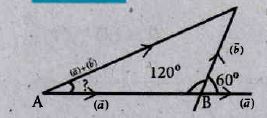
\(A B=B C=2 \text { (ie) } \vec{a}=\vec{b}=2\)
\(\therefore A B C \text { is isosceles triangle }\)
\(\therefore \angle A+\angle B =180^{\circ}-120^{\circ} \)
\(2 \angle A =60^{\circ} \)
\(\angle A =30^{\circ} \)
21.
\(\cos 60^{\circ} =\frac{\vec{a} \cdot \vec{b}}{|\vec{a}||\vec{b}|} \)
\(\frac{1}{2} =\frac{\frac{1}{2}}{|\vec{a} \| \vec{a}|} \)
\(|\vec{a}|^{2} =1 \Rightarrow|a|=1 \)
22.
\(\left(\frac{3+2+x_{1}}{3},\right. \left.\frac{4+3+x_{2}}{3}, \frac{-4+4+x_{3}}{3}\right)=(1,2,3) \)
\(3+2+x_{1} =3 ; 4+3+x_{2}=6 ;-4+4+x_{3}=9 \)
\(5+x_{1}=3 7+x_{2}=6 \)
\(x_{1}=-2 \quad x_{2}=-1 \)
\(\therefore \text { Third vertex is }(-2,-1,9)\)
23.
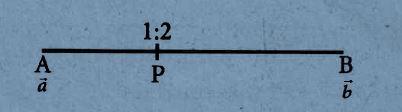
\(\vec{m}=\frac{|\vec{b}+2 \vec{a}|}{1+2}=\frac{2 \vec{a}+\vec{b}}{3}\)
24.
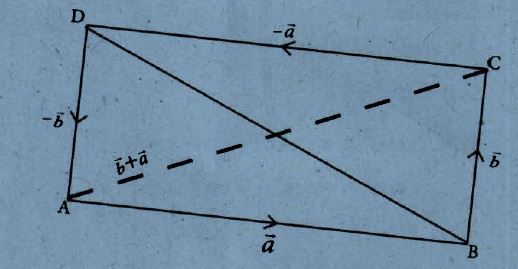
\(\text { In } \Delta \mathrm{BCD}, \overrightarrow{\mathrm{BD}}=\overrightarrow{\mathrm{BC}}+\overrightarrow{\mathrm{CD}}\)
\(=\overrightarrow{\mathrm{b}}-\overrightarrow{\mathrm{a}}\)
25.
(d)
coplanar vectors.
26.
\(\vec{a}+\vec{b} =2 \hat{i}-\hat{j} \)
\(|\vec{a}+\vec{b}| =\sqrt{4+1}=\sqrt{5} \)
\(\text { Unit vector }=\frac{2 \hat{i}-\hat{j}}{\sqrt{5}}\)
27.
\(\underbrace{\overrightarrow{A B}}+ \overrightarrow{B C}+\overrightarrow{C D}+\overrightarrow{D A} \)
\(=\underbrace{\overrightarrow{A C}+\overrightarrow{C D}}+\overrightarrow{D A} \)
\(=\underbrace{\overrightarrow{A D}+\overrightarrow{D A}} \)
\(=\overrightarrow{A A}=\overrightarrow{0} . \)

11th Standard Syllabus & Materials
11th Standard
TN 11th Tamil பீடு பெற நில் - செய்யுள் - காவடிச்சிந்து Important Questions And Answers Study Material - QB365 Set A
NEW11th Standard
TN 11th Tamil பீடு பெற நில் - உரைநடை - மலை இடப்பெயர்கள் : ஓர் ஆய்வு Important Questions And Answers Study Material - QB365 Set A
NEW11th Standard
TN 11th Tamil மாமழை போற்றுதும் - துணைப்பாடம் - யானை டாக்டர் Important Questions And Answers Study Material - QB365 Set A
NEW11th Standard
TN 11th Tamil மாமழை போற்றுதும் - செய்யுள் - ஐங்குறுநூறு Important Questions And Answers Study Material - QB365 Set A



Tamilnadu Stateboard 11th Standard Subjects
Maths

Commerce

Economics

Biology

Business Maths and Statistics

Accountancy

Computer Science

Physics

Chemistry
Maths
Biology
Economics
Physics
Chemistry

History
Business Maths and Statistics

Computer Science
Accountancy

Computer Applications
History
Computer Technology
Commerce
Computer Applications
Computer Technology

Tamil

English

French
Tamilnadu Stateboard Standards

