
 100% FREE ACCESS
11th Standard Syllabus & Materials
11th Standard
TN 11th Tamil இயற்கை வேளாண்மை,சுற்றுச்சூழல் -செய்யுள் - மனோன்மணீயம் Important Questions And Answers Study Material - QB365 Set A
NEW11th Standard
TN 11th Tamil என்னுயிர் என்பேன் -துணைப்பாடம் - இசைத்தமிழர் இருவர் Important Questions And Answers Study Material - QB365 Set A
NEW11th Standard
TN 11th Tamil மொழி கலை -செய்யுள் - ஒவ்வொரு புல்லையும் Important Questions And Answers Study Material - QB365 Set A
NEW11th Standard
TN 11th Tamil பீடு பெற நில் - இலக்கணம் - பகுபத உறுப்புகள் Important Questions And Answers Study Material - QB365 Set A
NEW11th Standard
TN 11th Tamil பீடு பெற நில் - துணைப்பாடம் - வாடிவாசல் Important Questions And Answers Study Material - QB365 Set A
NEW11th Standard
TN 11th Tamil பீடு பெற நில் - செய்யுள் - குறுந்தொகை Important Questions And Answers Study Material - QB365 Set A

Published on: 16/09/2019
Laws of Motion
Download Tamil Nadu 11th Standard Physics question papers, model tests, one-mark questions, important questions, and public exam papers in PDF format. Free study materials and answer keys for TN State Board students.
Questions + Answers key
Take MCQ Physics Test1.
Consider two objects of masses 5 kg and 20 kg which are initially at rest. A force 100 N is applied on the two objects for 5 second.
(a) What is the momentum gained by each object after 5s?
(b) What is the speed gained by each object after 5s?
2.
Calculate the centripetal acceleration of the Earth which orbits around the Sun. The Sun to Earth distance is approximately 150 million km. (Assume the orbit of Earth to be circular).
3.
The position of the particle is represented by y = ut - \(\frac { 1 }{ 2 } \) gt2
(a) What is the force acting on the particle?
(b) What is the momentum of the particle?
4.
A force \(\vec { F } =(6\hat { i } -8\hat { j } +10\hat { k } )\) N produces acceleration of 1 m/s2 in a body. Calculate the mass of the body.
5.
A ball of mass 150g moving with a velocity of 1s ms-1 is brought to rest by a player in 0.05s. Calculate the impulse and the average force exerted by the player.
6.
It is easier to roll a barrel than to pull it along the road. Why?
7.
What is the angle of friction between two surfaces in contact if the coefficient of friction \(\frac { 1 }{ \sqrt { 3 } } \)?
8.
Prove that second derivative of position vector is not zero, then there must be a force on the body.
9.
"Force and motion are in the opposite direction". Give example.
10.
Find the acceleration when multiple forces act on the body?
11.
How to verify Newton's third law, using spring balances?
12.
People often say "For every action there is an equivalent opposite reaction". Here they meant 'action of a human'. Is it correct to apply Newton's third law to human actions? What is mean by 'action' in Newton third law? Give your arguments based on Newton's laws.
13.
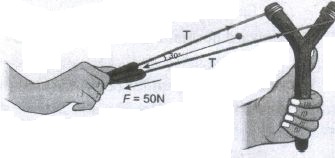
Apply Lami's theorem on sling shot and calculate the tension in each string?
14.
The physics books are stacked on each other in the sequence: +1 volumes 1 and 2; +2 volumes 1 and 2 on a table
a) Identify the forces acting on each book and draw the free body diagram.
b) Identify the forces exerted by each book on the other
15.
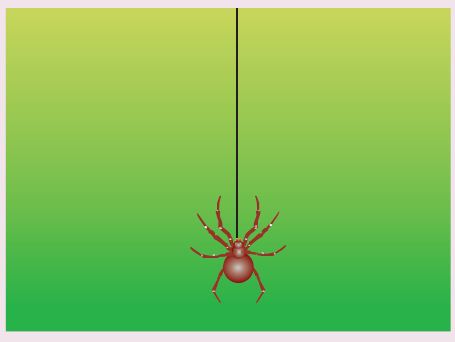
A spider of mass 50 g is hanging on a string of a cob web. What is the tension in the string?
1.
Final momentum on each object Δp = FΔt = 100\(\times\)5 = 500 kg ms-1
Final speed on the object of mass 5 kg = 500/5 =100 m s-1
Final speed on the object of mass 20 kg = 500/20 =25 m s-1
Note that momentum on each object is the same after 5 seconds but speed is not the same after 5 seconds. The heavier mass acquires lesser speed than the one with lower mass.
2.
The centripetal acceleration ac=\(\frac { { v }^{ 2 } }{ r } \)
V.- velocity of Earth around the orbit
r - radius of orbit or distance of Earth to Sun
Velocity of Earth is written in terms of angular velocity (ω) as
v-ωr
By substituting in the centripetal acceleration formula, ac=\({ a }_{ c }=\frac { { \omega }^{ 2 }{ r }^{ 2 } }{ r } =\omega ^{ 2 }\)=ω2r
But ω=\(\frac { 2\pi }{ T } \) where T is time for the Earth to orbit around the sun, which is one year.
T = 365 days = 365\(\times\)24\(\times\)60\(\times\)60s
T = 31\(\times\)107 s
(ω)= 2.02\(\times\)10-7 rad per see
ac = (2.02\(\times\)10-7)2 \(\times\)(150\(\times\)108)
ac= 6.12\(\times\)10-4 ms-2
3.
To find the force, we need to find the acceleration experienced by the particle.
Th e acceleration is given by a=\(\frac { { d }^{ 2 }y }{ { dt }^{ 2 } } \) or a=\(\frac { dv }{ dt } \)
Here v = velocity of the particle in y direction
v = \(\frac { dy }{ dt } \) = u - gt
The momentum of the particle = mv = m(u - gt)
a = \(\frac { dv }{ dt } \) = -g
The force acting on the object is given by F = ma = -mg
The negative sign implies that the force is acting on the negative y direction. This is exactly the force that acts on the object in projectile motion.
4.
Given, \(\vec { F } =(6\hat { i } -8\hat { j } +10\hat { k } )\)
m = \(\frac { |\vec { F } | }{ a } =\frac { \sqrt { { 6 }^{ 2 }+{ 8 }^{ 2 }+{ 10 }^{ 2 } } }{ 1 } =10\sqrt { 2 } \) kg
5.
m = 150g = 0.15 kg
u = 15 ms-1, v = 0, t=0.05s
Impulse = m(v-u)
=0.15 (0-15) = -2.25 NS
Average force = \(\frac { Impulse }{ Time } =\frac { -2.25 }{ 0.05 } \) = -45N
The negative sign indicates the retarding nature of the force.
6.
Rolling friction < Sliding friction
7.
μ = tanθ
\(\frac { 1 }{ \sqrt { 3 } } \) = tanθ
θ = 300
8.
The acceleration is the second derivative of position vector of the body \(\left( \bar { a } =\frac { { d }^{ 2 }\vec { r } }{ dt^{ 2 } } \right) \) the force on the body is \(\vec { F } =m\frac { { d }^{ 2 }\vec { r } }{ { dt }^{ 2 } } \).
If \(\frac { { d }^{ 2 }r }{ d{ t }^{ 2 } } \neq 0\) , F≠0.
9.
If an object is thrown vertically upward, the direction of motion is upward, but gravitational force is downward.
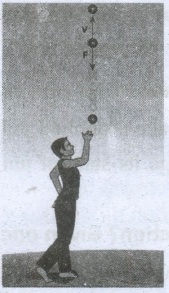
force and direction of motion are in opposite direction
10.
(i) If multiple forces \(\overset { \rightarrow }{ { F } } _{ 1 },\overset { \rightarrow }{ { F } } _{ 2 },\overset { \rightarrow }{ { F } } _{ 3 }...\overset { \rightarrow }{ { F } } _{ n }\) act on the same body, then the total force \(\left( \overset { \rightarrow }{ { F }_{ net } } \right) \) is equivalent to the vectorial sum of the individual forces
(ii) Their net force provides the acceleration. \(\overset { \rightarrow }{ { F } } _{ net }=\overset { \rightarrow }{ { F } } _{ 1 },\overset { \rightarrow }{ { F } } _{ 2 },\overset { \rightarrow }{ { F } } _{ 3 }...\overset { \rightarrow }{ { F } } _{ n }\)
(iii) Newton's second law for this case is \(\overset { \rightarrow }{ { F } } _{ net }=m\overset { \rightarrow }{ a } \)
In this case the direction of acceleration is in the direction of net force.
11.
(i) Two spring balances are attached.
(ii) One end is fixed with rigid support and the other free end pulled by the force.
(iii) Pull one end with same force and note the readings on both the balances.
(iv) Repeat it. We can notice same reading in both balances.
12.
As per Newton's Third Law of Motion every action has an equal and opposite reaction. As this law is valid on the physical plane in the physical science, it equally holds well but not completely in the metaphysics and in the spiritual science. In the physical plane, the action and reaction are instantaneous; one follows the other without significant time lapse, where as in the metaphysical science there is always a time lag between actions and their reactions. The complete Karmic theory, the theory of actions and reactions, is closely linked and follow the principle of Newton's Third law of equal actions and reactions.
The only difference and additional parameter in the Karmic theory. of actions/ reactions is "inertia or time lapse" of reactions, which has made it more complex and has created confusion in the mind of a common man. Sometimes reaction cannot be easily linked with the action because the reaction may be entirely different from the action executed. Furthermore, actions done on physical plane, mental plane and on intellectual plane bring different reactions in the metaphysical science. It must be experienced and understood by metaphysical science that behind every action there is a divine force. This force acts on us by His grace similar to the Newton's Third Law of physical science as a result of our past actions and it is governed by the inertial forces with time lag, which varies very widely and is beyond the perception of a common human being. Newton's third law is applicable to only human's actions which involves physical force. Third law is not applicable to human's psychological actions or thoughts.
13.
Force acting vertically to sling shot
Tension T in each string;
Now applying Lami's theorem, we get
\(\frac{2 T}{\sin \theta} =F
\)
\(\frac{2 T}{\sin (2 \times 30)} =50 N
\)
\(\frac{2 T}{\sin (60)} =50 N
\)
\(\frac{2 T}{\sqrt{3}} =50 N
\)
\(\frac{T}{2 T} =\frac{2}{\sqrt{3}} \times 50 N
\)
\(T=\frac{50 N}{\sqrt{3}}=28.268 N\)
14.
.JPG)
| Force acting on 12 - Vol - II | .JPG) |
| Force acting on 12 - Vol - I | .JPG) |
| Force acting on 11- Vol - I | .JPG) |
| Force acting on 11 - Vol - II | .JPG) |
15.
T = mg
T = 50g x 9.8m/s2
Tension (T) = 0.49 N

11th Standard Syllabus & Materials
11th Standard
TN 11th Tamil பீடு பெற நில் - செய்யுள் - காவடிச்சிந்து Important Questions And Answers Study Material - QB365 Set A
NEW11th Standard
TN 11th Tamil பீடு பெற நில் - உரைநடை - மலை இடப்பெயர்கள் : ஓர் ஆய்வு Important Questions And Answers Study Material - QB365 Set A
NEW11th Standard
TN 11th Tamil மாமழை போற்றுதும் - துணைப்பாடம் - யானை டாக்டர் Important Questions And Answers Study Material - QB365 Set A
NEW11th Standard
TN 11th Tamil மாமழை போற்றுதும் - செய்யுள் - ஐங்குறுநூறு Important Questions And Answers Study Material - QB365 Set A



Tamilnadu Stateboard 11th Standard Subjects

Maths

Commerce

Economics

Biology

Business Maths and Statistics

Accountancy

Computer Science
Physics

Chemistry
Maths
Biology
Economics
Physics
Chemistry

History
Business Maths and Statistics

Computer Science
Accountancy

Computer Applications
History
Computer Technology
Commerce
Computer Applications
Computer Technology

Tamil

English

French
Tamilnadu Stateboard Standards

