
 100% FREE ACCESS
11th Standard Syllabus & Materials
11th Standard
TN 11th Tamil இயற்கை வேளாண்மை,சுற்றுச்சூழல் -செய்யுள் - மனோன்மணீயம் Important Questions And Answers Study Material - QB365 Set A
NEW11th Standard
TN 11th Tamil என்னுயிர் என்பேன் -துணைப்பாடம் - இசைத்தமிழர் இருவர் Important Questions And Answers Study Material - QB365 Set A
NEW11th Standard
TN 11th Tamil மொழி கலை -செய்யுள் - ஒவ்வொரு புல்லையும் Important Questions And Answers Study Material - QB365 Set A
NEW11th Standard
TN 11th Tamil பீடு பெற நில் - இலக்கணம் - பகுபத உறுப்புகள் Important Questions And Answers Study Material - QB365 Set A
NEW11th Standard
TN 11th Tamil பீடு பெற நில் - துணைப்பாடம் - வாடிவாசல் Important Questions And Answers Study Material - QB365 Set A
NEW11th Standard
TN 11th Tamil பீடு பெற நில் - செய்யுள் - குறுந்தொகை Important Questions And Answers Study Material - QB365 Set A

Published on: 06/09/2019
Kinetic Theory of Gases
Download Tamil Nadu 11th Standard Physics question papers, model tests, one-mark questions, important questions, and public exam papers in PDF format. Free study materials and answer keys for TN State Board students.
Questions + Answers key
Take MCQ Physics Test1.
A gas made of a mixture of 2 moles of oxygen and 4 moles of argon at temperature T. Calculate the energy of the gas in terms of RT. Neglect the vibrational modes.
2.
What is the microscopic origin of pressure?
3.
Ten particles are moving at the speed of 2, 3, 4, 5, 5, 5, 6, 6, 7 and 9 m s-1. Calculate rms speed, average speed and most probable speed.
4.
Estimate the total number of air molecules in a room of capacity 25 m3 at a temperature of 27°C.
5.
Describe the Brownian motion.
6.
An oxygen molecule is travelling in air at 300 K and 1 atm, and the diameter of oxygen molecule is 1.2\(\times\)10−10m. Calculate the mean free path of oxygen molecule.
7.
For a given gas molecule at a fixed temperature, the area under the Maxwell-Boltzmann distribution curve is equal to
\(\frac{PV}{KT}\)
\(\frac{KT}{PV}\)
\(\frac{P}{NKT}\)
PV
8.
If sP and sV denote the specific heats of nitrogen gas per unit mass at constant pressure and constant volume respectively, then
sP - sV = 28R
sP - sV = R/28
sP - sV = R/14
sP - sV = R
9.
If the internal energy of an ideal gas U and volume V are doubled then the pressure
doubles
remains same
halves
quadruples
10.
The average translational kinetic energy of gas molecules depends on
number of moles and T
only on T
P and T
P only
11.
Two identically sized rooms A and B are connected by an open door. If the room A is air conditioned such that its temperature is 4°C lesser than room B, which room has more air in it?
Room A
Room B
Both room has same air
Cannot be determined
12.
Derive the expression for mean free path of the gas.
13.
Explain in detail the Maxwell Boltzmann distribution function.
1.
Since oxygen is a diatomic molecule with 5 degrees of freedom. Degrees of freedom of molecules in 2 moles of oxygen = f1
\(=2 \mathrm{~N} \times 5=10 \mathrm{~N}\)
Since argon is a mono atomic molecule with 3 degrees of freedom. Degrees of freedom of molecules in 4 moles of argon = f2
\(=4 \mathrm{~N} \times 3=12 \mathrm{~N}\)
∴ Total degrees of freedom of the mixture = f
\(=\mathrm{f}_{1}+\mathrm{f}_{2}=22 \mathrm{~N}\)
According to the principle of law of equipartition energy, energy associated with each degree of freedom of a molecule
\(=\frac{1}{2} k T\)
∴ Total energy of the system \(=\frac{1}{2} k T \times 22\)
But k = R
∴ Total energy of the system \(=\frac{1}{2} R T \times 22=11 \mathrm{RT}\)
2.
Pressure arises due to momentum transfer to the wall of the container.
3.
The average speed
\(\overset { - }{ v } =\frac { 2+3+4+5+5+5+6+6+7+9 }{ 10 } =5.2{ ms }^{ -1 }\)
To find the rms speed, first calculate the mean square speed \(\overset { - }{ { v }^{ 2 } } \)
\(\overset { - }{ { v }^{ 2 } } =\frac { { 2 }^{ 2 }+{ 3 }^{ 2 }+{ 4 }^{ 2 }+{ 5 }^{ 2 }+{ 5 }^{ 2 }+{ 5 }^{ 2 }+6^{ 2 }+{ 6 }^{ 2 }+{ 7 }^{ 2 }+{ 9 }^{ 2 } }{ 10 } \)
= 30.6ms2s-2
The rms speed
\({ v }_{ rms }\sqrt { \overset { - }{ { v }^{ 2 } } } =\sqrt { 30.6 } =5.53{ ms }^{ -1 }\)
The most probable speed is 5 m s-1 because three of the particles have that speed.
4.
Boltzmann's constant \(\mathrm{k}_{\mathrm{B}}=1.38 \times 10^{-23} \mathrm{JK}^{-1}\)
\(\mathrm{k}_{\mathrm{B}}=\frac{R}{N} \quad \therefore R=K_{B} N\)
Now
\(\mathrm{P}=n R T=n k_{B} N T\)
∴ The number of molecules in the room
\(=\mathrm{nN}=\frac{P V}{T k_{B}} ;
\)
\(\text {Temperature }=27+273 =300 \mathrm{~K}
\)
\( \leq \frac{1.013 \times 10^{5} \times 25}{300 \times 1.38 \times 10^{-23}}
\)
\(=6.117 \times 10^{26} \text { molecules }
\)
\(=6.1 \times 10^{26} \text { molecules }\)
5.
In 1827, Robert Brown, a botanist reported that grains of pollen suspended in a liquid moves randomly from one place to other. The random (Zig - Zag path) motion of pollen suspended in a liquid is called Brownian motion. In fact we can observe the dust particle in water moving in random directions. This discovery puzzled scientists for long time. There were a lot of explanations for pollen or dust to move in random directions were found adequate. After a systematic study, Wiener and Gouy proposed that Brownian motion is to the bombardment of suspended particles by bombardment of suspended particles by molecules of the surrounding fluid. But during 19+++ century people did not accept that every matter is made up of small atoms or molecules. In the year 1905, Einstein gave systematic theory of Brownian motion based on kinetic theory and he deduced the average size of molecules.
According to kinetic theory any particle suspended in a liquid or gas is continuously bombarded from all the directions so that the mean free path is almost negligible. This leads to the motion of the particles in a random and zig-zag manner as shown in Figure. But when we put our hand in water it causes no random motion because the mass of our hand is so large that the momentum transferred. by the molecular collision is not enough to move our hand.
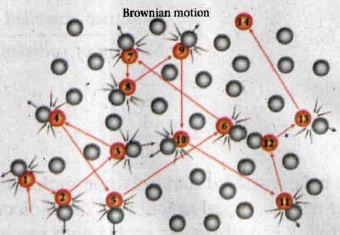
Factors affecting Brownian Motion:
(i) Brownian motion increases with increasing temperature.
(ii) Brownian motion decreases with bigger particle size, high viscosity and density of the liquid (or) gas.
6.
From (9.26) \(\lambda =\frac { 1 }{ \sqrt { 2 } \pi { nd }^{ 2 } } \)
We have to find the number density n By using ideal gas law
\(n=\frac { N }{ V } =\frac { P }{ KT } =\frac { { 101.3\times 10 }^{ 3 } }{ 1.381\times { 10 }^{ -23 }\times 300 } \)
= 2.449\(\times\)1025 molecues/m3
\(\lambda =\frac { 1 }{ \sqrt { 2 } \times \pi \times 2.449\times { 10 }^{ 25 }\times \left( 1.2\times { 1 }0^{ -10 } \right) ^{ 2 } } \)
\(=\frac { 1 }{ 15.65\times 10^{ 5 } } \)
λ = 0.63\(\times\)10−6m
7.
The area under the graph will give total member of gas molecules in the system
\(\mathrm{n} =\frac{P V}{R T} \quad \mathrm{R}=k \)
\(\therefore \quad \mathrm{n} =\frac{P V}{k T} \)
8.
\(C_{p}-C_{v}=R\)
For diatomic gas (N2) No of degrees of freedom = 5
\(\therefore S_{p}-S_{v}=R / 28\)
9.
Pressure is independent of internal energy.
10.
Average K.E of each degree of freedom
\(=\frac{1}{2} k T=\frac{1}{2} N T[k=N]\)
N - no. of moles
T - temperature
11.
As Temperature of room A is less than that of room B evidently Room A has more air in it.
12.
(i) We know from postulates of kinetic theory that the molecules of a gas are in random motion and they collide with each other.
(ii) Between two successive collisions, a molecule moves along a straight path with uniform velocity.
(iii) This path is called mean free path. Consider a system of molecules each with diameter d. Let n be the number of molecules per unit volume.
(iv) Assume that only one molecule is in motion,and all others are at rest.
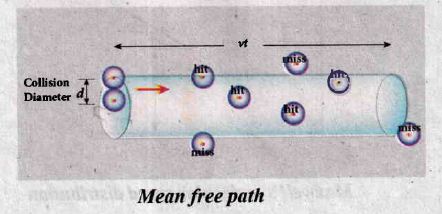
(v) If a molecule moves with average speed v in a time t, the distance travelled is vt.
(vi) In this time t, consider the molecule to move in an imaginary cylinder of volume nd2vr.
(vii) It collides with any molecule. whose center is within this cylinder. Therefore, the number of collisions is equal to the number of molecules in the volume of the imaginary cylinder.
(viii) It is equal to \(\pi\)d2vtn. The total path length divided by the number of collisions in time t is the mean free path.
Mean free pat, \(\lambda =\frac{distance \ travelled}{Number \ of \ collisions}\)
\(\lambda =\frac { vt }{ n{ \pi d }^{ 2 }vt } =\frac { 1 }{ n{ \pi d }^{ 2 } } \) ...(1)
(ix) Though we have assumed that only one molecule is moving at a time and other molecules are at rest, in actual practice all the molecules are in random motion.
(x) So the average relative speed of one molecule with respect to other molecules has to be taken into account. After some detailed calculations (you will learn in higher classes) the correct expression for mean free path .
\(\therefore \ \lambda =\frac { 1 }{ \sqrt { 2 } n{ \pi d }^{ 2 } } \) ...(2)
(xi) The equation (1) implies that the mean free path is inversely proportional to number density.
(xii) When the number density increases the molecular collisions increases and it decreases the distance travelled by the molecule before collisions:
Case1: Rearranging the equation (2) using 'm' (mass of the molecule)
\(\therefore \ \lambda =\frac { 1 }{ \sqrt { 2 } n{ \pi d }^{ 2} mm } \)
But mn = mass per unit volume = p (density of the gas)
\(\therefore \ \lambda =\frac { 1 }{ \sqrt { 2 } n{ \pi d }^{ 2 } p} \)
Also we know that PV = NkT
P =\(\frac{N}{V}\)KT= nKT
\(\therefore n =\frac{P}{KT}\)
Substituting n = \(\frac{P}{KT}\) in equation, we get
\(\lambda =\frac { 1 }{ \sqrt { 2 } n{ \pi d }^{ 2 }P } \)
13.
In general our interest our interest is to find how many gas molecules have the range of speed from v to v + dv. This is given by Maxwell's speed distribution function.
\({ N }_{ v }=4\pi N{ \left( \frac { m }{ 2\pi KT } \right) }^{ \frac { 3 }{ 2 } }{ v }^{ 2 }{ e }^{ \frac { { mv }^{ 2 } }{ 2KT } }\) ....(1)
The above expression is graphically shown as follows
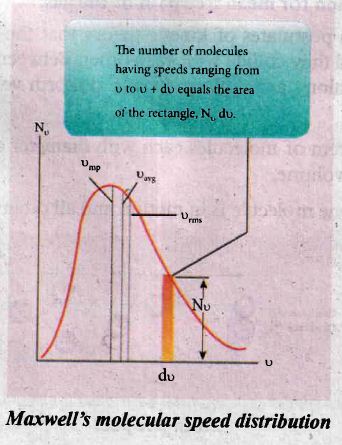
From the figure it is clear that, for a given temperature the number of molecules having lower speed increases parabolically but decreases exponentially after reaching most probable speed. The rms speed, average speed and most probable speed are indicated in the figure. It can be seen that the rms speed is greatest among the three. To Know the number of molecules in the range of speed between \(50 \mathrm{~m} \mathrm{~s}^{-1} \ and \ 60 \mathrm{~m}\mathrm{s}^{-1}\), we need to integrate \(\int_{50}^{60} 4 \pi N\left(\frac{m}{2 \pi k T}\right)^{\frac{3}{2}} v^{2} e^{\frac{m v^{2}}{2 k T}} d v=\mathrm{N}\left(50\right.\ to \ \left.60 \mathrm{~ms}^{-1}\right)\). In general the number of molecules within the range of speed v and v + dv is given by
\(\int_{v}^{v+d v} 4 \pi N\left(\frac{m}{2 \pi k T}\right)^{\frac{3}{2}} v^{2} e^{\frac{m v^{2}}{2 k T}} d v=N(v \text { to } v+d v)
\)
The exact integration is beyond the scope of the book. But we can infer the behaviour of gas molecules from the graph.
(i) The area under the graph will give the total number of gas molecules in the system.
(ii) Figure shows the speed distribution graph for two different temperatures. As temperature increases, the peak of the curve is shifted to the right. It implies that the average speed of each molecule will increase. But the area under each graph is same since it represents the total number of gas molecules.
.JPG)

11th Standard Syllabus & Materials
11th Standard
TN 11th Tamil பீடு பெற நில் - செய்யுள் - காவடிச்சிந்து Important Questions And Answers Study Material - QB365 Set A
NEW11th Standard
TN 11th Tamil பீடு பெற நில் - உரைநடை - மலை இடப்பெயர்கள் : ஓர் ஆய்வு Important Questions And Answers Study Material - QB365 Set A
NEW11th Standard
TN 11th Tamil மாமழை போற்றுதும் - துணைப்பாடம் - யானை டாக்டர் Important Questions And Answers Study Material - QB365 Set A
NEW11th Standard
TN 11th Tamil மாமழை போற்றுதும் - செய்யுள் - ஐங்குறுநூறு Important Questions And Answers Study Material - QB365 Set A



Tamilnadu Stateboard 11th Standard Subjects

Maths

Commerce

Economics

Biology

Business Maths and Statistics

Accountancy

Computer Science
Physics

Chemistry
Maths
Biology
Economics
Physics
Chemistry

History
Business Maths and Statistics

Computer Science
Accountancy

Computer Applications
History
Computer Technology
Commerce
Computer Applications
Computer Technology

Tamil

English

French
Tamilnadu Stateboard Standards

