
 100% FREE ACCESS
11th Standard Syllabus & Materials
11th Standard
TN 11th Tamil இயற்கை வேளாண்மை,சுற்றுச்சூழல் -செய்யுள் - மனோன்மணீயம் Important Questions And Answers Study Material - QB365 Set A
NEW11th Standard
TN 11th Tamil என்னுயிர் என்பேன் -துணைப்பாடம் - இசைத்தமிழர் இருவர் Important Questions And Answers Study Material - QB365 Set A
NEW11th Standard
TN 11th Tamil மொழி கலை -செய்யுள் - ஒவ்வொரு புல்லையும் Important Questions And Answers Study Material - QB365 Set A
NEW11th Standard
TN 11th Tamil பீடு பெற நில் - இலக்கணம் - பகுபத உறுப்புகள் Important Questions And Answers Study Material - QB365 Set A
NEW11th Standard
TN 11th Tamil பீடு பெற நில் - துணைப்பாடம் - வாடிவாசல் Important Questions And Answers Study Material - QB365 Set A
NEW11th Standard
TN 11th Tamil பீடு பெற நில் - செய்யுள் - குறுந்தொகை Important Questions And Answers Study Material - QB365 Set A

Published on: 27/12/2018
11th Half Yearly Model Question
Download Tamil Nadu 11th Standard Physics question papers, model tests, one-mark questions, important questions, and public exam papers in PDF format. Free study materials and answer keys for TN State Board students.
Questions + Answers key
Take MCQ Physics Test1.
The ratio of frequences of 2 pendulums are 2 : 3, then their lengths are in ratio ______________.
\(\sqrt { \frac { 2 }{ 3 } } \)
\(\sqrt { \frac { 3 }{ 2 } } \)
\(\frac{4}{9}\)
\(\frac{9}{4}\)
2.
A pure substance would freeze or solidity at its _____________.
boiling point
condensation point
melting point
sublimation point
3.
In the following, what are the quantities which that are conserved?
Linear momentum of planet
Angular momentum of planet
Total energy of planet
Potential energy of a planet
4.
Let y = \(\frac{1}{1+x^2}\) at t = 0 s be the amplitude of the wave propagating in the positive x-direction. At t = 2 s, the amplitude of the wave propagating becomes \(y=\frac{1}{1+(x-2)^{2}}. \) Assume that the shape of the wave does not change during propagation. The velocity of the wave is
0.5m s-1
1.0m s-1
1.5m s-1
2.0m s-1
5.
6.
If sP and sV denote the specific heats of nitrogen gas per unit mass at constant pressure and constant volume respectively, then
sP - sV = 28R
sP - sV = R/28
sP - sV = R/14
sP - sV = R
7.
An ideal refrigerator has a freezer at temperature −12°C. The coefficient of performance of the engine is 5. The temperature of the air (to which the heat ejected) is
50°C
45.2°C
40.2°C
37.5°C
8.
The wettability of a surface by a liquid depends primarily on
viscosity
surface tension
density
angle of contact between the surface and the liquid
9.
In a rectangle ABCD (BC = 2AB). The moment of inertia is minimum along axis through _____________
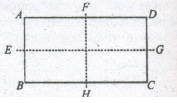
BC
BD
HF
EG
10.
The speed of the center of a wheel rolling on a horizontal surface is vo. A point on the rim in level with the center will be moving at a speed of,
zero
vo
\(\sqrt{2}\)vo
2vo
11.
Choose the motion in two dimension from the following.
Motion of a train along a straight railway track
An object falling freely under gravity close to the Earth.
A particle moving along a curved path in a plane.
Flying of a kite on a windy day.
12.
A uniform force of (2\(\hat { i }\)+\(\hat { j }\)) N acts on a particle of mass 1 kg. The particle displaces from position (3\(\hat { j }\)+\(\hat { k }\)) m to (5\(\hat { i }\)+3\(\hat { j }\)) m. The work done by the force on the particle is
9 J
6 J
10 J
12 J
13.
A vehicle is moving along the positive x direction, if sudden brake is applied, then
frictional force acting on the vehicle is along negative x direction
frictional force acting on the vehicle is along positive x direction
no frictional force acts on the vehicle
frictional force acts in downward direction
14.
If a particle executes uniform circular motion in the xy plane in clockwise direction, then the angular velocity is in
+y direction
+z direction
-z direction
-x direction
15.
The dimension of \({\left( {\mu}_{0}{\epsilon}_{0} \right)}^{{{1}\over{2}}}\) is
length
time
velocity
force
16.
What is persistence of hearing?
17.
Calculate the speed of sound in a steel rod whose Young’s modulus Y = 2\(\times\)1011 N m-2 and \(\rho\) = 7800 kg m-3.
18.
What is meant by force constant of a spring?
19.
A man starts bicycling in the morning at a temperature around 25°C, he checked the pressure of tire which is equal to be 500 kPa. Afternoon he found that the absolute pressure in the tyre is increased to 520 kPa. By assuming the expansion of tyre is negligible, what is the temperature of tyre at afternoon?
20.
A man pulls a lawn roller through a distance of 20 m with a force of 20 kg weight. If he applies the force at an angle of 60° with the ground, calculate the power developed if he takes 1 min in doing so.
21.
A train 100 m long is moving with a speed of 60 km h-1. In how many seconds will it cross a bridge of 1 km long?
22.
Check the correctness of the equation\(\frac { 1 }{ 2 } \)mv2 = mgh using dimensional analysis method.
23.
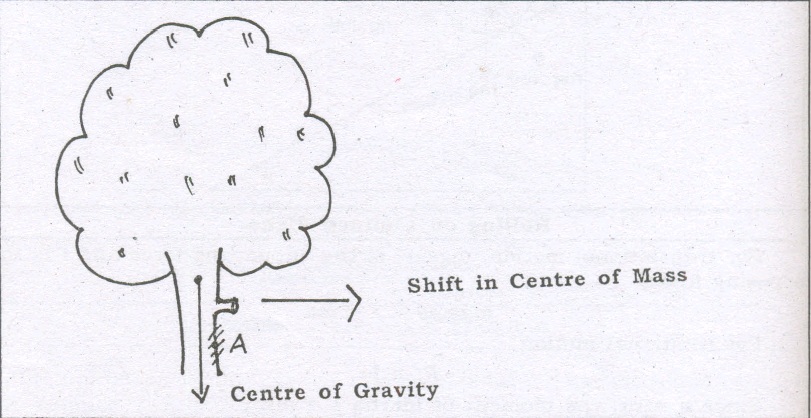
When a tree is cut, the cut is made on the side facing the direction in which the tree is required to fall. Why?
24.
Why it is not possible to push a car from inside?
25.
Is it possible to have length and velocity both as fundamental quantities? Why
26.
What is non uniform circular motion?
27.
Motor volume is occupied 1 moleof any (ideal) gas at standard temperature and pressure. Show that it is 22.4 litres.
28.
Show that the projection of uniform circular motion on a diameter is SHM.
29.
Discuss how ripples are formed in still water.
30.
Explain in detail Newton’s law of cooling.
31.
Obtain an equation of continuity for a flow of fluid on the basis of conservation of mass.
32.
Derive an expression for kinetic energy in rotation and establish the relation between rotational kinetic energy and angular momentum.
33.
Write note on integration.
34.
A shot travelling at the rate of 100 ms-1 is just able to pierce a plank 4cm thick. What velocity is required to just pierce a plank 9cm thick?
35.
Explain the types of equilibrium with suitable examples?
36.
Derive the kinematic equations of motion for constant acceleration.
37.
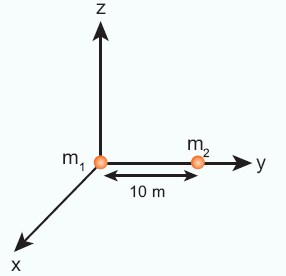
Consider two point masses m1 and m2 which are separated by a distance of 10 meter as shown in the following figure. Calculate the force of attraction between them and draw the directions of forces on each of them. Take m1= 1 kg and m2 = 2 kg.
38.
Draw graphs showing the variation of acceleration due to gravity with
(i) height above the earth's surface
(ii) depth below the earth's surface.
39.
Equal masses of O2 and He gases are supplied equal amount of heat. Which gas will undergo a greater temperature rise and why?
40.
A metal tube & a rod of same distance, same material & same outer diameter are given same amount of heat. Which will show less expansion & why?
41.
Which of the following represent simple harmonic motion?
(i) x = A sin ωt + B cos ωt
(ii) x = A sin ωt + B cos 2ωt
(iii) x = A eiωt
(iv) x = A ln ωt
42.
Write down the expression for the Stoke’s force and explain the symbols involved in it.
43.
A block of mass m is pushed momentarily along a horizontal surface with an initial velocity u. If uk is the coefficient of kinetic friction between the object and surface, find the time at which the block comes to rest.
44.
Consider a circular leveled road of radius 10m having coefficient of static friction 0.81. Three cars (A, B and C) are travelling with speed 7 ms-1, 8 m s-1 and 10 ms-1 respectively. Which car will skid when it moves in the circular level road? (g = 10 m s-2).
45.
Write the equation for the CM of two point masses when,
(i) Masses are on positive x-axis
(ii) Origin coincides with anyone of the masses
(iii) origin coincides with CM itself.
46.
What is meant by negative work? Give example.
47.
Give any three practical units of time.
1.
(d)
\(\frac{9}{4}\)
2.
(c)
melting point
3.
(c)
Total energy of planet
4.
Factual information
\(\text { At } \mathrm{t}=0 \text { amplitude } \mathrm{y}=\frac{1}{1+x^{2}}\)
\(\text { At } \mathrm{t}=2 \text { amplitude } \mathrm{y}=\frac{1}{1+(x-2)^{2}}\)
\(\therefore v=\frac{\Delta y}{\Delta t} =\frac{2}{2} =1.0 \mathrm{~ms}^{-1} \)
5.
(d)
6.
\(C_{p}-C_{v}=R\)
For diatomic gas (N2) No of degrees of freedom = 5
\(\therefore S_{p}-S_{v}=R / 28\)
7.
\(\mathrm{COP}=\frac{T_{L}}{T_{H}-T_{L}}\)
\(\mathrm{T}_{\mathrm{L}}=-12+273 =261 \mathrm{~K} \)
\(5=\frac{261}{T_{H}-261} \)
\(\therefore 5\left(T_{H}-261\right) =261 \)
\(5 \mathrm{~T}_{\mathrm{H}}-1305 =261 \)
\(5 \mathrm{~T}_{\mathrm{H}} =261+1305 =1566 \)
\(\therefore T_{H} =\frac{1566}{5} \)
\(=313.2 \mathrm{~K} \)
\(\mathrm{~T}_{\mathrm{H}}=313.2-273 =40.2^{\circ} \mathrm{C} \)
8.
(d)
angle of contact between the surface and the liquid
9.
(d)
EG
10.
\(v_{0}=r \omega ; \quad \therefore v_{0} \alpha r\)
For a wheel (uniform ring) the distance of a point on the rim in level with the center
\(\text { [i.e., radius] is } \sqrt{2} r\)
\(\therefore \text { The speed of the center is } \sqrt{2} v_{0}\)
11.
(c)
A particle moving along a curved path in a plane.
12.
\(\text { Force } \overrightarrow{\mathbf{F}}=(2 i+\vec{j}) N\)
\(\text { Displacement } d=(5 \vec{i}+3 \vec{j})-(3 \vec{j}+\vec{k})\)
\(=(5 i-k) m\)
\(\text { Work done } W=F . d\)
\(=(2 \vec{i}+\vec{j})(5 i-k)\)
\(=10-0-0=10 J \)
13.
(a)
frictional force acting on the vehicle is along negative x direction
14.
Use thumb rule
15.
\(\text { Velocity of light } c=\frac{1}{\sqrt{\mu_{0} \varepsilon_{0}}}\)
\(c=\left(\mu_{0} \varepsilon_{0}\right)^{-\frac{1}{2}}\)
\(\text { Hence dimension }\left(\mu_{0} \varepsilon_{0}\right)^{-\frac{1}{2}} \text { is that of velocity. }\)
16.
Velocity = \(\frac{Distance\ travelled}{time\ taken}=\frac{2d}{t}\)
2d = 344\(\times\)0.1 = 34.4 m
d = 17.2 m.
17.
\(v=\sqrt { \frac { y }{ \rho } } =\sqrt { \frac { 2\times { 10 }^{ 11 } }{ 7800 } } =\sqrt { 0.2564\times { 10 }^{ 8 } } \)
= 0.506\(\times\)104ms-1= 5\(\times\)103ms-1
Therefore, longitudinal waves travel faster in a solid than in a liquid or a gas. Now you may understand why a shepherd checks before crossing railway track by keeping his ears on the rails to safeguard his cattle.
18.
Force constant of a spring is defined as the restoring force per unit length.
19.
Temperature in the mornfurg
T1 = 25 oC
= 25 + 273 = 298K
Let the temperature at the afternoon = T2
Pressure in the morning P1 = 500 kPa
Pressure in the afternoon P2 = 520 kPa
\(\mathrm{V}_{1} =\mathrm{V}_{2}=\text { negligible volume }
\)
\(\therefore \frac{P_{1}}{P_{2}} =\frac{T_{1}}{T_{2}}
\)
\(\frac{500}{520} =\frac{298}{T_{2}}
\)
\(\therefore T_{2} =\frac{520 \times 298}{500}
\)
\(=\frac{154960}{500}
\)
\(=309.92 \mathrm{~K}\)
\(\therefore\) Temperature of tyre at afternoon
\(\mathrm{T}_{2} =309.92-273
\)
\(\therefore \mathrm{T}_{2} =36.92^{\circ} \mathrm{C}\)
20.
\(P=\frac { W }{ t } =\frac { Fs\cos { \theta } }{ t } =32.66\)W
21.
Total distance to be covered = 1 km + 100 m = 1100 m (including both bridge and time)
Then, Speed=60 kmh-1\(=60\times\frac{5}{18}ms^{-1}=\frac{50}{3}\ ms^{-1}\)
Then, time taken to cover this distance \(=\frac{1100}{\frac{150}{9}}s=66s\)
22.
Dimension formula for
\(\frac { 1 }{ 2 } \)mv2 = [M][LT-1]2 = [ML2T-2]
Dimension formula for
mgh = [M][LT-2][L] = [ML2T-2]
[ML2T-2] = [ML2T-2]
Both sides are dimensionally the same, hence the equations \(\frac { 1 }{ 2 } \)mv2 = mgh is dimensionally correct
23.
The weight of tree exerts a torque about the point where the cut is made. This causes rotation of the tree about the cut has to be made at say point A to weaken the tree trunk and to shift the centre of mass to the right and eventually move towards the ground on the right.
24.
(i) According to Newton's third law when one body exerts a force on a second body, the second body simultaneously exerts a force equal in magnitude and opposite in direction on the first body.
(ii) When you push a car from inside, the reaction force of your pushing is balanced out by your body moving backward and eventually the seat behind you pushes against to bring things to static equilibrium.
25.
No, length is fundamental quantity where as velocity is the derived quantity.
26.
When a point object is moving on a circular path if the velocity of the object changes both in speed (magnitude) and direction the motion is said to be non uniform circular motion.
27.
The ideal gas equation relating pressure (P),
volume (v), and absolute temperature (T) is
given as: pv = nRT, where R is the universal gas
constant = 8.314 J mol-1 K-1.
n = Number of moles = 1
T = Standard temperature = 273 K
P = Standard pressure = 1atm = 1.013\(\times\)105 Nm-2
\(\therefore v=\frac { nRT }{ P } =\frac { 1\times 8.314\times 273 }{ 1.013\times { 10 }^{ 5 } } \)
\(=\frac { 2269.7 }{ 1.013 } \times { 10 }^{ -5 }\)
= 0.0224m3
= 22.4 litres
Hence, the molar volume of gas at STP is 22.4 litres.
28.
Consider a particle moving along the y circumference of a circle of radius a and NP centre 0, with uniform speed v, in anticlockwise direction.
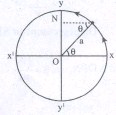
Let xx1 and yy1 be the two perpendicular x diameters. Suppose the particle is at p after a time t. If w is the angular velocity then the angular displacement θ in time t is given by θ = -wt.
From p draw pN perpendicular to yy1. As the particles moves from x to y, foot of the perpendicular N moves from 0 to y. As it moves further from y to x1, then from x1 to y1 and back again to x, the point N moves from y to 0, from 0 to y1 and back again to O. When the particle completers one revolution along the circumference, the point N completes one vibration about the mean position O. The motion of the point N along the diameter yy1 is simple harmonic.
Hence the projection of a uniform circular motion on a diameter of side in simple harmonic motion.
29.
A stone is dropped in a trough of still water, we can see a disturbance produced at the place where the stone strikes the water surface is seen.
This disturbance spreads out (diverges out) in the form of concentric circles of ever increasing radii (ripples) and strike the boundary of the trough. This is because some of the kinetic energy of the stone is transmitted to the water molecules on the surface. Actually the particles of the water (medium) themselves do not move outward with the disturbance. This can be observed by keeping a paper strip on the water surface. The strip moves up and down when the disturbance (wave) passes on the water surface. This shows that the water molecules only undergo vibratory motion about their mean positions.
30.
Newton's law of cooling states that the rate of loss of heat of a body is directly proportional to the difference in the temperature between that body and its surroundings.
\(\frac{d Q}{d t} \propto-\left(\mathrm{T}-\mathrm{T}_{s}\right)\) ...(1)
The negative sign indicates that the quantity of heat lost by liquid goes on decreasing with time. Where,
T = Temperature of the object
Ts = Temperature of the surrounding
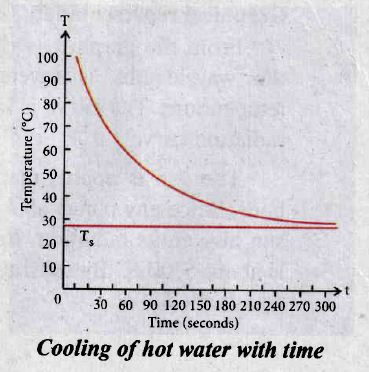
From the graph in figure it is clear that the rate of cooling is high initially and decreases with falling temperature.
Let us consider an object of mass m and specific heat capacity s at temperature T. Let Ts be the temperature of the surroundings. If the temperature falls by a small amount dT in time dt, then the amount of heat lost is,
dQ = msdT ........(2)
(iv) Dividing both sides of equation (2) by dt
\(\frac { dQ }{ dt } =\frac { msdT }{ dt } \)..........(3)
From Newton's law of cooling
\(\frac { dQ }{ dt } \propto -(T-{ T }_{ s })\)
\(\frac { dQ }{ dt } =-\alpha (T-{ T }_{ s })\) ...(4)
Where a is some positive constant.
From equation (2) and (4)
-\(\alpha\) (T - Ts) = \(md\frac { dt }{ dt } \)
\(\frac { dt }{ T-{ T }_{ s } } =\frac { a }{ ms } dt\) ....(5)
Integrating equation (5) on both sides,
\(\int _{ 0 }^{ \infty }{ \frac { dt }{ T-{ T }_{ a } } =-\int _{ 0 }^{ 1 }{ \frac { a }{ ms } dt } } \)
ln (T - Ts) = \(-\frac { a }{ ms } t+{ b }_{ 1 }\)
Where b1 is the constant of integration taking exponential both sides, we get
\(\mathrm{T} =T_{s}+b_{2} e^{-\frac{a}{m s} t} \)
here \(\mathrm{~b}_{2} =e^{b_{1}}=\text { constant }\)
31.
Consider a pipe AB of varying cross sectional area a1 and a2 such that a1 > a2. A non-viscous and incompressible liquid flows steadily through the pipe, with velocities v1 and v2 in area a1 and a2, respectively as shown in Figure.
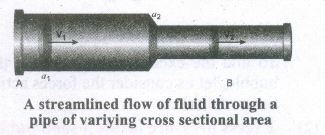
Let m1 be the mass of fluid flowing through section A in time Δt, m1 = (a1v1Δt) p
Let m2 be the mass of fluid flowing through section B in time Δt, m2= (a2v2Δt) p
For an incompressible liquid, mass is conserved m1 =m2
a1v1Δtρ = a2v2Δtρ
a1v1 = a2v2 ⇒ av = constant
which is called the equation of continuity and it is a statement of conservation of mass in the flow of fluids.
In general, a v = constant, which means that the volume flux or flow rate remains constant throughout the pipe. In other words, the smaller the cross section, greater will be the velocity of the fluid.
32.
Let us consider a rigid body rotating with angular velocity \(\omega\) about an axis as shown in figure. Every particle of the body will have the same angular velocity \(\omega\) and different tangential velocities v based on its positions from the axis of rotation.
Let us choose a particle of mass mi situated at distance ri from the axis of rotation. It has a tangential velocity vi given by the relation, vi = ri \(\omega\). The kinetic energy KEi of the particle is,
KEi = \(\frac { 1 }{ 2 } { m }_{ i }{ v }_{ i }^{ 2 }\)
Writing the expression with the angular velocity,
\(KE=\frac { 1 }{ 2 } { m }_{ i }\left( { r }_{ i }\omega \right) ^{ 2 }=\frac { 1 }{ 2 } \left( { m }_{ i }{ r }_{ i }^{ 2 } \right) \omega ^{ 2 }\)
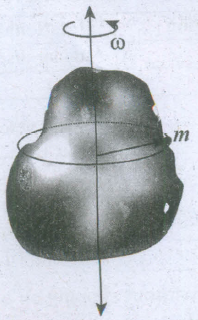
For the kinetic energy of the whole body, which is made up of large number of such particles, the equation is written with summation as,
\(KE=\frac { 1 }{ 2 } \left( \sum { { m }_{ i }{ r }_{ i }^{ 2 } } \right) \omega ^{ 2 }\)
where, the term \(\sum { { m }_{ i }{ r }_{ i }^{ 2 } } \) is the moment of interiaI of the whole body. \(\sum { { m }_{ i }{ r }_{ i }^{ 2 } } \)
Hence, the expression for KE of the rigid body in rotational motion is,
KE = \(\frac{1}{2}\)I\(\omega^2\)
This is analogous to the expression for kinetic energy in translational motion.
KE = \(\frac{1}{2}\)Mv2
Relation between rotational kinetic energy and angular momentum
Let a rigid body of moment of inertia \(\omega\) rotate with angular velocity \(\omega\).
The angular momentum of a rigid body is, L = I\(\omega\)
The rotational kinetic energy of the rigid body is, KE = \(\frac{1}{2}I\omega^2\)
By multiplying the numerator and denominator of the above equation with I, we get a relation between Land KE as,
KE = \(\frac{1}{2}\)\(\frac { I^{ 2 }\omega ^{ 2 } }{ I } =\frac { 1 }{ 2 } \frac { \left( I\omega \right) ^{ 2 } }{ I } \)
\(KE=\frac { { L }^{ 2 } }{ 2I } \)
33.
Integration is basically an area finding process. For certain geometric shapes we can directly find the area. But for irregular shapes the process of integration is used.
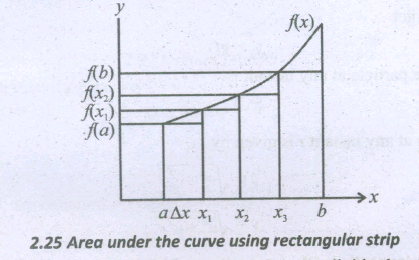
To find the area of the irregular shaped curve given by fix), we divide the area into rectangular strips as shown in the figure. The area under the curve is approximately equal to sum of areas of each rectangular strip.
This is given by \(A\approx f\left( a \right) \triangle x+f\left( { x }_{ 1 } \right) \triangle x+f\left( { x }_{ 2 } \right) \triangle x+f\left( b \right) \triangle x\)
Where f(a) is the value of the function f(x) at x = a,f(x1) is the value of f(x) for x = x1 and so on.
As we increase the number of strips, the area evaluated becomes more accurate. If the area under the curve is divided into N strips, the area under the curve is given by
\(A=\sum _{ n=1 }^{ N }{ { f }_{ n }\left( { x }_{ n } \right) \triangle { x }_{ n } } \)
As the number of strips goes to infinity,\(N\rightarrow \infty \) the sum becomes an integral,
\(A=\int _{ a }^{ b }{ f\left( x \right) dx } \) (Note: As \(N\rightarrow \infty ,\triangle x\rightarrow 0\))
The integration will give the total area under the curve f(x).
34.
v1 = 100 m/s
s1 =4 cm
s2 =9 cm
v2 =??
K.E lost = Word done against plank's resistance.
\({1\over 2}{mv}_{1}^{2}=F\times s_1\)
\({1\over 2}{mv}_{1}^{2}=F\times s_2
\)
\({(2)\over(2)}\Rightarrow{{v}_{2}^{2} \over {v}_{1}^{2}}={s_2\over s_1}\Rightarrow{v_2 \over v_2}=\sqrt{{s_2 \over s_1}}\)
\({v_2 \over v_1}=\sqrt{{9 \over 4}}={3 \over 2}\Rightarrow v_2={3 \over 2}\times v_1\)
\(v_2={3 \over 2}\times100=150m/s\)
35.
A body is said to be in equilibrium if both the linear momentum and angular momentum of the rigid body remain constant with time. Hence for a body in equilibrium, the linear acceleration of its centre of mass would be zero and also the angular acceleration of the rigid body about any axis would be zero.
The different types of equilibrium of a body are
1. Stable equilibrium
2. Unstable equilibrium
3. Neutral equilibrium
Equilibrium is thus stable, unstable neutral according, to whether potential energy is minimum, maximum or instant.

Let us consider the motion of a marble along a curved surface of a bowls.
If a marble M is placed on a curved surface of a bowl S it rolls down and settles in equilibrium at the lowest point A as shown in figure (a).
If the marble is disturbed and displaced at B, its energy increases. When it is released, the marble rolls back at A. Thus the marble at the portion A is said to be in stable equilibrium. In this case, the body possess minimum potential energy.
Suppose, now that bowl S is inverted and the marble is placed at its top point at A as shown in Fig (b).
If the marble is displaced slightly to the point C, its potential energy is lowered and tends to move further away from the equilibrium position to one of lowest energy. Thus the marble is said to be in unstable equilibrium.
Consider that the marble M is placed on the plane surface as shown in figure (c). If it is displaced slightly, its potential energy does not change. In this case, the marble is said to be in neutral equilibrium.
Translational equilibrium:
The resultant of all the external forces acting on the body must be zero.
\(\sum \vec{F}_{ext} =0 \ or \sum F_x=0\sum F_y=0\sum F_2=0\)
\(\sum \vec{F}_{ext} =M\vec{\alpha}_{CM}=M \frac{d\vec{v}_{CM}}{dt}=0\)
or \(\frac{d\vec{v}_{CM}}{dt}\)=0 or \(\vec{v}_{cm}\) = constant
This implies that a body in translational equilibrium, will be either at rest (v = 0) or in uniform motion. If the body is in uniform motion along a straight path, it is in dynamic equilibrium
Rotational equilibrium:
For rotational equilibrium \(\sum \vec{\tau}_{ext}=\sum \vec{r}.x\vec{F}_{ext}=0\)
If the total torque is zero about any point, then it will be zero about any other point when the body is in equilibrium
36.
Consider an object moving in a straight line with uniform or constant acceleration 'a'. Let u be the velocity of the object at time I = 0, and v be velocity of the body at a later time t.
Velocity - time relation
(i) The acceleration of the body at any instant is given by the first derivative of the velocity with respect to time, \(a={{dv}\over{dt}}or\ dv=a.dt\)
Integrating both sides with the condition that as time changes from 0 to I, the velocity changes from u to v. For the constant acceleration,
\(\int _{ u }^{ v }{ dv } =\int _{ 0 }^{ v }{ a\ dt } =a\int _{ u }^{ v }{ dt } \Rightarrow{[v]}^{v}_{u}=a{[t]}_{0}^{t}\)
v - u = a (or) v = u + at
Displacement - time relation
(ii) The velocity of the body is given by the first derivative of the displacement with respect to time.
\(v={{ds}\over{dt}}\) or ds = vdr
and since v = u + at,
We get ds = (u + at) dt
Assume that initially at time 1=0, the particle started from the origin. At a later time t, the particle displacement is s. Further assuming that acceleration is time - independent, we have
\(\int _{ 0 }^{ s }{ ds } =\int _{ 0 }^{ t }{ u\ dt } +\int _{ 0 }^{ t }{ at } \ dt\) (or) s = ut + \({{1}\over{2}}{at}^{2}\)
Velocity - displacement relation
(iii) The acceleration is given by the first derivative of velocity with respect to time.
\(a={{dv}\over{dt}}={{dv}\over{ds}}{{ds}\over{dt}}={{dv}\over{ds}}v\)
[since dsl dt = v] where s is distance traversed]
This is rewritten as a \(={{1}\over{2}}{{{dv}^{2}}\over{ds}}\)
or ds \(={{1}\over{2a}}d({v}^{2})\)
Integrating the above equation, using the fact when the velocity changes from u2 to v2, displacement changes from 0 to s, we get
\(\int _{ 0 }^{ s }{ ds } =\int _{ u }^{ v }{{{1}\over{}2a} (v^2) } \)
\(\therefore s\ ={{1}\over{2a}}(v^2-u^2)\)
\(\therefore v^2=u^2+2as\) ............(3)
We can also derive the displacement's f in terms of initial velocity 'u' and final velocity v.
From equation 1, we can write
at = v - u
Substitute this in equation 2, we get
\(s=ut+{{1}\over{2}}(v-u)t\)
\(s={{(u+v)t}\over{2}}\) .....................(4)
The equations 1, 2, 3 and 4 are called kinematic equations of motion, and have a wide variety of practical applications.
Kinematic equations
v = u+at
\(s=ut+{{1}\over{2}}{at}^{2}\)
v2=u2+2as
\(s={{(u+v)t}\over{2}}\)
37.
The force of attraction is given by
\(\vec { F } =-\frac { { Gm }_{ 1 }{ m }_{ 2 } }{ { r }^{ 2 } } \)
From the figure, r = 10 m.
First, we can calculate the magnitude of the force
\(F=-\frac { { Gm }_{ 1 }{ m }_{ 2 } }{ { r }^{ 2 } } =\frac { 6.67\times { 10 }^{ -11 }\times 1\times 2 }{ 100 } \)
= 13.34\(\times\)10-13N.
It is to be noted that this force is very small. This is the reason we do not feel the gravitational force of attraction between each other. The small value of G plays a very crucial role in deciding the strength of the force.
The force of attraction \(\left( { \vec { F } }_{ 21 } \right) \) experienced by the mass m2 due to m1 is in the negative ‘y’ direction ie. \(\hat{r}=-\hat{j}.\) According to Newton’s third law, the mass m2 also exerts equal and opposite force on m1. So the force of attraction \(\left( { \vec { F } }_{ 12 } \right) \) experienced by m1 due to m2 is in the direction of positive ‘y' axis ie., \(\hat{r}=\hat{j}.\)
\(\overrightarrow { F } _{ 21 }=-13.34\times { 10 }^{ -13 }\hat { j } \)
\(\overrightarrow { F } _{ 12 }=13.34\times { 10 }^{ -13 }\hat { j } \)
The direction of the force is shown in the figure,
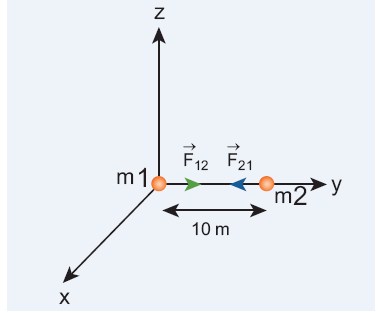
Gravitational force of attraction between m1 and m2
\({ \vec { F } }_{ 12 }=-{ \vec { F } }_{ 21 }\) which confirms Newton’s third law.
38.
(i) The value of g varies with height has
g a\(\frac { 1 }{ { \left( R+h \right) }^{ 2 } } \ or\ g\ a\ \frac { 1 }{ { r }^{ 2 } } \)
Thus the graph of g versus V is the parabolic curve AB
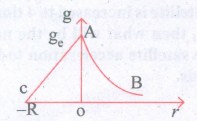
(ii) The value of g varies with depth d as
\(g=g\left( 1-\frac { d }{ R } \right) \)i.e g\(\alpha \)(R-d)
Thus the graph of g versus depth d is the straight line AB.
39.
Heat supplied the oxygen = Heat supplied to Helium
\({ mc }_{ 1 }{ \Delta T }_{ 1 }={ mc }_{ 2 }{ \Delta T }_{ 2 }\)
\(\frac { { \Delta T }_{ 1 } }{ { \Delta T }_{ 2 } } =\frac { { C }_{ 2 } }{ { C }_{ 1 } } \)
\(C\times \frac { 1 }{ m } ,m\)= molecular mass.
\(\frac { { \Delta T }_{ 1 } }{ { \Delta T }_{ 2 } } =\frac { { C }_{ 2 } }{ { C }_{ 1 } } =\frac { { m }_{ 1 } }{ { m }_{ 2 } } ,As\quad { m }_{ 1 }>{ m }_{ 2 }\)
\({ \Delta T }_{ 1 }>{ \Delta T }_{ 2 }\)
\(\therefore\)Therefore oxygen gas is greater temperature rise than the Helium gas.
40.
(i) For a metal tube & a rod of same length, same material & same outer diameter, the mass of rod is more than that of tube.
(ii) When same amount of heat is given to metal tube & a rod, then the temp rise for rod is less, hence expansion for rod is less than that of tube.
41.
x = A sin \(\omega t\) + B cos \(\omega t\)
\(\frac { { d }x }{ { dt } } \) = A \(\omega \) cos \(\omega t\) - B sin \(\omega t\)
\(\frac { { d }^{ 2 }x }{ { dt }^{ 2 } } \) = -\({ \omega }^{ 2 }\)(A sin \(\omega t\) + B cos \(\omega t\))
\(\frac { { d }^{ 2 }x }{ { dt }^{ 2 } } =-{ \omega }^{ 2 }x\)
This differential equation is similar to the differential equation of SHM (equation 10.10).
Therefore, x = A sin \(\omega t\) + B cos \(\omega t\) represents SHM.
(ii) x = A sin \(\omega t\) + B cos2\(\omega t\)
\(\frac { { d }x }{ { dt } } \) = A \(\omega \) cos \(\omega t\) − B (2\(\omega \)) sin2\(\omega t\)
\(\frac { { d }^{ 2 }x }{ { dt }^{ 2 } } \) = − \({ \omega }^{ 2 }\) (A sin \(\omega t\) + 4B cos 2\(\omega t\))
\(\frac { { d }^{ 2 }x }{ { dt }^{ 2 } } \neq -{ \omega }^{ 2 }x\)
This differential equation is not like the differential equation of a SHM. Therefore, x = A sin \(\omega t\) + B cos 2\(\omega t\) does not represent SHM.
(iii) x = A ei\(\omega t\)
\(\frac { { d }x }{ { dt } } \) = A \(i\omega\)ei\(\omega t\)
\(\frac { { d }^{ 2 }x }{ { dt }^{ 2 } } \) = \(A{ \omega }^{ 2 }\)ei\(\omega t\) = −\({ \omega }^{ 2 }\)x ( ∴ i2 = –1)
This differential equation is like the differential equation of SHM (equation 10.10). Therefore, x = A ei\(\omega t\) represents SHM.
(iv) x = A ln\(\omega t\)
\(\frac { { d }x }{ { dt } } =\left( \frac { A }{ \omega t } \right) \omega =\frac { A }{ t } \)
\(\frac { { d }^{ 2 }x }{ { dt }^{ 2 } } =\frac { A }{ { t }^{ 2 } } \Rightarrow { \frac { { d }^{ 2 }x }{ { dt }^{ 2 } } \neq - }{ \omega }^{ 2 }x\)
This differential equation is not like the differential equation of a SHM (equation 10.10). Therefore, x = A ln \(\omega t\) does not represent SHM.
42.
Stoke's force F = 6πη αv
where a - radius of the sphere
v - velocity of the sphere and
η - coefficient of viscosity of the liquid
43.
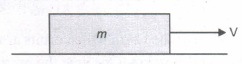
When the block slides, the force acting on the block is kinetic friction which is equal to fk= μsmg.
From Newton's second law ma = -μsmg
The negative sign implies that force acts on the opposite direction of motion.
The acceleration of the block while sliding a =-μkg
The negative sign implies that the acceleration is in opposite direction of the velocity. Note that the acceleration depends only on g and the coefficient of kinetic friction μk. We can apply the following kinematic equation
v=u+at
The final velocity is zero
0=u-ukgt
t=\(\frac { u }{ { \mu }_{ k }g } \).
44.
From the safe turn condition the speed of the vehicle (v) must be less than or equal to \(\sqrt { { \mu }_{ s }rg } \)
v ≤ \(\sqrt { { \mu }_{ s }rg } \)
\(\sqrt { { \mu }_{ s }rg } \)=\(\sqrt { 0.81\times 10\times 10 } \)=9 ms-1
For car C, \(\sqrt { { \mu }_{ s }rg } \) is less than v.
The speed of car A, B and Care 7 m s-1, 8 m s-1 and 10 m s-1 respectively. The cars A and B will have safe turns. But the car C has speed 10 m s-1 while it turns which exceeds the safe turning speed. Hence, the car C will skid.
45.
(i) \({ X }_{ CM }=\frac { { m }_{ i }{ x }_{ i }+{ m }_{ 2 }{ x }_{ 2 } }{ { m }_{ 1 }+{ m }_{ 2 } } \)
(ii) \({ X }_{ CM }=\frac { { m }_{ 2 }{ x }_{ 2 } }{ { m }_{ 1 }+{ m }_{ 2 } } \)
(iii) \({ m }_{ 1 }{ x }_{ 1 }={ m }_{ 2 }{ x }_{ 2 }\)
46.
(i) If a force acting on the body in the opposite direction of displacement, the work done is negative.
(ii) For negative work (90° < θ <180°)
i.e. - 1
47.
(i) Solar year:
It is the time taken by the earth to complete one revolution around the sun in its orbit. 1 solar year = 365.25 average solar days.
(ii) Leap year:
The year which is divisible by 4 and in which the month of February has 29 days is called leap year.
(iii) Lunar month:
It is the time taken by the moon to complete one revolution around the earth in its orbit. 1 lunar month = 27.3 days.

11th Standard Syllabus & Materials
11th Standard
TN 11th Tamil பீடு பெற நில் - செய்யுள் - காவடிச்சிந்து Important Questions And Answers Study Material - QB365 Set A
NEW11th Standard
TN 11th Tamil பீடு பெற நில் - உரைநடை - மலை இடப்பெயர்கள் : ஓர் ஆய்வு Important Questions And Answers Study Material - QB365 Set A
NEW11th Standard
TN 11th Tamil மாமழை போற்றுதும் - துணைப்பாடம் - யானை டாக்டர் Important Questions And Answers Study Material - QB365 Set A
NEW11th Standard
TN 11th Tamil மாமழை போற்றுதும் - செய்யுள் - ஐங்குறுநூறு Important Questions And Answers Study Material - QB365 Set A



Tamilnadu Stateboard 11th Standard Subjects

Maths

Commerce

Economics

Biology

Business Maths and Statistics

Accountancy

Computer Science
Physics

Chemistry
Maths
Biology
Economics
Physics
Chemistry

History
Business Maths and Statistics

Computer Science
Accountancy

Computer Applications
History
Computer Technology
Commerce
Computer Applications
Computer Technology

Tamil

English

French
Tamilnadu Stateboard Standards

