
 100% FREE ACCESS
11th Standard Syllabus & Materials
11th Standard
TN 11th Tamil இயற்கை வேளாண்மை,சுற்றுச்சூழல் -செய்யுள் - மனோன்மணீயம் Important Questions And Answers Study Material - QB365 Set A
NEW11th Standard
TN 11th Tamil என்னுயிர் என்பேன் -துணைப்பாடம் - இசைத்தமிழர் இருவர் Important Questions And Answers Study Material - QB365 Set A
NEW11th Standard
TN 11th Tamil மொழி கலை -செய்யுள் - ஒவ்வொரு புல்லையும் Important Questions And Answers Study Material - QB365 Set A
NEW11th Standard
TN 11th Tamil பீடு பெற நில் - இலக்கணம் - பகுபத உறுப்புகள் Important Questions And Answers Study Material - QB365 Set A
NEW11th Standard
TN 11th Tamil பீடு பெற நில் - துணைப்பாடம் - வாடிவாசல் Important Questions And Answers Study Material - QB365 Set A
NEW11th Standard
TN 11th Tamil பீடு பெற நில் - செய்யுள் - குறுந்தொகை Important Questions And Answers Study Material - QB365 Set A

Published on: 12/11/2019
Download Tamil Nadu 11th Standard Physics question papers, model tests, one-mark questions, important questions, and public exam papers in PDF format. Free study materials and answer keys for TN State Board students.
Questions + Answers key
Take MCQ Physics Test1.
A particle executing SHM has an acceleration of 64 cm/s2 with its displacement is 4 cm. Its time period, in seconds is ________.
\(\frac{\pi}{2}\)
\(\frac{\pi}{4}\)
\(\pi\)
2\(\pi\)
2.
The pressure of the Earth's atmosphere at sea level is due to the _________.
gravitational attraction of the Earth for the atmosphere
evaporation of water from the seas and oceans
fact that most living things constantly breathe air
heating of the atmosphere by the Sun
3.
A satellite is moving around the Earth with speed v in a circular orbit of radius r. If the orbit radius is decreased by 1% its speed will _______.
increase by 1%
increase by 0.5%
decrease by 1%
decrease by 0.5%
4.
Which of the following options is correct?.
| A | B |
| (1) Quality | (A) Intensity |
| (2) Pitch | (B) Waveform |
| (3) Loudness | (C) Frequency |
Options for (1), (2) and (3), respectively are
(B), (C) and (A)
(C), (A) and (B)
(A), (B) and (C)
(B), (A) and (C)
5.
A distant star emits radiation with maximum intensity at 350 nm. The temperature of the star is
8280 K
5000 K
7260 K
9044 K
6.
If the distance between the Earth and Sun were to be doubled from its present value, the number of days in a year would be
64.5
1032
182.5
730
7.
A car moves from X to Y with a uniform speed Vn and returns to Y with a uniform speed Vd The average speed for this round trip is _____________.
\(\sqrt{V_uV_d}\)
\(\frac{V_uV_d}{V_d+V_u}\)
\(\frac{V_u+V_d}{2}\)
\(\frac{2V_dV_u}{V_d+V_u}\)
8.
A rod of length is 3m and its mass acting per unit length is directly proportional to distance x from one of its end then its centre of gravity from that end will be at _______________.
1.5 m
2 m
2.5 m
3.0 m
9.
A body of mass 5 kg explodes at rest into three fragments with masses in the ratio 1 : 1 : 3. The fragments with equal masses fly in mutually perpendicular directions with speeds of 21 m/s. The velocity of heaviest fragment in m/s will be _____________.
7\(\sqrt { 2 } \)
5\(\sqrt { 2 } \)
3\(\sqrt { 2 } \)
\(\sqrt { 2 } \)
10.
Which of the following is not a perfectly inelastic collision?
Striking of two glass bulbs
Bullet striking a bag and sand
An electron captured by a proton
A man jumping onto a moving cart
11.
A particle which is constrained to move along x-axis, is subjected to a force in the same direction which varies with the distance x of the particle from the origin as F(x) = kx + ax3. Here, k and a are positive constants. For x ≥ 0, the functional form of the potential, energy U(x) of the particles
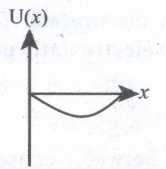
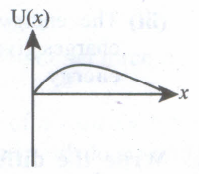
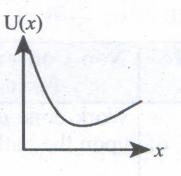
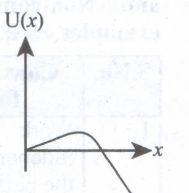
12.
The center of mass of a system of particles does not depend upon,
position of particles
relative distance between particles
masses of particles
force acting on particle
13.
The centrifugal force appears to exist
only in inertial frames
only in rotating frames
in any accelerated frame
both in inertial and non-inertial frames
14.
How many light years make 1 per sec?
3.26
6.67
1.5
9.4
15.
One of the combinations from the fundamental physical constants is \({{hc}\over{G}},\) The unit of this expression is
Kg2
m3
S-1
m
16.
Explain the classification of longitudinal strain?
17.
What do you mean by weight of a body? Is it a scalar or vector?
18.
Consider two organ pipes of same length in which one organ pipe is closed and another organ pipe is open. If the fundamental frequency of closed pipe is 250 Hz. Calculate the fundamental frequency of the open pipe.
19.
What is meant by an echo? Explain.
20.
A piece of wood of mass m is floating erect in a liquid whose density is ρ. If it is slightly pressed down and released, then executes simple harmonic motion. Show that its time period of oscillation is \(T=2 \pi \sqrt{\frac{m}{A g \rho}}\)
21.
Two bodies of masses m and 4m are placed at a distance r. Calculate the gravitational potential at a point on the line joining them where the gravitational field is zero.
22.
A vehicle of mass 1250 kg is driven with an acceleration 0.2 along a straight level road against an external resistive force 500 N. Calculate the power delivered by the vehicle's engine if the velocity of the vehicle is 30 ms-1.
23.
If \(\vec A=3\hat i+4\hat j\) and \(\vec B=7\hat i+24\hat j\) , find a vector having the same magnitude as \(\vec B\) and parallel to \(\vec A\).
24.
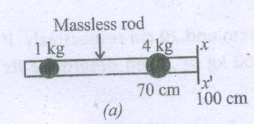
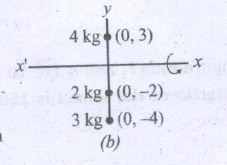
Calculate moment of inertia with respect to rotational axis xx' in following figures (a) and (b).
25.
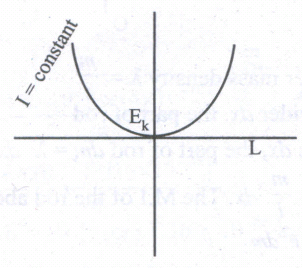
Write the relation between angular momentum and rotational kinetic energy. Draw a graph for the same. For two objects of same angular momentum, compare the moment of inertia using the graph.
26.
What are types of discoveries in physics?
27.
Two heavy spheres, each of mass 100kg and radius 0.8m are placed 1m about on a table What is the gravitational force and potential at the mid point of the line joining the centers of the spheres?
28.
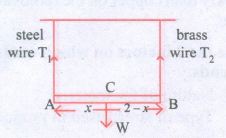
A light rod of length 2m is suspended horizontally by means of 2 vertical wires of equal lengths tied to its ends. One of the wires is made of steel & is of cross section A1 = 0.1 cm2 & other of brass & is of cross section A2 = 0.2 cm2, find out the position along the rod at which a weight must be suspended to produce
(i) equal stresses in both wires
(ii) equai strains in both wires for steel, y = 20\(\times\)1010 Nm-2 & for brass y =10\(\times\)1010 Nm-2.
29.
Write the important properties of thermal radiations.
30.
Consider a particle undergoing simple harmonic motion. The velocity of the particle at position x1 is v1 and velocity of the particle at position x2 is v2. Show that the ratio of time period and amplitude is
\(\frac { T }{ A } =2\pi \sqrt { \frac { { x }_{ 2 }^{ 2 }-{ x }_{ 1 }^{ 2 } }{ { { v }_{ 1 }^{ 2 }x }_{ 2 }^{ 2 }-{ { v }_{ 2 }^{ 2 }x }_{ 1 }^{ 2 } } } \)
31.
Figure shows the position-time graph of a particle of mass 4 kg. What is the
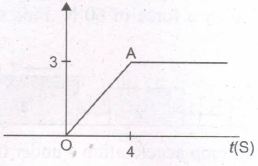
(a) Force on the particle for t < 0, t > 4s, 0 < t < 4s?
(b) Impulse at t = 0 and t = 4s?
(Consider one dimensional motion only)
32.
Calculate the number of times a human heart beats in the life of 100 years old man. Time of one heart beat = 0.8s.
33.
Arrive at an expression for power and velocity. Give some examples for the same.
34.
Find Torque about an Axis?
35.
Drive the relation between g & Gravitational constant.
36.
Distinguish between isothermal and adiabatic process.
37.
If a ball of skeel (density p =7.8 g cm-3) attains a terminal velocity of 10 cm S-1 when falling in a tank of water (coefficient of viscosity) water = 8.5\(\times\)10-4pa s. What will the terminal velocity in glycerine (P = 1.2 g cm-3, η = 13.2 ρa.s) be?
38.
Write short notes on reflection of sound waves from plane and curved surfaces.
39.
Explain in detail the Maxwell Boltzmann distribution function.
40.
Find the adiabatic exponent \(\gamma\) for mixture of μ1 moles of monoatomic gas and μ2 moles of a diatomic gas at normal temperature (27°C).
41.
Explain the principle of homogeniety of dimensions. What are its uses? Give example
42.
Write note on integration.
43.
Write an expression for the kinetic energy of a body in pure rolling.
1.
(a)
\(\frac{\pi}{2}\)
2.
(a)
gravitational attraction of the Earth for the atmosphere
3.
(b)
increase by 0.5%
4.
(a)
(B), (C) and (A)
5.
\(\lambda_{m} T =\mathrm{b} \)
\(\therefore T =\frac{2.898 \times 10^{-3}}{350 \times 10^{-9}}\)
\(\mathrm{~T} =0.00828 \times 10^{6} \)
\(=8280 \mathrm{~K} \)
6.
T2 = C (R + h)3
\(\therefore T \alpha (R_E)^\frac{3}{2}\)
RE = 2RE
\(\therefore T \alpha (2R_E)^\frac{3}{2}\)
Time period increases by \(2^\frac{2}{3}\)= 2\(\sqrt 2\)
No. of days in a year = (365.4) \(\times\)2\(\sqrt 2\)
= 1032
7.
(d)
\(\frac{2V_dV_u}{V_d+V_u}\)
8.
(b)
2 m
9.
(a)
7\(\sqrt { 2 } \)
10.
(d)
A man jumping onto a moving cart
11.
\(F=-\frac{d u}{d x} \quad F(x) =k x+a x^{3} \)
\(d u =-F d x \)
\(u(x) =-\int_{0}^{x}\left(-k x+a x^{3}\right) d x \)
\(=\int_{0}^{x} k x d x-a \int_{0}^{x} x^{3} d x \)
\(=\frac{k x^{2}}{2}-\frac{a x^{4}}{2} \)
\(U(x) =\frac{x^{2}}{2}\left(k-\frac{a x^{2}}{2}\right) \)
\(u(x)=0 \text { at } x=0 \text { and }\)
\(U(x) =0 ; k-\frac{a x^{2}}{2}=0 \)
\(=\frac{a}{2} x^{2}=-k \)
\(x^{2} =\frac{2 k}{a} \)
\(\therefore x =\sqrt{\frac{2 k}{a}} \)
\(\text { Clearly } u(x)=0 \text { at } x=0 \text { and }\)
\(x=\sqrt{\frac{2 k}{a}}\)
\(\text { For } x>\sqrt{\frac{2 k}{a}} U(x) \text { will be negative. } \)
\(\text { At } x=0 ; F=\frac{-d u}{d x}=0\)
(i.e.,) Slope of V - x graph is zero at x = 0
Hence the most appropriate answer is d.
12.
(d)
force acting on particle
13.
(b)
only in rotating frames
14.
(a)
3.26
15.
Unit of a (Planck's constant) - Js
Unit of c (Velocity of light) - ms-1
Unit of G (Gravitational Constant) - \(\frac{\mathrm{Nm}^{2}}{\mathrm{Kg}^{2}}\)
\(\therefore \text { Unit of } \frac{h c}{G} \text { is }=\frac{J s \times m s^{-1}}{N m^{2} / k g^{2}} \)
\(=\frac{N m s \times m s^{-1} \times k g^{2}}{N m^{2}}[J=N m] =\mathrm{kg}^{2}\)
16.
Longitudinal strain can be classified into two types:
(i) Tensile strain: If the length is increased from its natural length then it is known as tensile strain.
(ii) Compressive strain: If the length is decreased from its natural length then it is known as compressive strain.
17.
Weight of a body is defined as the gravitational force with which a body is attracted towards the centre of the earth. Hence the weight of a body is given by W = mg (or) \(\vec { w } =m\vec { g } \)
18.
For a closed organ Pipe
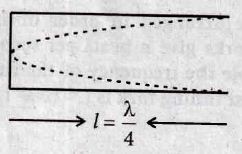
\(\ell=\frac{\lambda}{4}
\)
\(\therefore \lambda=4 \ell\)
For a open organ pipe \(L=\frac{\lambda}{2} \quad \therefore \lambda=2 L\)
Fundamental frequency of a closed pipe
\(f_{c} =250 \mathrm{~Hz}
\)
\(f_{0} =\frac{V}{\lambda}
\)
\(=\frac{V}{2 L}\)
Fundamental frequency of open organ pipe
\(f_{o} =2\left(\frac{V}{4 L}\right)
\)
\(=2 \times f_{c}
\)
\(=2 \times 250=500 \mathrm{~Hz}\)
∴ Frequency of open organ pipe =500 Hz.
19.
An echo is a repetition of sound produced by the reflection of sound waves fiom a wall, mountain or other obstructing surfaces. The speed of sound in air at 20De is 344 ms-1. If we shout at a wall which is at 344 m away, then the sound will take 1 second to reach the wall. After reflection, the sound will take one more second to reach us. Therefore, we hear the echo after two seconds. Scientists have estimated that we can hear two sounds properly if the time gap or time interval between each sound is \((\frac{1}{10})^{th}\) of a second (persistence of hearing) i.e., 0.1 s. Then,
Velocity = \(\frac{Distance\ travelled}{time\ taken}=\frac{2d}{r}\)
2d = 344\(\times\)0.1 = 34.4 m
d = 17.2 m
The minimum distance from a sound reflecting wall to hear an echo at 2oCe is 17.2 meter.
20.
When a piece of wood is pressed and released,
\(\mathrm{F}=\mathrm{ma}, \quad \mathrm{m} =\text { volume } \times \text { density }=\mathrm{A} \times \rho
\)
\(\text { Change in force } =\mathrm{mg}=\mathrm{A} \times \rho \mathrm{g}
\)
\(\therefore \text { Acceleration a } =\frac{F}{m}
\)
\(a =\left(\frac{A \rho g}{m}\right) x
\) .....(1)
For SHM, \(a =\omega^{2} x\) .....(2)
From equation (1) & (2) we get
\(\omega^{2}=\frac{A \rho g}{m} \quad \therefore \omega=\sqrt{\frac{A \rho g}{m}}\)
Time period \(\mathrm{T}=\sqrt{\frac{2 \pi}{\omega}} \quad \therefore \mathrm{T}=2 \pi \sqrt{\frac{m}{A \rho g}}\)
21.
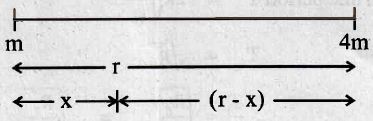
\(\text {The gravitational field }=-\frac{G m}{r^{2}} \hat{r}
\)
\(\frac{G m}{x^{2}}=\frac{G \times 4 m}{(r-x)^{2}}
\)
\(\frac{m}{x^{2}}=\frac{4 m}{(r-x)^{2}}
\)
\(\frac{1}{x^{2}}=\frac{4}{(r-x)^{2}}
\)
\(\frac{1}{x}=\frac{2}{r-x}\)
r - x = 2x
\(\mathrm{r}=3 x \quad \therefore x=\frac{r}{3}
\)
\(\text {Gravitational potential } \mathrm{V}=-\frac{G m}{r}=-\frac{9 \mathrm{Gm}}{r}\)
22.
The vehicle's engine has to do work against resistive force and make vehicle to move with an acceleration. Therefore, power delivered by the vehicle engine is
P (resistive force + mass x acceleration) (velocity)
\(P=\overrightarrow { { F }_{ -tot } } \overrightarrow { v } =\left( { F }_{ resistance }+F \right) \overrightarrow { v } \)
\(P=\overrightarrow { { F }_{ tot } } .\overrightarrow { v } =\left( { F }_{ resistance }+ma \right) \overrightarrow { v } \)
= (500 N + (1250 kg) \(\times\) (0.2 ms-2)) (30 ms-1) = 22.5 kW
23.
\(|\vec A|=\sqrt {3^2+4^2}=5\)
also \(|\vec B|=\sqrt {7^2+24^2}=25\)
desired vector \(=|\vec B|\hat A=25\times\frac{3\hat i+4\hat j}{5}=5(3\hat i+4\hat j)=15\hat i+20\hat j\).
24.
(a) Ixx' = 4 \(\times\) (0.3)2 + 1 \(\times\) (0.8)2 = 1 kgm2
(b) Ixx'= 4 \(\times\) (3)2 + 2 \(\times\) (2)2 + 3 \(\times\) (4)2 = 92 kgm2
25.
Relation between angular momentum and rotational K.E.
Angular momentum, L = IW.
Rotational K.E., EK = \(\frac{1}{2}\)
\(2I={ (I\omega ) }^{ 2 }\)
\({ x }_{ k }=\frac { { L }^{ 2 } }{ 2I } \)
\(\sqrt { { E }_{ k } } =\frac { L }{ \sqrt { 2I } } \)
\(\frac { \sqrt { { E }_{ k } } }{ L } =\frac { I }{ \sqrt { 2I } } =constant\)
If I = 1, graph will be hyperbola.
.png)
26.
(i) Accidental discoveries and well-analysed research outcome in the laboratory based on intuitive thinking and prediction.
(ii) For example, magnetism was accidentally observed but the reason for this strange behaviour of magnets was later analysed theoretically.
(iii) This analysis revealed the underlying phenomena of magnetism. With this knowledge, artificial magnets were prepared in the laboratories.
27.
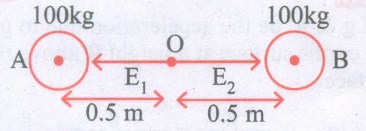
A & B be the two given spheres & 0 = mid point
If E1 & E2 are the gravitational fields
\({ E }_{ 1 }=\frac { G\times 100 }{ { \left( 0.5 \right) }^{ 2 } } { E }_{ 2 }=\frac { G\times 100 }{ { \left( 0.5 \right) }^{ 2 } } \)
E1 & E2 are equal & opposite, then resultant gravitational field at O is zero.
V - gravitational potential at O due to A & B
\(V=-\frac { D.100 }{ 0.5 } -\frac { G.100 }{ 0.5 } =-\frac { 2G.100 }{ 0.5 } \)
\(=\frac { -200\times { 6.67 }^{ - }{ 10 }^{ -11 } }{ 0.5 } =-2.7\times { 10 }^{ -8 }J/kg\)
28.
The situation in diagram
Let A & B be a rod of length 2m suppose a weight w is hung at C at a distance x from A. Let T1 & T2 be the tension in the steel & brass rods.
(i) stress in steel wire = \(\frac{T_{1}}{A_{1}}\)
stress in brass wire = \(\frac{T_{2}}{A_{2}}\) as both the stresses are equal, so
\(\frac{T_{1}}{A_{1}}\)=\(\frac{T_{2}}{A_{2}}\) or \(\frac{T_{1}}{T_{2}}=\frac{A_{1}}{A_{2}}\)
\(= \frac{0.1}{0.2}=\frac{1}{2}\)
Now moments about C are equal system is in equilibrium
\(T_{1}=T_{2}(2-x) \ or \ \frac{T_{1}}{T_{2}}=\frac{2-x}{x}\)
\(\frac{1}{2}=\frac{2-x}{x}\)
x = 4-2x
3x = 4 or \(x=\frac{4}{3}=1.33 m\)
(ii) Now \(y= \frac{stress}{stram}\)
∴ strain = stress/ y
strain in steel wire = \(\frac{T_{1}/A_{1}}{y}\)
strain in brass wire = \(\frac{T_{2}/A_{2}}{y_{2}}\)
Now, \(\frac{T_{1}}{A_{1}y_{1}}=\frac{T_{2}}{A_{2}y_{2}}\)
\(\frac{T_{1}}{T_{2}}=\frac{A_{1}y_{1}}{A_{2}y_{2}}\)
=\(\frac{0.1 cm^{2}\times 20\times 10^{10}Nm^{-2}}{0.2 m^{2}\times 10\times 10^{10}Nm^{-2}}=1\)
again, T1x = T2(2-x)
\(1=\frac{2-x}{2}\)
x = 2 - x
2x = 2 or x = 1m
29.
(i) Thermal radiations are EM waves having wavelength range 1 mm to 100 mm. It is also called IR waves
(ii) They travel in straight lines.
(iii) It obeys the laws of reflection and refraction
(iv) It shows the phenomenon of interference; diffraction and polarisation.
(v) It produces heat when they fall on the substance
30.
Using equation
v = \(\omega \sqrt { { A }^{ 2 }-{ x }^{ 2 } } \Rightarrow { v }^{ 2 }={ \omega }^{ 2 }\left( { A }^{ 2 }-{ x }^{ 2 } \right) \)
Therefore, at position x1,
\({ v }_{ 1 }^{ 2 }={ \omega }^{ 2 }\left( { A }^{ 2 }-{ x }_{ 1 }^{ 2 } \right) \) .................(1)
Similarly, at position x2,
\({ v }_{ 2 }^{ 2 }={ \omega }^{ 2 }\left( { A }^{ 2 }-{ x }_{ 2 }^{ 2 } \right) \) ...................(2)
Subtrating (2) from (1), we get
\({ v }_{ 1 }^{ 2 }-{ v }_{ 2 }^{ 2 }={ \omega }^{ 2 }\left( { A }^{ 2 }-{ x_1 }^{ 2 } \right) -{ \omega }^{ 2 }\left( { A }^{ 2 }-{ x }_{ 2 }^{ 2 } \right) \)
\(= { \omega }^{ 2 }\left( { x }_{ 2 }^{ 2 }-{ x }_{ 1 }^{ 2 } \right) \)
\({ \omega }=\sqrt { \frac { { v }_{ 1 }^{ 2 }-{ v }_{ 2 }^{ 2 } }{ { x }_{ 2 }^{ 2 }-{ x }_{ 1 }^{ 2 } } } \Rightarrow T=2\pi \sqrt { \frac { { x }_{ 2 }^{ 2 }-{ x }_{ 1 }^{ 2 } }{ { { v }_{ 1 }^{ 2 } }-{ { v }_{ 2 }^{ 2 } } } } \) ....................(3)
Dividing (1) and (2), we get
\(\frac { { v }_{ 1 }^{ 2 } }{ { v }_{ 2 }^{ 2 } } =\frac { { \omega }^{ 2 }\left( { A }^{ 2 }-{ x }_{ 1 }^{ 2 } \right) }{ { \omega }^{ 2 }\left( { A }^{ 2 }-{ x }_{ 2 }^{ 2 } \right) } \Rightarrow A=\sqrt { \frac { { { v }_{ 1 }^{ 2 }x }_{ 2 }^{ 2 }-{ v }_{ 2 }^{ 2 }{ x }_{ 1 }^{ 2 } }{ { { v }_{ 1 }^{ 2 } }-{ { v }_{ 2 }^{ 2 } } } } \) .................(4)
Dividing equation (3) and equation (4), we have
\(\frac { T }{ A } =2\pi \sqrt { \frac { { x }_{ 2 }^{ 2 }-{ x }_{ 1 }^{ 2 } }{ { { v }_{ 1 }^{ 2 }x }_{ 2 }^{ 2 }-{ { v }_{ 2 }^{ 2 }x }_{ 1 }^{ 2 } } } \)
31.
(a) For t < 0. No force as Particles is at rest.
For t > 4s, No force again particle comes at rest.
For 0 < t < 4s, as slope of OA is constant so velocity constant i.e., a = 0, so force must be zero.
(b) Impulse = change in momentum
I = m(v-u) = 4(0-0.75) = 3 kg ms-1
Impulse at t = 4s
I = m(v-u) = 4(0-0.75) = -3 kg ms-1
32.
Life of the man = 100 years
100 years includes 76 normal years and 24 leap years
Total no of days = 76\(\times\)365 + 24\(\times\)366 = 36524 days
Number of seconds = 36524\(\times\)24\(\times\)3600 = 3.155\(\times\)10° second
\(\text{Number of hearts beats}=\frac{Total\ no\ of\ seconds}{Time\ period\ of\ heart\ beat}=\frac{3.155\times10^9}{0.8s}=3.94\times10^9\)
33.
Relation between power and velocity
The work done by a force \(\overrightarrow{\mathbf{F}}\) for a displacement \(d \vec{r}\) is
\(W=\int \overrightarrow{\mathrm{F}} \cdot d \vec{r}\) ......(1)
Left hand side of the equation (1) can be written as
\(W=\int d W=\int \frac{d W}{d t} d t\)
(multiplied and divided by dt) (2)
Since, velocity is \(\vec{v}=\frac{d \vec{r}}{d t} ; \overrightarrow{d r}=\vec{v} d t.\) Right hand side of the equation (1) can be written as
\(\int \overrightarrow{\mathrm{F}} \cdot d \vec{r}=\int\left(\overrightarrow{\mathrm{F}}, \frac{d \vec{r}}{d t}\right) d t=\int(\overrightarrow{\mathrm{F}} \cdot \vec{v}) d t\left[v=\frac{d \vec{r}}{d t}\right] \ldots \ldots\) (3)
Substituting equation (2) and equation (3) in equation (1), we get
\(\int \frac{d W}{d t} d t=\int(\overrightarrow{\mathrm{F}} \cdot \vec{v}) d t\)
Or
\(\int\left(\frac{d W}{d t}-\overrightarrow{\mathrm{F}} \cdot \vec{v}\right) d t=0\)
This relation is true for any arbitrary value of dt. This implies that the term within the bracket must be equal to zero, i.e.,
\(\frac{d W}{d t}-\overrightarrow{\mathrm{F}} \cdot \vec{v} =0 \)
\(\frac{d W}{d t} =\overrightarrow{\mathbf{F}} \vec{v}\)
Examples: Motors, Engines and Automobiles
A vehicle of mass 1250 kg is driven with an acceleration 0.2 ms-2 along a straight level road against an external resistive force 500 N. Calculate the power delivered by the vehicle's engine if the velocity of the vehicle is 30 ms-1.
Solution
The vehicle's engine has to do work against resistive force and make vehicle to move with an acceleration. Therefore, power delivered by the vehicle engine is
\(P =(\text { resistive force }+\text { mass } \times \text { acceleration }) \text { (velocity) } \)
\(P =\overrightarrow{\mathbf{F}}_{-\mathrm{ma}} \vec{v}=\left(F_{\text {reistie }}+F\right) \vec{v} \)
\(P =\overrightarrow{\mathbf{F}}_{\text {tot }} \vec{v}=\left(F_{\text {reithie }}+m a\right) \vec{v} \)
\(=500 \mathrm{~N}+\left((1250 \mathrm{~kg}) \times\left(0.2 \mathrm{~ms}^{-2}\right)\right)\left(30 \mathrm{~ms}^{-1}\right)=22.5 \mathrm{kw}\)
34.
(i) Consider a rigid body capable of rotating about an axis AB as shown in Figure. Let the force F act at a point P on the rigid body.
(ii) The force F may not be on the plane ABP. The origin O at any random point on the axis AB is taken.
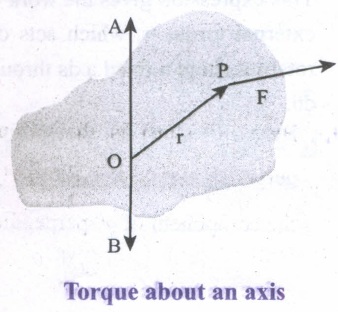
(iii) The torque of the force \(\overset { \rightarrow }{ F } \) about O is \(\overset { \rightarrow }{ \tau } =\overset { \rightarrow }{ r } \times \overset { \rightarrow }{ F } \) . The component of the torque along the axis is the torque of \(\overset { \rightarrow }{ F } \) about the axis. To find it, we should first find the vector \(\overset { \rightarrow }{ \tau } =\overset { \rightarrow }{ r } \times \overset { \rightarrow }{ F } \) and then find the angle φ between ፒ and AB. (Remember here, \(\overset { \rightarrow }{ F } \) is not on the plane ABP). The torque about AB is the parallel component of the torque along AB, which is \(\left| \overset { \rightarrow }{ r } \times \overset { \rightarrow }{ F } \right| \) cos\(\phi \) . And the torque perpendicular to the axis AB is \(\left| \overset { \rightarrow }{ r } \times \overset { \rightarrow }{ F } \right| \)sin\(\phi \).
35.
The gravitational force exerted by Earth on the mass m near the surface of the Earth is given by
\(\overrightarrow { F } =-\frac { { GMM }_{ e } }{ { R }_{ e }^{ 2 } } \hat { r } \)
Now equating Gravitational force to Newton's second law,
\(ma=-\frac { { GMM }_{ e } }{ { R }_{ e }^{ 2 } } \hat { r } \)
Hence, acceleration is,
\(\overrightarrow { a } =-\frac { { GM }_{ e } }{ { R }_{ e }^{ 2 } } \hat { r } \)
The acceleration experienced by the object near the surface of the Earth due to its gravity is called acceleration due to gravity. It is denoted by the symbol g. The magnitude of acceleration due to gravity is
\(\left| g \right| =\frac { { GM }_{ e } }{ { R }_{ e }^{ 2 } } \hat { r } \)
It is to be noted that the acceleration experienced by any object is independent of its mass. The value of g depends only on the mass and radius of the Earth.
36.
| S.No | Isothermal | Adiabatic |
|---|---|---|
| 1. | Temperature remains constant \(\triangle\)T =0 | Heat content remains constant \(\triangle\)Q |
| 2 | Walls of the container is perfectly conductivity. | All walls and piston are perfectly an insulating. |
| 3. | The changes occur slowly i.e. slow process. | The changes occur suddenly i.e. a fast process. |
| 4. | Internal energy remains constant, i.e \(\triangle\)U = 0 | internal energy changes \(\triangle\)U \(\neq \) 0 |
| 5. | Pv = constant | \({ P }_{ v }^{ \gamma }\) constant |
| 6 | Slope of isothermal curve on pv dig. \(\frac { -P }{ v } =\frac { dp }{ dv } \) |
Slope is \(\frac { -\gamma p }{ v } \) \(\gamma >1\) Slope of adiabatic greater than isothermal. |
37.
Here ρ = 7.8 g/cm3 ; rw = 10 cm/s
ηw = 8.5\(\times\)10-4 ρa.s
Pg=1.2g/cm3 ; ηg =13.2 ρa s; Vg=?
Terminal velocity V = \(\frac{2r^{2}(\rho-\rho_{0})g}{9\eta}\)
\(v \propto \frac{(\rho-\rho_{0})}{\eta}\)
When ball falls in water, then
\(V_{w} \propto \frac{(\rho-\rho_{w})}{\eta_{w}}\)
When ball falls in glycerine
\(V_{g} \propto \frac{(\rho-\rho_{g})}{\eta_{g}}\)
\(\frac{V_{g}}{V_{w}}=(\frac{\rho-\rho_{g}}{\rho-\rho_{w}})\frac{\eta_{w}}{\eta_{g}}\)
\(V_{g}={V_{w}}=(\frac{\rho-\rho_{g}}{\rho-\rho_{w}})\frac{\eta_{w}}{\eta_{g}}\)
= 10\((\frac{7.8-1.2}{7.8-1})\times \frac{8.5 \times 10^{-4}}{13.2}\)
= 6.25 \(\times\)10-4 cm/s
38.
Sound reflects from a harder flat surface, is called as specular reflection.
Specular reflection is observed only when the wavelength of the source is smaller than dimensions of the reflecting surface, as well as smaller than surface irregularities.
When the sound waves hit the plane wall, they bounce off in a manner similar to that of light. Suppose a loudspeaker is kept at an angle with respect to a wall (plane surface), then the waves coming from the source (assumed to be a point source) can be treated as spherical wave fronts (say, compressions moving like a spherical wave front). Therefore, the reflected wave front on the plane surface is also spherical, such that its centre. of curvature (which lies on the other side of plane surface) can be treated as the image of the sound source (virtual or imaginary loud speaker) which can be assumed to be at a position behind the plane surface.
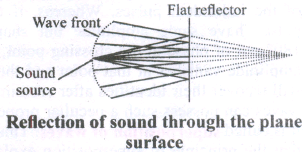
Reflection of so d ' through the curved surface.
The behaviour of sound is different when it is reflected from different surfaces-convex or concave or plane. The sound reflected from a convex surface is spread out and so it is easily attenuated and weakened. Whereas, if it is reflected from the concave surface it will converge at a point and this can be easily amplified. The parabolic reflector (curved reflector) which is used to focus the sound precisely to a point is used in designing the parabolic mics which are known as high directional microphones. We know that any surface (smooth or rough) can absorb sound.
39.
In general our interest our interest is to find how many gas molecules have the range of speed from v to v + dv. This is given by Maxwell's speed distribution function.
\({ N }_{ v }=4\pi N{ \left( \frac { m }{ 2\pi KT } \right) }^{ \frac { 3 }{ 2 } }{ v }^{ 2 }{ e }^{ \frac { { mv }^{ 2 } }{ 2KT } }\) ....(1)
The above expression is graphically shown as follows
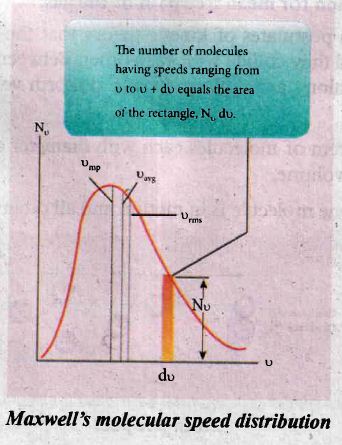
From the figure it is clear that, for a given temperature the number of molecules having lower speed increases parabolically but decreases exponentially after reaching most probable speed. The rms speed, average speed and most probable speed are indicated in the figure. It can be seen that the rms speed is greatest among the three. To Know the number of molecules in the range of speed between \(50 \mathrm{~m} \mathrm{~s}^{-1} \ and \ 60 \mathrm{~m}\mathrm{s}^{-1}\), we need to integrate \(\int_{50}^{60} 4 \pi N\left(\frac{m}{2 \pi k T}\right)^{\frac{3}{2}} v^{2} e^{\frac{m v^{2}}{2 k T}} d v=\mathrm{N}\left(50\right.\ to \ \left.60 \mathrm{~ms}^{-1}\right)\). In general the number of molecules within the range of speed v and v + dv is given by
\(\int_{v}^{v+d v} 4 \pi N\left(\frac{m}{2 \pi k T}\right)^{\frac{3}{2}} v^{2} e^{\frac{m v^{2}}{2 k T}} d v=N(v \text { to } v+d v)
\)
The exact integration is beyond the scope of the book. But we can infer the behaviour of gas molecules from the graph.
(i) The area under the graph will give the total number of gas molecules in the system.
(ii) Figure shows the speed distribution graph for two different temperatures. As temperature increases, the peak of the curve is shifted to the right. It implies that the average speed of each molecule will increase. But the area under each graph is same since it represents the total number of gas molecules.
.JPG)
40.
The specific heat of one mole of a monoatomic gas CV = \(\frac{3}{2}\)R
For \(\mu\)1 mole , CV = \(\frac{3}{2}\)\(\mu\)1R Cp = \(\frac{5}{2}\)\(\mu\)1 R
The specific heat of one mole of a diatomic gas
Cv = \(\frac{5}{2}\)R
For μ2 mole, CV = \(\frac{5}{2}\)μ2 R CP = \(\frac{7}{2}\)μ2 R
The specific heat of the mixture at constant volume CV = \(\frac{3}{2}\)\(\mu\)1R +\(\frac{5}{2}\)\(\mu\)2 R
The specific heat of the mixture at constant pressure CP = \(\frac{5}{2}\)\(\mu\)1 R + = \(\frac{7}{2}\)\(\mu\)2 R
The adiabatic exponent \(\gamma =\frac { { C }_{ p } }{ { C }_{ V } } =\frac { 5{ \mu }_{ 1 }+{ 7\mu }_{ 2 } }{ 3{ \mu }_{ 1 }+{ 5\mu }_{ 2 } } \)
41.
The principle of homogeneity of dimensions states that the dimensions of all the terms in a physical expression should be the same. For example, in the physical expression v2= u2 + 2as, the dimensions of v2, u2 and 2 as are the same and equal to [L2T-2].
This method is used to
(i) Convert a physical quantity from one system of units to another.
(ii) Check the dimensional correctness of a given physical equation.
(iii) Establish relations among various physical quantities.
(i) To convert a physical quantity from one system of units to another: This is based on the fact that the product of the numerical values (n) and its corresponding unit (u) is a constant. i.e, n1[u1] = constant (or) n, n1[u1 ] = n2[u2].
Consider a physical quantity which has dimension 'a' in mass, 'b' in length and 'c' in time.
If the fundamental units in one system are M1, L1 and T1 and the other system are M2, L2, and T2 respectively, then we can write, n1 [M1a L1b T1c] = n2 [ M 2a L2b T2c]
We have thus converted the numerical value of physical quantity from one system of units into the other system.
Example: Convert 76 cm of mercury pressure into Nm-2 using the method of dimensions.
Solution: In cgs system 76 cm of mercury pressure =76\(\times\)13.6\(\times\)980 dyne cm-2
The dimensional formula of pressure P is [ML-1T-2]
\(P_{1}\left[M_{1}^{a} L_{1}^{b} T_{1}^{c}\right]=P_{2}\left[M_{2}^{a} L_{2}^{b} T_{2}^{c}\right]\)
We have
\(P_{2} =\left[\frac{\mathrm{M}_{1}}{\mathrm{M}_{2}}\right]^{a}\left[\frac{\mathrm{L}_{1}}{\mathrm{~L}_{2}}\right]^{b}\left[\frac{\mathrm{T}_{1}}{\mathrm{~T}_{2}}\right]^{c} \)
\(M_{1} =1 \mathrm{~g}, \mathrm{M}_{2}=1 \mathrm{~kg}\)
\(L_{1}=1 \mathrm{~cm}, \mathrm{~L}_{2}=1 \mathrm{~m}
\)
\(T_{1}=1 \mathrm{~s}, T_{2}=1 \mathrm{~s}\)
So a=1, b=1 and c=-2
Then
\(P_{2} =76 \times 13.6 \times 980\left[\frac{\mathrm{g}}{1 \mathrm{~kg}}\right]^{1}\left[\frac{\mathrm{cm}}{1 \mathrm{~m}}\right]^{-1}\left[\frac{1 \mathrm{~s}}{1 \mathrm{~s}}\right]^{-2} \)
\(=76 \times 13.6 \times 980\left[\frac{10^{-3} \mathrm{~kg}}{1 \mathrm{~kg}}\right]^{1}\left[\frac{10^{-2} \mathrm{~m}}{1 \mathrm{~m}}\right]^{-1}\left[\frac{1 \mathrm{~s}}{1 \mathrm{~s}}\right]^{-2} \)
\(=76 \times 13.6 \times 980 \times\left[10^{-3}\right] \times 10^{2} \)
\(P_{2} =1.01 \times 10^{5} \mathrm{Nm}^{-2}\)
(ii) To check the dimensional correctness of a given physical equation:
Example: The equation \(1\over 2\) mv2 = mgh can be checked by using this method as follows.
Solution: Dimensional formula for
\(\boxed{{1\over 2}mv^2=[M][LT^{-1}]^2=[ML^2T^{-2}]}\)
Dimensional formula for
\(\boxed {mgh=[M][LT^{-2}][L]=[ML^{2}T^{-2}] \\ [ML^{2}T^{2}]=[ML^{2}T^{-2}]}\)
Both sides are dimensionally the same, hence the equations\(1\over 2\) mv2 = mgh is dimensionally correct.
(iii) To establish the relation among various physical quantities:
If the physical quantity Q depends upon the quantities Q1, Q2 and Q3 ie. Q is proportional to Q1, Q2 and Q3.
Then,
\(Q \alpha Q_{1}^{a} Q_{2}^{b} Q_{3}^{c}
\)
\(Q=k Q_{1}^{a} Q_{2}^{b} Q_{3}^{c}\)
where k is a dimensionless constant. When the dimensional formula of Q1, Q2 and Q3 are substituted, then according to the principle of homogeneity, the powers of M, L, T are made equal on both sides of the equation. From this, we get the values of a, b, c.
Example:
Obtain an expression for the time period T of a simple pendulum. The time period T depend upon (i) mass 'm' of the bob (ii) length 'l' of the pendulum and (iii) acceleration due to gravity g at the place where the pendulum is suspended. (Constant k=2π ) i.e
Solution:
\(\boxed{T \alpha m^a l^b g^c \\ T=k.m^al^bg^c}\)
Here k is the dimensionless constant. Rewriting the above equation with dimensions.
\(\boxed{[T^1]=[M^a][L^b][LT^{-2}]^c\\ [M^oL^oT^1]=[M^aL^{b+c}T^{-2c}]}\)
Comparing the powers of M, L and T on both sides, a = 0, b + C = 0, -2c = 1
Solving for a, b and c a = 0, b = 1/2, and c = -1/2
From the above equation
T = k. mo l1/2 g-1/2
T=\(k{1\over g}^{1\over 2}=k\sqrt{1\over g}\)
Experimentally k = 2\(\pi\) , hence \(T=2\pi \sqrt{l\over g}\)
42.
Integration is basically an area finding process. For certain geometric shapes we can directly find the area. But for irregular shapes the process of integration is used.
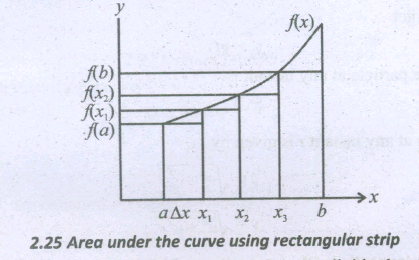
To find the area of the irregular shaped curve given by fix), we divide the area into rectangular strips as shown in the figure. The area under the curve is approximately equal to sum of areas of each rectangular strip.
This is given by \(A\approx f\left( a \right) \triangle x+f\left( { x }_{ 1 } \right) \triangle x+f\left( { x }_{ 2 } \right) \triangle x+f\left( b \right) \triangle x\)
Where f(a) is the value of the function f(x) at x = a,f(x1) is the value of f(x) for x = x1 and so on.
As we increase the number of strips, the area evaluated becomes more accurate. If the area under the curve is divided into N strips, the area under the curve is given by
\(A=\sum _{ n=1 }^{ N }{ { f }_{ n }\left( { x }_{ n } \right) \triangle { x }_{ n } } \)
As the number of strips goes to infinity,\(N\rightarrow \infty \) the sum becomes an integral,
\(A=\int _{ a }^{ b }{ f\left( x \right) dx } \) (Note: As \(N\rightarrow \infty ,\triangle x\rightarrow 0\))
The integration will give the total area under the curve f(x).
43.
(i) The total kinetic energy (KE) can be written as the sum of kinetic energy due to translational motion (KETRANS) and kinetic energy due to rotational motion (KEROT)
KE = KETRANS + KEROT
(ii) If the mass of the rolling object is M, the velocity of center of mass is vCM its moment of inertia about center of mass is ICM and angular velocity is ω, then
KE = \(\frac { 1 }{ 2 } Mv^{ 2 }_{ CM }+\frac { 1 }{ 2 } { I }_{ CM }\omega ^{ 2 }\)
(iii) With center of mass as reference:
The moment of inertia (lCM) of a rolling object about the center of mass is,
ICM= MK2 and vCM= Rω. Here, K is radius of gyration.
\(KE=\frac { 1 }{ 2 } Mv^{ 2 }_{ CM }+\frac { 1 }{ 2 } \left( MK^{ 2 } \right) \frac { v^{ 2 }_{ CM } }{ R^{ 2 } } \\ \\ \)
\(KE=\frac { 1 }{ 2 } Mv^{ 2 }_{ CM }+\frac { 1 }{ 2 } Mv^{ 2 }_{ CM }\left( \frac { { K }^{ 2 } }{ R^{ 2 } } \right) \)
\(KE=\frac { 1 }{ 2 } Mv^{ 2 }_{ CM }\left( 1+\frac { K^{ 2 } }{ R^{ 2 } } \right) \)
(iv) With point of contact as reference: We can also arrive at the same expression by taking the momentary rotation happening with respect to the point of contact (another approach to rolling). if we take the point of contact as 0, then,
\(KE=\frac { 1 }{ 2 } { I }_{ 0 }\omega ^{ 2 }\)
Here, Io is the moment of inertia of the object about the point of contact. By parallel axis theorem, Io = ICM+ MR2. Further we can write, Io = MK2 + MR2. With vCM= Rω or
\(\omega =\frac { { v }_{ CM } }{ R } \)
\(KE=\frac { 1 }{ 2 } \left( MK^{ 2 }+MR^{ 2 } \right) \frac { v^{ 2 }_{ CM } }{ { R }^{ 2 } } \)
\(KE=\frac { 1 }{ 2 } Mv^{ 2 }_{ CM }\left( 1+\frac { { K }^{ 2 } }{ R^{ 2 } } \right) \)
(vi) K.E. in pure rolling can be determined by anyone of the following two cases.
(a) The combination of translational motion and rotational motion about the center of mass. (or)
(b) The momentary rotational motion about the point of contact.

11th Standard Syllabus & Materials
11th Standard
TN 11th Tamil பீடு பெற நில் - செய்யுள் - காவடிச்சிந்து Important Questions And Answers Study Material - QB365 Set A
NEW11th Standard
TN 11th Tamil பீடு பெற நில் - உரைநடை - மலை இடப்பெயர்கள் : ஓர் ஆய்வு Important Questions And Answers Study Material - QB365 Set A
NEW11th Standard
TN 11th Tamil மாமழை போற்றுதும் - துணைப்பாடம் - யானை டாக்டர் Important Questions And Answers Study Material - QB365 Set A
NEW11th Standard
TN 11th Tamil மாமழை போற்றுதும் - செய்யுள் - ஐங்குறுநூறு Important Questions And Answers Study Material - QB365 Set A



Tamilnadu Stateboard 11th Standard Subjects

Maths

Commerce

Economics

Biology

Business Maths and Statistics

Accountancy

Computer Science
Physics

Chemistry
Maths
Biology
Economics
Physics
Chemistry

History
Business Maths and Statistics

Computer Science
Accountancy

Computer Applications
History
Computer Technology
Commerce
Computer Applications
Computer Technology

Tamil

English

French
Tamilnadu Stateboard Standards

