
 100% FREE ACCESS
11th Standard Syllabus & Materials
11th Standard
TN 11th Tamil இயற்கை வேளாண்மை,சுற்றுச்சூழல் -செய்யுள் - மனோன்மணீயம் Important Questions And Answers Study Material - QB365 Set A
NEW11th Standard
TN 11th Tamil என்னுயிர் என்பேன் -துணைப்பாடம் - இசைத்தமிழர் இருவர் Important Questions And Answers Study Material - QB365 Set A
NEW11th Standard
TN 11th Tamil மொழி கலை -செய்யுள் - ஒவ்வொரு புல்லையும் Important Questions And Answers Study Material - QB365 Set A
NEW11th Standard
TN 11th Tamil பீடு பெற நில் - இலக்கணம் - பகுபத உறுப்புகள் Important Questions And Answers Study Material - QB365 Set A
NEW11th Standard
TN 11th Tamil பீடு பெற நில் - துணைப்பாடம் - வாடிவாசல் Important Questions And Answers Study Material - QB365 Set A
NEW11th Standard
TN 11th Tamil பீடு பெற நில் - செய்யுள் - குறுந்தொகை Important Questions And Answers Study Material - QB365 Set A

Published on: 09/10/2019
Heat and Thermodynamics
Download Tamil Nadu 11th Standard Physics question papers, model tests, one-mark questions, important questions, and public exam papers in PDF format. Free study materials and answer keys for TN State Board students.
Questions + Answers key
Take MCQ Physics Test1.
A steam engine boiler is maintained at 250°C and water is converted into steam. This steam is used to do work and heat is ejected to the surrounding air at temperature 300K. Calculate the maximum efficiency it can have?
2.
500 g of water is heated from 30°C to 60°C. Ignoring the slight expansion of water, calculate the change in internal energy of the water? (specific heat of water 4184 J/kg.K)
3.
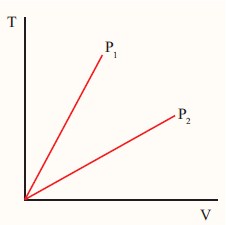
The following graph shows a V-T graph for isobaric processes at two different pressures. Identify which one occurs at higher pressure.
4.
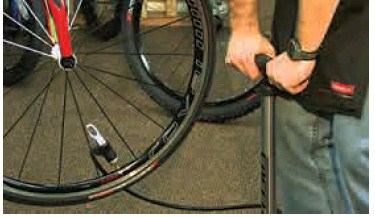
We often have the experience of pumping air into bicycle tyre using hand pump. Consider the air inside the pump as a thermodynamic system having volume V at atmospheric pressure and room temperature, 27°C. Assume that the nozzle of the tyre is blocked and you push the pump to a volume 1/4 of V.
Calculate the final temperature of air in the pump? (For air, since the nozzle is blocked air will not flow into tyre and it can be treated as an adiabatic compression).
5.
Give an example of a quasi-static process.
6.
Jogging every day is good for health. Assume that when you jog a work of 500 kJ is done and 230 kJ of heat is given off. What is the change in internal energy of your body?
7.
A person does 30 kJ work on 2 kg of water by stirring using a paddle wheel. While stirring, around 5 kcal of heat is released from water through its container to the surface and surroundings by thermal conduction and radiation. What is the change in internal energy of the system?
8.
During a cyclic process, a heat engine absorbs 500 J of heat from a hot reservoir, does work and ejects an amount of heat 300 J into the surroundings (cold reservoir). Calculate the efficiency of the heat engine?
9.
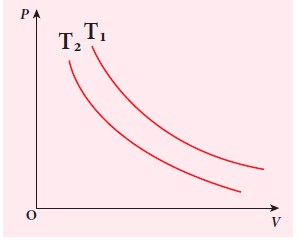
The following PV curve shows two isothermal processes for two different temperatures and. Identify the higher temperature of these two.
10.
A 0.5 mole of gas at temperature 300 K expands isothermally from an initial volume of 2 L to 6 L
(a) What is the work done by the gas?
(b) Estimate the heat added to the gas?
(c) What is the final pressure of the gas?
(The value of gas constant, R = 8.31 J mol-1 K-1)
1.
The steam engine is not a Carnot engine, because all the process involved in the steam engine are not perfectly reversible. But we can calculate the maximum possible efficiency of the steam engine by considering it as a Carnot engine.
\(\eta =1-\frac { { T }_{ L } }{ { T }_{ H } } =1-\frac { 300K }{ 523K } =0.43\)
The steam engine can have maximum possible 43% of efficiency, implying this steam engine can convert 43% of input heat into useful work and remaining 57% is ejected as heat. In practice the efficiency is even less than 43%.
2.
When the water is heated from 30°C to 60°C, there is only a slight change in its volume. So we can treat this process as isochoric. In an isochoric process the work done by the system is zero. The given heat supplied is used to increase only the internal energy.
ΔU = Q = msv ΔT
The mass of water = 500 g = 0.5 kg
The change in temperature = 30K
The heat Q = 0.5\(\times\)4184\(\times\)30 = 62.76 kJ
3.
From the ideal gas equation, \(V=\left( \frac { \mu R }{ P } \right) T\)
V-T graph is a straight line passing the origin.
The slope = \(\frac { \mu R }{ P } \)
The slope of V-T graph is inversely proportional to the pressure. If the slope is greater, lower is the pressure.
Here P1 has larger slope than P2. So P2 > P1.
4.
Here, the process is adiabatic compression. The volume is given and temperature is to be found. we can use the equation (8.38 )
\({ T }_{ i }{ V }_{ i }^{ \Upsilon -1 }{ =T }_{ f }{ V }_{ f }^{ \Upsilon -1 }.\)
Ti = 300 K (273 + 27°C = 300 K)
\({ V }_{ i }=V\& { V }_{ f }=\frac { V }{ 4 } \)
\({ T }_{ f }={ T }_{ i }{ \left( \frac { { V }_{ i } }{ { V }_{ f } } \right) }^{ \Upsilon -1 }\) = 300 K × 41.4-1 = 300K\(\times\)1.741
T2 ≈ 522 K or 2490C
This temperature is higher than the boiling point of water. So it is very dangerous to touch the nozzle of blocked pump when you pump air.
5.
Consider a container of gas with volume V, pressure P and temperature T. If we add sand particles one by one slowly on the top of the piston, the piston will move inward very slowly. This can be taken as almost a quasi-static process. It is shown in the figure
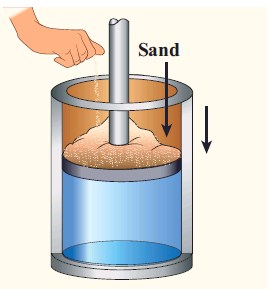
Sand particles added slowly- quasi-static process
6.

Work done by the system (body),
W = +500 kJ
Heat released from the system (body),
Q = –230 kJ
The change in internal energy of a body
= \(\Delta\)U= – 230 kJ – 500 kJ = – 730 kJ
7.
Work done on the system (by the person while stirring), W = -30 kJ = -30,000J
Heat flowing out of the system,
Q = -5 kcal = 5\(\times\)4184 J =-20920 J
Using First law of thermodynamics
\(\Delta\)U = Q-W
\(\Delta\)U = -20,920 J - (-30,000) J
\(\Delta\)U = -20,920 J + 30,000 J = 9080 J
Here, the heat lost is less than the work done on the system, so the change in internal energy is positive.
8.
The efficiency of heat engine is given by
\(\eta =1-\frac { { Q }_{ L } }{ { Q }_{ H } } \)
\(\eta =1-\frac { 300 }{ 500 } =1-\frac { 3 }{ 5 } \)
\(\eta \) = 1 – 0.6 = 0.4
The heat engine has 40% efficiency, implying that this heat engine converts only 40% of the input heat into work.
9.
To determine the curve corresponding to higher temperature, draw a horizontal line parallel to x axis as shown in the figure. This is the constant pressure line. The volumes V1 and V2 belong to same pressure as the vertical lines from V1 and V2 meet the constant pressure line.
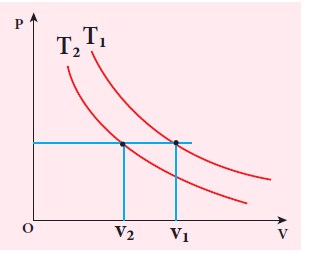
At constant pressure, higher the volume of the gas, higher will be the temperature. From the figure, as V1 > V2 we conclude T1 > T2. In general the isothermal curve closer to the origin, has lower temperature.
10.
(a) We know that work done by the gas in an isothermal expansion
Since μ = 0.5
W = 0.5mol \(\times\)\(\frac { 8.31J }{ mol.K } \times 300 K\ In\ \left( \frac { 6L }{ 2L } \right) \)
W = 1.369 kJ
Note that W is positive since the work is done by the gas.
(b) From the First law of thermodynamics, in an isothermal process the heat supplied is spent to do work.Therefore, Q = W = 1.369 kJ. Thus Q is also positive which implies that heat flows into the system.
(c) For an isothermal process
PiVi = PfVf = μRT
\({ P }_{ f }=\frac { \mu RT }{ { V }_{ f } } =0.5mol\times \frac { 8.31J }{ mol.K } \times \frac { 300K }{ 6\times { 10 }^{ -3 }{ m }^{ 3 } } \)
= 207.75 k Pa

11th Standard Syllabus & Materials
11th Standard
TN 11th Tamil பீடு பெற நில் - செய்யுள் - காவடிச்சிந்து Important Questions And Answers Study Material - QB365 Set A
NEW11th Standard
TN 11th Tamil பீடு பெற நில் - உரைநடை - மலை இடப்பெயர்கள் : ஓர் ஆய்வு Important Questions And Answers Study Material - QB365 Set A
NEW11th Standard
TN 11th Tamil மாமழை போற்றுதும் - துணைப்பாடம் - யானை டாக்டர் Important Questions And Answers Study Material - QB365 Set A
NEW11th Standard
TN 11th Tamil மாமழை போற்றுதும் - செய்யுள் - ஐங்குறுநூறு Important Questions And Answers Study Material - QB365 Set A



Tamilnadu Stateboard 11th Standard Subjects

Maths

Commerce

Economics

Biology

Business Maths and Statistics

Accountancy

Computer Science
Physics

Chemistry
Maths
Biology
Economics
Physics
Chemistry

History
Business Maths and Statistics

Computer Science
Accountancy

Computer Applications
History
Computer Technology
Commerce
Computer Applications
Computer Technology

Tamil

English

French
Tamilnadu Stateboard Standards

