
 100% FREE ACCESS
11th Standard Syllabus & Materials
11th Standard
TN 11th Tamil இயற்கை வேளாண்மை,சுற்றுச்சூழல் -செய்யுள் - மனோன்மணீயம் Important Questions And Answers Study Material - QB365 Set A
NEW11th Standard
TN 11th Tamil என்னுயிர் என்பேன் -துணைப்பாடம் - இசைத்தமிழர் இருவர் Important Questions And Answers Study Material - QB365 Set A
NEW11th Standard
TN 11th Tamil மொழி கலை -செய்யுள் - ஒவ்வொரு புல்லையும் Important Questions And Answers Study Material - QB365 Set A
NEW11th Standard
TN 11th Tamil பீடு பெற நில் - இலக்கணம் - பகுபத உறுப்புகள் Important Questions And Answers Study Material - QB365 Set A
NEW11th Standard
TN 11th Tamil பீடு பெற நில் - துணைப்பாடம் - வாடிவாசல் Important Questions And Answers Study Material - QB365 Set A
NEW11th Standard
TN 11th Tamil பீடு பெற நில் - செய்யுள் - குறுந்தொகை Important Questions And Answers Study Material - QB365 Set A

Published on: 21/09/2019
Heat and Thermodynamics
Download Tamil Nadu 11th Standard Physics question papers, model tests, one-mark questions, important questions, and public exam papers in PDF format. Free study materials and answer keys for TN State Board students.
Questions + Answers key
Take MCQ Physics Test1.
Define Emissivity.
2.
State Prevost theory of heat exchange.
3.
What is steady state?
4.
What is meant by triple point of substance?
5.
What is latent heat of sublimation?
6.
What is meant by latent heat of vaporization?
7.
Suppose a person wants to increase the efficiency of the reversible heat engine that is operating between 100°C and 300°C. He had two ways to increase the efficiency.
(a) By decreasing the cold reservoir temperature from 100°C to 50°C and keeping the hot reservoir temperature constant
(b) by increasing the temperature of the hot reservoir from 300°C to 350°C by keeping the cold reservoir temperature constant. Which is the suitable method?
8.
For a given ideal gas 6\(\times\)105J heat energy is supplied and the volume of gas is increased from 4 m3 to 6 m3 at atmospheric pressure. Calculate
(a) the work done by the gas
(b) change in internal energy of the gas
(c) graph this process in P-V and T-V diagram.
9.
What is meant by ‘thermal equilibrium’?
10.
What are the different types of thermodynamic systems?
11.
What is Wien’s law?
12.
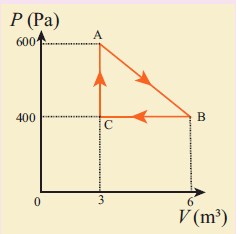
An ideal gas is taken in a cyclic process as shown in the figure. Calculate
(a) work done by the gas.
(b) work done on the gas
(c) Net work done in the process
13.
What is a thermodynamic system? Give examples.
14.
What is a black body?
15.
Define thermal conductivity. Give its unit.
1.
Emissivity is defined as the ratio of the energy radiated from a material's surface to that radiated from a perfect black body at the same temperature and wavelength.
2.
Prevost theory states that all bodies emit thermal radiation at all temperatures above absolute zero irrespective of the nature of the surroundings
3.
The state at which temperature attains constant value everywhere and there is no further transfer of heat anywhere is called steady state.
4.
The triple point of a substance is the temperature and pressure at which the three phases (gas, liquid and solid) of that substance coexist in thermodynamic equilibrium. The triple point of a substance is the temperature and pressure at which the three phases (gas, liquid and solid) of that substance coexist in thermodynamic equilibrium.
5.
The latent heat for a solid - gas state change is called the latent heat of sublimation (Ls)
6.
The latent heat for a liquid -gas state change is called the latent heat of vaporization (Lv)
7.
Temperature of sin x = 100°C + 273 = 373 K
Temperature of sin x = 300°C + 273 = 573 K
Efficiency \(\eta \) = ?
\(\eta =1-\cfrac { 273 }{ 573 } \)
\(=\cfrac { 537-273 }{ 573 } =\cfrac { 300 }{ 573 } =52.3%\)
(a) By decreasing the cold reservoir
\(\eta =1-\cfrac { { T }_{ 2 } }{ { T }_{ 1 } } \)
T2 = 50 + 273 = 323 k
T1= 300 + 273 = 573 k
\(\eta =1-\cfrac { 523 }{ 573 } =\cfrac { 573-323 }{ 573 } \)
= 0.436\(\times\)100
= 43.6%
(b) By increasing the temperature of hot reservoir
T1 = 350 + 273 = 623 k
T2 =100+273=373k
\(\eta =1-\cfrac { { T }_{ 2 } }{ { T }_{ 1 } } =1-\cfrac { 373 }{ 623 } =\cfrac { 623-373 }{ 623 } \)
= 0.401\(\times\)100
=40.1%
Method (a) is more efficient than method (b).
8.
Heat energy supplied to the gas Q = 6\(\times\)105J
Change in Volume\(\triangle \)V = (6 - 4) = 2m3
(a). Atmospheric pressure \(P=1.013 \times 10^{5} \mathrm{Nm}^{-2}\)
\(\Delta V =2 \mathrm{~m}^{3} \)
\(\therefore \text {Work done by the gas } =1.013 \times 10^{5} \times 2
\)
\(=2.026 \times 10^{5} \mathrm{~J}
\)
\(\mathrm{~W} =202.6 \mathrm{~kJ}\)
(b) Change in internal energy = ΔU
\(\Delta U =\Delta Q-\Delta W=\Delta Q-P \Delta V
\)
\(=6 \times 10^{5}-2.026 \times 10^{5}
\)
\(=3.974 \times 10^{3} \mathrm{~J}
\)
\(\Delta U =3.97 \mathrm{~kJ}\)
(c)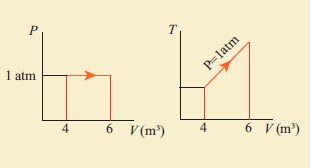
9.
Two systems are said to be in thermal equilibrium with each other if they are at the same temperature, will not change with time.
10.
The different types of thermodynamic system are
(i) open system
(ii) closed system
(iii) isolated system
11.
Wien's law states that, the wavelength of maximum intensity of emission of a black body radiation is inversely proportional to the absolute temperature of the black body.
\({ \lambda }_{ m } \)∝\(\frac { 1 }{ T } \)
\({ \lambda }_{ m }=\frac { b }{ T } \)
12.
(a) Work done by the gas along AB
W = P\(\triangle \)V
∴ W = 600\(\times\)3 = 1800 J = 1.8 kJ
(b) Work is done on the gas along BC
W = -P\(\triangle \)V
= -400\(\times\)(6 - 3)
= - 400 x 3 = -1200 J
=-1.2 kJ
(c) Net work done in the process
= Area under the curve AB
= Area of rectangle + Area of triangle
Area of triangle =\(\cfrac { 1 }{ 2 } \)\(\times\)b\(\times\) h
\(=\cfrac { 1 }{ 2 } \times \triangle V\times \triangle P\)
=\(\cfrac { 1 }{ 2 } \)\(\times\)3\(\times\)200 = 300J
Area of rectangle = I\(\times\) b
=400\(\times\)3 = 1200 J
∴ Net work done= 1200 + 300
W = 1500 J = 1.5 J
∴ W = 1.5 J
13.
A thermodynamic system is a finite part of the universe. It is a collection of large number of particles (atoms and molecules) specified by certain parameters called pressure (P), Volume (V) and Temperature (T).
14.
A black body is the one which absorbs completely heat radiations of all wavelengths when heated. A black body neither reflects nor transmits any radiation. Its absorptive power is unity.
15.
The quantity of heat transferred through a unit length of a material in a direction normal to unit surface area due to a unit temperature difference under steady state conditions is known as thermal conductivity of a material.

11th Standard Syllabus & Materials
11th Standard
TN 11th Tamil பீடு பெற நில் - செய்யுள் - காவடிச்சிந்து Important Questions And Answers Study Material - QB365 Set A
NEW11th Standard
TN 11th Tamil பீடு பெற நில் - உரைநடை - மலை இடப்பெயர்கள் : ஓர் ஆய்வு Important Questions And Answers Study Material - QB365 Set A
NEW11th Standard
TN 11th Tamil மாமழை போற்றுதும் - துணைப்பாடம் - யானை டாக்டர் Important Questions And Answers Study Material - QB365 Set A
NEW11th Standard
TN 11th Tamil மாமழை போற்றுதும் - செய்யுள் - ஐங்குறுநூறு Important Questions And Answers Study Material - QB365 Set A



Tamilnadu Stateboard 11th Standard Subjects

Maths

Commerce

Economics

Biology

Business Maths and Statistics

Accountancy

Computer Science
Physics

Chemistry
Maths
Biology
Economics
Physics
Chemistry

History
Business Maths and Statistics

Computer Science
Accountancy

Computer Applications
History
Computer Technology
Commerce
Computer Applications
Computer Technology

Tamil

English

French
Tamilnadu Stateboard Standards

