
 100% FREE ACCESS
11th Standard Syllabus & Materials
11th Standard
TN 11th Tamil இயற்கை வேளாண்மை,சுற்றுச்சூழல் -செய்யுள் - மனோன்மணீயம் Important Questions And Answers Study Material - QB365 Set A
NEW11th Standard
TN 11th Tamil என்னுயிர் என்பேன் -துணைப்பாடம் - இசைத்தமிழர் இருவர் Important Questions And Answers Study Material - QB365 Set A
NEW11th Standard
TN 11th Tamil மொழி கலை -செய்யுள் - ஒவ்வொரு புல்லையும் Important Questions And Answers Study Material - QB365 Set A
NEW11th Standard
TN 11th Tamil பீடு பெற நில் - இலக்கணம் - பகுபத உறுப்புகள் Important Questions And Answers Study Material - QB365 Set A
NEW11th Standard
TN 11th Tamil பீடு பெற நில் - துணைப்பாடம் - வாடிவாசல் Important Questions And Answers Study Material - QB365 Set A
NEW11th Standard
TN 11th Tamil பீடு பெற நில் - செய்யுள் - குறுந்தொகை Important Questions And Answers Study Material - QB365 Set A

Published on: 30/09/2018
Important 5 mark questions
Download Tamil Nadu 11th Standard Physics question papers, model tests, one-mark questions, important questions, and public exam papers in PDF format. Free study materials and answer keys for TN State Board students.
Questions + Answers key
Take MCQ Physics Test1.
The radius of the circle is 3.12 m. Calculate the area of the circle with regard to significant figures.
2.
Discuss the important features of the law of gravitation.
3.
(i) Can a body in translatory motion have angular momentum? Explain.
(ii) Why is it more difficult to revolve a stone by tying it to a longer string than by tying it to a shorter string?
4.
Briefly explain how is a vehicle able to go round a level curved track. Determine the maximum speed with which the vehicle can negotiate this curved track safely.
5.
Two bodies A and B are moving with velocities VA and VB making an 'θ' with each other. Determine the relative velocity of A with respect to B. What will be the relative velocity.
(i) When 2 bodies are moving in the same direction.
(ii) When 2 bodies are moving in the opposite direction.
(iii) When 2 bodies are moving at right angle to each other.
6.
If the KE of a body increases by 300% by what percent will the linear momentum of the body increase.
7.
A bullet of mass 30 g moving with a speed of 500 ms-1 penetrates 10 cm into a fixed target. Calculate the average force exerted by target on the bullet.
8.
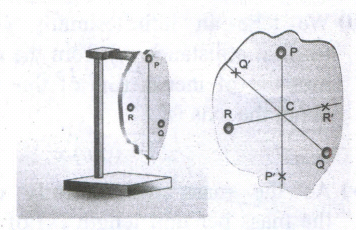
Explain the method to find the center of gravity of a irregularly shaped lamina?
9.
Write to causes of errors in measurement.
10.
A velocity-time graph is given for a particle moving in x direction, as below
.png)
(a) Describe the motion qualitatively in the interval 0 to 55 s.
(b) Find the distance and displacement travelled from 0 s to 40 s
(c) Find the acceleration at t = 5 s and at t = 20 s.
11.
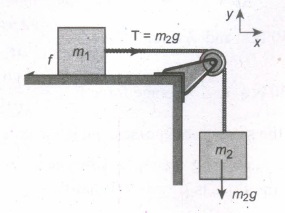
Two bodies of masses 7 kg and 5 kg are connected by a light string passing over a smooth pulley at the edge of the table as shown in the figure. The coefficient of static friction between the surfaces (body and table) is 0.9. Will the mass m1 = 7 kg on the surface move? If not what value of m2 should be used so that mass 7 kg begins to slide on the table?
1.
Radius of the circle r = 3.12 m
Area of the circle A = \(\pi\) r2
= 3.14\(\times\)3.12\(\times\)3.12
= 30.566016 m2
According to the rule of significant
A = 30.6 m2
2.
As the distance between two masses increases, the strength of the force tends to decrease because of inverse dependence on r2. Physically it implies that the planet Uranus experiences less gravitational force from the Sun than the Earth since Uranus is at larger distance from the Sun compared to the Earth.
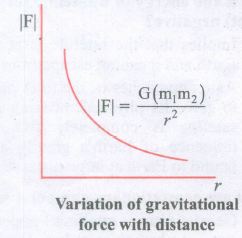
The gravitational forces between two particles always constitute an action reaction pair. It implies that the gravitational force exerted by the Sun on the Earth is always towards the Sun. The reaction-force is exerted by the Earth on the Sun. The direction of this reaction force is towards Earth.
The torque experienced by the Earth due to the gravitational force of the Sum is zero given by
\(\vec { \tau } =\vec { r } \times \vec { F } =\vec { r } \times \left( -\frac { { GM }_{ s }{ M }_{ E } }{ { r }^{ 2 } } \hat { r } \right) =0\)
Since \(\vec { r } =r\hat { r } ,(\hat { r } \times \hat { r } )=0\)
So, \(\hat { \tau } =\frac { d\vec { L } }{ dt } =0\)
It implies that angular momentum \(\vec{L}\) is a constant vector. The angular momentum of the Earth about the Sun is constant throughout the motion. It is true for all the planets. In fact, this constancy of angular momentum leads to the Kepler's second law.
The expression \(\vec{F}=-\frac{G M_{1} M_{2}}{r^{2}} \hat{r}\) has one inherent assumption that both M1 and M2 are treated as point masses. When it is said that Earth orbits around the Sun due to Sun's gravitational force, we assumed Earth and Sun to be point masses. This assumption is a good approximation because the distance between the two bodies is very much larger than their diameters. For some irregular and extended objects separated by a small distance, we cannot directly use the equation. Instead, we have to invoke separate mathematical treatment which will be brought forth in higher classes.
However, this assumption about point masses holds even for small distance for one special case. To calculate force of attraction between a hollow sphere of mass M with uniform density and point mass m kept outside the hollow sphere, we can replace the hollow sphere of mass M as equivalent to a point mass M located at the center of the hollow sphere. The force of attraction between the hollow sphere of mass M and point mass m can be calculated by treating the hollow sphere also as another point the center of the hollow sphere. It is shown in the Figure.
There is also another interesting result. Consider a hollow sphere of mass M. If we place another object of mass 'm' inside this hollow sphere as in Figure, the force experienced by this mass 'm' will be zero.
The triumph of the law of gravitation is that it concludes that the mango that is falling down and the Moon orbiting the Earth are due to the same gravitational force.
3.
(i) Yes, a body in translatory motion shall have angular momentum unless fixed point about which angular momentum is taken lies on the line of motion of body
\(|\overrightarrow{L}|=rp\sin \theta\)
= 0 only when \(\theta=0^{0} or 180^{0}\)
(ii) MI of stone I = ml2 (l⇾length of string) I is large, α is very small
\(\tau=I \alpha\)
\(\alpha=\frac{\tau}{I}=\frac{\tau}{ml^{2}}\)
if l is large α is very small. Therefore more difficult to revolve.
4.
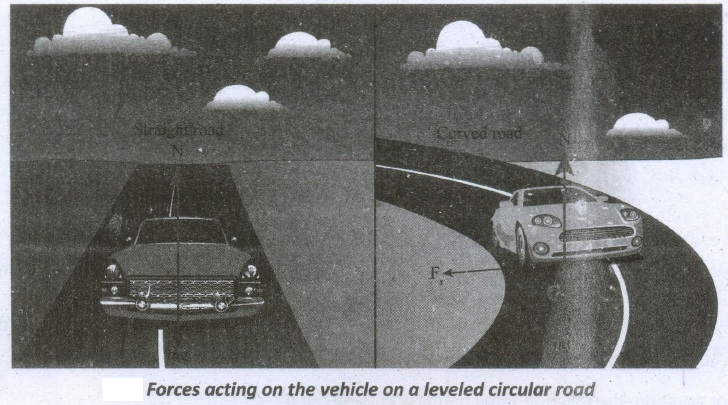
When a vehicle travels in a curved path, there must be a centripetal force acting on it. This centripetal force is provided by the frictional force between tyre and surface of the road. Consider a vehicle of mass 'm' moving at a speed 'v' in the circular track of radius 'r'. There are three forces acting on the vehicle when it moves as shown in the figure.
(i) Gravitational force (mg) acting downwards
(ii) Normal force (mg) acting upwards
(iii) Frictional force (Fs) acting horizontally inwards along the road
Suppose the road is horizontal then the normal force and gravitational force are exactly equal and opposite. The centripetal force is provided by the force of static friction Fs between the tyre and surface of the road which acts towards the center of the circular track,
\(\frac { m{ v }^{ 2 } }{ r } ={ F }_{ s }\)
As we have already seen in the previous section, the static friction can increase from zero to a maximum value
Fs ≤ μsmg
There are two conditions possible namely without skidding and skidding.
For without skidding \(\frac { m{ v }^{ 2 } }{ r } \le { \mu }_{ s }mg\), or \({ \mu }_{ s }\ge \frac { { v }^{ 2 } }{ rg } \) or \(\sqrt { { \mu }_{ s }rg } \ge v\)
The static friction would be able to provide necessary-centripetal force to bend the car on the road.
5.
Consider the velocities \(\overrightarrow { { V }_{ A } } \) and \(\overrightarrow { { V }_{ B } } \) at an angle \(\theta \) between their directions.
The relative velocity of A with respect to B,
\(\overrightarrow { { V }_{ AB } } =-\overrightarrow { { V }_{ B } } -\overrightarrow { { V }_{ A } } \)
Then, the magnitude and direction of \(\overrightarrow { { V }_{ AB } } \) is given by VAB= \({ v }_{ aB }=\sqrt { { v }_{ A }^{ 2 }+{ v }_{ B }^{ 2 }-2{ v }_{ A }{ v }_{ B }cos\theta } \) and tan \(\beta =\frac { { v }_{ B }sin\theta }{ { v }_{ B }-{ v }_{ A }cos\theta } \) (Here \(\beta\) is angle between \(\overrightarrow { { V }_{ AB } } and\quad \overrightarrow { { V }_{ B } } \) )
(i) When \(\theta\) = 0, the bodies move along parallel straight lines in the same direction, We have vAB = (vA - vB) in the direction of \(\overrightarrow { { V }_{ A } } \) . Obviously vBA= (VB+ vA) in the direction of \(\overrightarrow { { V }_{ B } } \).
(ii) When \(\theta\) = 180°, the bodies move along parallel straight lines in opposite directions, We have vAB= (vA + VB) in the direction of \(\overrightarrow { { V }_{ A } } \) .Similarly vBA= (VB+ vA) in the direction of \(\overrightarrow { { V }_{ B } } \).
(iii) If the two bodies are moving at right angles to each other, then \(\theta\) =90°. The magnitude of the relative velocity of A with respect to \(B={ v }_{ BA }=\sqrt { { v }_{ A }^{ 2 }+{ v }_{ B }^{ 2 } } \).
6.
KE = \({1\over2}{mv}^{2}={p^2 \over 2m}\)
\(\therefore\) Initial momentum \(p=\sqrt{2mk}\)
Increase in K.E = 300% of k
= 3k
Final KE (k')= k + 3k = 4k
Final momentum \(p'=\sqrt{2mk'}=\sqrt{2m(4k)}\)
\(=2\sqrt{2mk}\Rightarrow 2p\)
Increase in momentum \(={p'-p\over p}=\times 100\)
\({2p-p \over p}\times 100={p \over p}\times100\)
% increase in momentum = 100%
7.
Mass of bullet,
\(m=\frac{30}{1000}g=0.03kg\)
Speed v = 500 ms-1
initial kinetic energy = \(\frac{1}{2}mv^{2}\)
=\(\frac{1}{2}\times0.03\times(500)^{2}\)
=\(\frac{1}{2}\times0.03\times250000\)
=3750 J
Final Kinetic energy=\(\frac{1}{2}mv^{2}=0\).
Lossin kinetic energy = 3750 J
Suppose
F = average force applied by block on bullet
S = displacement => 10 cm = 0.10m
Applying work energy principle,
\(W=\Delta K\)
\(F_s=\Delta K\)
\(F\times10=3750 ; F=\frac{3750}{0.10}=3.75\times10^{4}N\)
8.
If we suspend the lamina from different points like P, Q, R as shown in Figure, the vertical lines PP', QQ', RR' all pass through the centre of gravity Here, reaction force acting at the point of suspension and the gravitational force acting at the centre of gravity cancel each other and the torques caused by them also cancel each other.
9.
| (i) | Least count error | Associated with the poor resolution of the instrument |
| (ii) | Instrumental errors | Associated with the faulty calibration or change in conditions |
| (iii) | Random errors | Getting difficult results for the same measurement done repeatedly |
| (iv) | Personal errors | Associated with the individual performing the experiments ie. Improper precautions, incorrect initial set up of experiment |
| (v) | Systematic errors | Which tends to be in the same direction |
10.
(a) From 0 to A: (0s to 10s)
At y = 0 s the particle has zero velocity. At t > 0, particle has positive velocity and moves in the positive x direction. From 0 s to 10 s the slope\(\left( \frac { dv }{ dt } \right) \) is positive, implying the particle is accelerating. Thus the velocity increases during this time interval.
From A to B: (10s to 15s)
From 10 s to 15 s the velocity stays constant at 60 m s-1. The acceleration is 0 during this period. But the particle continues to travel in the positive x-direction.
From B to C : (15s to 30s)
From the 15 s to 30 s the slope is negative, implying the velocity is decreasing. But the particle is moving in the positive x direction. At t = 30 s the velocity becomes zero, and the particle comes to rest momentarily at t = 30 s.
From C to D: (30s to 40s)
From 30 s to 40 s the velocity is negative. It implies that the particle starts to move in the negative x direction. The magnitude of velocity increases to a maximum 40 ms-1
From D to E: (40s to 55s)
From 40 s to 55 s the velocity is still negative, but starts increasing from -40 m s-1. At t = 55 s the velocity of the particle is zero and particle comes to rest.
(b) The total area under the curve from 0 s to 40 s will give the displacement. Here the area from O to C represents motion along positive x-direction and the area under the graph from C to D represents the particle's motion along negative x-direction.
The displacement travelled by the particle from 0 s to 10s =\(\frac { 1 }{ 2 } \) \(\times\)10\(\times\)60=300 m
The displacement travelled from 10 s to 15 s = 60\(\times\)5 = 300 m
The displacement travelled from 15 s to 30 s =\(\frac { 1 }{ 2 } \) \(\times\)15\(\times\)60 = 450 m
The displacement travelled from 30 s to 40 s = \(\frac { 1 }{ 2 } \) \(\times\)10\(\times\)(-40)= -200 m. Here the negative sign implies that the particle travels 200 m in the negative x direction.
The total displacement from 0 s to 40 s is given by
300m + 300m +450m-200 m =+850m
Thus the particle's net displacement is along the positive x-direction.
The total distance travelled by the particle from 0 s to 40 s = 300 + 300 + 450 + 200 = 1250 m.
(c) The acceleration is given by the slope in the velocity-time graph. In the first 10 seconds the velocity has constant slope (constant acceleration). It implies that the acceleration a is from v1 = 0 to v2 = 60 ms-1
Hence \(a=\frac { { v }_{ 2 }-{ v }_{ 1 } }{ { t }_{ 2 }-{ t }_{ 1 } } \) gives
\(a=\frac { 60-0 }{ 10-0 } \) =6 ms-2
Next, the particle has constant negative slope from 15 s to 30 s In this case v2 = 0 and v1 = 60 ms-1 Thus the acceleration at t = 20s is given by
a =\(\frac { 0-60 }{ 30-15 } \)=-4ms-2 .Here the negative sign implies that the particle has negative acceleration
11.
As shown in the figure, there are four forces acting on the mass m1
(a) Downward gravitational force along the negative y-axis (m1g)
(b) Upward normal force along the positive y-axis (N)
(c) Tension force due to mass m2 along the positive x axis
(d) Frictional force along the negative x-axis
Since the mass m1 has no vertical motion, m1g = N
Free body diagram for mass m1
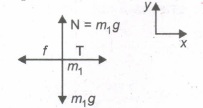
To determine whether the mass m1 moves on the surface, calculate the maximum static friction exerted by the table on the mass m1 If the tension on the mass m1 is equal to or greater than this maximum static friction, the object will move.
fsmax = μsN = μsm1g
fsmax = 0.9\(\times\)7\(\times\)9.8 =61.74 N
The tension T = m2g= 5\(\times\)9.8 = 49 N
T < fsmax
The tension acting on the mass mi is less than the maximum static friction. So the mass m1 will not move.
To move the mass m1, T > fsmax where T = m2g
m2 = \(\frac { { \mu }_{ s }{ m }_{ 1 }g }{ g } \)=μsm1
m2 = 0.9\(\times\)7 = 6.3 kg
If the mass m2 is 6.3 kg then the mass m1 will begin to slide. Note that if there is no friction on the surface, the mass m1 will move for m2 even for just 1 kg.
The values of coefficient of static friction for pairs of materials are presented in Table 3.1. Note that the ice and ice pair have very low coefficient of static friction. This means a block of ice can move easily over another block of ice.

11th Standard Syllabus & Materials
11th Standard
TN 11th Tamil பீடு பெற நில் - செய்யுள் - காவடிச்சிந்து Important Questions And Answers Study Material - QB365 Set A
NEW11th Standard
TN 11th Tamil பீடு பெற நில் - உரைநடை - மலை இடப்பெயர்கள் : ஓர் ஆய்வு Important Questions And Answers Study Material - QB365 Set A
NEW11th Standard
TN 11th Tamil மாமழை போற்றுதும் - துணைப்பாடம் - யானை டாக்டர் Important Questions And Answers Study Material - QB365 Set A
NEW11th Standard
TN 11th Tamil மாமழை போற்றுதும் - செய்யுள் - ஐங்குறுநூறு Important Questions And Answers Study Material - QB365 Set A



Tamilnadu Stateboard 11th Standard Subjects

Maths

Commerce

Economics

Biology

Business Maths and Statistics

Accountancy

Computer Science
Physics

Chemistry
Maths
Biology
Economics
Physics
Chemistry

History
Business Maths and Statistics

Computer Science
Accountancy

Computer Applications
History
Computer Technology
Commerce
Computer Applications
Computer Technology

Tamil

English

French
Tamilnadu Stateboard Standards

