
 100% FREE ACCESS
11th Standard Syllabus & Materials
11th Standard
TN 11th Tamil இயற்கை வேளாண்மை,சுற்றுச்சூழல் -செய்யுள் - மனோன்மணீயம் Important Questions And Answers Study Material - QB365 Set A
NEW11th Standard
TN 11th Tamil என்னுயிர் என்பேன் -துணைப்பாடம் - இசைத்தமிழர் இருவர் Important Questions And Answers Study Material - QB365 Set A
NEW11th Standard
TN 11th Tamil மொழி கலை -செய்யுள் - ஒவ்வொரு புல்லையும் Important Questions And Answers Study Material - QB365 Set A
NEW11th Standard
TN 11th Tamil பீடு பெற நில் - இலக்கணம் - பகுபத உறுப்புகள் Important Questions And Answers Study Material - QB365 Set A
NEW11th Standard
TN 11th Tamil பீடு பெற நில் - துணைப்பாடம் - வாடிவாசல் Important Questions And Answers Study Material - QB365 Set A
NEW11th Standard
TN 11th Tamil பீடு பெற நில் - செய்யுள் - குறுந்தொகை Important Questions And Answers Study Material - QB365 Set A

Published on: 30/09/2018
Important 5mark
Download Tamil Nadu 11th Standard Physics question papers, model tests, one-mark questions, important questions, and public exam papers in PDF format. Free study materials and answer keys for TN State Board students.
Questions + Answers key
Take MCQ Physics Test1.
Explain the variation of g with altitude.
2.
A car takes a turn with velocity 50 ms-1 on the circular road of radius of curvature 10m. calculate the centrifugal force experienced by a person of mass 60kg inside the car?
3.
Convert the vector \(\vec { r } =3\hat { i } +2\hat { j } \) into a unit vector.
4.
The force F acting on a body moving in a circular path depends on mass of the body (m), velocity (v) and radius (r) of the circular path. Obtain the expression for the force by dimensional analysis method. (Take the value of k = 1)
5.
A particle moves in a circle of radius 4.0 cm clockwise at constant speed of 2 cms-1. If \(\hat x\) and \(\hat y\) are unit acceleration vectors along x-axis and y-axis respectively (in cms-2 ), find the acceleration of the particle at the instant half way between P and Q.
6.
What happens to the object at rest if
(i) fs = 0
(ii) fs = Fext
(iii) fs = max.
7.
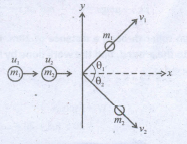
If a particle elastically collides obliquely with a particle of same mass at rest then show that they move perpendicular to each other after collision.
8.
Two particles P and Q of mass 1 kg and 3 kg respectively start moving towards each other from rest under mutual attraction. What is the velocity of their center of mass?
9.
A solid cylinder of mass 20 kg rotates about its axis with angular speed 100 rad/s. The radius of the cylinder is 0.25m. Calculate the kinetic energy associated with the rotation of the cylinder.
10.
A bullet of mass 25 g moving with a velocity of 400 ms-1 strikes a cardboard and goes out from the other end with a velocity of 300 ms-1, find out the work done in passing through the cardboard.
11.
Explain propagation of errors in the difference of two quantities and also in the division of two quantities.
1.
Consider an object of mass m at a height h from the surface of the Earth. Acceleration experienced by the object due to Earth is
g' = \(\frac { GM }{ ({ R }_{ e }+h)^{ 2 } } \) ..........(1)
g'= \(\frac { GM }{ { R }_{ e }^{ 2 }\left( 1+\frac { h }{ { R }_{ e } } \right) ^{ 2 } } \)
g'=\(\frac { GM }{ { R }_{ e }^{ 2 } } \left( 1+\frac { h }{ { R }_{ e } } \right) ^{ 2 }\)
If h << Re
We can use Binomial expansion. Taking the terms up to first order
g'= \(\frac { GM }{ { R }_{ e }^{ 2 } } \left( 1-2\frac { h }{ { R }_{ e } } \right) \)
g' = \(g\left( 1-2\frac { h }{ { R }_{ e } } \right) \) .....(2)
We find that g'< g. This means that as altitude h increases, the acceleration due to gravity g decreases.
2.
\(\text {Centrifugal force experience by person } =\frac{m v^{2}}{r}=\frac{60 \mathrm{~kg} \times(50 \mathrm{~m} / \mathrm{s})^{2}}{10 \mathrm{~m}} \)
\(=\frac{60 \times 2500}{10} \mathrm{~N} \)
\(=15000 \mathrm{~N}\)
3.
\(\overrightarrow { r } =3\hat { i } +2\hat { j } \)
\(\text { Unit vector } =\frac{\vec{r}}{|\vec{r}|} \)
\(|\vec{r}| =\sqrt{3^{2}+2^{2}}=\sqrt{13} \)
\(\therefore \text { Unit vector } =\frac{3 \hat{i}+2 \hat{j}}{\sqrt{13}}\)
4.
F ∝ ma vb rc ;
F = k ma vb rc
where k is a dimensionless constant of proportionality. Rewriting above equation in terms of dimensions and taking k= 1, we have
[MLT-2] = [M]a [LT-1]b [L]c
= [MaLbT-bLc]
[MLT-2] = [MaLb+cT-b]
Comparing the powers of M, L and T on both sides
a = 1 ; b + c = 1; -b =-2
2 + c = 1 ; b = 2;
a = 1 b = 2 and c = -1
From the above equation we get
F = mavbrc
F =m1v2r-1
or F = \(\frac { m{ v }^{ 2 } }{ r } \)
5.
As shown in the figure (ii), let R be the midpoint of arc PQ. Then \(\angle POR=45^0\) Magnitude of acceleration at R,
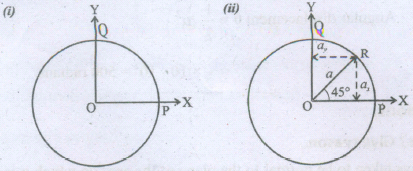
\(a=\frac{v^2}{r}=\frac{(2)^2}{4}=1\ cms^{-2}\)
The acceleration a acts along RO
Magnitude of component of along x-axis, ax = a cos45°
\(=1\times\frac{1}{\sqrt 2}=\frac{1}{\sqrt 2}\ cms^{-2}\)
\(\therefore\ \hat a_x=-\frac{1}{\sqrt 2}\hat x\)
Magnitude of component of a along y-axis, ay = 1\(\times\)sin45°
\(=\frac{1}{\sqrt 2}\ cms^{-2}\)
\(\therefore\hat a_y=-\frac{1}{\sqrt 2}\hat y\)
Hence \(\hat a=\hat a_x+\hat a_y=\frac{-1}{\sqrt 2}(\hat x+\hat y)\)
6.
(i) If the object is at rest and no external force is applied on the object, the static friction acting on the object is zero (fs = 0).
(ii) If the object is at rest, and there is an external force applied parallel to the surface, then the force of static friction acting on the object is exactly equal to the external force applied on the object (fs = Fext). But still the static friction Is is less than μsN.
(iii) When object begins to slide, the static friction (fs) acting on the object attains maximum.
7.
From law of conservation of momentum, along x-axis,
\(mu_1+0=mv_1\cos\theta_1+mv_2\cos\theta_2\)
\(u_1=v_1\cos\theta_1+v_2\cos\theta_2\) ....(1)
along y-axis, \(0=v_1\sin\theta_1-v_2\sin\theta_2\) ....(2)
From energy of conservation,
\({1\over2}{mu}_{1}^{2}={1\over2}{mv}_{1}^{2}+{1\over 2}{mv}_{2}^{2}\)
\({u}_{1}^{2}={v}_{1}^{2}+{v}_{2}^{2}\) ...(3)
By using equation (1) and (2) in equation (3) we get,
\(2v_1 v_2\cos(\theta_1+\theta_2)=0\)
\(\cos(\theta_1+\theta_2)=\cos{\pi \over 2}\)
\(\theta_1+\theta_2={\pi \over 2}\)
\(\therefore\) This shows that the particle move perpendicular to each other after collision.
8.
Mass of particle P m1 = 1 kg.
Mass of particle Q m2 = 3 kg
Velocity of particle P = velocity of particle Q but in opposite direction
Velocity of center of mass vcm = ?
\({ vc }_{ m }=\frac { { m }_{ 1 }{ v }_{ 1 }+{ m }_{ 2 }{ v }_{ 2 } }{ { m }_{ 1 }+{ m }_{ 2 } } \)
= 0.
9.
Kinetic energy of rotation = \(\frac { 1 }{ 2 } I{ \omega }^{ 2 }\)
=\(\frac { 1 }{ 2 } \left( \frac { 1 }{ 2 } { mr }^{ 3 } \right) { \omega }^{ 2 }\)
=\(\frac { 1 }{ 4 } \times 20\times (0.25)^{ 2 }\times 100\times 100\)
=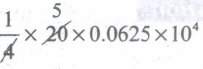
= 3125 J
10.
Mass of the bullet (m) = 25 g
Initial velocity (m) = 400 ms-1
Final velocity (v) = 300 ms-1
Work done (w) =?
From work-energy theorem,
Work done = loss in kinetic energy,
\(W=\frac{1}{2}m(u^{2}-v^{2})\)
=\(\frac{1}{2}\times\frac{25}{100}kg\times(400^{2}-300^{2})\)
=\(\frac{1}{2}\times0.025\times(16\times10^{4}-9\times10^{4})\)
=\(\frac{1}{2}\times0.025\times(7\times10^{4})\)
= 0.0125\(\times(7\times10^{4})\)
Work done (W) = 875J
11.
Errors in the difference of two quantities.
Let \(\triangle A\) and \(\triangle B\) be the absolute errors in the two quantities, A and B, respectively. Then,
Measured value of \(A=A\pm\triangle A\)
Measured value of \(B=B\pm\triangle B\)
Consider the difference, Z =A - B
The error \(\triangle Z\) in Z is the given by
\(Z\pm \triangle Z=(A+\triangle A)-(B\pm \triangle B)\)
\(=(A-B)\pm(\triangle A+\triangle B)\)
\(=Z\pm(\triangle A+\triangle B)\)
(or) \(\triangle Z=\triangle A+\triangle B\)
The maximum error in difference of two quantities is equal to the sum of the absolute errors in the individual quantities. Error in the division or quotient of two quantities
Let \(\triangle A\) and \(\triangle B\) be the absolute errors in the two quantities A and B respectively.
Consider the quotient, \(Z={{A}\over{B}}\)
The error \(\triangle Z\) in Z is given by
\(Z\pm Z={{A\pm \triangle A}\over{B+\triangle B}}={{A\left(1\pm{{{\triangle A}\over{A}}} \right)}\over{B\left( 1\pm{{\triangle B}\over{B}} \right)}}\)
\(={{A}\over{B}} \left( 1\pm{{\triangle A}\over{A}} \right)\left( 1\pm{{\triangle B}\over{B}} \right)^{-1}\)
or \(Z\pm \triangle Z=Z\left( 1\pm{{\triangle A}\over{A}} \right)\left( 1\mp{{\triangle B}\over{B}} \right)\)
[ using (1+x)n \(\approx\) 1 + nx, when x<<1]
Dividing both sides by Z, we get
\(1\pm{{\triangle Z}\over{Z}}=\left( 1\pm{{\triangle A}\over{A}} \right)\left( 1\mp {{\triangle B}\over{B}} \right)\)
\(=1\pm{{\triangle A}\over{A}}\mp{{\triangle B}\over{B}}\pm{{\triangle A}\over{A}}.{{\triangle B}\over{B}}\)
As the terms \(\triangle A/A\) and \(\triangle B/B\) are small, their product term can be neglected.
The maximum fractional error in Z is given by
\({{\triangle Z}\over{Z}}=\left( {{\triangle A}\over{A}} +{{\triangle B}\over{B}}\right)\)
The maximum fractional error in the quotient of two quantities is equal to the sum of their individual fractional errors.

11th Standard Syllabus & Materials
11th Standard
TN 11th Tamil பீடு பெற நில் - செய்யுள் - காவடிச்சிந்து Important Questions And Answers Study Material - QB365 Set A
NEW11th Standard
TN 11th Tamil பீடு பெற நில் - உரைநடை - மலை இடப்பெயர்கள் : ஓர் ஆய்வு Important Questions And Answers Study Material - QB365 Set A
NEW11th Standard
TN 11th Tamil மாமழை போற்றுதும் - துணைப்பாடம் - யானை டாக்டர் Important Questions And Answers Study Material - QB365 Set A
NEW11th Standard
TN 11th Tamil மாமழை போற்றுதும் - செய்யுள் - ஐங்குறுநூறு Important Questions And Answers Study Material - QB365 Set A



Tamilnadu Stateboard 11th Standard Subjects

Maths

Commerce

Economics

Biology

Business Maths and Statistics

Accountancy

Computer Science
Physics

Chemistry
Maths
Biology
Economics
Physics
Chemistry

History
Business Maths and Statistics

Computer Science
Accountancy

Computer Applications
History
Computer Technology
Commerce
Computer Applications
Computer Technology

Tamil

English

French
Tamilnadu Stateboard Standards

