
 100% FREE ACCESS
11th Standard Syllabus & Materials
11th Standard
TN 11th Tamil இயற்கை வேளாண்மை,சுற்றுச்சூழல் -செய்யுள் - மனோன்மணீயம் Important Questions And Answers Study Material - QB365 Set A
NEW11th Standard
TN 11th Tamil என்னுயிர் என்பேன் -துணைப்பாடம் - இசைத்தமிழர் இருவர் Important Questions And Answers Study Material - QB365 Set A
NEW11th Standard
TN 11th Tamil மொழி கலை -செய்யுள் - ஒவ்வொரு புல்லையும் Important Questions And Answers Study Material - QB365 Set A
NEW11th Standard
TN 11th Tamil பீடு பெற நில் - இலக்கணம் - பகுபத உறுப்புகள் Important Questions And Answers Study Material - QB365 Set A
NEW11th Standard
TN 11th Tamil பீடு பெற நில் - துணைப்பாடம் - வாடிவாசல் Important Questions And Answers Study Material - QB365 Set A
NEW11th Standard
TN 11th Tamil பீடு பெற நில் - செய்யுள் - குறுந்தொகை Important Questions And Answers Study Material - QB365 Set A

Published on: 30/09/2018
Important 1 mark question -
Download Tamil Nadu 11th Standard Physics question papers, model tests, one-mark questions, important questions, and public exam papers in PDF format. Free study materials and answer keys for TN State Board students.
Questions + Answers key
Take MCQ Physics Test1.
The kinetic energy of the satellite orbiting around the Earth is
equal to potential energy
less than potential energy
greater than kinetic energy
zero
2.
If the acceleration due to gravity becomes 4 times its original value, then escape speed
remains same
2 times of original value
becomes halved
4 times of original value
3.
If a person moves from Chennai to Trichy, his weight
increases
decreases
remains same
increases and then decreases
4.
If the mass and radius of the Earth are both doubled, then the acceleration due to gravity g'
remains same
\({g\over 2}\)
2g
4g
5.
The work done by the Sun’s gravitational force on the Earth is
always zero
always positive
can be positive or negative
always negative
6.
The gravitational potential energy of the Moon with respect to Earth is
always positive
always negative
can be positive or negative
always zero
7.
8.
If the distance between the Earth and Sun were to be doubled from its present value, the number of days in a year would be
64.5
1032
182.5
730
9.
A planet moving along an elliptical orbit is closest to the Sun at distance r1 and farthest away at a distance of r2. If v1 and v2 are linear speeds at these points respectively. Then the ratio \({v_1\over v_2}\) is
\({r_2\over r_1}\)
\(({r_2\over r_1})^2\)
\({r_1\over r_2}\)
\(({r_1\over r_2})^2\)
10.
If the masses of the Earth and Sun suddenly double, the gravitational force between them will
remain the same
increase 2 times
increase 4 times
decrease 2 times
11.
Two resistors of resistances R1 = 10 ± 0.3 ohm and R2 = 20 ± 0.4 ohm are connected in parallel. The equivalent resistance of the parallel combination in ohm is ____________.
5.7 ± 0.1
15.2 ± 0.2
6.7 ± 0.2
9.5 ± 0.1
12.
An engine pumps water continuously through a hose. Water leaves the hose with a velocity v and m is the mass per unit length of the water of the jet. What is the rate at which kinetic energy is imparted to water?
\({{1}\over{2}}{m}{v}^{2}\)
mv3
\({{1}\over{2}}{m}{v}^{3}\)
\({{1}\over{2}}{m}{v}^{2}\)
13.
If the amount of work done by a force depends only on the initial and final positions of the object which has been moved, then such a force is called ______________.
gravitation
conservative
Retarding
Non-conservative
14.
A block B is pushed momentarily along a horizontal surface with initial velocity v- μ coefficient of friction between B and surface, block B will come to rest after a time ___________.
v/gμ
gμ/v
g/v
v/g
15.
A force of 2.5 N acts on a body of mass 10 g. What is the acceleration of the body?
1.5\(\times\)102 ms-2
2.0\(\times\)103 ms-2
2.5\(\times\)103 ms-2
3.0\(\times\)102 ms-2
16.
How many degrees make a one newton?
102 dyne
202 dyne
105 dyne
205 dyne
17.
A constant retarding force of 60 N is applied to a body of mass 25 kg moving with a speed of 20 ms-1 How long does the body take to stop?
8.33 seconds
7.58 seconds
4 seconds
5.8 seconds
18.
A ball of 300 g mass moving with a speed of 20 m/s rebounds after striking normally a perfectly elastic wall. The change in momentum of a ball is ______________.
12 kg ms-1
-12 kg ms-1
6 kg ms-1
-6 kg ms-1
19.
In a rocket, the fuel burns at the rate of 1 kg s-1. This fuel burnt eject gases at a speed of 90 km s-1. The force exerted on the rocket is, ________________.
45000 N
90000 N
60000 N
10000 N
20.
What is the SI unit of Area?
m
m2
Nm-1
cm-1
21.
How many parsec are there in one kilometer?
3.084\(\times\)10-16
3.084\(\times\)108
3.24\(\times\)10-14
None
22.
The value of 1o is ______________.
1.745\(\times\)10-2 rad
1.946\(\times\)10-11 rad
3.6 rad
3600 rad
23.
3.5 kg mass of a metal plate has the volume of 1.5 m3. Find the density of metal plate ____________.
1.5 kg/m3
2.3 kg/m3
3.4 kg/m3
4.8 kg/m3
24.
The speed of an object v = 90km/h. The same quantity of speed in m/s is ______________.
90
25
45
180
25.
How many AU present in one light year?
6.30\(\times\)104m
9.46\(\times\)1015m
6.2\(\times\)102m
9.4\(\times\)1016m
26.
When a mass is rotating in a plane about a fixed point, its angular momentum is directed along
a line perpendicular to the plane of rotation
the line making an angle of 45o to the plane of rotation
the radius
tangent to the path
27.
The speed of the center of a wheel rolling on a horizontal surface is vo. A point on the rim in level with the center will be moving at a speed of,
zero
vo
\(\sqrt{2}\)vo
2vo
28.
The speed of a solid sphere after rolling down from rest without sliding on an inclined plane of vertical height h is,
\( \sqrt \frac{4}{3}gh\)
\( \sqrt \frac{10}{7}gh\)
\(\sqrt{2gh}\)
\( \sqrt \frac{1}{2}gh\)
29.
The ratio of the acceleration for a solid sphere (mass m and radius R) rolling down an incline of angle \(\theta\) without slipping and slipping down the incline without rolling is,
5: 7
2: 3
2: 5
7: 5
30.
A disc of the moment of inertia Ia is rotating in a horizontal plane about its symmetry axis with a constant angular speed \(\omega\). Another disc initially at rest of moment of inertia Ib is dropped coaxially on to the rotating disc. Then, both the discs rotate with the same constant angular speed. The loss of kinetic energy due to friction in this process is,
\(\frac { 1 }{ 2 } \frac { { I }_{ b }^{ 2 } }{ 2({ I }_{ a }+{ I }_{ b }) } { \omega }^{ 2 }\)
\(\frac { { I }_{ b }^{ 2 } }{ ({ I }_{ a }+{ I }_{ b }) } { \omega }^{ 2 }\)
\(\frac { { ({ I }_{ b }-{ I }_{ a }) }^{ 2 } }{ ({ I }_{ a }+{ I }_{ b }) } { \omega }^{ 2 }\)
\(\frac { 1 }{ 2 } \frac { { { I }_{ b }{ I }_{ b } } }{ ({ I }_{ a }+{ I }_{ b }) } { \omega }^{ 2 }\)
31.
Distance is a scalar quantity and ______________ is a vector.
Speed
Length
Time
Displacement
32.
The length of a vector is _______________
always a negative quantity
always a positive quantity
either positive or negative
denoted by '\(\lambda \)'
33.
Consider the quantities pressure, power, energy, impulse, charge. Out of these, the only vector quantity is _______________.
pressure
power
impulse
charge
34.
A spring of force constant k is cut into two pieces such that one piece is double the length of the other. Then, the long piece will have a force constant of
\(\frac{2}{3}\)k
\(\frac{3}{2}\)k
3k
6k
35.
A particle is placed at the origin and a force F = kx is acting on it (where k is a positive constant). If U (0) = 0, the graph of U(x) versus x will be (where U, is the potential , energy function)
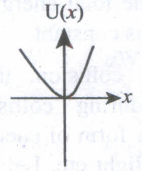
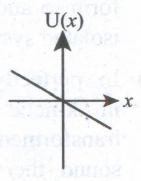
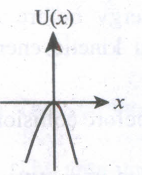
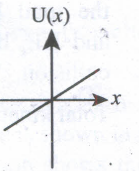
36.
37.
If the potential energy of the particle is \(\alpha -\frac { \beta }{ 2 } { x }^{ 2 }\), then force experienced by the particle is
F = \(\frac { \beta }{ 2 } { x }^{ 2 }\)
F = βx
F = -βx
F = -\(\frac { \beta }{ 2 } { x }^{ 2 }\)
38.
If the linear momentum of the object is increased by 0.1% then the kinetic energy is Increased by
0.1 %
0.2 %
0.4 %
0.01 %
39.
The work done by the conservative force for a closed path is
always negative
zero
always positive
not defined
40.
The potential energy of a system increases, if work is done
by the system against a conservative force
by the system against a non-conservative force
upon the system by a conservative force
upon the system by a non- conservative force
41.
42.
A rigid body rotates with an angular momentum L. If its kinetic energy is halved, the angular momentum becomes,
L
L/2
2L
L/\(\sqrt{2}\)
43.
A closed cylindrical container is partially filled with water. As the container rotates in a horizontal plane about a perpendicular bisector, its moment of inertia
increases
decreases
remains constant
depends on direction of rotation
44.
A rope is wound around a hollow cylinder of mass 3 kg and radius 40 cm. What is the angular acceleration of the cylinder if the rope is pulled with a force 30 N?
0.25 rad s-2
25 rad s-2
5 ms-2
25 ms-2
45.
A body of mass 4 m is lying in xy-plane at rest. It suddenly explodes into three pieces. Two pieces each of mass m move perpendicular to each other with equal speed v. The total kinetic energy generated due to explosion is
mv2
\(\frac{3}{2}\)mv2
2mv2
4mv2
46.
A uniform force of (2\(\hat { i }\)+\(\hat { j }\)) N acts on a particle of mass 1 kg. The particle displaces from position (3\(\hat { j }\)+\(\hat { k }\)) m to (5\(\hat { i }\)+3\(\hat { j }\)) m. The work done by the force on the particle is
9 J
6 J
10 J
12 J
47.
The center of mass of a system of particles does not depend upon,
position of particles
relative distance between particles
masses of particles
force acting on particle
48.
Choose the correct statement from the following
Centrifugal and centripetal forces are action reaction pairs
Centripetal forces is a natural force
Centrifugal force arises from gravitational force
Centripetal force acts towards the center and centrifugal force appears to act away from the center in a circular motion.
49.
Choose appropriate free body diagram for the particle experiencing net acceleration along negative y direction. (Each arrow mark represents the force acting on the system).
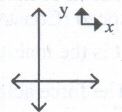
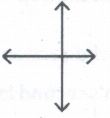
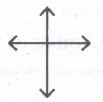
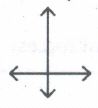
50.
Two masses m1 and m2 are experiencing the same force where m1 < m2.The ratio of their acceleration \(\frac { { a }_{ 1 } }{ { a }_{ 2 } } \) is _____________.
1
less than 1
greater than 1
all the three cases
51.
52.
If an object is thrown vertically up with the initial speed u from the ground, then the time taken by the object to return back to ground is
\(\frac{u^2}{2g}\)
\(\frac{u^2}{g}\)
\(\frac{u}{2g}\)
\(\frac{2u}{g}\)
53.
If a particle executes uniform circular motion, choose the correct statement
The velocity and speed are constant
The acceleration and speed are constant.
The velocity and acceleration are constant.
The speed and magnitude of acceleration are constant.
54.
A ball is dropped from some height towards the ground. Which one of the following represents the correct motion of the ball?
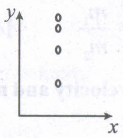
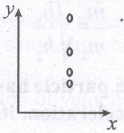
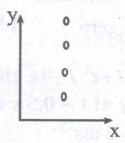
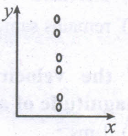
55.
If an object is dropped from the top of a building and it reaches the ground at t = 4 s, then the height of the building is (ignoring air resistance) (g = 9.8 ms-2)
77.3 m
78.4 m
80.5 m
79.2 m
56.
If the velocity is \(\overrightarrow { v } =2\hat { i } +{ t }^{ 2 }\hat { j } -9\overrightarrow { k } \), then the magnitude of acceleration at t = 0.5s is
1 ms-2
2 ms-2
zero
-1 ms-2
57.
Identify the unit vector in the following?
\(\hat { i } +\hat { j } \)
\(\frac { \hat { i } }{ \sqrt { 2 } } \)
\(\hat { k } -\frac { \hat { j } }{ \sqrt { 2 } } \)
\(\frac { \hat { i } +\hat { j } }{ \sqrt { 2 } } \)
58.
A length-scale (I) depends on the permittivity (e) of a dielectric material, Boltzmann constant (kB), the absolute temperature (T), the number per unit volume (n) of certain charged particles, and the charge (q) carried by each of the particles. Which of the following expression for I is dimensionally correct?
\(l=\sqrt{{{nq^2}\over{\epsilon {k}_{B}T}}}\)
\(l=\sqrt{{{\epsilon {k}_{B}T}\over{nq^2}}}\)
\(l=\sqrt{{{q^2}\over{e{n}^{{{2}\over{3}}}{k}_{B}}T}}\)
\(l=\sqrt{{{q^2}\over{\epsilon n{k}_{B}T}}}\)
59.
If \(\pi=3.14,\) then the value of \({\pi}^{2}\) is
9.8596
9.860
9.86
9.9
60.
The length of a body is measured as 3.51 m, if the accuracy is 0.01 mm, then the percentage error in the measurement is
35.1%
1%
0.28%
0.035%
1.
Escape speed ve = \(\sqrt 2g R\)
if g' = 4g
then \(v'_e\) = \(\sqrt (4g) R\)
= \(\sqrt 2g R \) \(\times\)2
= 2ve
2.
\(\text { Escape speed } v_{e}=\sqrt{2 g R}\)
\(\text { If } g^{\prime}=4 \mathrm{~g}\)
\(\text { Then } v_{e}^{\prime}=\sqrt{2(4 g) R}\)
\(=\sqrt{2 g R} \times 2 \)
\(=2 v_{e}
\)
3.
(b)
decreases
4.
g = \(\frac{GM_e}{R^2_e}\)
Me = 2 Me Re= 2 Re then,
g' = \(\frac{G \times 2M_e}{(2R_e)^2}\) = \(2 \frac{Gm_e}{4R_e^2}\)
\(2 \frac{Gm_e}{4R_e^2}\) = \(\cfrac g2\)
5.
(c)
can be positive or negative
6.
(b)
always negative
7.
(b)
8.
T2 = C (R + h)3
\(\therefore T \alpha (R_E)^\frac{3}{2}\)
RE = 2RE
\(\therefore T \alpha (2R_E)^\frac{3}{2}\)
Time period increases by \(2^\frac{2}{3}\)= 2\(\sqrt 2\)
No. of days in a year = (365.4) \(\times\)2\(\sqrt 2\)
= 1032
9.
(a)
\({r_2\over r_1}\)
10.
\(\text { Gravitational force } F \propto m_{1} m_{2}\)
\(\text { If } m_{1}=2 m_{1} \text { and } m_{2}=2 m_{2} \text { then }\)
\(\text { Force } F \propto\left(2 m_{1}\right)\left(2 m_{2}\right)\)
\(\propto 4 m_{1} m_{2}\)
11.
(c)
6.7 ± 0.2
12.
Mass per unit length = m
Velocity = v
(mass of water pumped in one second)
M = mv
\(\text { Kinetic energy }=\frac{1}{2} M v^{2}\)
\(=\frac{1}{2} m v^{3}\)
13.
(b)
conservative
14.
(a)
v/gμ
15.
(c)
2.5\(\times\)103 ms-2
16.
(c)
105 dyne
17.
(a)
8.33 seconds
18.
(b)
-12 kg ms-1
19.
(b)
90000 N
20.
(b)
m2
21.
(c)
3.24\(\times\)10-14
22.
(a)
1.745\(\times\)10-2 rad
23.
(b)
2.3 kg/m3
24.
(b)
25
25.
(a)
6.30\(\times\)104m
26.
(a)
a line perpendicular to the plane of rotation
27.
\(v_{0}=r \omega ; \quad \therefore v_{0} \alpha r\)
For a wheel (uniform ring) the distance of a point on the rim in level with the center
\(\text { [i.e., radius] is } \sqrt{2} r\)
\(\therefore \text { The speed of the center is } \sqrt{2} v_{0}\)
28.
Potential energy = Translational kinetic energy + Rotational kinetic energy
\(m g h=\frac{1}{2} m v^{2}+\frac{1}{2} I \omega^{2} \)
\(=\frac{1}{2} m v^{2}+\frac{1}{2} \times \frac{2}{5} M R^{2} \times \frac{v^{2}}{R^{2}}\left[\omega=\frac{v}{R}\right] \)
\(=\frac{1}{2} m v^{2}+\frac{1}{5} m v^{2} \)
\(=\frac{5 m v^{2}+2 m v^{2}}{10}=\frac{7 m v^{2}}{10} \)
\(m g h=\frac{7 m v^{2}}{10} \)
\(g h=\frac{7 v^{2}}{10} \)
\(\therefore v^{2}=\frac{10 g h}{7} \)
\(\therefore v=\frac{\sqrt{10 g h}}{7} \)
29.
Acceleration of the solid sphere while rolling down without slipping
\(a_{1}=\frac{g \sin \theta}{1+\frac{k^{2}}{r^{2}}}\)
Acceleration developed while slipping down \(a_{2}=g \sin \theta\)
\(\text { Required ratio } \frac{a_{1}}{a_{2}}=\frac{g \sin \theta}{1+\frac{k^{2}}{r^{2}}} / g \sin \theta\)
\(\frac{a_{1}}{a_{2}}=\frac{1}{1+\frac{k^{2}}{r^{2}}}\)
\(\text { For a solid sphere } \frac{k^{2}}{r^{2}}=\frac{2}{5}\)
\(\therefore \text { Ratio of accelerations } \frac{a_{1}}{a_{2}}=\frac{1}{1+\frac{2}{5}}\)
\(=\frac{1}{5+\frac{2}{5}}=\frac{1}{\frac{7}{5}}=\frac{5}{7}\)
\(\therefore a_{1}: a_{2}=5: 7 \)
30.
The moments of inertia of two discs are Ia and Ib respectively The angular velocity of the disc A is \(\omega\).
The sum of kinetic energies of two discs before coming in contact is \(k_{1}=\frac{1}{2} I_{a} \omega_{1}^{2}+\frac{1}{2} I_{b} \omega_{2}^{2}\)
\(\text { But angular velocity of the disc be is } \omega_{2}=0 \ \text {(rest)}\)
\(\therefore k_{1}=\frac{1}{2} I_{a} \omega_{1}^{2}\)
The final kinetic energy of the two discs system \(k_{2}=\frac{1}{2} \frac{I_{a}^{2} \omega_{1}^{2}}{I_{a}+I_{b}}\)
The loss of kinetic energy is
\(k_{1}-k_{2} =\frac{1}{2} I_{a} \omega^{2}-\frac{1}{2}\left[\frac{I a^{2} \omega_{1}^{2}}{I_{a}+I_{2 b}}\right] \)
\(=\frac{1}{2} \frac{\left[I_{1}\left(I_{a}+I_{b}\right) \omega^{2}-I_{a}^{2} \omega^{2}\right]}{I_{a}+I_{b}} \)
\(k_{1}-k_{2} =\frac{1}{2} \frac{I_{a} b}{\left(I_{a}+I_{b}\right)} \omega^{2} \)
31.
(d)
Displacement
32.
(b)
always a positive quantity
33.
(c)
impulse
34.
For any spring kl = constant
Length of the longer piece
\(=\frac{2 l}{3} \)
\(\therefore k^{1} \times \frac{2 l}{3} =k l \)
\(\therefore k^{1}=\frac{k l \times 3}{2 l}=\frac{3}{2} k \)
\(\therefore k^{1}=\frac{3}{2} k \)
35.
For a conservative force
\(F=-\frac{d v}{d t} \)
\(\int_{0}^{u(x)} d v=-\int_{0}^{x} F d x=-\int_{0}^{x} k x d x \)
\(\text { As } v(0)=0\)
\(U(x)=-\frac{k x^{2}}{2}\)
Thus, the graph of U(x) versus (x) will be a parabola, symmetric about U - ax is bying below x - ax is with its vertex at the origin. Hence the correct answer is C
36.
(c)
37.
\(\text {Potential energy } P . E=\alpha-\frac{\beta}{2} x^{2}\)
P.E = Work = Fx
\(P=\alpha-\frac{\beta}{2} x^{2}\)
\(\text {Force }=\frac{d p}{d x}=\frac{d}{d x}\left(\alpha-\frac{\beta}{2} x^{2}\right)\)
\(=0-\frac{\beta}{2} \times 2 x =-\beta x \)
38.
\(\text { Kinetic energy } E_{k}=\frac{p^{2}}{2 m}\)
\(\frac{\Delta E_{k}}{E_{k}}=\frac{2 \Delta p}{p}\)
\(\text {Given that } \frac{\Delta p}{p}=0.1\)
∴ Increase in kinetic energy
\(\frac{\Delta E_{k}}{E_{k}}=2 \frac{\Delta p}{p} \)
\(\frac{\Delta E_{k}}{E_{k}}=2 \times 0.1=0.2 \% \)
39.
(b)
zero
40.
(a)
by the system against a conservative force
41.
(a)
42.
\(K \cdot E=\frac{1}{2} I \omega^{2} ; \quad L=I \omega ; \quad K \cdot E=\frac{2^{2}}{2^{2}} \)
\(\therefore K \cdot E \alpha L^{2} \quad E_{1} \alpha L_{1}^{2} \quad E_{2} \alpha L_{2}^{2}\)
\(\frac{E_{1}}{E_{2}}=\left(\frac{L_{1}}{L_{2}}\right)^{2} \)
\(\text { Here } E_{1}=E \quad E_{2}=\frac{E}{2} \)
\(L_{1}=L \quad \quad L_{2}=? \)
\(\frac{E}{\frac{E}{2}}=\left(\frac{L}{L_{2}}\right)^{2} \)
\(\frac{2 E}{E}=\left(\frac{L}{L_{2}}\right)^{2}\left(\frac{L_{1}}{L_{2}}\right)^{2}=2 \)
\(\therefore \frac{L}{L_{2}}=\sqrt{2} \)
\(L_{2}=\frac{L}{\sqrt{2}} \)
43.
(a)
increases
44.
\(m=3 \mathrm{~kg} \quad r=40 \times 10^{-2} \mathrm{~m}=0.4 \mathrm{~m}\)
\(\text { Force }=30 N\)
Moment of inertia of a hollow-cylinder I= MR2
\(=3 \times\left(40 \times 10^{-2}\right)^{2} \)
\(=3 \times 0.4 \times 0.4=0.48 \mathrm{kgm}^{2} \)
\( F R =I \alpha \)
\(30 \times 40 \times 10^{-2}=0.48 d \)
\(d=\frac{12}{0.48}=\frac{1200}{48}=25 \mathrm{rad} \mathrm{s}^{-2} \)
\(\alpha=25 \mathrm{rad} \mathrm{s}^{-2} \)
45.
Using law of conservation of momentum,
\(2 m v =\sqrt{m^{2} v^{2}+m^{2} v^{2}} \)
\(=\sqrt{2 m^{2} v^{2}} \)
\(v =\frac{\sqrt{2} m v}{2 m}=\frac{v}{\sqrt{2}} \)
Energy released in explosion = \(2 \times \frac{1}{2} m v^{2} +\frac{1}{2} \times 2 m \times\left(\frac{v^{2}}{\sqrt{2}}\right)^{2} \)
\(=m v^{2}+m \times \frac{v^{2}}{2} \)
\(=\frac{3}{2} m v^{2} \)
46.
\(\text { Force } \overrightarrow{\mathbf{F}}=(2 i+\vec{j}) N\)
\(\text { Displacement } d=(5 \vec{i}+3 \vec{j})-(3 \vec{j}+\vec{k})\)
\(=(5 i-k) m\)
\(\text { Work done } W=F . d\)
\(=(2 \vec{i}+\vec{j})(5 i-k)\)
\(=10-0-0=10 J \)
47.
(d)
force acting on particle
48.
(d)
Centripetal force acts towards the center and centrifugal force appears to act away from the center in a circular motion.
49.
(c)
50.
(c)
greater than 1
51.
(b)
52.
\(\text {Time of flight }=\frac{2 u}{g}\)
53.
It is a uniform circular motion. So the direction of velocity changes but not the magnitude. Therefore speed in considered constant. Again magnitude of acceleration does not change.
54.
Distance travelled \(s=\frac{1}{2} g t^{2} ; s \alpha t^{2}\). The ratio of distances travelled by a freely falling body will be with ratio 1:4:9:...
55.
(b)
78.4 m
56.
\(\vec{v}=2 \hat{l}+t^{2} \hat{j}-9 \vec{k}\)
\(\vec{a}=\frac{d \vec{v}}{d t}=2 t \hat{j}\)
\(\text { When } t=0.5 \mathrm{~s}\)
\(a=1 \mathrm{~ms}^{-2}\)
57.
Unit vector specifies only direction
\(\hat{A}=\frac{\vec{A}}{|\vec{A}|} \)
\(\therefore \hat{i}+\hat{j}=\frac{\hat{l}+\hat{j}}{|\hat{l}+\hat{j}|}
\)
\(\hat{i} \text { and } \hat{j} \text { are orthogonal components of vectors. }\)
\(\therefore|\hat{i}+\hat{j}|=\sqrt{1^{2}+1^{2}}=\sqrt{1+1}=\sqrt{2}\)
58.
\(\text {Dimension of permittivity } \varepsilon=A^{2} C^{2} N^{-1} m^{-2}\)
\(\text {Dimension of Boltzmann constant } k_{B}=\left[\mathrm{ML}^{2} \mathrm{~T}^{-2} \mathrm{~K}^{-1}\right]\)
\(\text {Dimension of Absolute Temperature }=T\)
No. of charged particles per unit
Volume = No. of dimensions = a
Dimension of charge = AT
Dimension of length = L
\(\text { Dimension of }=\frac{\sqrt{\varepsilon k_{B} T}}{n q^{2}}\)
\(=\frac{\sqrt{\left[\mathrm{A}^{2} \mathrm{C}^{2} \mathrm{~N}^{-1} \mathrm{~m}^{-2}\right]}\left[\mathrm{ML}^{2} \mathrm{~T}^{-2} \mathrm{~K}^{-1}\right][\mathrm{T}]}{[\mathrm{AT}]^{2}}\)
\(=\sqrt{L^{2}}=L\)
\(\therefore \text { Dimension of length }=\mathrm{L}\)
59.
\(\pi=3.14 \)
\(\pi^{2} =3.14 \times 3.14 \)
\(=9.8596=9.86 \)
60.
\(\Delta l =0.01 \)
\(l =3.51 \)
\(\% \text { error } =\frac{\Delta l}{l} \times 100=\frac{0.01}{3.51} \times 100 \)
\(=0.00284 \times 100 \)
\(=0.284=0.28 \% \)

11th Standard Syllabus & Materials
11th Standard
TN 11th Tamil பீடு பெற நில் - செய்யுள் - காவடிச்சிந்து Important Questions And Answers Study Material - QB365 Set A
NEW11th Standard
TN 11th Tamil பீடு பெற நில் - உரைநடை - மலை இடப்பெயர்கள் : ஓர் ஆய்வு Important Questions And Answers Study Material - QB365 Set A
NEW11th Standard
TN 11th Tamil மாமழை போற்றுதும் - துணைப்பாடம் - யானை டாக்டர் Important Questions And Answers Study Material - QB365 Set A
NEW11th Standard
TN 11th Tamil மாமழை போற்றுதும் - செய்யுள் - ஐங்குறுநூறு Important Questions And Answers Study Material - QB365 Set A



Tamilnadu Stateboard 11th Standard Subjects

Maths

Commerce

Economics

Biology

Business Maths and Statistics

Accountancy

Computer Science
Physics

Chemistry
Maths
Biology
Economics
Physics
Chemistry

History
Business Maths and Statistics

Computer Science
Accountancy

Computer Applications
History
Computer Technology
Commerce
Computer Applications
Computer Technology

Tamil

English

French
Tamilnadu Stateboard Standards

