
 100% FREE ACCESS
11th Standard Syllabus & Materials
11th Standard
TN 11th Tamil இயற்கை வேளாண்மை,சுற்றுச்சூழல் -செய்யுள் - மனோன்மணீயம் Important Questions And Answers Study Material - QB365 Set A
NEW11th Standard
TN 11th Tamil என்னுயிர் என்பேன் -துணைப்பாடம் - இசைத்தமிழர் இருவர் Important Questions And Answers Study Material - QB365 Set A
NEW11th Standard
TN 11th Tamil மொழி கலை -செய்யுள் - ஒவ்வொரு புல்லையும் Important Questions And Answers Study Material - QB365 Set A
NEW11th Standard
TN 11th Tamil பீடு பெற நில் - இலக்கணம் - பகுபத உறுப்புகள் Important Questions And Answers Study Material - QB365 Set A
NEW11th Standard
TN 11th Tamil பீடு பெற நில் - துணைப்பாடம் - வாடிவாசல் Important Questions And Answers Study Material - QB365 Set A
NEW11th Standard
TN 11th Tamil பீடு பெற நில் - செய்யுள் - குறுந்தொகை Important Questions And Answers Study Material - QB365 Set A

Published on: 30/09/2018
Important questions
Download Tamil Nadu 11th Standard Physics question papers, model tests, one-mark questions, important questions, and public exam papers in PDF format. Free study materials and answer keys for TN State Board students.
Questions + Answers key
Take MCQ Physics Test1.
The gravitational potential energy of the Moon with respect to Earth is
always positive
always negative
can be positive or negative
always zero
2.
The body must have a speed at highest point in vertical circular motion to stay in the circular path _____________.
\(\ge \sqrt { gr } \)
\(\ge \sqrt { 2gr } \)
\(\ge \sqrt { 5gr } \)
\(\ge\)5gr
3.
The force F acting on a particle of mass m is indicated by the force-time graph shown below. The change in momentum of the particle over the time interval from zero to 8 s is ________________.
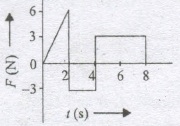
24 N s
20 N s
12 N s
6 N s
4.
Identify the pair of physical quantities having the same dimensions.
Light year and period of a pendulum
Angular momentum and torque
Energy and Modulus of elasticity
Torque and work
5.
Which of the following is true regarding projectile motion?
horizontal velocity of projectile is constant
vertical velocity of projectile is constant
acceleration is not constant
momentum is constant
6.
How many \(\mu\)m present in one metre?
10-6 \(\mu\)m
106 \(\mu\)m
10-3 \(\mu\)m
10-2 \(\mu\)m
7.
The ratio of the acceleration for a solid sphere (mass m and radius R) rolling down an incline of angle \(\theta\) without slipping and slipping down the incline without rolling is,
5: 7
2: 3
2: 5
7: 5
8.
Which one of the following statement is true?
A scalar quantity is conserved in a process
A scalar quantity does not vary from one point to another in apace
A scalar quantity can never take -ve values
A scalar quantity has only magnitude and no direction.
9.
The work done by the conservative force for a closed path is
always negative
zero
always positive
not defined
10.
The angular momentum of a rotating body is doubled, its K.E. of rotation becomes ________________
Two times
Four times
Halved
Eight times
11.
If a person moving from pole to equator, the centrifugal force acting on him
increases
decreases
remains the same
increases and then decreases
12.
Earth revolves around the Sun at 30 km s−1. Calculate the kinetic energy of the Earth. In the previous example you calculated the potential energy of the Earth. What is the total energy of the Earth in that case? Is the total energy positive? Give reasons.
13.
14.
An elevator which can carry a maximum load of 1800 kg (elevator + passengers) is moving up at a constant speed of 2 ms-1. The frictional force opposing the motion is 4000 N. Determine the minimum power delivered by the motor to the elevator in watts as well as in horsepower.
15.
What are positive and negative acceleration in straight line motion?
16.
The vernier scale of a travelling microscope has 50 divisions which coincide with 49 main scale divisions. If each main scale division is 0.5 mm. Calculate the minimum inaccuracy in the measurement of distance.
17.
There is a stick half of which is wooden and half is of steel.
(i) it is pivoted at the wooden end and a force is applied at the steel end at right angle to its length
(ii) it is pivoted at the steel end and the same force is applied at the wooden end. In which case is the angular acceleration more and why?
18.
Two resistances R1 = (100 ± 3) \(\Omega\), R2 = (150 ± 2)\(\Omega\), are connected in series. What is their equivalent resistance?
19.
"Jumping on a cemented floor receives more injuries than on the sand" - Given reason.
20.
A body of mass 0.3 kg is taken up an inclined plane of length 10 m and height 5 m and then allowed to slide down to bottom again. Find
(i) work done by frictional force over the round trip if \(\mu\) = 0.15.
(ii) kinetic energy at the end of the trip.
21.
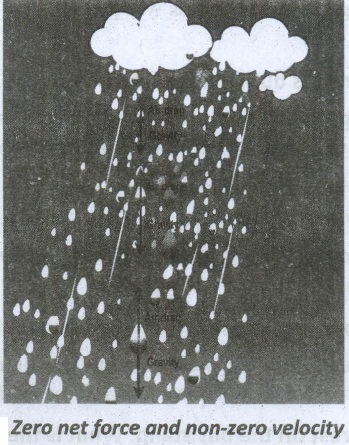
For the following situation, Explain with an example.
22.
Briefly explain on Aristotle vs. Newton's approach on sliding object.
23.
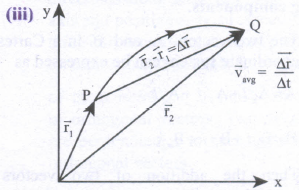
Define average velocity and represent it graphically.
24.
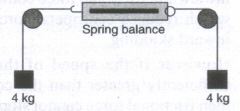
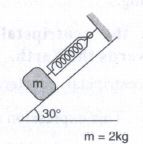
What is the reading shown in spring balance?
25.
Calculate the average velocity of the particle whose position vector changes from \(\overrightarrow { { r }_{ 1 } } =5\hat { i } +6\hat { j } \) to \(\overrightarrow { { r }_{ 2 } } =2\hat { i } +3\hat { j } \) in a time 5 second.
26.
A train 100 m long is moving with a speed of 60 km h-1. In how many seconds will it cross a bridge of 1 km long?
27.
Consider two objects of masses 5 kg and 20 kg which are initially at rest. A force 100 N is applied on the two objects for 5 second.
(a) What is the momentum gained by each object after 5s?
(b) What is the speed gained by each object after 5s?
28.
What happens to the P.E. of a bubble when it rises in water?
29.
Jupiter is at a distance of 824. 7 million km from the earth, its angular diameter is measured to be 35.720 of arc. Calculate diameter of Jupiter.
30.
Round off the following numbers as indicated 18.35 up to 3 digits
31.
Some heavy boxes are to be loaded along with some empty boxes on a cart. Which boxes should be put on the cart first and why?
32.
A thin metal hoop of radius 0.25m and mass 2 kg starts from rest and rolls down an inclined plane. If its linear velocity on reaching the foot of the plane is 2 ms-1, what is its rotational K.E. at that instant?
33.
Is whole of the kinetic energy lost in any perfectly inelastic collision?
34.
Can we use the equations of kinematics to find the height attained by a body projected upward with any velocity.
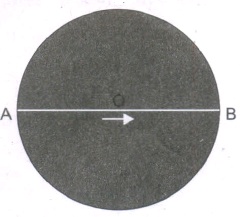
35.
A thin horizontal circular disc is rotating about a vertical axis passing through its center. An insect goes from A to point B along its diameter as shown in Figure. Discuss how the angular speed of the circular disc changes?
36.
From a complete ring of mass M and radius R, a sector angle \(\theta\) is removed. What is the moment of inertia of the incomplete ring about axis passing through the center of the ring and perpendicular to the plane of the ring?
37.
If the value of universal gravitational constant in SI is 6.610-11Nm-2kg-2, then find its value in CGS System?
38.
A ball falls under gravity from a height of 10m with an initial downward velocity u. It collides with the ground, loses 50% of its energy in collision and then rises back to the same -'height. Find the initial velocity "u".
1.
(b)
always negative
2.
(a)
\(\ge \sqrt { gr } \)
3.
(c)
12 N s
4.
(d)
Torque and work
5.
(a)
horizontal velocity of projectile is constant
6.
(b)
106 \(\mu\)m
7.
Acceleration of the solid sphere while rolling down without slipping
\(a_{1}=\frac{g \sin \theta}{1+\frac{k^{2}}{r^{2}}}\)
Acceleration developed while slipping down \(a_{2}=g \sin \theta\)
\(\text { Required ratio } \frac{a_{1}}{a_{2}}=\frac{g \sin \theta}{1+\frac{k^{2}}{r^{2}}} / g \sin \theta\)
\(\frac{a_{1}}{a_{2}}=\frac{1}{1+\frac{k^{2}}{r^{2}}}\)
\(\text { For a solid sphere } \frac{k^{2}}{r^{2}}=\frac{2}{5}\)
\(\therefore \text { Ratio of accelerations } \frac{a_{1}}{a_{2}}=\frac{1}{1+\frac{2}{5}}\)
\(=\frac{1}{5+\frac{2}{5}}=\frac{1}{\frac{7}{5}}=\frac{5}{7}\)
\(\therefore a_{1}: a_{2}=5: 7 \)
8.
(d)
A scalar quantity has only magnitude and no direction.
9.
(b)
zero
10.
(b)
Four times
11.
(a)
increases
12.
Velocity of the Earth around Sun
y = 30 km/s
Kinetic energy \( \mathrm{K} . \mathrm{E}=\frac{1}{2} \frac{G M_{E} M_{\mathrm{s}}}{\left(\mathrm{R}_{E}+\mathrm{h}\right)}\)
Kinetic Energy \( \mathrm{K} . \mathrm{E} =\frac{1}{2} M_{s} V^{2}=\frac{1}{2} \times 1.9 \times 10^{30} \times\left(30 \times 10^{3}\right)^{2} \)
\(=\frac{1.9 \times 900 \times 10^{30+6}}{2} \)
\(\mathrm{~K} . \mathrm{E} =\mathrm{U}_{\mathrm{K}}=26.5 \times 10^{32} \mathrm{~J} \)
Total energy \(\mathrm{E} =-\frac{G M_{s} M_{E}}{2\left(\mathrm{R}_{E}\right)}
\)
\(\mathrm{E}_{\text {tot }} =-\frac{-6.67 \times 10^{-11} \times 1.9 \times 10^{36} \times 5.9 \times 10^{24}}{2 \times 6.4 \times 10^{6}}\)
\(\mathrm{E}_{\mathrm{tot}}=-23.29 \times 10^{32} \mathrm{~J}\)
Total energy has the negative sign. The negative sign in the total energy implies that the satellite is bound to the Earth and Earth cannot escape from the Sun i,e., -ve sign implies that Earth is bounded with Sun.
13.
14.
The downward force on the elevator is :
F = mg + f = 22000 N
\(\therefore\) Power supplied by motor to balance this force is:
P = Fv = 44000 W =\(\frac { 44000 }{ 746 } \)= 59 hp.
15.
If speed of an object increases with time, its acceleration is positive.
(Acceleration is in the direction of motion) and if speed of an object decreases with time its acceleration is negative (Acceleration is opposite to the direction of motion).
16.
Minimum inaccuracy = Vernier constant
= 1 MSD -1 VS.D
=1 MSD-\(\frac { 49 }{ 50 } \) MSD
= \(\frac { 1 }{ 50 } \)(0.5 mm)= 0.01 mm
17.
I (first case) >1 (Second case)
\(\because \ \tau =I\alpha \)
\(\Rightarrow \alpha \left( first \ case \right) <\alpha \left( second \ case \right) \)
18.
R1 = 100 ± = 3\(\Omega\); R2 = 150 ± 2\(\Omega\)
Equivalent resistance R =?
Equivalent resistance R = R1+ R2 = (100 ± 3) + (150 ± 2) = (100 + 150) ± (3 + 2)
R = (250 ± 5) \(\Omega\)
19.
Jumping on a concrete cemented floor is more dangerous than jumping on the sand. Sand brings the body to rest slowly than the concrete floor, so that the average force experienced by the body will be lesser.
20.
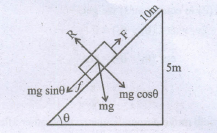
\(\sin\theta={5\over10}={1\over2}=\sin{\pi \over6}so,\theta={\pi \over 6}\)
Work done by frictional force, W \(=2\bar{f}.\bar{l}\)
W = \(2fil\ \cos\alpha(\alpha=\pi,\cos\alpha=-1)\)
W = \(-2\times0.15\times0.3\times\cos{\pi \over 6}\times10\times 9.8\)
= -7.6 J
kE at the end of trip = PE at top - work done against friction = 0.3\(\times\)9.8\(\times\)5 - 3.8 = 10.9J
21.
When a raindrop gets detached from the cloud it experiences both downward gravitational force and upward air drag force. As it descends towards the Earth, the upward after drag force increases and after a certain time, the upward air drag force cancels the downward gravity. From then on the raindrop moves at constant velocity till it touches the surface of the Earth.
22.
(i) Newton's second law gives the correct explanation for the experiment on the inclined plane.
(ii) In normal cases, where friction is not negligible, once the object reaches the bottom of the inclined plane, it travels some distance and stops.
(iii) Note that it stops because there is a frictional force acting in the direction opposite to its velocity.
(iv) It is this frictional force that reduces the velocity of the object to zero and brings it to rest.
(v) As per Aristotle's idea, as soon as the body reaches the bottom of the plane, it can travel only a small distance and stops because there is no force acting on the object.
23.
(i) The average velocity is defined as ratio of the displacement vector to the corresponding time interval
\(\overrightarrow { { v }_{ avg } } =\frac { \Delta \overrightarrow { r } }{ \Delta t } \)
(ii) It is a vector quantity. The direction of average velocity is in the direction of the displacement vector (\(\Delta \)\(\overrightarrow { r } \)).
24.
1. Equal mass balancing each side so reading shows Zero.
2. Mass of string acting downward direction in the inclined plane.
mg sin θ = T
T = 2kg x 9.8m/s2 x sin(30o)
T = 9.8N
25.
\(\overrightarrow { { v }_{ 1 } } =5\hat { i } +6\hat { j } \)
\(\overrightarrow { { v }_{ 2 } } =2\hat { i } +3\hat { j } \)
\(\therefore \Delta \vec{r} =\vec{r}_{2}-\vec{r}_{1}=2 \hat{i}+3 \hat{j}-5 \hat{i}-6 \hat{j}
\)
\(=-3 \hat{i}-3 \hat{j}
\)
\(\Delta t =5 \mathrm{sec}
\)
\(\therefore \Delta v_{\text {avg }} s =\frac{\Delta \vec{r}}{\Delta t}
\)
\(=\frac{-3}{5}(\hat{i}+\hat{j})\)
26.
Total distance to be covered = 1 km + 100 m = 1100 m (including both bridge and time)
Then, Speed=60 kmh-1\(=60\times\frac{5}{18}ms^{-1}=\frac{50}{3}\ ms^{-1}\)
Then, time taken to cover this distance \(=\frac{1100}{\frac{150}{9}}s=66s\)
27.
Final momentum on each object Δp = FΔt = 100\(\times\)5 = 500 kg ms-1
Final speed on the object of mass 5 kg = 500/5 =100 m s-1
Final speed on the object of mass 20 kg = 500/20 =25 m s-1
Note that momentum on each object is the same after 5 seconds but speed is not the same after 5 seconds. The heavier mass acquires lesser speed than the one with lower mass.
28.
Decreases.
29.
\(\text {Distance of Jupiter } x =824.7 \times 10^{6} \mathrm{~km} \)
\(\text {Angular diameter } Q =35.72^{\prime \prime} \)
\(1^{\prime \prime} =4.85 \times 10^{-6} \mathrm{rad} \)
\(Q =35.72 \times\left(4.85 \times 10^{-6}\right) \mathrm{rad} \)
\(=173.242 \times 10^{-6} \mathrm{rad}\)
\(x =\frac{b}{Q} \)
Diameter of Jupiter b = x \(\times\) Q
b = 824.7 x 106 x 173.242 x 10-6
= 142,872.6 x 106-6
= 1.428 x 10⁵ km
30.
18.4
31.
The heavy boxes should be loaded first so that the CG of the loaded cart remains in the lowest position. This ensures stability of equilibrium.
32.
Here R = 0.25m
M= 2kg
V= 2ms-1
Rotational K.E = \(\frac { 1 }{ 2 } I\omega ^{ 2 }\) = \(\frac { 1 }{ 2 } MR ^{ 2 }\) \(\times \left( \frac { V }{ R } \right) ^{ 2 }\)
\(\frac { 1 }{ 2 } MV ^{ 2 }\) = \(\frac { 1 }{ 2 }\) x2x4 =4J
33.
No, only that much amount of kinetic energy is lost as is necessary for the conservation of momentum.
34.
No, because equations of motions are applicable as long as the acceleration is uniform.
35.
As the disc is freely rotating, with the insect on it, the angular momentum of the system is conserved.
\(L=I\omega\)=constant
When the insect moves towards the center (from A to 0), the moment of inertia (I) increases. Thus, the angular velocity (co) increases. When it moves away from center (from 0 to B), the moment of inertia (I) decreases. Thus, the angular velocity decreases.
36.
Let R be the radius of the ring and M be the total mass of the complete ring.
Let m be the mass of the section removed from the ring then, mass of the incomplete ring is M-m
Let us introduce a positive integer (n), such that, \(n\theta=360^{0} \), or \(n=\frac{360^{0}}{\theta}\)
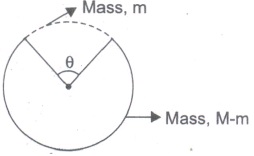
mass of incomplete ring=M - m
\(m=\frac{M}{360}\times \theta\)
∴ Mass of complete ring = \(M-\frac{M}{360}\times \theta\)
Mass of incomplete ring = \(M-\frac{M}{n}=M(\frac{n-1}{n})\)
For example, (a) when \(\theta=60^{0}; n=\frac{360^{0}}{60^{0}}=6\)
∴ n-1 =5
Mass of incomplete ring = \(\frac{5}{6}M\)
(b)when \(\theta=30^{0}; n=\frac{360^{0}}{30^{0}}=12\)
n-1=11
Mass of incomplete ring = \(\frac{11}{12}M\)
The moment of inertia of the incomplete ring is, I=\(M \frac{(n-1)}{n}R^{2}.\)
37.
Let GSI be the gravitational constant in the SI system and Gcgs in the cgs system. Then
GSI = 6.6 10-11 Nm2 kg-2;
Gcgs = ?
n2 =\(n_1{ \left[ \frac { { M }_{ 1 } }{ { M }_{ 2 } } \right] }_{ }^{ a }{ \left[ \frac { L_{ 1 } }{ L_{ 2 } } \right] }_{ }^{ a }{ \left[ \frac { T_{ 1 } }{ T_{ 2 } } \right] }_{ }^{ c }\)
Gcgs = GSI \({ \left[ \frac { { M }_{ 1 } }{ { M }_{ 2 } } \right] }_{ }^{ a }{ \left[ \frac { L_{ 1 } }{ L_{ 2 } } \right] }_{ }^{ a }{ \left[ \frac { T_{ 1 } }{ T_{ 2 } } \right] }_{ }^{ c }\)
M1= 1 kg L1 = 1 m T1= 1s
M2= 1 kg L2 = 1 m T2= 1s
The dimensional formula for G is M-1L3 T-2
a = -1 b = 3 and c =-2
Gcgs = 6.6\(\times\)10-11 \(\left[ \frac { 1kg }{ 1g } \right] ^{ -1 }\left[ \frac { 1m }{ 1cm } \right] ^{ 3 }\left[ \frac { 1s }{ 1s } \right] ^{ -2 }\)
= 6.6\(\times\)10-11 \(\left[ \frac { 1kg }{ { 10 }^{ -3 }kg } \right] ^{ -1 }\left[ \frac { 1m }{ { 10 }^{ -2 }m } \right] ^{ 3 }\left[ \frac { 1s }{ 1s } \right] ^{ -2 }\)
= 6.6\(\times\)10-11\(\times\)10-3\(\times\)106\(\times\)1
Gcgs = 6.6\(\times\)10-8 dyne cm2 g-2
38.
Total initial energy = \({1 \over 2}{mu}^{2}+mgh\)
Energy after collision = 50% of \(\left( {1 \over 2}{mv}^{2}+mgh \right)\)
\(={1\over 2}\left({1 \over 2}{mv}^{2}+mgh \right)\)
As the ball rebounds to same height,
\({1\over 2}\left( {1 \over 2} {mv}^{2}+mgh \right)=mgh
\)
\({1\over 4}{mv}^{2}={1 \over2}mgh\)
\(u=\sqrt{2gh}=\sqrt{2\times9.8\times10}\)
u = 14 m/s.

11th Standard Syllabus & Materials
11th Standard
TN 11th Tamil பீடு பெற நில் - செய்யுள் - காவடிச்சிந்து Important Questions And Answers Study Material - QB365 Set A
NEW11th Standard
TN 11th Tamil பீடு பெற நில் - உரைநடை - மலை இடப்பெயர்கள் : ஓர் ஆய்வு Important Questions And Answers Study Material - QB365 Set A
NEW11th Standard
TN 11th Tamil மாமழை போற்றுதும் - துணைப்பாடம் - யானை டாக்டர் Important Questions And Answers Study Material - QB365 Set A
NEW11th Standard
TN 11th Tamil மாமழை போற்றுதும் - செய்யுள் - ஐங்குறுநூறு Important Questions And Answers Study Material - QB365 Set A



Tamilnadu Stateboard 11th Standard Subjects

Maths

Commerce

Economics

Biology

Business Maths and Statistics

Accountancy

Computer Science
Physics

Chemistry
Maths
Biology
Economics
Physics
Chemistry

History
Business Maths and Statistics

Computer Science
Accountancy

Computer Applications
History
Computer Technology
Commerce
Computer Applications
Computer Technology

Tamil

English

French
Tamilnadu Stateboard Standards

