
 100% FREE ACCESS
11th Standard Syllabus & Materials
11th Standard
TN 11th Tamil இயற்கை வேளாண்மை,சுற்றுச்சூழல் -செய்யுள் - மனோன்மணீயம் Important Questions And Answers Study Material - QB365 Set A
NEW11th Standard
TN 11th Tamil என்னுயிர் என்பேன் -துணைப்பாடம் - இசைத்தமிழர் இருவர் Important Questions And Answers Study Material - QB365 Set A
NEW11th Standard
TN 11th Tamil மொழி கலை -செய்யுள் - ஒவ்வொரு புல்லையும் Important Questions And Answers Study Material - QB365 Set A
NEW11th Standard
TN 11th Tamil பீடு பெற நில் - இலக்கணம் - பகுபத உறுப்புகள் Important Questions And Answers Study Material - QB365 Set A
NEW11th Standard
TN 11th Tamil பீடு பெற நில் - துணைப்பாடம் - வாடிவாசல் Important Questions And Answers Study Material - QB365 Set A
NEW11th Standard
TN 11th Tamil பீடு பெற நில் - செய்யுள் - குறுந்தொகை Important Questions And Answers Study Material - QB365 Set A

Published on: 30/09/2018
Important 3mark
Download Tamil Nadu 11th Standard Physics question papers, model tests, one-mark questions, important questions, and public exam papers in PDF format. Free study materials and answer keys for TN State Board students.
Questions + Answers key
Take MCQ Physics Test1.
Define gravitational potential energy.
2.
A particle of mass m is fixed to one end of a light spring of force constant k and unstretched length I. It is rotated with an angular velocity ω in horizontal circle. What will be the length increase in the spring?
3.
A railway carriage of mass 9000 kg moving with a speed of 36 kmph collides with a stationary carriage of the same mass. After the collision, the carriages get coupled and move together. What is their common speed after the collision? What type of collision is this?
4.
Two springs A and B are identical except that A is harder than B (KA> KB) if these are stretched by the equal force. In which spring will more work be done?
5.
Is the acceleration of a particle in circular motion not always towards the centre. Explain.
6.
Consider an object travelling in a semi-circular path from point O to point P in 5 second, as is shown in the Figure. Calculate the average velocity and average speed.
.png)
7.
A uniform circular disc of mass m is set rolling on a smooth horizontal table with a uniform linear velocity v. Find the total K.E. of the disc.
8.
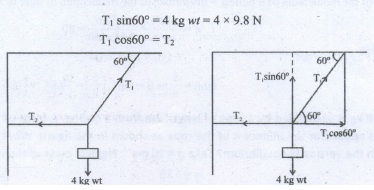
Determine the tensions T1 and T2 in the strings shown in the diagram.
9.
A bullet of mass 100gm is fired by a gun of 10 kg with a speed of 2000 m/sec. Find Recoil velocity of gun.
10.
Find the distance travelled by the particle during the time t = 0 to t = 3 seconds from the figure.
11.
What do you understand by the term parallax angle?
12.
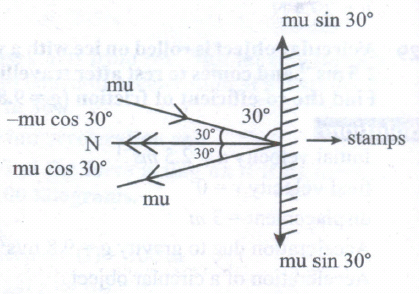
A cricket ball of mass 35 g hits a stumps at an angle of 30° with a velocity of 20 m/s. If the ball rebounds at 60° the to the direction of incidence, calculate the impulse received by the cricket ball.
13.
Define
(i) unit vector
(ii) Orthogonal unit vectors.
14.
What is Gross Error & How can it be minimised.
15.
State Newton's third law.
16.
What are the limitations of dimensional analysis?
17.
What is meant by escape speed in the case of the Earth?
18.
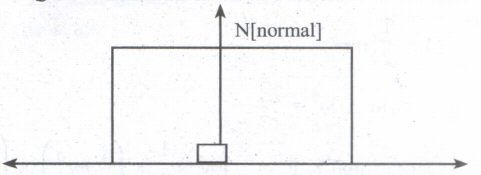
A rectangle block rests on a horizontal table. A horizontal force is applied on the block at a height h above the table to move the block. Does the line of action of the normal force N exerted by the table on the block depend on h?
19.
Two identical water bottles one empty and the other filled with water are allowed to roll down an inclined plane. Which one of them reaches the bottom first? Explain your answer.
20.
State conservation of angular momentum.
21.
The shadow of a pole standing on a level ground is found to be 45 m longer when the sun's altitude is 30o than when it was 60o. Determine the height of the pole. [Given \(\sqrt { 3 } \)=1.73]
1.
The gravitational potential energy U(r) of a system of two masses m1 and m2 separated by a distance r as the amount of work done to bring the mass m2 from infinity to a distance r assuming m1 to be fixed in its position and is written as
\(\mathrm{U}(\mathrm{r})=-\frac{G m_{1} m_{2}}{r}\)
2.
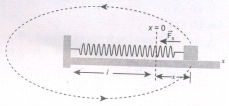
Mass spring = m
Force constant = k
Un-stretched length = l
Angular velocity = ω
Let 'x' be the increase in the length of the spring.
The new length = (l +x) = r
When the spring is rotated in a horizontal circle, Spring force = centripetal force.
kx = mω2 (l + x)
x=\(\frac{mω^2l}{k-mω^2}\)
3.
m1 = 9000 kg, u1 = 36 km/h = 10 m/s
m2 = 9000 kg, u2 = 0, v = v1= v2 =?
By conservation of momentum:
m1u1 + m2u2 = (m1 + m2)v
\(\therefore\) v = 5 m/s
Total K.E. before collision = \(\frac { 1 }{ 2 } { m }_{ 1 }{ u }_{ 1 }^{ 2 }+\frac { 1 }{ 2 } { m }_{ 2 }{ u }_{ 2 }^{ 2 }=45000J\)
Total K.E. after collision = \(\frac { 1 }{ 2 } \left( { m }_{ 1 }+{ m }_{ 2 } \right) { v }^{ 2 }=225000J\)
As total K.E. after collision < Total K.E. before the collision
\(\therefore\) Collision is inelastic.
4.
F = K.x so x = \(\frac { F }{ K } \)
For same F, \({ W }_{ A }=\frac { 1 }{ 2 } { K }_{ A }{ x }^{ 2 }=\frac { 1 }{ 2 } \frac { { F }^{ 2 } }{ { K }_{ A } } \)
and \({ W }_{ B }=\frac { { F }^{ 2 } }{ { 2K }_{ B } } \)
\(\therefore\) \(\frac { { W }_{ A } }{ { W }_{ B } } =\frac { { K }_{ B } }{ { K }_{ A } } \)
As KA > KB so WA < WB
5.
No acceleration is towards the centre only in case of uniform circular motion.
6.
Average velocity
\(\vec v_{avg}=\frac{\vec r_p-\vec r_O}{\Delta t}\)
Here \(\Delta t=5s\)
\(\vec r_0-i ;\vec r_p=10\hat i\)
\(\vec v_{avg}=\frac{10\hat i}{5 sec}=2\hat icms^{-1}\)
The average velocity is in the positive x-direction.
The average speed total path length/time taken (the path is semi-circular)
= \(\frac{5\pi cm}{5s}=\pi cms^{-1}=3.14 cms^{-1}\)
Note that the average speed is greater than the magnitude of the average velocity.
7.
M.I. of the disc about its own axis.
\(I={1\over2}mr^2\)
As v = \(rω\therefore ω^2={v^2 \over r^2}\)
Rotational K.E. \(={1\over 2}Iω^2={1\over2}\times{1\over 2}mr^2\times{v^2 \over r^2}={1 \over 4}mv^2\)
Translational K.E \(={1\over 2}mv^2\)
Translational K.E = Rotational K.E. + Translational K.E
8.
As shown in figure, resolve the tension T1 along horizontal and vertical directions. As the body is in equilibrium,
T1 sin600 = 4kg wt =4 x 9.8N ....(1)
T1 cos60° = T2 ......(2)
From (1), T1 = \(\frac { 4\times 9.8 }{ sin60^{ 0 } } =\frac { 4\times 9.8\times 2 }{ \sqrt { 3 } } \) = 45.26 N
From (2), T2 = T1 cos600 = 45.26 x 0.5 = 22.63N
9.
According to conservation of linear momentum.
mv + MV = 0
v = \(\frac { -mv }{ M } =\frac { -0.1\ \times\ 2000 }{ 10 } \)
v = -20 m/s
10.
Given:
t=3s
Distance s = Area of \(\triangle OAB\)
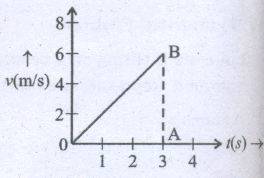
\(=\frac{1}{2}\times OA\times BA\)
\(=\frac{1}{2}\times 3\times 6=9m\)
If the speed varies with the time: Then \(v=\frac{ds}{dt}\Rightarrow ds=v\ dt\)
\(\Rightarrow \int { ds } =\int { v }\ dt\)
\(or\ s=\int { v }\ dt\)
11.
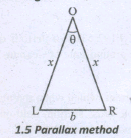
In the diagram \(\angle\) LOR is called the parallax angle or parallactic angle
12.
Mass of ball(m) = \(\frac { 35 }{ 100 } =0.035kg\)
A ball hits by a stumps at an angle (\(\theta\)1) = 30°
Ball rebounds at an .angle (\(\theta\)2) = 60°
Change in momentum along horizontal direction
= -mu cos30° - (mu cos300)
= -2 mu cos30°
= -2\(\times\)0.035\(\times\)20\(\times\)cos30°
= -2 \(\times\)0.035\(\times\)20\(\times\)\(\sqrt { \frac { 3 }{ 2 } } \) \(\quad \left[ \because cos{ 30 }^{ 0 }=\sqrt { \frac { 3 }{ 2 } } \right] \)
= \(-1.4\times \frac { \sqrt { 3 } }{ 2 } =1.21\quad kgms^{ -1 }\)
The impulse received by a ball j = 1.2 kg ms-1
13.
(i) Unit vector:
A vector divided by its magnitude is a unit vector. The unit vector for\(\overrightarrow { A } \)is denoted by\(\hat { A } \). It has a magnitude equal to unity or one.
Since, \(\hat { A } =\frac { \overrightarrow { A } }{ A } we\ van\ write\ \overrightarrow { A } =A\hat { A } \)
Thus, we can say that the unit vector specifies only the direction of the vector quantity.
(ii) Orthogonal unit vectors:
Let \(\hat { i } ,\hat { j } \) and \(\hat { k } \) be three unit vectors which specify the directions along positive x-axis, positive y-axis and positive z-axis respectively. These three unit vectors are directed perpendicular to each other, the angle between any two of them is 90°. \(\hat { i } \hat { j } \) and \(\hat { k } \) are examples of orthogonal vectors. Two vectors which are perpendicular to each other are called orthogonal vectors.
14.
Gross Error
(i) The error caused due to the shear carelessness of an observer is called gross error.
For example:
(ii) Reading an instrument without setting it properly.
(iii) Taking observations in a wrong manner without bothering about the sources of errors and the precautions.
(iv) Recording wrong observations. These errors can be minimized only when an observer is careful and mentally alert.
15.
Newton's third law states that for every action there is an equal and opposite reaction.
16.
Limitations of Dimensional analysis:
(i) This method gives no information about the dimensionless constants in the formula like 1, 2,................ \(\pi\), e, etc.
(ii) This method cannot decide whether the given quantity is a vector or a scalar.
(iii) This method is not suitable to derive relations involving trigonometric, exponential and logarithmic functions.
(iv) It cannot be applied to an equation involving more than three physical quantities.
(v) It can only check on whether a physical relation is dimensionally correct but not the correctness of the relation.
For example, using dimensional analysis, s = ut + 1/3 at2 is dimensionally correct whereas the correct relation is s = ut+1/2 at2.
17.
Escape speed is the minimum speed of an object thrown vertically up such that it escapes the Earth's gravity and would never come back.
18.
The line of action of normal force N exerted by the table on the block does not depend on h because the reactionary force N exerted by the table which is directed vertically upward and passes through its centre of gravity. Since the block is in equilibrium, N=mg.
Friction is always perpendicular to the normal force N acting between the surfaces. It acts tangential to the surface of contact.
19.
(i) Bottle filled with water rolls, faster than the empty bottle. Due to M.I. I = mr2.
(ii) When it rolls, down it possesses translational K.E. and rotational K.E.
(iii) For the empty bottle 100% of the mass of the bottle spins as the bottle rolls.
(iv) But for full bottle, much of the water in the bottle is effectively sliding down without spinning.
(v) Thus 100% of the mass of the sliding water goes into translational K.E. and full bottle have a greater speed
20.
Law of conservation of angular momentum states that, when no external torque acts on the body, the net angular momentum of a rotating body remains constant.
21.
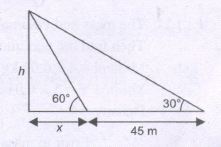
Let the height of the pole be h
Solution \(\frac { x+45 }{ h } \) = cot 30o ⇒ h =\(\frac { x+45 }{ cot\quad { 30 }^{ o } } \)
\(\frac { x }{ h } \) = cot 30o ⇒ x = h cot 60o
Substituting the values of x in the above equation
h = \(\frac { h\quad cot \ { 60 }^{ o }+45 }{ cot \ { 30 }^{ o } } \)
\(h \cot 30^{\circ} =h \cot 60^{\circ}+45
\)
\(h\left(\cot 30^{\circ}-\cot 60^{\circ}\right) =45
\)
\(h =\frac{45}{\cot 30^{\circ}-\cot 60^{\circ}}=\frac{45}{\sqrt{3}-\frac{1}{\sqrt{3}}}=38.97 \mathrm{~m}\)

11th Standard Syllabus & Materials
11th Standard
TN 11th Tamil பீடு பெற நில் - செய்யுள் - காவடிச்சிந்து Important Questions And Answers Study Material - QB365 Set A
NEW11th Standard
TN 11th Tamil பீடு பெற நில் - உரைநடை - மலை இடப்பெயர்கள் : ஓர் ஆய்வு Important Questions And Answers Study Material - QB365 Set A
NEW11th Standard
TN 11th Tamil மாமழை போற்றுதும் - துணைப்பாடம் - யானை டாக்டர் Important Questions And Answers Study Material - QB365 Set A
NEW11th Standard
TN 11th Tamil மாமழை போற்றுதும் - செய்யுள் - ஐங்குறுநூறு Important Questions And Answers Study Material - QB365 Set A



Tamilnadu Stateboard 11th Standard Subjects

Maths

Commerce

Economics

Biology

Business Maths and Statistics

Accountancy

Computer Science
Physics

Chemistry
Maths
Biology
Economics
Physics
Chemistry

History
Business Maths and Statistics

Computer Science
Accountancy

Computer Applications
History
Computer Technology
Commerce
Computer Applications
Computer Technology

Tamil

English

French
Tamilnadu Stateboard Standards

