
 100% FREE ACCESS
11th Standard Syllabus & Materials
11th Standard
TN 11th Tamil இயற்கை வேளாண்மை,சுற்றுச்சூழல் -செய்யுள் - மனோன்மணீயம் Important Questions And Answers Study Material - QB365 Set A
NEW11th Standard
TN 11th Tamil என்னுயிர் என்பேன் -துணைப்பாடம் - இசைத்தமிழர் இருவர் Important Questions And Answers Study Material - QB365 Set A
NEW11th Standard
TN 11th Tamil மொழி கலை -செய்யுள் - ஒவ்வொரு புல்லையும் Important Questions And Answers Study Material - QB365 Set A
NEW11th Standard
TN 11th Tamil பீடு பெற நில் - இலக்கணம் - பகுபத உறுப்புகள் Important Questions And Answers Study Material - QB365 Set A
NEW11th Standard
TN 11th Tamil பீடு பெற நில் - துணைப்பாடம் - வாடிவாசல் Important Questions And Answers Study Material - QB365 Set A
NEW11th Standard
TN 11th Tamil பீடு பெற நில் - செய்யுள் - குறுந்தொகை Important Questions And Answers Study Material - QB365 Set A

Published on: 22/09/2018
Model Paper 3mark
Download Tamil Nadu 11th Standard Physics question papers, model tests, one-mark questions, important questions, and public exam papers in PDF format. Free study materials and answer keys for TN State Board students.
Questions + Answers key
Take MCQ Physics Test1.
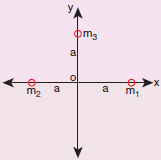
Calculate the gravitational field at point O due to three masses m1, m2 and m3 whose positions are given by the following figure. If the masses m1 and m2 are equal what is the change in gravitational field at the point O?
2.
Suppose unknowingly you wrote the universal gravitational constant value as G = 6.67\(\times\)1011 instead of the correct value G = 6.67\(\times\)1011, what is the acceleration due to gravity g' for this incorrect G? According to this new acceleration due to gravity, what will be your weight W'?
3.
Consider two trains A and B moving along parallel tracks with the same velocity in the same direction. Let the velocity of each train be 50 km h-1 due east. Calculate the relative velocities of the trains.
4.
Suppose two trains A and B are moving with uniform velocities along parallel tracks but in opposite directions. Let the velocity of train A be 40 km h-1 due east and that of train B be 40 km h-1 due west. Calculate the relative velocities of the trains.
5.
Consider two objects of masses 5 kg and 20 kg which are initially at rest. A force 100 N is applied on the two objects for 5 second.
(a) What is the momentum gained by each object after 5s?
(b) What is the speed gained by each object after 5s?
6.
Find the maximum speed at which a car can turn round a curve of 36 m radius on a level road. Given the coefficient of friction between the tyre and the road is 0.53.
7.
Three blocks of masses 10 kg, 7 kg and 2 kg are placed in contact with each other on a frictionless table. A force of 50 N is applied on the heaviest mass. What is the acceleration of the system?
8.
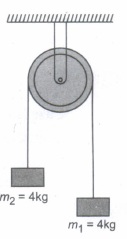
Two masses m1 = 5 kg and m2 = 4 kg tied to a string are hanging over a light frictionless pulley. What is the acceleration of each mass when left free to move? (g = 10 ms-2).
9.
A particle moves on a circular path with decreasing speed. What happens to its angular momentum?
10.
The moment of inertia of two rotating bodies A and B are IA and IB ( CA> IB) and their angular momenta are equal. Which one has a greater kinetic energy?
11.
Determine the value of the T from the given vector equation \(5\hat j-T\hat j=6\hat j+3T\hat j\)
12.
Compare the components for the following vector equations
(a) \(\vec F=m\vec a\)
(b) \(\vec p=0\)
13.
A stone of mass 1kg is whirled in a circular path of radius 1m. Find out the tension in the string if the linear velocity is 10m/s.
14.
If angular momentum is conserved in a system whose moment of inertia is decreased, will its rotational kinetic energy be conserved?
15.
A block of mass 2 kg rests on a plane inclined at an angle of 300 with the horizontal. The coefficient of friction between the block and the surface is 0.7. What will be the frictional force acting on the block?
16.
A ball tied to a string takes 4s to complete revolution along a horizontal circle. If by pulling the cord, the radius of the circle is reduced to half of the previous value, then how much time the ball will take in one revolution.
17.
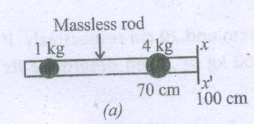
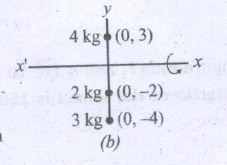
Calculate moment of inertia with respect to rotational axis xx' in following figures (a) and (b).
18.
What is position vector? Explain.
19.
What do you mean by multiplication of a vector by a real number?
20.
Using components method, subtract the following vectors.
\(\overrightarrow { A } ={ A }_{ x }\hat { i } +{ A }_{ y }\hat { j } +{ A }_{ z }\hat { k } \)
\(\overrightarrow { B } ={ B }_{ x }\hat { i } +{ B }_{ y }\hat { j } +{ B }_{ z }\hat { k } \)
21.
When the sum of two vectors is maximum?
22.
Does a scalar quantity depends upon the frame of reference chosen.
23.
Define angle of friction?
24.
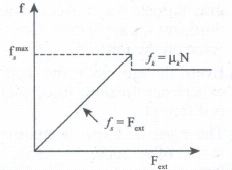
Draw the graph for the variation of both static and kinetic frictional forces with external applied force?
25.
What is static friction? Explain
26.
Why do passengers fall in backward direction when a bus suddenly starts moving from the rest position?
27.
Define inertia.
28.
What is idea proposed by Aristotle and Galileo about force?
29.
What is right handed coordinate system?
30.
What is meant by frame of reference?
31.
What is meant by rolling friction?
32.
Obtain an expression for the power delivered by torque.
33.
Define a vector. Give examples.
34.
Explain what is meant by Cartesian coordinate system?
35.
Suppose two cars A and B are moving with uniform velocities with respect to ground along parallel tracks and in the same direction. Let the velocities of A and B be 35 km h-1 due east and 40 km h-1 due east respectively. What is the relative velocity of car B with respect to A?
.png)
36.
Given two vectors \(\vec A=2\hat i+4\hat j+5\hat k\) and \(\vec B=\hat i+3\hat j+6\hat k\). Find the product \(\vec A.\vec B\), and the magnitudes of \(\vec A\) and \(\vec B\) . What is the angle between them?
37.
A vector \(\vec A\) is given as in the following figure. Find 4\(\vec A\) and -4\(\vec A\).
38.
Explain the addition of two vectors using components method.
39.
State Newton's First Law.
40.
The Moon is orbiting the Earth approximately once in 27 days, what is the angle traversed by the Moon per day?
1.
From the figure, the distance of m1 from the origin = a
From the figure, the distance of m2 from the origin = a
Gravitational field \(\mathrm{E}=\frac{G M}{r^{2}} \hat{r}\)
At the origin (Point O) the change in gravitational field is
\(\vec{E}=\frac{G M}{a^{2}}\left[\left(m_{1}-m_{2}\right) \hat{i}+m_{3} \hat{j}\right]\)
It is given that
\(\mathrm{m}_{1} =\mathrm{m}_{2} \)
\(\therefore \vec{E} =\frac{G M}{a^{2}}\left[m_{3} \hat{j}\right]\)
2.
Mass of the earth M = 6.024 5 1024 kg
Radius of the earth R = 6.4\(\times\)106 m
Gravitational constant G' = 6.67\(\times\)1011
Gravitational constant G = 6.67\(\times\)1011
Acceleration due to gravity g' =?
g' =
g' = 9.8\(\times\)1022 m/s2
g = 9.8 m/s2
∴ g' = g\(\times\)1022 (or) 1022
g = g' m/s2
Weight W = mg
W' = mg'
= 1022 .W
W = 1022
3.
Relative velocity of B with respect to A
\({ v }_{ BA }={ v }_{ B }-{ v }_{ A }\)
= 50 km h-1 + (-50) km h-1
= 0 kmh-1
Similarly, relative velocity of A with respect to B i.e., vAB is also zero.
Thus each train will appear to be at rest with respect to the other.
4.
Relative velocity of A with respect to B, \( { v } _{ AB }\)= 80 km h-1 due east
Thus to a passenger in train B, the train A will appear to move east with a velocity of 80 km h-1.The relative velocity of B with respect to A, VBA = 80 km h-1 due west.
To a passenger in train A, the train B will appear to move westwards with a velocity of 80 km h-1
5.
Final momentum on each object Δp = FΔt = 100\(\times\)5 = 500 kg ms-1
Final speed on the object of mass 5 kg = 500/5 =100 m s-1
Final speed on the object of mass 20 kg = 500/20 =25 m s-1
Note that momentum on each object is the same after 5 seconds but speed is not the same after 5 seconds. The heavier mass acquires lesser speed than the one with lower mass.
6.
Radius of the curve r = 36 m.
Coefficient of friction μ= 0.53
Acceleration due to gravity g = 10 ms-2
vmax=\(\sqrt { \mu rg } =\sqrt { 0.53\times 36\times 10 } \)=13.81 ms-1.
7.
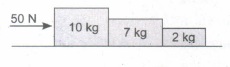
We know that a=\(\left[ \frac { F }{ { m }_{ 1 }+{ m }_{ 2 }+{ m }_{ 3 } } \right] =\frac { 50N }{ 10kg+7kg+2kg } =\frac { 50 }{ 19 } \)= 2.63 ms-2
8.
a=\(\frac { { m }_{ 1 }-{ m }_{ 2 } }{ { m }_{ 1 }+{ m }_{ 2 } } \times g=\frac { 5-4 }{ 5+4 } \times 10=\frac { 1 }{ 9 } \)=1.1 ms-2.
9.
As \(\vec L\)= \(\vec r\) \(\times\) \(\vec mv\) i.e., \(\vec L\) magnitude decreases but direction remains constant.
10.
\(K=\frac { { L }^{ 2 } }{ 2I } \Rightarrow K_{ A }>K_{ A }\)
11.
By comparing the components both sides, we can write
5 - 6 = 3T + T
-1 = 4T
T = \(-\frac{1}{4}\)
12.
(a) \(\vec F=m\vec a\)
\(F_x\hat i+F_y\hat j+F_z\hat k=ma_x\hat i+ma_y\hat j+ma_z\hat k\)
By comparing the components, we get
\(F_x=ma_x,F_y=ma_y,F_z=ma_z\)
This implies that one vector equation is equivalent to three scalar equations.
(b) \(\vec p=0\)
\(p_x\hat i+p_y\hat j+p_z\hat k=0\hat i+0\hat j+0\hat k\)
By comparing the components, we get
\(p_x=0,p_y=0,p_z=0\)
13.
T = \(\frac { mv^{ 2 } }{ R } =\frac { 1\times (10)^{ 2 } }{ 1 } \) = 100N
14.
Given: L = Iω= Constant
Formula: Rotational K.E. is given by,
K = \(\frac { 1 }{ 2 } \) Iω2=\(\frac { 1 }{ 2 } \frac { { I }^{ 2 }\omega ^{ 2 } }{ I } \)= \(\frac { 1 }{ 2 } .\frac { L^{ 2 } }{ I } \)
For constant L, \(K\propto\frac{1}{1}\)
So when the moment of inertia decreases, the rotational K.E. increases. Hence rotational K.E. is not conserved.
15.
Here f = μR = μmg cosፀ = 0.7\(\times\)2\(\times\)9.8 cos300
=0.7\(\times\)9.8\(\times\)0.866 = 11.9 N
16.
Formula: By conservation of angular momentum
l1ω 1 = I2ω2
or mr2. \(\frac { 2\pi }{ T_{ 1 } } \) = m \(\left( \frac { r }{ 2 } \right) ^{ 2 }.\frac { 2\pi }{ T_{ 2 } } \)
\({ T }_{ 2 }=\frac { 1 }{ 4 } { T }_{ 1 }\)
= \(\frac { 1 }{ 4 } \times 4\)=1s
17.
(a) Ixx' = 4 \(\times\) (0.3)2 + 1 \(\times\) (0.8)2 = 1 kgm2
(b) Ixx'= 4 \(\times\) (3)2 + 2 \(\times\) (2)2 + 3 \(\times\) (4)2 = 92 kgm2
18.
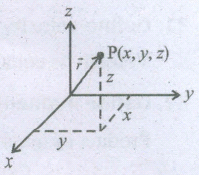
A vector which denotes the position of a particle at any instant of time, with respect to origin of coordinate system.
The position vector \(\vec{r}\) of the particle at a point P is given by \(\vec{r}=x\vec{i}+y\vec{j}+z\vec{k}\)
19.
A vector \(\vec{A}\) multiplied by a scalar \(\lambda\) results in another vector, \(\lambda\vec{A}\) .
Eg: Force F = m\(\vec{a}\) . Here mass om is a scalar, and a is the acceleration. Since 'm' is always a positive scalar, the direction of force is always in the direction of acceleration.
20.
Similarly the subtraction of two vectors is equivalent to subtracting the corresponding x, y and z components:
\(\vec{A}-\vec{B}=(A_x-B_{x})\hat{i}+(A_y-B_y)\hat{j}+(A_z-B_z)\hat{k}\)
21.
Two vectors have same direction.
22.
No.
23.
The angle of friction is defined as the angle between the normal force (N) and the resultant force (R) of normal force and maximum friction force (fsmax).
24.
(i) The graph shows that static friction increases linearly with external applied force till it reaches the maximum.
(ii) If the object begins to move then the kinetic friction is slightly lesser than the maximum static friction.
(iii) Note that the kinetic friction is constant and it is independent of applied force.
25.
(i) Static friction is the force which opposes the initiation of motion of an object on the surface.
(ii) When the object is at rest on the surface, only two forces act on it.
(iii) They are the downward gravitational force and upward normal force
(iv) The resultant of these two forces on the object is zero.
26.
(i) Inertia of rest: When a stationary bus starts to move, the passengers experience a sudden backward push.
(ii) Due to inertia, the body (of a passenger) will try to continue in the state of rest, while the bus moves forward. This appears as a backward push.
27.
The inability of objects to move on its own or change its state of motion is called inertia.
28.
(i) Aristotle said that 'Force causes motion'.
(ii) Galileo said force is not required to maintain motion.
29.
If the x, y and z axes are drawn in anticlockwise direction then the coordinate system is called as "right-handed Cartesian coordinate system".
30.
A coordinate system and the position of an object is described relative to it, then such a coordinate system is called frame of reference.
31.
When the round object moves, it always tends to roll on any surface which has a coefficient of friction any value greater than zero (μ > 0). The friction that enabling the rolling motion is called rolling friction.
32.
Power delivered is the work done per unit time. If we differentiate the expression for work done with respect to time, we get the instantaneous power (P).
p =\(\frac { dw }{ dt } =\tau \frac { d\theta }{ dt } \) \(\because (dw=\tau d\theta )\)
p =ፒω
33.
(i) A quantity which is described by both its magnitude and direction is called a vector quantity.
(ii) Geometrically, a vector is a directed line segment
Examples: Force, velocity displacement, acceleration, position vector, linear momentum and angular momentum.
34.
(i) Cartesian Coordinate system is a frame of reference in which the position of an object at any given instant is described in terms of its distances along x, y and z axes.
(ii) Conventionally right - handed Cartesian Coordinate system where the x, y and z axes are drawn in anti clockwise direction is followed in physics.
35.
The relative velocity of B with respect to A, \(\vec { { V }_{ BA } } =\vec { { V }_{ B } } -\vec { { V }_{ A } } \)= 5 km h-1 due west similarly, the relative velocity of A with respect to B i.e., \(\vec { { V }_{ AB } } =\vec { { V }_{ A } } -\vec { { V }_{ B } } \) = 5 km h-1. To a passenger in the car A, the car B will appear to be moving east with a velocity 5 km h-1. To a passenger in train B, the train A will appear to move westwards with a velocity of 5 km h-1
36.
\(\vec A.\vec B\) = 2 + 12 + 30 = 44
Magnitude A = \(\sqrt{4+16+25}=\sqrt{45}\) units
Magnitude B = \(\sqrt{1+9+36}=\sqrt{46}\) units
The angle between the two vectors is given by
\(\theta=\cos^{-1}(\frac{\vec A.\vec B}{AB})=\cos^{-1}(\frac{44}{\sqrt{45}\times \sqrt{46}})=\cos^{-1}(\frac{44}{45.49})=\cos^{-1}(0.967)\)
\(\therefore \theta \cong { 15 }^{ o }\)
37.
.png)
In physics, certain vector quantities can be defined as a scalar times another vector quantity.
38.
The two vectors \(\vec{A}\) and \(\vec{B}\) in a Cartesian coordinate system can be expressed as
\(\overrightarrow { A } ={ A }_{ x }\hat { i } +{ A }_{ y }\hat { j } +{ A }_{ z }\hat { k } \)
\(\overrightarrow { B } ={ B }_{ x }\hat { i } +{ B }_{ y }\hat { j } +{ B }_{ z }\hat { k } \)
Then the addition of two vectors is equivalent to adding their corresponding x, y and z components.
\(\vec{A}+\vec{B}=(A_x+B_x)\hat{i}+(A_y+B_y)\hat{j}+(A_z+B_z)\hat{k}\)
39.
Every object continues to be in the state of rest or of uniform motion (constant velocity) unless there is external force acting on it.
40.
360o = 27 days
1 day = \(\frac{360^o}{27}=13^o.3'\)

11th Standard Syllabus & Materials
11th Standard
TN 11th Tamil பீடு பெற நில் - செய்யுள் - காவடிச்சிந்து Important Questions And Answers Study Material - QB365 Set A
NEW11th Standard
TN 11th Tamil பீடு பெற நில் - உரைநடை - மலை இடப்பெயர்கள் : ஓர் ஆய்வு Important Questions And Answers Study Material - QB365 Set A
NEW11th Standard
TN 11th Tamil மாமழை போற்றுதும் - துணைப்பாடம் - யானை டாக்டர் Important Questions And Answers Study Material - QB365 Set A
NEW11th Standard
TN 11th Tamil மாமழை போற்றுதும் - செய்யுள் - ஐங்குறுநூறு Important Questions And Answers Study Material - QB365 Set A



Tamilnadu Stateboard 11th Standard Subjects

Maths

Commerce

Economics

Biology

Business Maths and Statistics

Accountancy

Computer Science
Physics

Chemistry
Maths
Biology
Economics
Physics
Chemistry

History
Business Maths and Statistics

Computer Science
Accountancy

Computer Applications
History
Computer Technology
Commerce
Computer Applications
Computer Technology

Tamil

English

French
Tamilnadu Stateboard Standards

