
 100% FREE ACCESS
11th Standard Syllabus & Materials
11th Standard
TN 11th Tamil இயற்கை வேளாண்மை,சுற்றுச்சூழல் -செய்யுள் - மனோன்மணீயம் Important Questions And Answers Study Material - QB365 Set A
NEW11th Standard
TN 11th Tamil என்னுயிர் என்பேன் -துணைப்பாடம் - இசைத்தமிழர் இருவர் Important Questions And Answers Study Material - QB365 Set A
NEW11th Standard
TN 11th Tamil மொழி கலை -செய்யுள் - ஒவ்வொரு புல்லையும் Important Questions And Answers Study Material - QB365 Set A
NEW11th Standard
TN 11th Tamil பீடு பெற நில் - இலக்கணம் - பகுபத உறுப்புகள் Important Questions And Answers Study Material - QB365 Set A
NEW11th Standard
TN 11th Tamil பீடு பெற நில் - துணைப்பாடம் - வாடிவாசல் Important Questions And Answers Study Material - QB365 Set A
NEW11th Standard
TN 11th Tamil பீடு பெற நில் - செய்யுள் - குறுந்தொகை Important Questions And Answers Study Material - QB365 Set A

Published on: 22/09/2018
Model paper-2mark
Download Tamil Nadu 11th Standard Physics question papers, model tests, one-mark questions, important questions, and public exam papers in PDF format. Free study materials and answer keys for TN State Board students.
Questions + Answers key
Take MCQ Physics Test1.
Calculate the change in g value in your district of Tamilnadu. (Hint: Get the latitude of your district of Tamilnadu from the Google). What is the difference in g values at Chennai and Kanyakumari?
2.
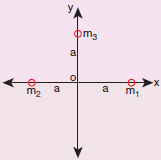
Calculate the gravitational field at point O due to three masses m1, m2 and m3 whose positions are given by the following figure. If the masses m1 and m2 are equal what is the change in gravitational field at the point O?
3.
Suppose unknowingly you wrote the universal gravitational constant value as G = 6.67\(\times\)1011 instead of the correct value G = 6.67\(\times\)1011, what is the acceleration due to gravity g' for this incorrect G? According to this new acceleration due to gravity, what will be your weight W'?
4.
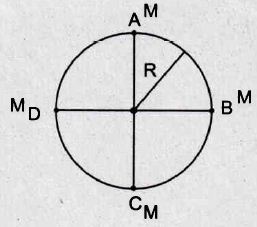
Four particles, each of mass M and equidistant from each other, move along a circle of radius R under the action of their mutual gravitational attraction. Calculate the speed of each particle.
5.
The Moon I0 orbits Jupiter once in 1.769 days. The orbital radius of the Moon I0 is 421700 km. Calculate the mass of Jupiter?
6.
An unknown planet orbits the Sun with distance twice the semi-major axis distance of the Earth’s orbit. If the Earth’s time period is T1, what is the time period of this unknown planet?
7.
If the Earth has no tilt, what happens to the seasons of the Earth?
8.
Why is there no lunar eclipse and solar eclipse every month?
9.
Define weight.
10.
Why is the energy of a satellite (or any other planet) negative?
11.
Suppose we go 200 km above and below the surface of the Earth, what are the g values at these two points? In which case, is the value of g small?
12.
If the angular momentum of a planet is given by \(\vec{L}=5t^2\hat i-6t\hat j+3\hat k\) . What is the torque experienced by the planet? Will the torque be in the same direction as that of the angular momentum?
13.
Assume that you are in another solar system and provided with the set of data given below consisting of the planets’ semi-major axes and time periods. Can you infer the relation connecting semi-major axis and time period?
| Planet (imaginary) |
Time period(T) (in year) |
Semi major axis (a) (in AU) |
|---|---|---|
| Kurinji | 2 | 8 |
| Mullai | 3 | 18 |
| Marutham | 4 | 32 |
| Neithal | 5 | 50 |
| Paalai | 6 | 72 |
14.
How will you prove that Earth itself is spinning?
15.
1.
\(\mathrm{g}_{\text {latitude'}} \ g^{\prime}=g-\omega^{2} R \cos ^{2} \lambda\)
Value of latitude of g at Chennai \(\simeq 13^{\circ}\)
\(\operatorname{Cos} 13^{\circ} =0.2268 \mathrm{rad}
\)
\(\omega =\frac{2 \pi}{T}=\frac{2 \pi}{24 \times 3600}
\)
\(=\frac{2 \pi}{86400}=\frac{2 \times 3.14}{86400}
\)
\(\therefore \omega^{2} R =\left(\frac{2 \times 3.14}{86400}\right)^{2} \times\left(6400 \times 10^{3}\right)
\)
\(=3.4 \times 10^{-2} \mathrm{~m} / \mathrm{s}^{2}
\)
\(\mathrm{g}_{\text {Cbeanai }} =\mathrm{g}-\omega^{2} R \cos ^{2} \lambda
\)
\(=9.8-\left(3.4 \times 10^{-2}\right)^{2} \cos (0.2268)^{2}
\)
\(\mathrm{~g}_{\text {Chennai }} =9.7677 \mathrm{~m} / \mathrm{s}^{2}\)
Value of latitude at Kanyakumari
\(=8.088^{\circ} \mathrm{N}=8.08=8.1^{\circ} \mathrm{N}
\)
\(\omega =\frac{2 \pi}{T}=\frac{2 \times 3.14}{86400}
\)
\(\omega^{2} R =\left(\frac{2 \times 3.14}{86400}\right)^{2} \times\left(6400 \times 10^{3}\right)
\)
\(=3.4 \times 10^{2} \mathrm{~m} / \mathrm{s}^{2}\)
\(\mathrm{g}_{\text {Kanyakumari }} =g-\omega^{2} R \cos ^{2} \lambda
\)
\(=9.8-\left(3.4 \times 10^{2}\right)^{2}\left[\cos \left(8.1^{\circ}\right)\right]^{2}
\)
\(g_{\text {Kanyakumari }} =9.798 \mathrm{~ms}^{-2}
\)
\(\Delta g =9.798-9.767=0.031 \mathrm{~ms}^{-2}\)
2.
From the figure, the distance of m1 from the origin = a
From the figure, the distance of m2 from the origin = a
Gravitational field \(\mathrm{E}=\frac{G M}{r^{2}} \hat{r}\)
At the origin (Point O) the change in gravitational field is
\(\vec{E}=\frac{G M}{a^{2}}\left[\left(m_{1}-m_{2}\right) \hat{i}+m_{3} \hat{j}\right]\)
It is given that
\(\mathrm{m}_{1} =\mathrm{m}_{2} \)
\(\therefore \vec{E} =\frac{G M}{a^{2}}\left[m_{3} \hat{j}\right]\)
3.
Mass of the earth M = 6.024 5 1024 kg
Radius of the earth R = 6.4\(\times\)106 m
Gravitational constant G' = 6.67\(\times\)1011
Gravitational constant G = 6.67\(\times\)1011
Acceleration due to gravity g' =?
g' =
g' = 9.8\(\times\)1022 m/s2
g = 9.8 m/s2
∴ g' = g\(\times\)1022 (or) 1022
g = g' m/s2
Weight W = mg
W' = mg'
= 1022 .W
W = 1022
4.
The gravitational potential energy
\(\mathrm{V} =-\frac{G M^{2}}{R}\left[1+\frac{4}{\sqrt{2}}\right]
\)
\(\mathrm{V} =-\frac{G M^{2}}{R}[1+2 \sqrt{2}]
\)
\(\text {Gravitational potential } \mathrm{V}_{\mathrm{o}}(\mathrm{r}) =-\frac{4 G M}{R}\)
Centripetal acceleration \(a=\frac{V^{2}}{R}\)
Centripetal force \(=\frac{M V^{2}}{R}\)
\(\therefore\) Speed \(V=\frac{1}{2} \sqrt{\frac{G M}{R}(1+2 \sqrt{2})}\)
5.
Time period, T = 1.769 days
Orbital radius, r = 421700 x 103 m
\(\mathrm{T} =2 \pi \sqrt{\frac{R^{3}}{G M}}
\)
\(\mathrm{T}^{2} =\frac{4 \pi^{2} \times R^{3}}{G M}
\)
\(\therefore \mathrm{M} =4 \pi^{2} \times G \times \frac{R^{3}}{T^{2}}
\)
\(\mathrm{~T}^{2} \propto \mathrm{R}^{3}
\)
\(\frac{R^{3}}{T^{2}} =\left[\frac{421700 \times 10^{3}}{1.769}\right]^{3 / 2}=\frac{\left(421.7 \times 10^{6}\right)^{3}}{(1.769)^{2}}
\)
\(=\frac{74991.3 \times 10^{3} \times 10^{18}}{3.1293}=\frac{7499.14 \times 10^{22}}{3.1293}
\)
\(=2396.4 \times 10^{22}\)
\(\mathrm{M} =4 \times 3.14 \times 6.67 \times 10^{-11} \times 2396.4 \times 10^{22}
\)
\(=1.898 \times 10^{27} \mathrm{~kg}\)
6.
Let the distance of the Earth = RE
The distance of unknown planet = RP = 2 RE
Let the time period of the Earth be T1
The time period of the unknown planet be T2
\(\text {Time period } \mathrm{T} =2 \pi \sqrt{\frac{R_{E}}{g}}
\)
\(\mathrm{~T} \propto \sqrt{R_{E}}
\)
\(\therefore \frac{T_{1}}{T_{2}} =\sqrt{\frac{R_{E}}{R_{P}}}=\sqrt{\frac{R_{E}}{2 R_{E}}}
\)
\(\therefore \frac{T_{1}}{T_{2}} =\frac{1}{\sqrt{2}}
\)
\(\mathrm{~T}_{2} =\sqrt{2} T_{1}\)
7.
If the Earth has us tilt then there would not be seasons of the Earth.
8.
If the orbits of the Moon and Earth lie on the same plane, during full Moon of every month, we can observe lunar eclipse. If this is so during new Moon we can observe solar eclipse. But Moon's orbit is tilted 5o with respect to Earth's orbit. Due to this 5o tilt, only during certain periods of the year, the Sun, Earth and Moon align in straight line leading to either lunar eclipse or solar eclipse depending on the alignment.
9.
The weight of an object is defined as the downward force whose magnitude W is equal to the upward force that must be applied to the object to hold it at rest or at constant velocity relative to the Earth.
10.
(i) Implies that the satellite is bound to the Earth and it cannot escape from the Earth
(ii) As h approaches ∝ the total energy tends to zero. Its physical meaning is that the satellite is completely free from the influence of Earth's gravity and is not bound to Earth at large distances.
11.
Height = Altitude h = 200 km
Depth d = 200 km
The value of g at that altitude is
\(\mathrm{g}_{\mathrm{h}}=g\left[1-\frac{2 h}{R_{e}}\right]
\)
\(R_{e}=6400 \mathrm{~km}
\)
\(\therefore \quad \mathrm{g}_{\mathrm{h}}=g\left[1-\frac{2 \times 200}{6400}\right]
\)
\(\therefore g_{u p}=g\left[1-\frac{2 \times 200}{6400}\right]
\)
\(g_{\text {up }} =g\left[\frac{6000 \times 10^{3}}{6400 \times 10^{3}}\right]
\)
\(=g \times \frac{15}{16}=g \times 0.9375
\)
\(\mathrm{g}_{\text {up }}=0.94 \mathrm{~g}
\)
\(\mathrm{g}_{\text {depth }}=\mathrm{g}_{d}=\mathrm{g}\left[1-\frac{d}{R_{E}}\right]
\)
\(g_{\text {down }}=g\left[1-\frac{200 \times 10^{3}}{6400 \times 10^{3}}\right]
\)
\(=g\left[1-\frac{200}{6200}\right]
\)
\(=g\left[1-\frac{1}{32}\right]=g\left[\frac{32-1}{32}\right]
\)
\(=-g \times \frac{31}{32}
\)
\(=0.96875 \mathrm{~g}
\)
\(\mathrm{g}_{\text {down }} \simeq 0.96 \mathrm{~g}\)
12.
Angular momentum \(\mathrm{L} =5 t^{2} \hat{i}-6 t \hat{j}+3 \hat{k} \)
\(\text {Torque } \propto \frac{d L}{d t}
\)
\(=\frac{d}{d t}\left[5 t^{2} \hat{i}-6 t \hat{j}+3 \hat{k}\right]=10 t \hat{i}-6 \hat{j}\)
13.
The value of semi major axis is directly proportional to twice the square of time period of a planet.
i.e, a \(\propto 2 \mathrm{~T}^{2}\)
It is given that for planet Kurinji,
\(\mathrm{T}_{1}=2, \quad \mathrm{a}_{1}=8=2 \times 2^{2} \Rightarrow 2 \mathrm{~T}_{1}{ }^{2}\)
For planet Mullai \(\quad \mathrm{T}_{2}=3, \quad \mathrm{a}_{2}=18=2 \times 3^{2} \Rightarrow 2 \mathrm{~T}_{2}{ }^{2}\)
For planet Marutham \(\quad \mathrm{T}_{3}=4, \quad \mathrm{a}_{3}=32=2 \times 4^{2} \Rightarrow 2 \mathrm{~T}_{3}{ }^{2}\)
For planet Neithal \(\quad \mathrm{T}_{4}=5, \quad \mathrm{a}_{4}=50=2 \times 5^{2} \Rightarrow 2 \mathrm{~T}_{4}{ }^{2}\)
For planet Paalai \(\quad \mathrm{T}_{5}=6, \quad \mathrm{a}_{5}=72=2 \times 6^{2} \Rightarrow 2 \mathrm{~T}_{5}^{2}\)
\(\therefore \alpha \propto 2 \mathrm{~T}^{2}\)
14.
Due to Earth's spinning motion, the stars in sky appear to move in circular motion about the pole star.
15.

11th Standard Syllabus & Materials
11th Standard
TN 11th Tamil பீடு பெற நில் - செய்யுள் - காவடிச்சிந்து Important Questions And Answers Study Material - QB365 Set A
NEW11th Standard
TN 11th Tamil பீடு பெற நில் - உரைநடை - மலை இடப்பெயர்கள் : ஓர் ஆய்வு Important Questions And Answers Study Material - QB365 Set A
NEW11th Standard
TN 11th Tamil மாமழை போற்றுதும் - துணைப்பாடம் - யானை டாக்டர் Important Questions And Answers Study Material - QB365 Set A
NEW11th Standard
TN 11th Tamil மாமழை போற்றுதும் - செய்யுள் - ஐங்குறுநூறு Important Questions And Answers Study Material - QB365 Set A



Tamilnadu Stateboard 11th Standard Subjects

Maths

Commerce

Economics

Biology

Business Maths and Statistics

Accountancy

Computer Science
Physics

Chemistry
Maths
Biology
Economics
Physics
Chemistry

History
Business Maths and Statistics

Computer Science
Accountancy

Computer Applications
History
Computer Technology
Commerce
Computer Applications
Computer Technology

Tamil

English

French
Tamilnadu Stateboard Standards

