
 100% FREE ACCESS
11th Standard Syllabus & Materials
11th Standard
TN 11th Tamil இயற்கை வேளாண்மை,சுற்றுச்சூழல் -செய்யுள் - மனோன்மணீயம் Important Questions And Answers Study Material - QB365 Set A
NEW11th Standard
TN 11th Tamil என்னுயிர் என்பேன் -துணைப்பாடம் - இசைத்தமிழர் இருவர் Important Questions And Answers Study Material - QB365 Set A
NEW11th Standard
TN 11th Tamil மொழி கலை -செய்யுள் - ஒவ்வொரு புல்லையும் Important Questions And Answers Study Material - QB365 Set A
NEW11th Standard
TN 11th Tamil பீடு பெற நில் - இலக்கணம் - பகுபத உறுப்புகள் Important Questions And Answers Study Material - QB365 Set A
NEW11th Standard
TN 11th Tamil பீடு பெற நில் - துணைப்பாடம் - வாடிவாசல் Important Questions And Answers Study Material - QB365 Set A
NEW11th Standard
TN 11th Tamil பீடு பெற நில் - செய்யுள் - குறுந்தொகை Important Questions And Answers Study Material - QB365 Set A

Published on: 21/11/2019
Kinematics
Download Tamil Nadu 11th Standard Physics question papers, model tests, one-mark questions, important questions, and public exam papers in PDF format. Free study materials and answer keys for TN State Board students.
Questions + Answers key
Take MCQ Physics Test1.
A train is moving towards east and a car is along north, both with same speed. The passenger in the train is observed the car moving in which of the following direction?
East-north direction
West-north direction
South-east direction
None of these
2.
Choose the motion in two dimension from the following.
Motion of a train along a straight railway track
An object falling freely under gravity close to the Earth.
A particle moving along a curved path in a plane.
Flying of a kite on a windy day.
3.
If a particle executes uniform circular motion, choose the correct statement
The velocity and speed are constant
The acceleration and speed are constant.
The velocity and acceleration are constant.
The speed and magnitude of acceleration are constant.
4.
If the velocity is \(\overrightarrow { v } =2\hat { i } +{ t }^{ 2 }\hat { j } -9\overrightarrow { k } \), then the magnitude of acceleration at t = 0.5s is
1 ms-2
2 ms-2
zero
-1 ms-2
5.
If a particle has negative velocity and negative acceleration, its speed
increases
decreases
remains same
zero
6.
What does the slope of 'position-time' graph represent? Which physical quantity is obtained from it?
7.
Write an expression for displacement vector in Cartesian coordinate system and also show graphically.
8.
The Moon is orbiting the Earth approximately once in 27 days, what is the angle traversed by the Moon per day?
9.
If Earth completes one revolution in 24 hours, what is the angular displacement made by Earth in one hour. Express your answer in both radian and degree.
10.
Convert the vector \(\vec { r } =3\hat { i } +2\hat { j } \) into a unit vector.
11.
Write down the expression for angle made by resultant acceleration and radius vector in the non uniform circular motion.
12.
Write down the kinematic equations for angular motion.
13.
Define velocity and speed
14.
The displacement x of a particle varies with time 't' as, x = 3t2 - 4t+ 30. Find the position, velocity and acceleration of the particle at t=0.
15.
The position of a particle is given by x = 6t + 2t3. Find out that its motion is uniform and non uniform.
16.
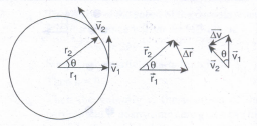
Derive the expression for total acceleration in the non uniform circular motion.
17.
18.
What is position vector? Show the position vector for particle in three dimensional motion. Write an expression for this position vector.
19.
What are the resultants of the vector product of two given vectors given by \(\overrightarrow { A } =4\hat { i } -2\hat { j } +\hat { k } \ and \ \overrightarrow { B } =5\hat { i } +3\hat { j } -4\hat { k } \)
1.
(b)
West-north direction
2.
(c)
A particle moving along a curved path in a plane.
3.
It is a uniform circular motion. So the direction of velocity changes but not the magnitude. Therefore speed in considered constant. Again magnitude of acceleration does not change.
4.
\(\vec{v}=2 \hat{l}+t^{2} \hat{j}-9 \vec{k}\)
\(\vec{a}=\frac{d \vec{v}}{d t}=2 t \hat{j}\)
\(\text { When } t=0.5 \mathrm{~s}\)
\(a=1 \mathrm{~ms}^{-2}\)
5.
Velocity and acceleration are in the same direction: So speed increases.
6.
(i) Graphically the slope of the position-time graph will give the velocity of the particle.
(ii) At the same time, if velocity-time graph is given, the distance and displacement are determined, by calculating the area under the curve.
Velocity is given by \(\frac { dx }{ dt } =v\)
(iii) Therefore, dx = vdt
By integrating both sides, \(\int _{ { x }_{ 1 } }^{ { x }_{ 2 } }{ dx=\int _{ { x }_{ 1 } }^{ { x }_{ 2 } }{ v\quad dt } } \)
Integration is equivalent to area under the given curve.
(iv) So the term \(\int _{ { t }_{ 1 } }^{ { t }_{ 2 } }{ vdt } \) represents the area under the curve v as a function of time.
(v) Since the left hand side of the integration represents the displacement travelled by the particle from time t1 to t2, the area under the velocity time graph will give the displacement of the particle.
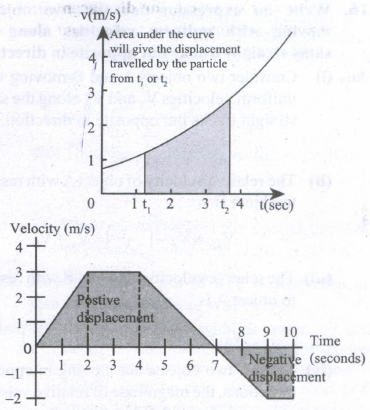
Displacement in the velocity - time graph
(vi) If the area is negative, it means that displacement is negative, so the particle has travelled in the negative direction.
7.
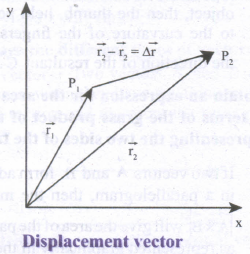
(i) In terms of position vector, the displacement vector is given as follows. Consider a particle moving from a point P1 having position vector \(\overrightarrow { { r }_{ 1 } } ={ x }_{ 1 }\hat { i } +{ y }_{ 1 }\hat { j } +{ z }_{ 1 }\hat { k } \) to a point P2 where its position vector is \(\overrightarrow { { r }_{ 2 } } ={ x }_{ 2 }\hat { i } +{ y }_{ 2 }\hat { j } +{ z }_{ 2 }\hat { k } \)
(ii) The displacement vector is given by \(\Delta \overrightarrow { r } =\overrightarrow { { r }_{ 2 } } -\overrightarrow { { r }_{ 1 } } \)
= (x2-x1)\(\hat { i } \) + (y2-y1)\(\hat { j } \)+(z2-z1)\(\hat {k } \)
(iii) This displacement is also shown in
8.
360o = 27 days
1 day = \(\frac{360^o}{27}=13^o.3'\)
9.
360o degrees in 24 hours.
\(\therefore\) angular displacement \(=\frac{360}{24}=15^{\circ}\ or \ \frac{2 \pi}{24}=\frac{\pi}{12}\) radius.
10.
\(\overrightarrow { r } =3\hat { i } +2\hat { j } \)
\(\text { Unit vector } =\frac{\vec{r}}{|\vec{r}|} \)
\(|\vec{r}| =\sqrt{3^{2}+2^{2}}=\sqrt{13} \)
\(\therefore \text { Unit vector } =\frac{3 \hat{i}+2 \hat{j}}{\sqrt{13}}\)
11.
If \(\theta \) in the angle made by the resultant acceleration, then \(tan \ \theta =\frac { { a }_{ 1 } }{ \left( \frac { { v }^{ 2 } }{ r } \right) } \) where at is the tangential acceleration and \(\frac{v^2}{r}\) is the centripetal acceleration.
12.
| 1. \(\omega ={ \omega }_{ 0 }+\alpha t\) | \(\omega \) = Final angular velocity |
| 2. \(\theta ={ \omega }_{ 0 }t+\frac { 1 }{ 2 } { \alpha t }^{ 2 }\) | \({ \omega }_{ 0 }\) = initial angular velocity |
| 3. \({ \omega }^{ 2 }={ \omega }_{ 0 }^{ 2 }+2\alpha \theta \) | \(\theta \) = Angular displacement |
| 4. \(\theta =\frac { \left( { \omega }_{ 0 }+\omega \right) t }{ 2 } \) | \(\alpha \) = angular acceleration t = time |
13.
Velocity:
Velocity is equal to the rate of change of position vector with respect to time.
It is a vector quantity \(\overrightarrow{v}=\frac{d\overrightarrow{r}}{dt}\)
Speed:
The magnitude of velocity is called speed and is given by \(v= \sqrt{v^2_x+v^2_y+v^2_z}\). It is a positive scalar.
14.
Position of a particle x = 3t2 - 4t + 30
Velocity \(v=\frac { dx }{ dt } =\frac { d }{ dt } ({ 3t }^{ 2 }-4t+30)\)
= 6t - 4 [\(\because\) xn = nxn-1]
Acceleration \(a=\frac { dv }{ dt } =\frac { d }{ dt } (6t-4)\)
a = 6
At time t = 0, we have
Position x = 3t2 - 4t + 30
=3(0)2 - 4(0)+30
x = 30 m
Velocity v = 6t - 4
= 6(0) - 4
= -4 m/s = -4 ms-1
Acceleration a = 6 ms-2
\(\because\) position x = 30 m, velocity v = -4 ms-1, acceleration = 6 ms-2
15.
The position of a particle x = 6t + 2t3
By differentiating with respect to 't'
\(\frac { dx }{ dt } =\frac { d }{ dt } (6t+2{ t }^{ 3 })\)
\(\frac { dx }{ dt } =6+6{ t }^{ 2 }\)
\(\because \ velocity\ v=\frac { dx }{ dt } =6+6{ { t }^{ 2 } }\ \ [\because { x }^{ n }={ nx }^{ n-1 }]\)
N = 6 + 6 t2
As velocity is time independent, it means that motion is uniform
16.
(i) Consider a particle moving along a circular path of radius r with a variable speed v.
(ii) As the speed of the particle changes so acceleration has a tangential component,
\({ a }_{ t }=\frac { dv }{ dt } r\infty ={ a }_{ t }={ r }_{ \infty }\)
(iii) As the direction of motion changes continuously, so the acceleration has a radial component (i.e.) centripetal acceleration.
\(\therefore \quad { a }_{ c }=\frac { { v }^{ 2 } }{ r } \)
(iv) The resultant acceleration is obtained by vector sum of centripetal and tangential acceleration.
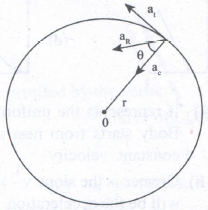
(v) the magnitude of this resultant acceleration is given by \({ a }_{ R }=\sqrt { { a }_{ t }^{ 2 }+{ \left( \frac { { v }^{ 2 } }{ r } \right) }^{ 2 } } \)
17.
18.
(i) It is a vector which denotes the position of a particle at any instant of time, with respect to some reference frame or coordinate system.
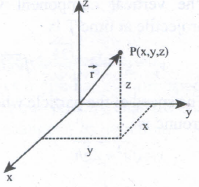
(ii) The position vector \(\overrightarrow { r } \)of the particle at a point P is given by \(\overrightarrow { r } =x\overrightarrow { i } +y\overrightarrow { j } +z\overrightarrow { k } \) where x, y and z are components of \(\overrightarrow { r } \).
19.
\(\overrightarrow { A } =4\hat { i } -2\hat { j } +\hat { k } \)
\(\overrightarrow { B } =5\hat { i } +3\hat { j } -4\hat { k } \)
Resultant vector = \(\overrightarrow { A } +\overrightarrow { B } \)
\(=\left| \begin{matrix} \hat { i } & \hat { j } & \hat { k } \\ 4 & -2 & 1 \\ 5 & 3 & -4 \end{matrix} \right| \)
\(=\hat{i}(8-3)+\hat{j}[5-(-16)]+\hat{k}(12+10)\)
Resultant vector = 5\(\hat { i } \) +21\(\hat { j } \) + 22\(\hat { k } \)

11th Standard Syllabus & Materials
11th Standard
TN 11th Tamil பீடு பெற நில் - செய்யுள் - காவடிச்சிந்து Important Questions And Answers Study Material - QB365 Set A
NEW11th Standard
TN 11th Tamil பீடு பெற நில் - உரைநடை - மலை இடப்பெயர்கள் : ஓர் ஆய்வு Important Questions And Answers Study Material - QB365 Set A
NEW11th Standard
TN 11th Tamil மாமழை போற்றுதும் - துணைப்பாடம் - யானை டாக்டர் Important Questions And Answers Study Material - QB365 Set A
NEW11th Standard
TN 11th Tamil மாமழை போற்றுதும் - செய்யுள் - ஐங்குறுநூறு Important Questions And Answers Study Material - QB365 Set A



Tamilnadu Stateboard 11th Standard Subjects

Maths

Commerce

Economics

Biology

Business Maths and Statistics

Accountancy

Computer Science
Physics

Chemistry
Maths
Biology
Economics
Physics
Chemistry

History
Business Maths and Statistics

Computer Science
Accountancy

Computer Applications
History
Computer Technology
Commerce
Computer Applications
Computer Technology

Tamil

English

French
Tamilnadu Stateboard Standards

