
 100% FREE ACCESS
11th Standard Syllabus & Materials
11th Standard
TN 11th Tamil இயற்கை வேளாண்மை,சுற்றுச்சூழல் -செய்யுள் - மனோன்மணீயம் Important Questions And Answers Study Material - QB365 Set A
NEW11th Standard
TN 11th Tamil என்னுயிர் என்பேன் -துணைப்பாடம் - இசைத்தமிழர் இருவர் Important Questions And Answers Study Material - QB365 Set A
NEW11th Standard
TN 11th Tamil மொழி கலை -செய்யுள் - ஒவ்வொரு புல்லையும் Important Questions And Answers Study Material - QB365 Set A
NEW11th Standard
TN 11th Tamil பீடு பெற நில் - இலக்கணம் - பகுபத உறுப்புகள் Important Questions And Answers Study Material - QB365 Set A
NEW11th Standard
TN 11th Tamil பீடு பெற நில் - துணைப்பாடம் - வாடிவாசல் Important Questions And Answers Study Material - QB365 Set A
NEW11th Standard
TN 11th Tamil பீடு பெற நில் - செய்யுள் - குறுந்தொகை Important Questions And Answers Study Material - QB365 Set A

Published on: 27/11/2019
Laws of Motion
Download Tamil Nadu 11th Standard Physics question papers, model tests, one-mark questions, important questions, and public exam papers in PDF format. Free study materials and answer keys for TN State Board students.
Questions + Answers key
Take MCQ Physics Test1.
A ship of mass 3\(\times\) 106 kg initially at rest is pulled by a force of 6 \(\times\) 104 N through a distance of 4m. The speed of the ship is (Assume resistive of water is negligible)
1.5 m/s
20 m/s
0.5 m/s
0.4 m/s
2.
A heavy iron rod of weight W is having its one end on the ground and the other on the shoulder of a man. The rod makes an angle ፀ with the horizontal. What is the weight experienced by the man?
W sin ፀ
W cos ፀ
W
\(\frac { W }{ 2 } \)
3.
A particle of mass m sliding on the smooth double inclined plane (shown in figure) will experience
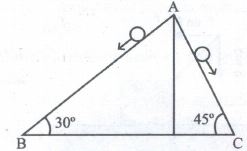
greater acceleration along the path AB
greater acceleration along the path AC
same acceleration in both the paths
no acceleration in both the paths
4.
A book is at rest on the table which exerts a normal force on the book. If this force is considered as reaction force, what is the action force according to Newton's third law?
Gravitational force exerted by Earth on the book
Gravitational force exerted by the book on Earth
Normal force exerted by the book on the table
None of the above
5.
A vehicle is moving along the positive x direction, if sudden brake is applied, then
frictional force acting on the vehicle is along negative x direction
frictional force acting on the vehicle is along positive x direction
no frictional force acts on the vehicle
frictional force acts in downward direction
6.
A lift is moving down with an acceleration 5.0 ms-2. Calculate the percentage change in the weight of a person in the lift
7.
A force of 10 N changes velocity of a body from 20 ms-1 to 40 ms-1 in 8 seconds. How much force is required to bring about the same change in 4s.
8.
9.
Explain various types of friction. Suggest a few methods to reduce friction.
10.
Give examples for inertia frames
11.
Why do passengers fall in backward direction when a bus suddenly starts moving from the rest position?
12.
Can the coefficient of friction be more than one?
13.
Why does a parachute descend slowly?
14.
There is a limit beyond which the polishing of a surface increases frictional resistance rather than decreasing it why?
15.
What are inertial frames?
16.
What is the meaning by 'pseudo force'?
17.
Explain why a gun recoils when a bullet is fired from it.
18.
Briefly explain what are all the forces act on a moving vehicle on a leveled circular road?
19.
Briefly explain 'centrifugal force' with suitable examples.
1.
(d)
0.4 m/s
2.
(d)
\(\frac { W }{ 2 } \)
3.
(b)
greater acceleration along the path AC
4.
(c)
Normal force exerted by the book on the table
5.
(a)
frictional force acting on the vehicle is along negative x direction
6.
When the lift is moving down with an acceleration
' a ' the weight of the person W is, given by
W = mg = ma = m(g-a)
Fractional change is the weight of the person
= \(\frac { mg-w }{ mg } \)
= \(1-\frac { w }{ mg } -\frac { mg-(mg-ma) }{ mg } \)
\(=\frac { a }{ g } =\frac { 5.0 }{ 9.8 } =0.51\)
=Percentage change = 0.51\(\times\)100
= 51 %
7.
Force F = F1 = F2
F1 = \(\frac { dp }{ { dt }_{ 1 } } ,{ F }_{ 2 }=\frac { dp }{ { dt }_{ 2 } } \)
\({ F }_{ 2 }={ F }_{ 1 }=\frac { { dt }_{ 1 } }{ { dt }_{ 2 } } \)
\(=10\times \frac { 8 }{ 4 } =20N\)
8.
9.
Static friction: The opposing force that comes into play when one body tends to move over the surface of another, but the actual motion has yet not started is called static friction.
Limiting friction: If the applied force is increased the force of static friction also increases. If the applied force exceeds a certain (maximum) value, the body starts moving. This maximum value of static friction up to which body does not move is called limiting friction.
Kinetic or dynamic friction: If the applied force is increased further and sets the body in motion, the friction opposing the motion is called kinetic friction.
We can reduce friction
(1) By polishing.
(2) By lubrication.
(3) By proper selection of material.
(4) By streamlining the shape of the body.
(5) By using ball bearing.
10.
(i) The car is moving with uniform velocity v with respect to a person standing (at rest) on the ground.
(ii) As the car is moving with constant velocity with respect to ground to the person is at rest on the ground, both frames (with respect to the car and to the ground) are inertial frames.
11.
(i) Inertia of rest: When a stationary bus starts to move, the passengers experience a sudden backward push.
(ii) Due to inertia, the body (of a passenger) will try to continue in the state of rest, while the bus moves forward. This appears as a backward push.
12.
Yes, μ > 1, friction is stronger than normal force
13.
The surface area of parachute is very large. And when it descends downwards, the air provides resistance to it and so it descends slowly.
14.
(i) Due to excessive polishing, more molecules of the two surfaces come closer. Thus they form more bonds and offer great resistances.
(ii) Because friction arises due to molecular adhesion i.e. due to electrostatic forces.
15.
(a) A frame of reference which is at rest or which is moving with a uniform velocity along a straight line is called an inertial frame of reference.
(b) In the inertial frame of reference Newton's laws of motion holds good.
Example: The lift at rest, lift moving (up or down) with constant velocity, car moving with constant velocity on a straight road.
16.
The centrifugal force appears to act on the particle, only when we analyses the motion from a rotating frame. With respect to an inertial frame there is only centripetal force which is given by the tension in the string. For this reason centrifugal force is called as a 'pseudo force'. A pseudo force has no origin, It arises due to the non-inertial nature of the frame considered.
17.
(i) Consider the firing of a gun. Here the system is Gun+bullet. Initially, the gun and bullet are at rest, hence the total linear momentum of the system is zero. Let \(\vec { { p }_{ 1 } } \) be the momentum of the bullet and \(\vec { { p }_{ 2 } } \) the momentum of the gun before firing. Since initially both are at rest, \(\vec { { p }_{ 1 } } \)=0 , \(\vec { { p }_{ 2 } } \)=0
(ii) Total momentum before firing the gun is zero,\(\vec { { p }_{ 1 } } +\vec { { p }_{ 2 } } =0\)
(iii) According to the law of conservation of linear momentum, total linear momentum has to be zero after the firing also.
(iv) When the gun is fired, a force is exerted by the gun on the bullet in forward direction. Now the momentum of the bullet changes from \(\vec { { p }_{ 1 } } \) to \(\vec { { p }_{ 1 } } \) To conserve the total linear momentum of the system, the momentum of the gun must also change from \(\vec { { p }_{ 2 } } \) to \(\vec { { p }_{ 2 } } \) Due to the conservation of linear momentum \(\vec { { p }'_{ 1 } } +\vec { { p }'_{ 2 } } =0\) It implies that \(\vec { { p }'_{ 1 } } =-\vec { { p }'_{ 2 } } \) the momentum of the gun is exactly equal, but in the opposite direction to the momentum of the bullet.
(v) This is the reason after firing, the gun suddenly moves backward with the momentum \(\left( \vec { { p }'_{ 2 } } \right) \) It is called 'recoil momentum'. This is an example of conservation of total linear momentum.
18.
(i) When a vehicle travels in a curved path, there must be a centripetal force acting on it.
(ii) This centripetal force is provided by the frictional force between tyre and surface of the road.
(iii) Consider a vehicle of mass Om'moving at a speed 'v' in the circular track of radius or
(iv) There are three forces acting on the vehicle when it moves.
(1) Gravitational force (mg) acting downwards
(2) Normal force (mg) acting upwards
(3) Frictional force (Fs) acting horizontally Inwards along the road.
(v) Suppose the road is horizontal then the normal force and gravitational force are exactly equal and opposite.
(vi) The centripetal force is provided by the force of static friction F between the tyre and surface of the road Which acts towards the center of the circular track.
\(\frac { { mv }^{ 2 } }{ r } ={ F }_{ s }\quad \)
The static friction can increase from zero to a maximum value
\(\quad { F }_{ s }\le { U }_{ s }mg\)
(vii) The static friction would be able to provide necessary centripetal force to bend the car on the road. So the coefficient of static friction between the tyre and the surface of the road determines what maximum speed the car can have for safe turn.
\(if\frac { { mv }^{ 2 } }{ r } >{ u }_{ s }mg\quad or\quad { u }_{ s }<\frac { { V }^{ 2 } }{ rg } \quad \)
If the static friction is not able to provide enough centripetal force to turn, the vehicle will start to skid
19.
(i) Consider the case of a whirling motion of a stone tied to a string. Assume that the stone has angular velocity ω in the inertial frame (at rest).
(ii) If the motion of the stone is observed from a frame which is also rotating along with the stone with same angular velocity ω then, the stone appears to be at rest.
(iii) This implies that in addition to the inward centripetal force - mω2r there must be an equal and opposite force that acts on the stone outward with value + mω2r.
(iv) So the total force acting on the stone in a rotating frame is equal to zero (-mω2r + mω2r=0).
(v) This outward force + mω2r is called the centrifugal force.

11th Standard Syllabus & Materials
11th Standard
TN 11th Tamil பீடு பெற நில் - செய்யுள் - காவடிச்சிந்து Important Questions And Answers Study Material - QB365 Set A
NEW11th Standard
TN 11th Tamil பீடு பெற நில் - உரைநடை - மலை இடப்பெயர்கள் : ஓர் ஆய்வு Important Questions And Answers Study Material - QB365 Set A
NEW11th Standard
TN 11th Tamil மாமழை போற்றுதும் - துணைப்பாடம் - யானை டாக்டர் Important Questions And Answers Study Material - QB365 Set A
NEW11th Standard
TN 11th Tamil மாமழை போற்றுதும் - செய்யுள் - ஐங்குறுநூறு Important Questions And Answers Study Material - QB365 Set A



Tamilnadu Stateboard 11th Standard Subjects

Maths

Commerce

Economics

Biology

Business Maths and Statistics

Accountancy

Computer Science
Physics

Chemistry
Maths
Biology
Economics
Physics
Chemistry

History
Business Maths and Statistics

Computer Science
Accountancy

Computer Applications
History
Computer Technology
Commerce
Computer Applications
Computer Technology

Tamil

English

French
Tamilnadu Stateboard Standards

