
 100% FREE ACCESS
11th Standard Syllabus & Materials
11th Standard
TN 11th Tamil இயற்கை வேளாண்மை,சுற்றுச்சூழல் -செய்யுள் - மனோன்மணீயம் Important Questions And Answers Study Material - QB365 Set A
NEW11th Standard
TN 11th Tamil என்னுயிர் என்பேன் -துணைப்பாடம் - இசைத்தமிழர் இருவர் Important Questions And Answers Study Material - QB365 Set A
NEW11th Standard
TN 11th Tamil மொழி கலை -செய்யுள் - ஒவ்வொரு புல்லையும் Important Questions And Answers Study Material - QB365 Set A
NEW11th Standard
TN 11th Tamil பீடு பெற நில் - இலக்கணம் - பகுபத உறுப்புகள் Important Questions And Answers Study Material - QB365 Set A
NEW11th Standard
TN 11th Tamil பீடு பெற நில் - துணைப்பாடம் - வாடிவாசல் Important Questions And Answers Study Material - QB365 Set A
NEW11th Standard
TN 11th Tamil பீடு பெற நில் - செய்யுள் - குறுந்தொகை Important Questions And Answers Study Material - QB365 Set A

Published on: 15/09/2018
Model Paper 2
Download Tamil Nadu 11th Standard Physics question papers, model tests, one-mark questions, important questions, and public exam papers in PDF format. Free study materials and answer keys for TN State Board students.
Questions + Answers key
Take MCQ Physics Test1.
The kinetic energy of the satellite orbiting around the Earth is
equal to potential energy
less than potential energy
greater than kinetic energy
zero
2.
If the acceleration due to gravity becomes 4 times its original value, then escape speed
remains same
2 times of original value
becomes halved
4 times of original value
3.
A dancer on ice spins faster when she folds her arms. This is due to _________________.
increase in energy & increase in angular momentum
increase in K.E & decrease in angular momentum
increase in K.E & constant in angular momentum
Decrease in friction at the skates
4.
Which of the following has largest M.I _________________.
Ring about its axis perpendicular to its plane
Disc about its axis perpendicular to its plane
Solid sphere
Bar magnet
5.
Two blocks of masses 20 kg and 5 kg are connected by a spring of negligible mass and placed on a frictionless horizontal surface. An impulse gives a velocity of 15 m/s to the heavier block in the direction of lighter block. The velocity of centre of mass is _____________.
22 ms-1
30 ms-1
12 ms-1
15 ms-1
6.
Four identical spheres each of mass m are placed at the corners of square of side 2 m. Taking the point of intersection of the diagonals as the origin the coordinates of the centre of mass are?
(1, 1)
(0, 0)
(1, -1)
(-1, 1)
7.
Two discs of same moment of inertia rotating about their regular axes passing through center and perpendicular to the plane of the disc with angular velocities ω1 and ω1. They are brought in to contact face to face coinciding with the axis of rotation. The expression for loss of energy during this process is
\(\frac{1}{4}\)\(I(\omega _{1}-\omega _{2})^2\)
\(I(\omega _{ 1 }-\omega _{ 2 })^{ 2 }\)
\(\frac{1}{8}\)\(I(\omega _{1}-\omega _{2})^2\)
\(\frac{1}{2}I\)\((\omega _{1}-\omega _{2})^2\)
8.
The speed of the center of a wheel rolling on a horizontal surface is vo. A point on the rim in level with the center will be moving at a speed of,
zero
vo
\(\sqrt{2}\)vo
2vo
9.
A couple produces,
pure rotation
pure translation
rotation and translation
no motion
10.
The center of mass of a system of particles does not depend upon,
position of particles
relative distance between particles
masses of particles
force acting on particle
11.
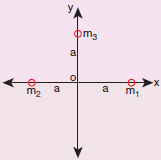
Calculate the gravitational field at point O due to three masses m1, m2 and m3 whose positions are given by the following figure. If the masses m1 and m2 are equal what is the change in gravitational field at the point O?
12.
Suppose unknowingly you wrote the universal gravitational constant value as G = 6.67\(\times\)1011 instead of the correct value G = 6.67\(\times\)1011, what is the acceleration due to gravity g' for this incorrect G? According to this new acceleration due to gravity, what will be your weight W'?
13.
Four particles, each of mass M and equidistant from each other, move along a circle of radius R under the action of their mutual gravitational attraction. Calculate the speed of each particle.
14.
An unknown planet orbits the Sun with distance twice the semi-major axis distance of the Earth’s orbit. If the Earth’s time period is T1, what is the time period of this unknown planet?
15.
If the Earth has no tilt, what happens to the seasons of the Earth?
16.
If the Earth’s pull on the Moon suddenly disappears, what will happen to the Moon?
17.
If a comet suddenly hits the Moon and imparts energy which is more than the total energy of the Moon, what will happen?
18.
A solid sphere of mass 20 kg and radius 0.25 m rotates about an axis passing through the center. What is the angular momentum if the angular velocity is 5 rad s-1.
19.
Two identical particles move towards each other with velocity 2 v and v respectively. The velocity of centre of mass?
20.
What is equilibrium?
21.
What are the conditions in which force can not produce torque?
22.
Assume that you are in another solar system and provided with the set of data given below consisting of the planets’ semi-major axes and time periods. Can you infer the relation connecting semi-major axis and time period?
| Planet (imaginary) |
Time period(T) (in year) |
Semi major axis (a) (in AU) |
|---|---|---|
| Kurinji | 2 | 8 |
| Mullai | 3 | 18 |
| Marutham | 4 | 32 |
| Neithal | 5 | 50 |
| Paalai | 6 | 72 |
23.
How do you distinguish between stable and unstable equilibrium?
24.
25.
1.
Escape speed ve = \(\sqrt 2g R\)
if g' = 4g
then \(v'_e\) = \(\sqrt (4g) R\)
= \(\sqrt 2g R \) \(\times\)2
= 2ve
2.
\(\text { Escape speed } v_{e}=\sqrt{2 g R}\)
\(\text { If } g^{\prime}=4 \mathrm{~g}\)
\(\text { Then } v_{e}^{\prime}=\sqrt{2(4 g) R}\)
\(=\sqrt{2 g R} \times 2 \)
\(=2 v_{e}
\)
3.
(c)
increase in K.E & constant in angular momentum
4.
(a)
Ring about its axis perpendicular to its plane
5.
(c)
12 ms-1
6.
(b)
(0, 0)
7.
Moment of inertia of a disc passing through
\(\text { centre } I=\frac{1}{2} M R^{2}\)
\(\text { Energy of the first disc }=\frac{1}{4} I \omega_{1}^{2}\)
\(\text { Energy of the second disc }=\frac{1}{4} I \omega_{2}^{2}\)
\(\text { Loss of energy }=\frac{1}{4} I\left(\omega_{1}-\omega_{2}\right)^{2}\)
8.
\(v_{0}=r \omega ; \quad \therefore v_{0} \alpha r\)
For a wheel (uniform ring) the distance of a point on the rim in level with the center
\(\text { [i.e., radius] is } \sqrt{2} r\)
\(\therefore \text { The speed of the center is } \sqrt{2} v_{0}\)
9.
(a)
pure rotation
10.
(d)
force acting on particle
11.
From the figure, the distance of m1 from the origin = a
From the figure, the distance of m2 from the origin = a
Gravitational field \(\mathrm{E}=\frac{G M}{r^{2}} \hat{r}\)
At the origin (Point O) the change in gravitational field is
\(\vec{E}=\frac{G M}{a^{2}}\left[\left(m_{1}-m_{2}\right) \hat{i}+m_{3} \hat{j}\right]\)
It is given that
\(\mathrm{m}_{1} =\mathrm{m}_{2} \)
\(\therefore \vec{E} =\frac{G M}{a^{2}}\left[m_{3} \hat{j}\right]\)
12.
Mass of the earth M = 6.024 5 1024 kg
Radius of the earth R = 6.4\(\times\)106 m
Gravitational constant G' = 6.67\(\times\)1011
Gravitational constant G = 6.67\(\times\)1011
Acceleration due to gravity g' =?
g' =
g' = 9.8\(\times\)1022 m/s2
g = 9.8 m/s2
∴ g' = g\(\times\)1022 (or) 1022
g = g' m/s2
Weight W = mg
W' = mg'
= 1022 .W
W = 1022
13.
The gravitational potential energy
\(\mathrm{V} =-\frac{G M^{2}}{R}\left[1+\frac{4}{\sqrt{2}}\right]
\)
\(\mathrm{V} =-\frac{G M^{2}}{R}[1+2 \sqrt{2}]
\)
\(\text {Gravitational potential } \mathrm{V}_{\mathrm{o}}(\mathrm{r}) =-\frac{4 G M}{R}\)
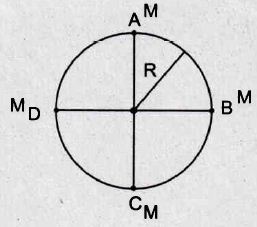
Centripetal acceleration \(a=\frac{V^{2}}{R}\)
Centripetal force \(=\frac{M V^{2}}{R}\)
\(\therefore\) Speed \(V=\frac{1}{2} \sqrt{\frac{G M}{R}(1+2 \sqrt{2})}\)
14.
Let the distance of the Earth = RE
The distance of unknown planet = RP = 2 RE
Let the time period of the Earth be T1
The time period of the unknown planet be T2
\(\text {Time period } \mathrm{T} =2 \pi \sqrt{\frac{R_{E}}{g}}
\)
\(\mathrm{~T} \propto \sqrt{R_{E}}
\)
\(\therefore \frac{T_{1}}{T_{2}} =\sqrt{\frac{R_{E}}{R_{P}}}=\sqrt{\frac{R_{E}}{2 R_{E}}}
\)
\(\therefore \frac{T_{1}}{T_{2}} =\frac{1}{\sqrt{2}}
\)
\(\mathrm{~T}_{2} =\sqrt{2} T_{1}\)
15.
If the Earth has us tilt then there would not be seasons of the Earth.
16.
Moon will start to move in spiral path towards the earth and it may hit on the surface of the Earth.
17.
Kinetic energy of the moon will vary but its total energy remains constant.
18.
Mass of the sphere, m = 20 kg
Radius r = 0.25 m
Angular velocity 0 = 5 rad s-1
Angular momentum \(L=I\omega =\frac{2}{5} mr^{2}\omega\)
\(=\frac{2}{5}\times 20 \times (0.25)^{2}\times 5 = 40 \times (0.0625)=2.5\)
L = 2.5 kg m2 s-1.
19.
\(m_1=m_2=m\)
v = 2v and v2 = -v
\(\therefore\) \({V}_{CM}={m_1v_1+m_2v_2\over m+m}={m\times(2v)+m(-v) \over m+m}={v \over 2}\)
20.
A rigid body is said to be in mechanical equilibrium when both its linear momentum and angular momentum remain constant.
21.
The conditions are
(i) When position vector \(\vec{r}\) and force \(\vec{F}\) are parallel or antiparallel.
(ii) If the force acts at the reference point.
22.
The value of semi major axis is directly proportional to twice the square of time period of a planet.
i.e, a \(\propto 2 \mathrm{~T}^{2}\)
It is given that for planet Kurinji,
\(\mathrm{T}_{1}=2, \quad \mathrm{a}_{1}=8=2 \times 2^{2} \Rightarrow 2 \mathrm{~T}_{1}{ }^{2}\)
For planet Mullai \(\quad \mathrm{T}_{2}=3, \quad \mathrm{a}_{2}=18=2 \times 3^{2} \Rightarrow 2 \mathrm{~T}_{2}{ }^{2}\)
For planet Marutham \(\quad \mathrm{T}_{3}=4, \quad \mathrm{a}_{3}=32=2 \times 4^{2} \Rightarrow 2 \mathrm{~T}_{3}{ }^{2}\)
For planet Neithal \(\quad \mathrm{T}_{4}=5, \quad \mathrm{a}_{4}=50=2 \times 5^{2} \Rightarrow 2 \mathrm{~T}_{4}{ }^{2}\)
For planet Paalai \(\quad \mathrm{T}_{5}=6, \quad \mathrm{a}_{5}=72=2 \times 6^{2} \Rightarrow 2 \mathrm{~T}_{5}^{2}\)
\(\therefore \alpha \propto 2 \mathrm{~T}^{2}\)
23.
| Stable equilibrium | Unstable equilibrium |
| The body tries to come back to equilibrium if slightly disturbed and released. | The body cannot come back to equilibrium if slightly disturbed and released. |
| The center of mass of the body shifts slightly higher if disturbed from equilibrium. | The center of mass of the body shifts slightly lower if disturbed from equilibrium. |
| Potential energy of the body is minimum and it increases if disturbed. | Potential energy of the body is not minimum and it decreases if disturbed. |
24.
25.

11th Standard Syllabus & Materials
11th Standard
TN 11th Tamil பீடு பெற நில் - செய்யுள் - காவடிச்சிந்து Important Questions And Answers Study Material - QB365 Set A
NEW11th Standard
TN 11th Tamil பீடு பெற நில் - உரைநடை - மலை இடப்பெயர்கள் : ஓர் ஆய்வு Important Questions And Answers Study Material - QB365 Set A
NEW11th Standard
TN 11th Tamil மாமழை போற்றுதும் - துணைப்பாடம் - யானை டாக்டர் Important Questions And Answers Study Material - QB365 Set A
NEW11th Standard
TN 11th Tamil மாமழை போற்றுதும் - செய்யுள் - ஐங்குறுநூறு Important Questions And Answers Study Material - QB365 Set A



Tamilnadu Stateboard 11th Standard Subjects

Maths

Commerce

Economics

Biology

Business Maths and Statistics

Accountancy

Computer Science
Physics

Chemistry
Maths
Biology
Economics
Physics
Chemistry

History
Business Maths and Statistics

Computer Science
Accountancy

Computer Applications
History
Computer Technology
Commerce
Computer Applications
Computer Technology

Tamil

English

French
Tamilnadu Stateboard Standards

