
 100% FREE ACCESS
11th Standard Syllabus & Materials
11th Standard
TN 11th Tamil இயற்கை வேளாண்மை,சுற்றுச்சூழல் -செய்யுள் - மனோன்மணீயம் Important Questions And Answers Study Material - QB365 Set A
NEW11th Standard
TN 11th Tamil என்னுயிர் என்பேன் -துணைப்பாடம் - இசைத்தமிழர் இருவர் Important Questions And Answers Study Material - QB365 Set A
NEW11th Standard
TN 11th Tamil மொழி கலை -செய்யுள் - ஒவ்வொரு புல்லையும் Important Questions And Answers Study Material - QB365 Set A
NEW11th Standard
TN 11th Tamil பீடு பெற நில் - இலக்கணம் - பகுபத உறுப்புகள் Important Questions And Answers Study Material - QB365 Set A
NEW11th Standard
TN 11th Tamil பீடு பெற நில் - துணைப்பாடம் - வாடிவாசல் Important Questions And Answers Study Material - QB365 Set A
NEW11th Standard
TN 11th Tamil பீடு பெற நில் - செய்யுள் - குறுந்தொகை Important Questions And Answers Study Material - QB365 Set A

Published on: 27/11/2019
Motion of System of Particles and Rigid Bodies
Download Tamil Nadu 11th Standard Physics question papers, model tests, one-mark questions, important questions, and public exam papers in PDF format. Free study materials and answer keys for TN State Board students.
Questions + Answers key
Take MCQ Physics Test1.
Two blocks of masses 20 kg and 5 kg are connected by a spring of negligible mass and placed on a frictionless horizontal surface. An impulse gives a velocity of 15 m/s to the heavier block in the direction of lighter block. The velocity of centre of mass is _____________.
22 ms-1
30 ms-1
12 ms-1
15 ms-1
2.
The speed of a solid sphere after rolling down from rest without sliding on an inclined plane of vertical height h is,
\( \sqrt \frac{4}{3}gh\)
\( \sqrt \frac{10}{7}gh\)
\(\sqrt{2gh}\)
\( \sqrt \frac{1}{2}gh\)
3.
4.
The angular momentum of a rotating body is doubled, its K.E. of rotation becomes ________________
Two times
Four times
Halved
Eight times
5.
A couple produces,
pure rotation
pure translation
rotation and translation
no motion
6.
A force of \((4\hat{i}-3\hat{j}+5\hat{k})\) N is applied at a point whose position vector is \((7\hat{i}+4\hat{j}-2\hat{k})\) m. Find the torque of force about the origin.
7.
Three identical solid spheres move down through three inclined planes A, B and C all same dimensions. A is without friction, B is undergoing pure rolling and C is rolling with slipping. Compare the kinetic energies EA EB and Ec at the bottom.
8.
What is equilibrium?
9.
What is meant by rolling friction?
10.
When does the body have precession?
11.
What is rigid body?
12.
Distinguish between internal and external forces.
13.
Write the comparison of translational and rotational quantities?
14.
Mention any two physical significance of moment of inertia?
15.
How do you distinguish between stable and unstable equilibrium?
16.
The moment of inertia of a thin rod of mass 'M' and length 'I' about an axis passing through its centre is \(\frac { M{ l }^{ 2 } }{ 12 } \). Calculate the moment of inertia about a parallel axis through end of rod.
17.
Discuss the motion of a disc rolling on a level surface.
18.
Derive the expression for moment of inertia of a uniform disc about an axis passing through the center and perpendicular to the plane.
19.
Explain the method to find the center of gravity of a irregularly shaped lamina?
1.
(c)
12 ms-1
2.
Potential energy = Translational kinetic energy + Rotational kinetic energy
\(m g h=\frac{1}{2} m v^{2}+\frac{1}{2} I \omega^{2} \)
\(=\frac{1}{2} m v^{2}+\frac{1}{2} \times \frac{2}{5} M R^{2} \times \frac{v^{2}}{R^{2}}\left[\omega=\frac{v}{R}\right] \)
\(=\frac{1}{2} m v^{2}+\frac{1}{5} m v^{2} \)
\(=\frac{5 m v^{2}+2 m v^{2}}{10}=\frac{7 m v^{2}}{10} \)
\(m g h=\frac{7 m v^{2}}{10} \)
\(g h=\frac{7 v^{2}}{10} \)
\(\therefore v^{2}=\frac{10 g h}{7} \)
\(\therefore v=\frac{\sqrt{10 g h}}{7} \)
3.
(a)
4.
(b)
Four times
5.
(a)
pure rotation
6.
\(\overrightarrow{r}=7\hat{i}+4\hat{j}-2\hat{k}\)
\(\overrightarrow{F}=4\hat{i}-3\hat{j}+5\hat{k}\)
Torque,\(\overrightarrow{\tau}=\overrightarrow{r}\times \overrightarrow{F}\)
\(\overrightarrow{\tau}=\left| \begin{matrix} \hat { i } & \hat {j } & \hat {k } \\ 7 &4 & -2 \\ 4 & -3 & 5 \end{matrix} \right| \)
\(\overrightarrow{\tau}=\hat{i}(20-6)-\hat{j}(35+8)+\hat{k}(-21-16)\)
\(\overrightarrow {\tau}=(14\hat{i}-43\hat{j}-37\hat{k})Nm\)
7.
The K.E. of A without friction EA = \(\frac{1}{2}\) m(2gh).
The K.E. of B undergoes pure rolling EB
\(= \frac{1}{2}m \left( \frac { 2gh }{ 1+\frac { { K }^{ 2 } }{ { R }^{ 2 } } } \right) \)
The K.E. of C rolling with slipping Ec
=\(\frac{1}{2}\) m(2gh).
8.
A rigid body is said to be in mechanical equilibrium when both its linear momentum and angular momentum remain constant.
9.
When the round object moves, it always tends to roll on any surface which has a coefficient of friction any value greater than zero (μ > 0). The friction that enabling the rolling motion is called rolling friction.
10.
(i) The -torque about the axis will rotate the object about it and the torque perpendicular to the axis will turn the axis of rotation.
(ii) When both exist simultaneously on a rigid body, the body will have a precession.
11.
A rigid body is the one which maintains its definite and fixed shape even when an external force acts on it.
12.
Internal forces are the forces acting among the particles within a system that constitute the body. External forces are the forces acting on the particles of a system from outside.
13.
| S.No | Transitional Motion | Rotational motion about a fixed axis |
| 1. | Displacement, x | Angular displacement, \(\theta\) |
| 2. | Time, t | Time, t |
| 3. | Velocity, v=\(\frac { dx }{ dt } \) | Angular velocity \(\omega =\frac { d\theta }{ dt } \) |
| 4. | Acceleration, a=\(\frac { dv }{ dt } \) | Angular acceleration \(\alpha =\frac { d\omega }{ dt } \) |
| 5. | Mass,m | Moment of inertia, I |
| 6. | Force, F =ma | Torque, ፒ=Iα |
| 7. | Linear momentum, p = mv | Angular momentum, L=Iω |
| 8. | Impulse, F Δt =Δp | Impulse, ፒΔt=ΔL |
| 9. | Work done, w=F s | Work done, w=ፒ\(\theta\) |
| 10. | Kinetic energy KE=\(\frac { 1 }{ 2 } \)mv2 | Kinetic energy KE =\(\frac { 1 }{ 2 } \)Iω2 |
| 11. | Power, P = F v | Power, P =ፒω |
14.
1. Greater the mass concentrated away from the axis, greater the moment of inertia.
2. Moment of inertia of a body about an axis of rotation resists a change in it. In rotational motion, moment of inertia increases with increase in torque to change its rotation.
15.
| Stable equilibrium | Unstable equilibrium |
| The body tries to come back to equilibrium if slightly disturbed and released. | The body cannot come back to equilibrium if slightly disturbed and released. |
| The center of mass of the body shifts slightly higher if disturbed from equilibrium. | The center of mass of the body shifts slightly lower if disturbed from equilibrium. |
| Potential energy of the body is minimum and it increases if disturbed. | Potential energy of the body is not minimum and it decreases if disturbed. |
16.
According to parallel axis theorem,
I = I0 + mx2
=\(\frac { M{ l }^{ 2 } }{ 12 } +M\left( \frac { l }{ 2 } \right) ^{ 2 }\)
=\(\frac { { Ml }^{ 2 } }{ 12 } +\frac { Ml^{ 2 } }{ 4 } ={ Ml }^{ 2 }\left[ \frac { 1 }{ 12 } +\frac { 1 }{ 4 } \right] \)
=\({ Ml }^{ 2 }\left[ \frac { 1 }{ 3 } \right] \)
I=\(\frac { { Ml }^{ 2 } }{ 3 } \) .
17.
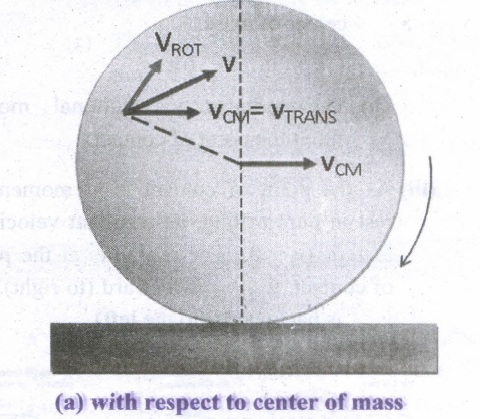
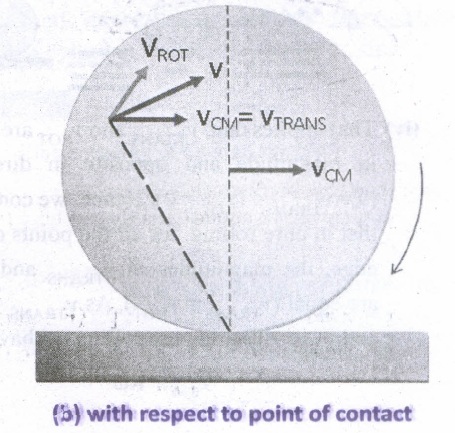
(i) If the radius of the rolling object is R, in one full rotation, the center of mass is displaced by 2\(\pi \)R (its circumference).
(ii) Not only the center of mass, but all the points on the disc are displaced by the same 2\(\pi \)R after one full rotation. The only difference is that the center of mass takes a straight path but, all the other points.
(iii) Undergo a path which has a combination of the translational and. rotational motion. Especially the point on the edge undergoes a path of a cycloid.
(iv) As the center of mass takes only a straight line path, its velocity vCM is only translational velocity vTRANS (vCM = vTRANS). All the other points have two velocities. One is the translational velocity vTRANS (which is also the velocity of center of mass) and the other is the rotational velocity vROT (VROT = rω).
(v) Here, r is the distance of the point from the center of mass and 0 is the angular velocity. The rotational velocity vROT is perpendicular to the instantaneous position vector from the center of mass.
(vi) The resultant of these two velocities is v. This resultant velocity v is perpendicular to the position vector from the point of contact of the rolling object with the surface on which it is rolling as shown in Figure.
18.
Consider a disc of mass M and radius R. This disc is made up of many infinitesimally small rings as shown in Figure. Consider one such ring of mass (dm) and thickness (dr) and radius (r). The moment of inertia (dI) of this small ring is,
dI = (dm)r2
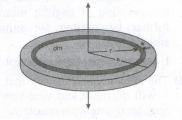
Moment of inertia of a uniform disc
As the mass is uniformly distributed, the mass per unit area (\(\alpha\)) is, \(\alpha=\frac{mass}{area}=\frac{M}{\pi R^2}\)
(iii) The mass of the infinitesimally small ring is,
dm = \(\alpha\)2\(\pi\)rdr = \(\frac { M }{ \pi R^{ 2 } } \) 2\(\pi\)rdr
where, the term (2\(\pi\)rdr) is the area of this elemental ring (2\(\pi\)r is the length and dr is the thickness) dm = \(\frac{2M}{R^2}rdr\)
dI = \(\frac{2M}{R^2}r^3dr\)
The moment of inertia (I) of the entire disc is,
\(I=\int { dI } \)
\(I=\int _{ 0 }^{ R }{ \frac { 2M }{ { R }^{ 2 } } } { r }^{ 3 }dr=\frac { 2M }{ R^{ 2 } } \int _{ 0 }^{ R }{ r^{ 3 }dr } \)
\(I=\frac { 2M }{ R^{ 2 } } \left[ \frac { { r }^{ 4 } }{ 4 } \right] ^{ R }_{ 0 }=\frac { 2M }{ R^{ 2 } } \left[ \frac { { R }^{ 4 } }{ 4 } -0 \right] \)
\(I=\frac { 1 }{ 2 } MR^{ 2 }\)
19.
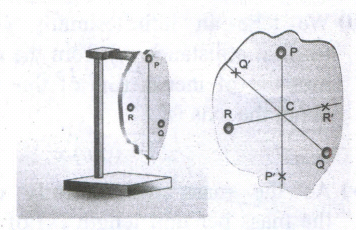
If we suspend the lamina from different points like P, Q, R as shown in Figure, the vertical lines PP', QQ', RR' all pass through the centre of gravity Here, reaction force acting at the point of suspension and the gravitational force acting at the centre of gravity cancel each other and the torques caused by them also cancel each other.

11th Standard Syllabus & Materials
11th Standard
TN 11th Tamil பீடு பெற நில் - செய்யுள் - காவடிச்சிந்து Important Questions And Answers Study Material - QB365 Set A
NEW11th Standard
TN 11th Tamil பீடு பெற நில் - உரைநடை - மலை இடப்பெயர்கள் : ஓர் ஆய்வு Important Questions And Answers Study Material - QB365 Set A
NEW11th Standard
TN 11th Tamil மாமழை போற்றுதும் - துணைப்பாடம் - யானை டாக்டர் Important Questions And Answers Study Material - QB365 Set A
NEW11th Standard
TN 11th Tamil மாமழை போற்றுதும் - செய்யுள் - ஐங்குறுநூறு Important Questions And Answers Study Material - QB365 Set A



Tamilnadu Stateboard 11th Standard Subjects

Maths

Commerce

Economics

Biology

Business Maths and Statistics

Accountancy

Computer Science
Physics

Chemistry
Maths
Biology
Economics
Physics
Chemistry

History
Business Maths and Statistics

Computer Science
Accountancy

Computer Applications
History
Computer Technology
Commerce
Computer Applications
Computer Technology

Tamil

English

French
Tamilnadu Stateboard Standards

